Kenneth Arrow
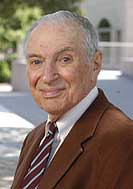
(1921 - )
Kenneth Joseph Arrow was born in New York City
on August 23, 1921. He earned a Bachelor of Science degree in Social
Science from the City College of New York in 1940. At Columbia, he received
a Master's degree in Mathematics in 1941 and a Ph.D. in Economics in
1951. In 1949, he was appointed Acting Assistant Professor of Economics
and Statistics at Stanford, eventually becoming Professor of Economics,
Statistics, and Operations Research. In 1968, Arrow moved to Harvard
to be the Professor of Economics.
Arrow was awarded the John Bates Clark Medal of the
American Economic Association in 1957. He was elected president of the
American Economic Association in 1972. Arrow has also been a member
of the National Academy of Sciences and the American Statistical Association.
Arrow is considered, along with Paul
Samuelson, one
of the founders of modern neo-classical economics. His most significant
works are his contributions to social choice theory, notably "Arrow's
impossibility theorem," and his work on general
equilibrium analysis. He has also provided foundational work in
many other areas of economics, including endogenous growth theory and information economics. In 1972, Kenneth
Arrow received the Nobel Prize for Economics.
General Possibility Theorem
Arrow's impossibility theorem was set out in his
Ph.D. thesis, Social choice and individual values.
In its final form it states the following: given
the conditions of Pareto Optimality (P), Unbounded social choice (S),
Independence of choices (I) and non-Dictatorship (D), it is impossible
to formulate a social choice function which satisfies all of them.
This has tremendous implications for welfare economics and theories
of justice. It was extended by Amartya Sen to the Liberal Paradox
which argued that given a status of "Minimal Liberty" there
was no way to obtain Pareto Optimality, nor to avoid the problem of
social choice of neutral but unequal results.
An example of this would be to have the following
choices to divide a cake between three people. Let us call them A,
B and C.
Choice 1: A gets nothing, B and C get half each.
Choice 2: B gets nothing, A and C get half each. Choice 3: C gets
nothing, A and B get half each. Choice 4: divide the cake equally.
Thus choice 4 would be third from the bottom in everyone's
list, and would, in any direct choice lose 2 to 1 against an unequal
distribution. Since all of these choices are Pareto optimal - no one's
welfare can be improved without reducing the welfare of others - choice
4 would not be chosen, since there would always be other preferred
choices.
General equilibrium theory
Working with Gerard Debreu (who won the Nobel prize
for this work in 1983), Arrow produced the first rigorous proof of
the existence of a market clearing equilibrium, given certain restrictive
assumptions. See general equilibrium. Arrow went on to extend the
model to deal with issues relating to uncertainty, stability of the
equilibrium, and whether a competitive equilibrium is efficient.
Endogenous Growth theory
Arrow was instrumental in kick-starting research
into endogenous growth theory (also known as new growth theory)
which sought to explain the source of technical change, which is a
key driver of economic growth. Until this theory came to prominence,
technical change was assumed to occur exogenously - that is, it was
assumed to occur with no explanation of why it occurred. Endogenous
growth theory provided standard economic reasons for why firms innovate
- so innovation and technical change are determined endogenously -
that is, within the model (hence the name). A vast literature on this
theory has developed subsequently to Arrow's pioneering work.
Information Economics
In yet more pioneering research, Arrow investigated
the problems caused by asymmetric information in markets. In many
transactions, one party (usually the seller) has more information
about the product being sold than the other party. Asymmetric information
creates incentives for the party with more information to cheat the
party with less information; as a result, a number of market structures
have developed, including warranties and third party authentication,
which enable markets with asymmetric information to function. Arrow
analysed this issue for medical care (a 1963 paper entitled "Uncertainty
and the Welfare Economics of Medical Care," in the American Economic
Review); later researchers investigated many other markets, particularly
second-hand assets, online auctions and insurance.
Arrow’s Works Include
• The Economic Implications of Learning
by Doing Review of Economic Studies 29 (June 1962) pp 155-73
• Essays in the Theory of Risk-Bearing 1971
• Existence of a Competitive Equilibrium for a Competitive
Economy Econometrica 22, no 3 (July 1954) pp 265-90, with Gerard
Debreu
• General Competitive Analysis 1971, with Frank Hahn
• Uncertainty and the Welfare Economics of Medical Care American Economic Review 1963
• Existence of an equilibrium for a competitive economy Econometrica (1954) Vol 22 No 3, with Gerard Debreu
• Social Choice and Individual Values 1951
• The Limits of Organization 1974
The following press release
from the Royal Swedish Academy of Sciences
describes Arrow's work:
The progress of thc economic sciences has led to
a profound transformation of the general equilibrium theory. To a
high degree, this development is marked by the pioneering works of
Sir John Hicks and of Professor Kenneth Arrow. Both have opened up
new productive paths for research in this area and thereby made fundamental
contributions to the renewal of the theory. Hicks initiated this recreative
process in the 1930s and Arrow provided it with fresh nourishment
in the 1950s and 60s. As the distance in time between these contributions
indicates, Hicks and Arrow belong to two different generations of
scientists, a fact which can be traced in their choice of problems
and methods of analysis.
Gcneral equilibrium theory had, earlier, essentially
the character of formal analysis. In his most well-known work, the
monography, Value and Capital, published in 1939, Hicks abandoned
this tradition and gave the theory an increased economic relevance.
He presented a complete economic equilibrium model with aggregated
markets for commodities, factors of production, credit and money.
The construction of this model included a number of innovations, i.e.,
a further development of older theories of consumption and of production,
the formulation of conditions for multimarket stability, an extension
of the applicability of the static method of analysis to include multiperiod
analysis, and the introduction of a capital theory based on profit
maximization assumptions. By being deeply anchored in theories of
the behaviour of consumers and of entrepreneurs, Hicks's model offered
far better possibilities to study the consequences of changes in externally
given variables than earlier models in this field, and Hicks succeeded
in formulating a number of economically interesting theorems. His
model became of great importance also as a connecting link between
general equilibrium theory and current theories of business cycles.
As his mathematical tool, Hicks used traditional
differential analysis. When, later on, more modern mathematical methods
were introduced in economic sciences, Arrow applied these methods
in his studies of general equilibrium systems. In a series of papers,
which preferentially treated the properties of solubility and stability
of such systems, he provided the basis for a radical reformulation
of the traditional equilibrium theory. Through this reformulation,
which was based on the mathematical theory of convex sets, the general
equilibrium theory gained both in generality and in simplicity. The
pioneering work, a paper from 1954, was written together with Gerhard
Debreu. The model presented in this paper became the starting point
for the major part of further research in this field. Among Arrow's
many important contributions should also be mentioned his development
of the theory of uncertainty and its incorporation within the frame
of general equilibrium theory and, furthermore, his analysis of the
possibilities for decentralized decisions in a society where the price
system is fixed by the central authority. This analysis was made in
collaboration with Leonid Hurwicz.
From general equilibrium theory to welfare theory
is but a short step, and both Hicks and Arrow have, on several points,
developed the welfare economic consequences of their achievements
indicated above. The most well-known contributions by Hicks to welfare
theory are his analysis of criteria for comparisons bctween different
economic situations, and his revision of thc concept of consumer surplus.
In its new form this concept has had a great impact, i.e., within
the cost-benefit analysis. Arrow has generalized the well-known theorem
about pareto-optimality of a competitive equilibrium, and he has demonstrated
that there exist general tendencies towards inoptimality in the allocation
of resources between research and investments in real capital. As
perhaps the most important of Arrow's many contributions to welfare
theory appears his "possibility theorem", according to which
it is impossible to construct a social welfare function out of individual
preference functions.
Both Hicks and Arrow have made important contributions
also to other fields than those mentioned above - Hicks to monetary
theory and to the theory of business cycles, and Arrow to growth theory
and decision theory.
Sources: Wikipedia;
"Kenneth
Arrow Autobiography"; Nobelprize.org.
Photo courtesy of Prof.
Kenneth Arrow |