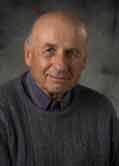
Walter Kohn is a Jewish
American theoretical physicist, Holocaust survivor and winner of the 1988 Nobel Prize for Chemistry.
In August, 1939 , Kohn was lucky enough to escape to England with his older sister as part of the Kindertransport rescue operation. Kohn's parents and other relatives were murdered under the Nazi regime in Austria.
In 1940, as a 17-year old, he was sent to Canada by British order. Kohn was held in detention camps in Quebec and New Brunswick. In these camps Kohn was able to continue his education and to fall in love with mathematics. In 1942, after passing his high school matriculation exams at the detention center, Kohn was cleared into Canada and allowed into the physics program at the University of Toronto.
Kohn joined the Canadian army, finishing out the war in the infantry, and was able to complete his bachelor's degree after only two and one half years of study at the university. In 1946 Kohn received an M.A. degree in applied mathematics at the University of Toronto. He then went on to complete his Ph.D. in physics at Harvard University.
After receiving his Ph.D., Kohn stayed on at Harvard for three years as a researcher and lecturer under the guidance of Julian Schwinger. Kohn received an appointment at Carnegie Mellon University in 1950. He delayed this post for two years, however, and worked at universities in both Denmark and France. In 1952, Kohn returned to the United States to complete his postponed fellowship at Carnegie Tech.
At Carnegie Mellon Kohn did much of his seminal work on multiple-scattering band-structure work, now known as the KKR method. His association with Bell Labs got him involved with semiconductor physics in outerspace- specifically in radiation damage.
In 1957, Walter Kohn relinquished his Canadian citizenship and became a naturalized citizen of the United States.
In 1960 Kohn moved to the University of California at San Diego, where he remained until 1979. There Kohn not only continued his important research in physics but he also helped to create a Judaic Studies program at the university. Kohn then became the first director at the new Institute for Theoretical Physics in Santa Barbara. Kohn is currently a Professor Emeritus.
In 1998, Walter Kohn was awarded, along with John Pople, the Nobel Prize in chemistry. The award recognized their contributions to the understandings of the electronic properties of materials. In particular, Kohn played the leading role in the development of the density functional theory, which made it possible to incorporate quantum mechanical effects in the electronic density. This computational simplification led to many insights and became an essential tool for electronic materials, atomic and molecular structure.
Kohn has also made other significant contributions to semiconductor physics. He was awarded the Oliver E. Buckley Prize by the American Physical Society. He was also awarded the Feenburg medal for his contributions to the many-body problem. During a sabbatical in Paris, Kohn worked on a density functional theory with Pierre Hohenberg. The Hohenberg-Kohn theorem was further developed, in collaboration with Lu Sham, to produce the Kohn-Sham equation.
Walter Kohn has taught all
over the world and feels at home in Denmark,
Israel, England, Canada and France.
The following press release
from the Royal Swedish Academy of Sciences
describes Kohn’s work:
Researchers have long sought methods for
understanding how bonds between the atoms
in molecules function. With such methods
it would be possible to calculate the properties
of molecules and the interplay between them.
The growth of quantum mechanics in physics
at the beginning of the 1900s opened new
possibilities, but applications within chemistry
were long in coming. It was not practically
possible to handle the complicated mathematical
relations of quantum mechanics for such complex
systems as molecules.
One of the founders of quantum physics,
Dirac, expressed the problem in 1929 as
follows: "The
fundamental laws necessary for the mathematical
treatment of large parts of physics and
the whole of chemistry are thus fully known,
and the difficulty lies only in the fact
that application of these laws leads to
equations that are too complex to be solved.
Things began to move at the beginning of
the 1960s when computers came into use for
solving these equations and quantum chemistry
(the application of quantum mechanics to
chemical problems) emerged as a new branch
of chemistry. As we approach the end of the
1990s we are seeing the result of an enormous
theoretical and computational development,
and the consequences are revolutionising
the whole of chemistry. Walter Kohn and John
Pople are the two most prominent figures
in this process. W.Kohn's theoretical work
has formed the basis for simplifying the
mathematics in descriptions of the bonding
of atoms, a prerequisite for many of today's
calculations. J. Pople developed the entire
quantum-chemical methodology now used in
various branches of chemistry.
Computer-based calculations are now used
generally to supplement experimental technics.
For several decades they have been developed
and refined so that it is now possible to
analyse the structure and properties of matter
in detail. Conventional calculation of the
properties of molecules is based on a description
of the motion of individual electrons. For
this reason, such methods are mathematically
very complicated. Walter Kohn showed
that it is not necessary to consider the
motion of each individual electron: it suffices
to know the average number of electrons located
at any one point in space. This has led to
a computationally simpler method, the density-functional
theory. The simplicity of the method
makes it possible to study very large molecules.
Today, for example, calculations can be used
to explain how enzymatic reactions occur.
It has taken more than thirty years for a
large number of researchers to render these
calculations practicable, and the method
is now one of the most widely used in quantum
chemistry.
John Pople is rewarded for developing
computational methods making possible the
theoretical study of molecules, their properties
and how they act together in chemical reactions.
These methods are based on the fundamental
laws of quantum mechanics as defined by,
among others, the physicist E. Schrödinger.
A computer is fed with particulars of a
molecule or a chemical reaction and the
output is a description of the properties
of that molecule or how a chemical reaction
may take place. The result is often used
to illustrate or explain the results of
different kinds of experiment. Pople made
his computational technics easily accessible
to researchers by designing the GAUSSIAN
computer program. The first version was
published in 1970. The program has since
been developed and is now used by thousands
of chemists in universities and commercial
companies the world over.
Quantum chemistry - a background
The laws of quantum mechanics as formulated
more than 70 years ago make it theoretically
possible to understand and calculate how
electrons and atomic nuclei interact to
build up matter in all its forms. The task
of quantum chemistry is to exploit this
knowledge to describe the molecular system.
This has proved easier said than done.
It was not until the beginning of the 1960s
that development really started, when two
events became decisive. One was the development
of an entirely new theory for describing
the spatial distribution of electrons,
and the other was the use of the increasing
potential offered by the computer. Walter
Kohn showed in 1964 that the total
energy for a system described by the laws
of quantum mechanics can be theoretically
calculated if the electrons' spatial distribution
(electron density) is known. The
question is only how the energy depends
on the density. Kohn gave important clues
based on what this dependence looked like
in an imaginary system with free electrons.
It was to take several decades and contributions
from many researchers, however, before
the equation for determining the energy
was sufficiently accurately mapped to permit
large-scale studies of molecular systems.
This has taken place partly through the
adaptation of a small number of variables
to experimental data. The method Kohn introduced
came to be known as the density-functional
theory. It is now used in studies of
numerous chemical problem areas, from calculating
the geometrical structure of molecules
(i.e. bonding distance and angles) to mapping
chemical reactions.
During the 1960s many research groups in
Europe and the USA started feverishly to
exploit the great potential of the computer.
New methods of computation were developed
and refined. John Pople was a leading
figure in this field. He realised that if
theoretical methods were to gain any significance
within chemistry it was necessary to know
how accurate the results are in any given
case. In addition, they must be easy to use
and not too demanding of resources. Through
significant improvements in the theoretical
methodology at the end of the 1960s Pople
designed a computer program which at a number
of decisive points was superior to others'
efforts. The prerequisites mentioned above
could now be fulfilled and GAUSSIAN-70, as
the program was called, very soon became
widely used. Pople continued during the 1970s
and 1980s to refine the methodology, at the
same time building up a well-documented model
chemistry. Here he was able at the beginning
of the 1990s to include Kohn's density-functional
theory. By these means new possibilities
opened up for analysing ever-more complex
molecules.
Applications of quantum chemistry
Quantum chemistry is today used within all
branches of chemistry and molecular physics.
As well as producing quantitative information
on molecules and their interactions, the
theory also affords deeper understanding
of molecular processes that cannot be obtained
from experiments alone. Theory and experimentation
combine today in the search for understanding
of the inner structure of matter. How is
then a quantum-chemical calculation carried
out?
Let us take the example of the amino acid
cystein, illustrated above. How do we produce
that image? We sit in front of the computer
and start the quantum chemistry program.
From the menu we select a molecule in which
a carbon atom (C) is bound to a hydrogen
atom (H), an amino group (NH2), a thiolathomethyl
group CH2SH) and a carboxyl group (COOH).
The computer draws a rough picture of the
molecule on the screen. We now instruct the
computer to determine the geometry of the
molecule with a quantum-chemical calculation.
This can take a minute or so if we are content
with a rough result, but up to a day if we
desire high accuracy. The screen picture
gradually changes towards greater accuracy
up to a predetermined level. When this operation
is finished we can ask the computer to calculate
different properties for the system. In the
illustration above we have calculated a surface
with constant electron density. The surface
is coloured according to the value of the
electrostatic potential. This can be used,
for example, to predict how the molecule
interacts with other molecules and charges
in its environment. Such information may
be used to study how proteins (which are
built up of amino acids) interact with different
substrates, e.g. in pharmaceuticals.
Another example may be taken from the universe,
in which, apart from stars and planets, there
are great quantities of interstellar matter,
often collected in vast clouds. What does
this matter consist of? It can be studied
from the Earth through the radiation the
molecules emit. The radiation occurs because
the molecules rotate. Hence it is possible
using the frequency spectrum of the radiation
to determine the composition and appearance
of the molecules. This, however, is an immensely
difficult task, particularly since these
molecules cannot always be produced in the
laboratory so as to obtain material for comparative
studies. Quantum chemistry, however, does
not suffer from such limitations. Calculations
based on assumed structures can give information
on radio emission frequencies that can be
directly compared with data collected by
the radio telescope. In this way, theory
and measurement together can give information
on the molecular composition of interstellar
matter.
Another example. High up in the atmosphere
there is a thin layer of ozone molecules
that protect us from ultra-violet radiation
from the sun. Substances that we release
into the atmosphere (e.g. freons) can lead
to the destruction of the ozone layer. How
does it happen? Which chemical reactions
are involved? With quantum-chemical computation
we can describe them in detail and thus understand
them. This knowledge may help us to take
steps to make our atmosphere cleaner.
Quantum chemistry is used nowadays in practically
all branches of chemistry, always with the
aim of increasing our knowledge of the inner
structure of matter. The scientific work
of Walter Kohn and John Pople has been crucial
for the development of this new field of
research.