Muammar Gaddafi
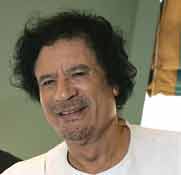
(1942 - 2011)
Colonel Muammar Abu Minyar al-Gaddafi (June 1942 - October 20, 2011) is best known as the de
facto leader of Libya from 1969 till his death in 2011.
Though Gaddafi did not have an official title or hold a
public office since 1977, he was accorded
the honorifics “Guide of the First
of September Great Revolution of the
Socialist People’s Libyan Arab
Jamahiriya” or “Brotherly
Leader and Guide of the Revolution” in
government statements and the official Libyan
press.
Early life
Gaddafi was the youngest child born into
a peasant family and grew up in the desert
region of Sirte. He was given a traditional
religious primary education and attended
the Sebha preparatory school in Fezzan from
1956 to 1961. Gaddafi and a small group of
friends that he met in this school went on
to form the core leadership of a militant
revolutionary group that would eventually
seize control of the country in the lat 1960's. Gaddafi's inspiration
was Gamal Abdel Nasser, president of neighboring Egypt, who rose to the presidency by appealing
to Arab unity. In 1961, Gaddafi was expelled
from Sebha for his political activism.
Gaddafi went on to study law at the University
of Libya, where he graduated with high grades.
He then entered the Military Academy in Benghazi
in 1963, where he and a few of his fellow
militants organized a secretive group dedicated
to overthrowing the pro-Western Libyan monarchy.
After graduating in 1965, he was sent to
Britain for further training at the British
Army Staff College, now the Joint Services
Command and Staff College, returning in 1966
as a commissioned officer in the Signal Corps.
Military coup d'état
On September 1, 1969, a small group of military
officers led by Gaddafi staged a bloodless
coup d'état against King Idris I,
while he was in Kammena Vourla, an area in
Greece for medical treatment. His nephew
the Crown Prince Hasan as-Senussi was set
to become King on September 2 when the abdication
of King Idris dated August 4 was to take
effect. Before the end of the day
the monarchy was abolished and the Libyan
Arab Republic was proclaimed with the Crown
Prince being placed under house arrest.
Unlike some other military
revolutionaries, Gaddafi did not promote
himself to the rank of general upon seizing
power, but rather accepted a ceremonial promotion
from captain to colonel, a rank he remained at throughout his life thereafter. While at odds with western
military ranking for a colonel to rule a
country and serve as Commander-in-Chief of
its military, in Gaddafi's own words, Libya's
utopian society is “ruled by the people,”
so he needs no more grandiose title or supreme
military rank. Gaddafi's decision to remain
a colonel is not a new concept among military
coup leaders; Gamal
Abdel Nasser remained
a colonel after seizing power in Egypt, and
Jerry Rawlings, President of Ghana, held
no military rank higher than flight lieutenant.
In the same fashion, the Republic of El Salvador
was ruled by Lieutenant Colonel Oscar Osorio
(1950-1956), Lieutenant Colonel José María
Lemus (1956-1960), and Lieutenant Colonel
Julio Adalberto Rivera (1962-1967).
Islamic socialism and pan-Arabism
Gaddafi based his new regime
on a blend of Arab nationalism, aspects of
the welfare state and what Gaddafi termed “direct,
popular democracy.” He called this
system “Islamic socialism” and
while he permitted private control over small
companies, the government controlled the
larger ones. Welfare, “liberation,” and
education were emphasized. He also imposed
a system of Islamic morals, outlawing alcohol
and gambling. To reinforce the ideals of
this socialist-Islamic state, Gaddafi outlined
his political philosophy in his Green
Book,
published in three volumes between 1975 and
1979. In practice, however, Libya's political
system is thought to be somewhat less idealistic
and from time to time Gaddafi has responded
to domestic and external opposition with
violence. His revolutionary committees called
for the assassination of Libyan dissidents
living abroad in April 1980, with Libyan
hit squads sent abroad to murder them. On
April 26, Gaddafi set a deadline of June
11 for dissidents to return home or be “in
the hands of the revolutionary committees.”
Nine Libyans were murdered during that time,
five of them in Italy.
External relations
With respect to Libya's
neighbors, Gaddafi followed Nasser's ideas
of pan-Arabism and became a fervent advocate
of the unity of all Arab states into one
Arab nation. He also supported pan-Islamism,
the notion of a loose union of all Islamic
countries and peoples. After Nasser's death
on September 28, 1970, Gaddafi attempted
to take up the mantle of ideological leader
of Arab nationalism. He proclaimed the “Federation of Arab
Republics” (Libya, Egypt and Syria)
in 1972, hoping to create a pan-Arab state,
but the three countries disagreed on the
specific terms of the merger. In 1974, he
signed an agreement with Tunisia's Habib
Bourguiba on a merger between the two countries,
but this also failed to work in practice
and ultimately differences between the two
countries would deteriorate into strong animosity.
Libya was also involved in a sometimes violent
territorial dispute with neighbouring Chad
over the Aouzou Strip, that Libya occupied
in 1973. This dispute eventually led to the
Libyan invasion of the country and to a conflict
that was ended by a ceasefire reached in
1987. The dispute was at the end settled
peacefully in June 1994 when Libyan troops
were withdrawn from Chad in full respect
for a judgement of the International Court
of Justice that was issued on 13 February
1994.[4]
Gaddafi also became a strong supporter of
the Palestine
Liberation Organization, which
ultimately harmed Libya's relations with
Egypt when in 1979 Egypt pursued a peace
agreement with Israel. As Libya's relations
with Egypt worsened, Gaddafi sought closer
relations with the Soviet Union. Libya became
the first country outside the Soviet bloc
to receive the supersonic MiG-25 combat fighters,
but Soviet-Libyan relations remained relatively
distant. Gaddafi also sought to increase
Libyan influence, especially in states with
an Islamic population, by calling for the
creation of a Saharan Islamic state and supporting
anti-government forces in sub-Saharan Africa.
Notable in his politics has been the support
for liberation movements, and also sponsoring
rebel movements in West Africa, notably Sierra
Leone and Liberia as well as Muslim groups.
In the 1970s and the 1980s, this support
was sometimes so freely given that even the
most unsympathetic groups could get Libyan
support. Often the groups represented ideologies
far away from Gaddafi's own. International
opinion was confused by these policies. Throughout
the 1970s, his regime was implicated in subversion
and terrorist activities in both Arab and
non-Arab countries. By the mid-1980s, he
was widely regarded in the West as the principal
financier of international terrorism. Reportedly,
Gaddafi was a major financier of the “Black
September Movement” which perpetrated
the Munich
massacre at the 1972 Summer Olympics,
and was accused by the United States of being
responsible for direct control of the 1986
Berlin discotheque bombing that killed three
people and wounded more than 200, of whom
a substantial number were U.S. servicemen.
He is also said to have paid “Carlos
the Jackal” to kidnap and then release
a number of the Saudi Arabian and Iranian
oil ministers.
Tensions between Libya and the West reached
a peak during the Ronald
Reagan administration,
which tried to overthrow Gaddafi. The Reagan
administration viewed Libya as a belligerent
rogue state because of its uncompromising
stance on Palestinian independence, its support
for revolutionary Iran in its 1980-1988 war
against Saddam Hussein's Iraq and its backing
for “liberation
movements” in the developing world.
Reagan himself dubbed Gaddafi the “mad
dog of the Middle East.” In March 1982
the U.S. declared a ban on the import of
Libyan oil and the export to Libya of US
oil industry technology; European nations
did not follow suit.
In 1984, British police
constable Yvonne Fletcher was shot outside
the Libyan Embassy in London while policing
an anti-Gaddafi demonstration. A burst of
machine-gun fire from within the building
was suspected of killing her, but Libyan
diplomats asserted their diplomatic immunity
and were repatriated. The incident led to
the breaking-off of diplomatic relations
between the United Kingdom and Libya for
over a decade.
The U.S. attacked Libyan patrol boats from
January to March 1986 during clashes over
access to the Gulf of Sidra, which Libya
claimed as territorial waters. Later, on
April 15, 1986, Ronald Reagan ordered major
bombing raids, dubbed Operation El Dorado
Canyon, against Tripoli and Benghazi killing
45 Libyan military and government personnel
as well as 15 civilians. This strike followed
U.S. interception of Telex messages from
Libya's East Berlin embassy suggesting Libyan
government involvement in a bomb explosion
in West Berlin's La Belle discotheque, a
nightclub frequented by U.S. servicemen on
April 5. Among the fatalities of the April
15 retaliatory attack by the U.S. was Gaddafi's
adopted daughter.
In late 1987 a merchant vessel, the MV Eksund,
was intercepted. Destined for the IRA, a
large consignment of arms and explosives
supplied by Libya was recovered from the
Eksund. British intelligence believed this
was not the first and that Libyan arms shipments
had previously reached the IRA. (See Provisional
IRA arms importation)
For most of the 1990s, Libya
endured economic sanctions and diplomatic
isolation as a result of Gaddafi's refusal
to allow the extradition to the United States
or Britain of two Libyans accused of planting
a bomb on Pan Am Flight 103, which exploded over Lockerbie, Scotland.
Through the intercession of South African
President Nelson Mandela - who made a high-profile
visit to Gaddafi in 1997 - and U.N. Secretary-General
Kofi Annan, Gaddafi agreed in 1999 to a compromise
that involved handing over the defendants
to the Netherlands for trial under Scottish
law. U.N. sanctions were thereupon suspended,
but U.S. sanctions against Libya remained
in force.
In August 2003, two years
after Abdelbaset Ali Mohmed Al Megrahi's
conviction, Libya wrote to the United
Nations formally accepting
'responsibility for the actions of its officials'
in respect of the Lockerbie bombing and agreed
to pay compensation of up to $2.7 billion – or
up to $10 million each – to the families
of the 270 victims. The same month, Britain
and Bulgaria co-sponsored a U.N. resolution
which removed the suspended sanctions. (Bulgaria's
involvement in tabling this motion led to
suggestions that there was a link with the
HIV trial in Libya in which 5 Bulgarian nurses,
working at a Benghazi hospital, were accused
of infecting 426 Libyan children with HIV.)
Forty per cent of the compensation was then
paid to each family, and a further 40% followed
once U.S. sanctions were removed. Because
the U.S. refused to take Libya off its list
of state sponsors of terrorism, Libya retained
the last 20% ($540 million) of the $2.7 billion
compensation package.
On June 28, 2007 Megrahi
was granted the right to a second appeal
against the Lockerbie bombing conviction.
One month later, the Bulgarian medics were
released from jail in Libya. They returned
home to Bulgaria and were pardoned by Bulgarian
president, Georgi Parvanov.
Western Openness
Simultaneously, Gaddafi also emerged
as a popular African leader. As one of the
continent's longest-serving, post-colonial
heads of state, the Libyan leader enjoyed
a reputation among many Africans as an experienced
and wise statesman who had been at the forefront
of many struggles over the years. Gaddafi
earned the praise of Nelson Mandela and
others, and was a prominent figure
in various pan-African organizations, such
as the Organization of African Unity (now
replaced by the African Union). He was also
seen by many Africans as a humanitarian,
pouring large amounts of money into sub-Saharan
states. Large numbers of Africans have come
to Libya to take advantage of the availability
of jobs there. In addition, many economic
migrants, primarily from Somalia and Ghana,
use Libya as a staging-post to reach Italy
and other European countries.
Gaddafi also appeared to be attempting to
improve his image in the West. Two years
prior to the terrorist attacks of September
11, 2001, Libya pledged its commitment to
fighting Al-Qaeda and offered to open up
its weapons program to international inspection.
The Clinton
administration did not pursue
the offer at the time since Libya's weapons
program was not then regarded as a threat,
and the matter of handing over the Lockerbie
bombing suspects took priority. Following
the attacks of September 11, Gaddafi made
one of the first, and firmest, denunciations
of the Al-Qaeda bombers by any Muslim leader.
Gaddafi also appeared on ABC for an open
interview with George Stephanopoulos, a move
that would have seemed unthinkable less than
a decade earlier.
There are many explanations for the change
of Gaddafi's politics. The most obvious is
that the once very rich Libya became much
less wealthy as oil prices dropped significantly
during the 1990's. Since then, Gaddafi has
tended to need other countries more than
before and hasn't been able to dole out foreign
aid as he once did. In this environment,
the increasingly stringent sanctions placed
by the UN and US on Libya made it more and
more isolated politically and economically.
Another possibility is that strong Western
reactions have forced Gaddafi into changing
his politics. It is also possible that realpolitik
changed Gaddafi. His ideals and aims did
not materialize: there never was any Arab
unity, the various armed revolutionary organizations
he supported did not achieve their goals,
and the demise of the Soviet Union left Gaddafi's
main symbolic target, the United States,
stronger than ever.
Following the overthrow
of Saddam
Hussein by U.S. forces in
2003, Gaddafi announced that his nation
had an active weapons of mass destruction
program, but was willing to allow international
inspectors into his country to observe
and dismantle them. President George
W. Bush and other supporters of the
Iraq War portrayed Gaddafi's announcement
as a direct consequence of the Iraq War
by stating that Gaddafi acted out of fear
for the future of his own regime if he
continued to keep and conceal his weapons.
Italian Premier Silvio Berlusconi, a supporter
of the Iraq War, was quoted as saying that
Gaddafi had privately phoned him, admitting
as much. Many foreign policy experts, however,
contend that Gaddafi's announcement was
merely a continuation of his prior attempts
at normalizing relations with the West
and getting the sanctions removed. To support
this, they point to the fact that Libya
had already made similar offers starting
four years prior to it finally being accepted.
International inspectors turned up several
tons of chemical weaponry in Libya, as
well as an active nuclear weapons program.
As the process of destroying these weapons
continued, Libya improved its cooperation
with international monitoring regimes to
the extent that, by March 2006, France
was able to conclude an agreement with
Libya to develop a significant nuclear
power program.
In March 2004, British prime
minister Tony Blair became one of the first
western leaders in decades to visit Libya
and publicly meet Gaddafi. Blair praised
Gaddafi's recent acts, and stated that he
hoped Libya could now be a strong ally in
the international war on terrorism. In the
run-up to Blair's visit, the British ambassador
in Tripoli, Anthony Layden, explained Libya's
and Gaddafi's political change thus:
“35 years of total
state control of the economy has left them
in a situation where they're simply not
generating enough economic activity to
give employment to the young people who
are streaming through their successful
education system. I think this dilemma
goes to the heart of Colonel Gaddafi's
decision that he needed a radical change
of direction.”
On May 15, 2006, the U.S.
State Department announced that it would
restore full diplomatic relations with Libya,
once Gaddafi declared he was abandoning Libya's
weapons of mass destruction program. The
State Department also said that Libya would
be removed from the list of nations supporting
terrorism. On August 31, 2006, however,
Gaddafi openly called upon his supporters
to “kill
enemies” who asked for political change.
In July 2007, French president
Nicolas Sarkozy visited Libya and signed
a number of bilateral and multilateral (EU)
agreements with Gaddafi.
Internal dissent
In October 1993, there was an unsuccessful
assassination attempt on Gaddafi by elements
of the Libyan army. In July 1996, bloody
riots followed a football match as a protest
against Gaddafi.
Fathi Eljahmi is a prominent dissident who
has been imprisoned since 2002 for calling
for increased democratization in Libya.
A website that actively sought
his overthrow was set up in 2006 and listed
343 victims of murder and political assassination.
The Libyan League for Human Rights (LLHR) – based
in Geneva – petitioned Gaddafi to set
up an independent inquiry into the February
2006 unrest in Benghazi in which some 30
Libyans and foreigners were killed.
In February 2011, following revolutions in neighbouring Egypt and Tunisia, protests against Gaddafi's rule began anew and in earnest. These escalated into an uprising that spread across the country, with the forces opposing Gaddafi establishing a government based in Benghazi. This led to the 2011 Libyan Civil War, which included a military intervention by a NATO-led coalition to enforce a Security Council resolution calling for a no-fly zone and protection of civilians in Libya.
Gaddafi and his forces lost the Battle of Tripoli in August, and on September 16, 2011 the newly formed government took Libya's seat at the UN, replacing Gaddafi. He retained control over parts of Libya, most notably the city of Sirte, to which it was presumed that he had fled. Although Gaddafi's forces initially held out against the NTC's advances, Gaddafi was captured alive as Sirte fell to the rebel forces on October 20, 2011 and he died the same day under unclear circumstances.
Personal life
Gaddafi has eight children,
seven of them sons. His eldest son, Muhammad
Gaddafi, is by a wife now in disfavor, but
runs the Libyan Olympic Committee and owns
all the telecommunication companies in Libya.
The next eldest Saif al-Islam Gaddafi, was
born in 1972, is a painter, runs a charity
which has been involved in negotiating freedom
for hostages taken by Islamic militants,
especially in the Philippines. In 2006, after
sharply criticizing his father's regime,
Saif Al Islam briefly left Libya, reportedly
to take on a position in banking outside
of the country. He returned to Libya soon
after, launching an environment friendly
initiative to teach children how they can
help clean up parts of Libya. He has also
been on the forefront of resolving the HIV
case of a Palestinian doctor and Bulgarian
nurses described previously.
The third eldest, Al-Saadi
Gaddafi, is married to the daughter of a
military commander. Al Saadi runs the Libyan
Football Federation, plays for Italian Serie
A team U.C. Sampdoria, made billions of dollars
in the petrol industry and produces films.
The fourth eldest, Mutasim-Billah
Gaddafi, was a Lieutenant Colonel in the
Libyan army. He fled to Egypt after allegedly
masterminding an Egyptian backed coup attempt
against his father. Gaddafi forgave
Mutasim-Billah and he returned to Libya where
he now holds the post of national security
adviser and heads his own unit within the
army. Saif Al Islam and Mutasim-Billah are
both seen as possible successors to their
father.
The fifth eldest, Hannibal
once worked for a public marine transportation
company in Libya. He is most notable for
being involved in a series of violent incidents
throughout Europe, including charges against
him for beating up his then pregnant girlfriend,
Alin Skaf. (In September
2004, Hannibal was involved in a police chase
in Paris.)
Gaddafi has two younger sons, Saif Al Arab
and Khamis, a police officer in Libya.
Gaddafi's only daughter is Ayesha Gaddafi,
a lawyer who had joined the defense team
of executed former Iraqi leader Saddam Hussein.
She married a cousin of her father in 2006.
Gaddafi's reportedly adopted
daughter, Hanna, was killed in the 1986 USAF
bombing raid. At a “concert for peace” held
on April 15, 2006 in Tripoli to mark the
20th anniversary of the bombing raid, U.S.
singer Lionel Richie told the audience:
“Hanna will be honored
tonight because of the fact that you've
attached peace to her name.”
In January 2002, Gaddafi purchased a 7.5%
share of Italian football club Juventus for
USD 21 million, through Lafico (“Libyan
Arab Foreign Investment Company”).
Though Gaddafi is an avid football fan, this
more importantly continued a longstanding
association with the late Gianni Agnelli,
the primary investor in Fiat. Gaddafi has
also become involved in chess: in March 2004,
FIDE, the game's world governing body, announced
that he would be providing prize money for
the World Championship, held in June-July
2004 in Tripoli.
Lahore, Pakistan's primary cricket stadium,
Gaddafi Stadium, is named after him.
In addition to his Green
Book, al-Gaddafi
is the author of a 1996 collection of short
stories, Escape to Hell.
In November 2002, he hosted the Miss Net
World beauty pageant, a first for Libya and
as far as is known, the world's first to
be held on the internet.
Gaddafi's personal bodyguard,
the Amazonian guard, is composed of women
who are martial arts experts and highly-trained
in the use of weapons. The Amazonian guard
accompanied him on his 2004 visit to Brussels.
The Amazonian Guard sparked
an international incident in 2006 when Gaddafi
landed in Nigeria with over two hundred armed
guards for a summit. Nigerian security officials
refused to allow the Libyans entry based
on their armaments, and Gaddafi angrily resolved
to set off on foot 40 km to Nigeria's capital
from the airport. The Nigerian President
personally intervened, and a compromise was
sought. However, the Libyans rejected mediation
and threatened to fly home, whereupon the
Nigerians revoked their compromise offers
and announced that the Libyans could only
bring in 8 pistols, which is the limit for
international delegations. The Libyans finally
backed down and complied with the Nigerians
after several hours.
Gaddafi holds an honorary
degree from Megatrend University in Belgrade
proclaimed by former Yugoslav President Zoran
Lilic.
Quotations
“Ronald Reagan plays
with fire! He sees the world like the theater.”
“I have nothing
but scorn for the notion of an Islamic
bomb. There is no such thing as an Islamic
bomb or a Christian bomb. Any such weapon
is a means of terrorizing humanity, and
we are against the manufacture and acquisition
of nuclear weapons. This is in line with
our definition of—and
opposition to—terrorism.”
“Israel is a colonialist-imperialist
phenomenon. There is no such thing as an
Israeli people. Before 1948, world geography
knew of no state such as Israel. Israel
is the result of an invasion, of aggression.”
“I've got two idols
in my life — President
Lincoln and Dr. Sun Yat-sen.”
“Irrespective of
the conflict with America, it is a human
duty to show sympathy with the American
people and be with them at these horrifying
and awful events which are bound to awaken
human conscience.” — September
11, 2001
“Man’s freedom
is lacking if somebody else controls what
he needs, for need may result in man’s
enslavement of man.”
“We have four million
Muslims in Albania. There are signs that
Allah will grant Islam victory in Europe – without
swords, without guns, without conquests.
The fifty million Muslims of Europe will
turn it into a Muslim continent within
a few decades. Europe is in a predicament,
and so is America. They should agree to
become Islamic in the course of time, or
else declare war on the Muslims.”
“The Libyans said
they'll buy their way out of these three
[terrorism] black lists. We'll pay so much,
to hell with $2 billion or more. It's not
compensation. It's a price. The Americans
said it was Libya who did it. It is known
that the president was madman Reagan who's
got Alzheimer's and has lost his mind.
He now crawls on all fours.”
Name
Due to the inherent difficulties
of transliterating written and regionally-pronounced
Arabic, Gaddafi's name can be transliterated
in many different ways. An article published
in the London Evening Standard in 2004 lists
a total of 37 spellings; a 1986 column by The
Straight Dope quotes a list of 32 spellings
known at the Library of Congress. Muammar
al-Gaddafi, used in this article, is the
spelling used by Time magazine and
the BBC. The Associated Press, CNN, and Fox
News use the spelling Moammar Gadhafi, Al-Jazeera
uses Muammar al-Qadhafi, the Edinburgh Middle
East Report uses Mu'ammar Qaddafi and the
U.S. Department of State uses Mu'ammar Al-Qadhafi.
In 1986, Gaddafi reportedly responded to
a Minnesota school's letter in English using
the spelling Moammar El-Gadhafi. Though
according to Gaddafi's personal website he
prefers the spelling Muammar Gadafi, the
domain name gives yet another version: al-Gathafi.
Sources: The
photograph was produced by Agência
Brasil, a public Brazilian news agency. Their website states: "O
conteúdo deste site é publicado
sob a licença Creative
Commons Atribuição 2.5 Brasil" (The
content of this website is published under
the Creative
Commons License Attribution 2.5 Brazil |