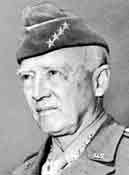
General George Smith Patton, Jr., was born on November
11, 1885 in San Gabriel, California. His military career was one of
the most colorful of all 20th Century military leaders. He participated
in the Pentathlon of the Stockholm Olympics in 1912 and placed fifth
overall in the event. Later, he served as a member of General John J.
Pershing’s staff both during the punitive Expedition to Mexico and in World War I. He joined the newly formed Tank Corps, where he
served until the Corps was abolished in 1920 at Fort Meade, Maryland.
After World War I, he held a variety of staff jobs in Hawaii and Washington,
D.C., and completed his military schooling as the distinguished graduate
of the Army War College. He served as control officer for the mechanized
maneuvers in Georgia and Louisiana, which tested the entire mechanized
concept of the Army.
With the formation of the Armored Force in 1940 at Fort Knox, he transferred to the 2d Armored Division at Fort Benning,
Georgia, and was named the Commanding General, 2d Armored Division,
on April 11, 1941.
On November 8, 1942,
Patton commanded the Western Task Force, the only all American force,
landing in North Africa. After
the American defeat at Kasserine Pass, he was given command of all American
forces in the Tunisia Combat Area.
He commanded the Seventh army during the invasion of Sicily in July 1943 and served
in this capacity until March 1944,
when he was given command of the Third Army which became operational
in France in August 1944. When American forces broke through the German
defenses, Patton's Third Army dashed across Europe and exploited German
weaknesses with remarkable success. In October 1945,
he assumed command of the Fifteenth Army in American-occupied Germany.
On December 21, 1945, General Patton died in Germany as a result of
an automobile accident. He is buried among the soldiers who died in
the Battle of the Bulge in Hamm, Luxembourg.