Paul von Kleist
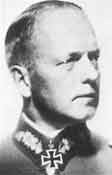
(1881 - 1954)
Paul von Kleist, the son of mathematics teacher, was
born in Hessen, Germany,
on August 8, 1881. He joined the German Army in 1900 and the following
year was commissioned as a second lieutenant in the 3rd Royal Field
Artillery Regiment.
Kleist attended the cavalry school in Hanover (1908-09)
and the Berlin War Academy (1910-12). By the outbreak of the First World
War Kleist was captain of cavalry (Rittmeister) of the 1st Prince's
Own Hussar Regiment. He was sent to the Eastern Front and commanded
a cavalry squadron at Tannenberg in 1914.
In October 1915, Kleist was promoted to staff officer
with the 85th Infantry Division. He continued to serve in Russia and
in 1917 became Chief of Staff of the Guards Cavalry Division. After
the signing of the Brest-Litovsk Treaty in 1918 Kleist was transferred
to the Western Front.
After the war, Kleist was Staff Officer with the 13th
Cavalry Regiment (1920-23), Instructor of Tactics at the Cavalry School
at Hanover (1923-26) and Chief of Staff of the 2nd Cavalry Division
(1927-28) where he replaced Gerd von Rundstedt. He then served as Chief
of Staff of Wehrkreis III (1928-31) and in 1932 was promoted to the
rank of major general.
Kleist was appointed general of cavalry in August 1936
and supervised Germany's military expansion in Silesia. He was known
to hold anti-Nazi views and in February 1938 General Heinrich von Brauchitsch
forced him into retirement.
On the outbreak of the Second World War, Kleist was
recalled to duty and during the invasion of Poland he commanded the XXII Corps under General Siegmund List. Kleist captured
the oil fields near Lvov and linked up with General Heinz
Guderian at Bug River on September 17, 1939.
Although Adolf
Hitler had doubts about Kleist's political loyalty, he had a high
regard for his military abilities and, on February 29, 1940, appointed
him commander of the main panzer forces for the Western Offensive. Kleist
began the offensive on May 9, 1940. Following the Manstein Plan, Kleist's
troops attacked through the wooded hills of the Ardennes.
Kleist wanted to move cautiously but General Heinz
Guderian, who commanded the 1st, 2nd and 10th Panzer divisions,
moved at great speed and crossed the Meuse near Sedan on May 14. Kleist
now ordered Guderian to halt until the arrival of General Siegmund List
and his 12th Army. Guderian disagreed with Kleist's view that the panzers
needed the support of the infantry. After a heated argument with Kleist,
who had the support of his superiors, Gerd
von Rundstedt and Heinrich von Brauchitsch, on May 17, 1940, Guderian
threatened to resign. Kleist responded by sacking Guderian.
Hitler was unwilling to lose this brilliant commander and General Siegmund
List was ordered to intervene and managed to persuade Kleist that Guderian
should return to duty. Guderian got his way and his troops rushed ahead
and reached the English Channel at Abbeville on May 21, 1940.
Boulogne was taken on May 23, but later that day Hitler called a halt arguing that the rapid advance was jeopardizing the whole
campaign. Kleist supported Hitler's decision but Heinz Guderian was
furious who argued that this would stop the German Army cutting off
the escape of the British Expeditionary Force (BEF) from Dunkirk.
In July 1940, Kleist was given command of the 1st Panzer
Group and sent to invade Bulgaria. The attack was a success and he entered
Belgrade on 12th April, 1941.
During Operation
Barbarossa Kleist led five panzer divisions and nine other divisions.
He drove into Ukraine destroying almost 20 divisions of the Red Army
before wheeling north to join Heinz Guderian in the encirclement of
Kiev. He then headed north and on November 20, 1941, entered Rostov.
However, with the temperature dropping to -20 C, Kleist had difficulties
with his tanks and under pressure from General Semen Timoshenko and
his troops was forced to retreat.
Kleist returned to the offensive in the summer of 1942
when he penetrated Russian defences along the Kuban River before moving
deep into the Caucasus. However, once again, he was forced to retreat
during the winter and by February 1943, he was having difficulty holding
on to the Crimea.
The Red Army launched a new counter-offensive in March
1944 and Kleist, now head of Army Group A, was pushed further back and
had to set up his headquarters at Nikolayev near Odessa. Hitler had now lost confidence in Kleist and General Erich
von Manstein. He remarked that "I can't trust Kleist or Manstein.
They're intelligent but they are not National Socialists." On March
29, 1944, they were both recalled to Germany and sacked.
Kleist was arrested by the Gestapo after the July Plot.
Although his cousin was one of the main conspirators they were unable
to find any information that directly linked Kleist to the attempt on
Hitler's life and he was released.
Kleist lived in retirement in the village of Mitterfels
in Bavaria until being taken into custody by the U.S. 26th Infantry
Division on April 25, 1945. He was turned over to Josip Tito in Yugoslavia
and in 1946 he was found guilty of war crimes and sentenced to fifteen
years' imprisonment.
In 1948, Kleist was extradited to the Soviet Union
and sent to Wladimir Prison Camp. Paul von Kleist died of arteriosclerosis
at Wladimir on October 15, 1954.
Sources: Spartacus
Schoolnet |