President George Bush
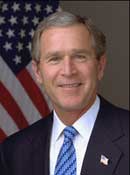
Learn More about Republican Incumbent President George W. Bush:
AICE does not rate or endorse any candidate for political office. This page is for informational purposes only.
Congressional
Research Service Summary of US-Israel Relations Under the Bush Administration
President George W. Bush and Prime Minister Sharon
established good relations in their March and June 2001 meetings. On
October 4, 2001, Sharon accused the Bush Administration of appeasing
the Palestinians at Israel’s expense in a bid for Arab support
for the U.S. anti-terror campaign. The White House said the remark was
unacceptable. Rather than apologize for the remark, Sharon said the
United States failed to understand him. Also, the United States criticized
the Israeli practice of assassinating Palestinians believed to be engaged
in terrorism, which appeared to some Israelis to be inconsistent with
the U.S. policy of pursuing international terrorist Osama bin Laden
“dead or alive.”
At their seventh White House meeting on October 16,
2002, the President and the Prime Minister discussed the possible U.S.
invasion of Iraq, Israel’s restrictions on the Palestinians, and
Israel’s request for additional military aid and loan guarantees
to help Israel prepare for the war against Iraq, according to press
accounts. On March 25, 2003, the President submitted a supplemental
request that sought $1 billion in military assistance and $9 billion
in loan guarantees for Israel, the amounts included in P.L. 108-11.
In preparation for their eighth meeting scheduled for May 19, 2003,
Sharon and Bush appeared to disagree over the so-called road map for
peace that Israel rejected until the Palestinians stopped all violence
against Israel and renounced their claim to the right of return for
1948 refugees. Sharon canceled the White House meeting after a series
of terror bombings in Israel on May 16 and 17. Sharon, Bush, and Palestinian
Prime Minister Abbas met at Aqaba, Jordan, on June 4, 2003, to begin
a new round of peace negotiations. President Bush repeated the U.S.
pledge to Israel’s security. Sharon and Bush met again at the White
House on July 24, 2003. (CRS
IB82008, October 10, 2003)
Foreign
Aid under President Bush
Bush has basically kept foreign aid at the level of
the agreed upon formula in which, during Clinton's term, Prime Minister
Netanyahu requested a decrease in economic aid with a slight increase
in military aid over the course of several years. President Bush also
supports loan guarantees to Israel.
In Fiscal Year 2004, The President requested $2.16
billion in military grants, $480 million in economic grants, and $50
million in refugee settlement funds for Israel. The House of Representatives
approved the $2.16b in military aide and $480 million in economic aide.
The President requested $600 million in ESF, $60 million
in refugee settlement, and $2.1 billion in FMF for Israel for FY2003.
Congress granted this request. In January 2003, Israel requested an
additional $4 billion in military grants and $8 billion in loan guarantees
to cover expenses incurred due to the US-led war with Iraq and the continuing
Palestinian intifada. The President sent a supplementary aid request
to Congress which included included $1 billion in Foreign Military Financing
(FMF) and $9 billion in loan guarantees for Israel. 75% had to be used
for purchases in the United States. The Presidents’s request attached
conditions to the loan guarantees: that the funds cannot be used in
the occupied territories; that the President can reduce the total of
the loan guarantee by an amount equal to the amount Israel spends on
settlements in the occupied territories; that Israel will pay the subsidy;
and that the President will determine if Israel meets certain budgetary
and economic reforms.
The President requested $720 million in ESF, $2.04
billion in FMF, and $60 million in refugee settlement funds for FY2002.
Congress reduced the request in their foreign aid bill. (CRS
IB85066, October 3, 2003)
Statements
about the Middle East
Bush on the People of Israel
We will speak up for our principles and we weill stand
up for our friends in the world. And one of our most important friends
in the world is the State of Israel... [Israel] is a small country that
has lived under threat throughout its existence. At the first meeting
of my National Security Council, I told them a top foreign policy priority
is the safety and security of Israel. My administration will be steadfast
in supporting Israel against terrorism and violence, and in seeking
the peace for which all Israelis pray. (Speech to the American Jewish
Committee, May 3, 2001, Preisdent
George W. Bush: A Friend of the American Jewish Community)
Bush on Anti-Semitism
This site is a sobering reminder that when we find
anti-Semitism, whether it be in Europe or anywhere else, mankind must
come together to fight such dark impulses. And this site is also a strong
reminder that the civilized world must never forget what took place
on this site. May God bless the victims and the families of the victims,
and may we always remember. (Speech in Auschwitz, May 31, 2003, Preisdent
George W. Bush: A Friend of the American Jewish Community)
Bush at the UN General Assembly
The Palestinian people deserve their own state—and
they will gain that state by embracing new leaders committed to fighting
terror and building peace. Israel must work to create the conditions
for a peaceful Palestinian state. (Bush-Cheney
'04, September 23, 2003)
Bush on Reform & Geneva
Q Mr. President, Secretary Powell has been meeting
with unofficial Middle East peace negotiators, despite Israel's objections.
And there's other signs of U.S. dissatisfaction with Israel. My question
is, what does Israel need to do to convince you that it's doing its
part in the peace process?
THE PRESIDENT: Randy, you may remember I gave the
speech on June 24, 2002. I laid out exactly what I think must happen
in order for us to achieve peace in the Middle East, in order for a
Palestinian state to emerge that is at peace with Israel. And I haven't
changed my opinion. Step one is for all parties to fight off terror,
to stop the few from destroying the hopes of the many. Step two is for
the Palestinians to find leadership that is willing to reject the tired
old policy of the past and lead the Palestinian people to not only a
democratic state, but a peaceful solution of differences.
Israel must be mindful that the decisions they make
today will make it difficult to create-must be mindful that they don't
make decisions that make it hard to create a Palestinian state. It's
in Israel's interests there be a Palestinian state. It's in the poor,
suffering Palestinian people's interest there be a Palestinian state.
The Arab world has got responsibilities to see that this vision be implemented.
...
Q But why these contacts with the unofficial negotiators?
THE PRESIDENT: I'm sure the Secretary of State meets
with all kinds of people all the time. But the policy of this administration
was laid out in the Rose Garden for everybody to see, everybody to listen
to.
You might remember I took that policy to Aqaba, Jordan.
I stood up in front of the world and said this man has-Abu Mazen-he
came to the Oval Office and said, I'm willing to join you, Mr. President,
to help fight off terror. Because he understood that terror was what
was preventing progress from being made. He said, I'm willing to work
to put the institutions in place for a Palestinian state. And as we
began to make progress, he got shoved aside. And that's why we're stalled
where we are today.
It is time for a Palestinian leadership to emerge
that believes in peace and believes in the aspirations of the Palestinian
people. (White House press briefing, 12/12/2003)
Bush on Geneva
Q The Geneva Accord, do you think some of these proposals
should be included in an overall peace agreement? And why is Secretary
Powell meeting with these people?
PRESIDENT BUSH: Everybody knows where I stand. I gave
a speech right here in Rose Garden in June of 2002. I laid out what
I believe is necessary to achieve peace in the Middle East. It starts
with having a Palestinian state that is at peace with Israel, a Palestinian
state based upon democratic principles, a Palestinian state which recognizes
the hopes and aspirations of the Palestinian people, and a Palestinian
state with leadership which is committed to defeating and dismantling
the terrorist organizations who are trying to prevent a Palestinian
state from emerging.
I also talked about the need for the Israelis to keep
in mind that if they support a Palestinian state, which they have told
me they do, that the conditions on the ground must be such for a Palestinian
state to be able to emerge. And that's why we're continuing to talk
to them about the illegal settlements and outposts-illegal outposts
and settlements, as well as the fence.
As well, nations in the neighborhood must take responsibility.
The King and I have spent a lot of time talking about this subject.
He understands fully what I'm talking about. I want to remind you that
it was in Jordan where His Majesty hosted us. I stood up with His Majesty,
as well as Prime Minister Sharon and then Prime Minister Abu Mazen,
and made a public declaration that we were prepared to work together
for the creation of a Palestinian state. Abu Mazen has since been shoved
aside, and the process stalled. What the Palestinians need is leadership
willing to remain committed to the aspirations of their people, and
bold enough to stand up and fight off the terrorists organizations.
And His Majesty and I will be glad to work with such leaders, as they
emerge.
Q This is a productive process, the Geneva Accords
and Secretary Powell's meeting?
PRESIDENT BUSH: Well, I think it's productive, so
long as they adhere to the principles I have just outlined. And that
is, we must fight off terror, that there must be security, and there
must be the emergence of a Palestinian state that is democratic and
free.
And it's-the position of this government is clear
and it's firm. We appreciate people discussing peace; we just want to
make sure people understand that the principles to peace are clear.
(White House Press Briefing, 12/04/03)
The Saddam-Israel connection
He had used weapons. He had manufactured weapons. He
had funded suicide bombers into Israel. He had terrorist connections.
In other words, all of those ingredients said to me: Threat. The fundamental
question is: Do you deal with the threat once you see it? What-in the
war on terror, how do you deal with threats? I dealt with a threat by
taking the case to the world and said, “Let's deal with this. We
must deal with it now.” (Meet
the Press, Feb. 8, 2004)
Bush on the Roadmap and other topics (Interview
with Middle East Television Network)
Q When you sit down with the leaders of the countries
you just mentioned, Mr. President, do you get a sense of the urgency,
when we talk about the issues of reform and democracy, from them?
THE PRESIDENT: Well, I get a sense of two things from
them. One, I do believe they understand the need to reform. But I also
know they agree that we need to continue to work together to fight terror.
And that's vital, because it's hard for a free society to develop with
terrorists killing innocent people.
For example, I have a vision in the Middle East for
there to be a Palestinian state. I'm the first President to have ever
articulated a Palestinian state. I believe there needs to be a Palestinian
state, and I'm not going to change my opinion. On the other hand, I
know how hard it is to achieve a Palestinian state, so long as there's
groups of terrorists willing to murder in order to prevent that from
happening.
And so I hear two things. I hear, one, the need to
reform, to include more people in the process, which is taking place;
but also the clear understanding from leaders that we must continue
to work together to fight off the terrorists. And I say this with conviction.
There's a -- the murderous ambitions of a few are trying to derail the
hopes of many. And my government wants to work with governments to prevent
that from happening.
Q Has the road map failed? Do we need a new approach
to revive the peace talks and work towards your vision?
THE PRESIDENT: No, not at all, no. The road map is
in place. What has failed is the -- some parties are not advancing on
the road map. They're stuck. And I stood up with Mr. Abu Mazen, at that
time the Prime Minister of the Palestinian Authority, with Prime Minister
Sharon, in Aqaba, Jordan -- and King Abdullah, of course, our host --
and we linked arms and said, let us move forward on the road map to
peace. There needs to be a commitment to fight terror. There needs to
be a commitment to put the institutions of a free society in place.
There needs to be a commitment on the Israelis to worry about the plight
of the average Palestinian citizen -- to encourage a society to evolve
that is commercially viable and free. There needs to be a commitment
from the neighborhood to help fight off the flow of funds to fund the
terrorist groups, that would stop.
And we were making progress, we really were. And then
he got shoved aside. And so the road map is still intact. The vision
for where we need to go is intact. What we need right now are parties
who are willing to take a risk for peace, and to lead. And I look forward
to working with any such party.
Q Why then are some people in the U.S. or some of
your friends and allies in the Middle East say that you're not personally
doing enough? How would you respond to that?
THE PRESIDENT: Well, I would remind them of the pictures
of Aqaba, Jordan. I mean, it's -- it is a rare occurrence when the President
stands up with Israel, the Palestinian Authority, and says we're linked
together to move toward peace. The problem was, was that somebody undermined
that peace process by making it very difficult for Prime Minister Abu
Mazen to work to achieve his vision. And that somebody was Chairman
Arafat. I'm sorry that happened. On the other hand, I still believe
that a Palestinian state is essential for the aspirations of the Palestinian
people. And I fully understand there needs to be a firm commitment to
fight off terror in order for that to happen. (The
White House, February 18, 2004, from the Middle East Television
Network)
President Bush on Syria and Syria-Israel Relations
Q You had a couple of phone calls with the Syrian
President after September 11 and things looked, you know, that the President
of Syria was going in the right direction, according to your administration.
And then things went sour. What happened?
THE PRESIDENT: Well, first of all, I think we made
some legitimate requests. I said, look, Hezbollah is a terrorist organization.
They headquartered in your country. You need to shut down those headquarters.
You need to prevent terrorist activities from being planned and/or orders
being -- emanating out of Syria. Secondly, you've got to work on the
border to make sure that the border between Iraq and Syria is not porous
but, in fact, you are able to stop the flow of people and contraband
and information back and forth. We don't want terrorists coming in from
Syria into Iraq to kill innocent Iraqis and/or American troops. And
it's very important for us to keep sending that message to him. That's
why I appreciate doing this interview. The message still stands. And
we would hope there would be a strong cooperation on these very reasonable
points.
Q The Syrian President sent a couple of signals recently
expressing his willingness to resume peace talks with Israel. Would
you be willing -- how do you assess this --
THE PRESIDENT: It's very interesting. First of all,
I'm interested in peace. And the fact that a party is willing to talk
about peace is, I think, a positive signal. I look forward to understanding
fully what that means. As you know, there was -- some progress had been
made prior to my arrival as President on Syrian-Israeli peace talks.
And we've just got to understand the intent, the sincerity and the desire
of both parties involved, that would be Syria and Israel. (The
White House, February 18, 2004, from the Middle East Television
Network)
President Bush, reacting to Israel's assassination
of Hamas founder Yassin
There are still people who want to harm our country.
And so-whether it be an Hamas threat, or an al Qaeda threat, we take
them very seriously in this administration.
As far as the Middle East, it's a troubled region,
and the attacks were troubling. There needs to be a focused, concerted
effort by all parties to fight terror. Any country has a right to defend
itself from terror. Israel has the right to defend herself from terror.
And as she does so, I hope she keeps consequences in mind as to how
to make sure we stay on the path to peace. This administration is committed
to finding a two-state solution-a two-state solution for the good of
Israel, a two-state solution for the good of the Palestinian people.
To this end, if the circumstances on the ground allow, I'll be sending
a team back out to the Middle East next week to see if we can't keep
the process alive, the process toward peace. (The
White House, March 23, 2004)
President Bush on his meeting with Egyptian President
Hosni Mubarak
Our two nations have nurtured a vision of peace that
is anchored by the Egyptian-Israeli peace treaty. This first peace agreement
between Israel and an Arab country has been a model for subsequent endeavors
to achieve a just, comprehensive, and lasting peace in the region.
Our two nations' unwavering commitment to this process
led to the universal acceptance of the necessity and inevitability of
a negotiated settlement. We envisage two states, Israel and Palestine,
living side-by-side in peace and security. We will continue our determined
efforts in the forthcoming months to achieve these objectives. We believe
that an Israeli withdrawal from Gaza and parts of the West Bank can,
under the right conditions, and if it is within the context of the implementation
of the Roadmap and President Bush's vision, be a significant step forward.
It is our firm conviction that resolving the Arab Israeli conflict will
be a major contribution to stability and progress in the region, removing
a major source of tension. (Project
Vote Smart, April 12, 2004)
President Bush Press Availability with President
Mubarak
The meetings we have just had focused on these goals
and on ways to make the Middle East safer and more secure. We recognize
that the starting point for a prosperous and peaceful Middle East must
be the rejection of terror. Egypt has taken a firm stand against terror
by working to disrupt the activities and capabilities of the region's
terrorist organizations. These are the policies of a nation and a statesman
that understand the threat that terrorism poses to all of us-to my nation,
to his, to all the Arab states, to Israel and to the future of any Palestinian
state.
Terrorism must be opposed and it must be defeated.
And I'm grateful for President Mubarak's support in the global war against
terror.
Our objective in the Middle East must be true peace-not
just a pause between wars-which can only happen within a framework of
democracy and stability. I'm pleased that Egypt has engaged its neighbor,
Israel, on closer trade ties that will help the Egyptian people find
jobs and improve their lives. President Mubarak and I discussed the
possible Israeli withdrawal from Gaza, and our shared view that creation
of a democratic, peaceful Palestinian state is a necessary goal on the
road to peace. (Project
Vote Smart, April 12, 2004)
Bush on accepting Sharon's unilateral withdrawal
plan [before he presented it]
Q Thank you, sir. If I could ask both of you-are both
of you prepared to endorse the Israeli withdrawal plan?
PRESIDENT BUSH: Steve, I welcome-first of all, let's
not prejudge what Prime Minister Sharon is going to tell me. So I don't
want to put words in his mouth until he actually comes to America on
Wednesday. We discussed the rumors of such a withdrawal. And we discussed
it in the context of the two-state solution and the roadmap.
In other words, we both are in agreement that if Israel
makes the decision to withdraw, it doesn't replace the road map, it
is a part of the road map, so that we can continue progress toward the
two-state solution. And I really welcomed my friend's advice. He is-he
knows the area well. And he's been in touch with the parties and he
has got good judgment on this matter. Let's wait until the Prime Minister
comes. But if he were to decide to withdraw from the Gaza, it would
be a positive development. (Project
Vote Smart, April 12, 2004)
Bush on Two-State Solution, Road Map
PRESIDENT BUSH: Great question. Yes, I think we can
achieve a two-state solution. You're right, I think I made the speech
at the United Nations in 2001, if I'm not mistaken-September of 2001
-- the first American President to do so, to make that public declaration
a policy. And the reason I did is because I believe it's in the Palestinians'
interest to have their own state, and I believe it's in Israel's interest
that the Palestinians develop a peaceful state.
The reason why-we've made some progress, by the way.
There is what they call the road map, a strategy to achieve that, which
is good. The problem is, is that there's terrorists who will kill people
in order to stop the process. And that's why it is essential that we
work together to stop terrorist killing. There will never be a Palestinian
state, in my judgment, if terrorists are willing to kill. And so the
first step we've got to do is to work on the mutual security concerns
of the region. And we can't let people blow up a process. But that's
what happened, as you might recall. And there's been suiciders and killers
and-you know-and it's essential that we work together to stop that kind
of terror.
It will be much easier for the Palestinians to assume
their responsibilities-and there are responsibilities for the Palestinians,
particularly when it comes to developing a state that is a peaceful
state-it will make it a lot easier if we can continue to keep the pressure
on the terrorists, make it a lot easier for them to assume their responsibilities.
(Project
Vote Smart, April 12, 2004)
President Bush On The Disengagement Plan
“The long-term strategy of this government is
to spread freedom around the world. And I believe -- I told you, a free
Iraq will be a major change agent for world peace. I also believe a
free Palestinian state would be a major change agent for world peace.
Ariel Sharon came to America and he stood up with me and he said, we
are pulling out of Gaza and parts of the West Bank. In my judgment,
the whole world should have said, thank you, Ariel. Now we have a chance
to begin the construction of a peaceful Palestinian state.
Yes, there was kind of silence, wasn't there? Because
the responsibility is hard. It's hard to be responsible for promoting
freedom and peace when you're used to something else. If you don't have
the aspirations of the people firmly embedded in your soul, it's hard
to take a gamble for peace by putting the institutions of a free society
in place, institutions that are bigger than the people.” (Statement
following meeting with Sharon, The
White House, April 21, 2004)
“Security is the foundation for peace. All parties
must embrace democracy and reform and take the necessary steps for peace.
I am troubled by the violence in Gaza and it underscores the need for
all parties to seize every opportunity for peace. I strongly support
the plan announced by Prime Minister Sharon to withdraw military installations
and settlements from Gaza and parts of the West Bank. This plan is a
bold and courageous step that can bring us closer to the goal of two
states — Israel and Palestine — living side by side in peace
and security.”
“Sharon's disengagement decision has given the Palestinian people
and the free world a chance to take bold steps of their own toward peace.
We must now call upon the Palestinian people to reject their corrupt
and failed leaders and insist on a leadership committed to reform, progress
and peace. When they renounce the terror and violence that frustrate
their aspirations and cost so many innocent lives, they will have the
opportunity to build a modern economy, creating the institutions and
developing the habits of liberty. The Palestinian people deserve a better
future, just as the people of Israel deserve a better future. And democracy
will deliver this future to us all..” (Forward,
(September 3, 2004)
President Bush on the Palestinian Leadership
“The Palestinian leadership has failed the people
year after year after year. And now is the time for the world to step
up and take advantage of this opportunity and help to build a Palestinian
state that's committed to the principles of individual rights, and rule
of law, and fairness, and justice so the Palestinian people have a chance
to grow a peaceful state, and so that Israel has a partner in peace
-- not a launching pad of terrorist attacks on her border.” (The
White House, April 21, 2004)
“For the sake of peace, we are committed to helping
the Palestinian people establish a democratic and viable state of their
own. Israel will benefit from a truly responsible partner in seeking
to achieve peace. The Palestinian people deserve democratic institutions
and responsible leaders. Progress toward this vision creates responsibilities
for Israel, the Palestinian people and Arab nations. It is essential
to the successful establishment of peace that all parties renounce violence
and mutually pursue the war against terror.” (Forward,
(September 3, 2004)
On meeting with Swedish PM Persson
We talked about the Palestinian/Israeli issue. I reminded
him that I was the first President ever to articulate the vision of
a Palestinian state. No other President has ever done that. I was pleased
to do so because I believe that is the best hope for the Palestinian
people and the best way to promote peace. (The
White House, April 28, 2004)
Bush on his support for Prime Minister Sharon's
plan for unilateral withdrawal to Alhurra Television
Q If I may ask you my final question on the issue of
the peace efforts that you are conducting. You supported Prime Minister
Sharon's plan to withdraw from Gaza and you sent senior officials to
Israel, and Israeli officials came to Washington and negotiated that
plan. Do you think it was a mistake to support a plan before the Prime
Minister secured the support of his own party?
THE PRESIDENT: I think when you see a step toward peace,
it's important for a peaceful nation like America to embrace it. And
I felt that a withdrawal from the Gaza by the Israeli Prime Minister,
as well as the withdrawal from four settlements from the West Bank by
the Israeli Prime Minister, was a step toward peace. And at the time
he did so, I called for the United States and others to seize this moment-the
Quartet and the European Union and Russia and the United Nations, and
hopefully the World Bank, to seize this moment and to help the development
of a Palestinian state that will be at peace with its neighbors; a Palestinian
state that will provide hope for long-suffering Palestinian people.
I think this is an historic moment for the world. I
think this is a good opportunity to step forth. I am confident that
a peaceful Palestinian state can emerge. I'm the first President ever
to call for the establishment of a Palestinian state. I still feel strongly
that there should be one. I also recognize that we have got a duty,
all of us, to fight off the terrorists who are trying to stop the spread
of a peaceful Palestinian state, or the creation of a Palestinian state.
And now is the time to make progress. And I believe
we can. There was a good statement yesterday out of the Quartet that
confirmed our desire for a Palestinian state to emerge. And it's-what
the Prime Minister of Israel did was-took a political risk; obviously
he did. I mean, his own party condemned the statement-condemned the
policy. However, I still believe it was the right thing for him to do.
And we support peace in the Middle East. And we support the vision of
two states, living side by side in peace. (Project
Vote Smart, May 5, 2004)
President Bush interview with Al-Ahram International
We want there to be a Palestinian state at peace with
its neighbors. We want there to be reform. We want people to have a
chance to participate in the process. (Project
Vote Smart, May 6, 2004)
Bush on his letter to Prime Minister Sharon and
the look of a future Palestinian state in interview with Al-Ahram International
Q Many Arabs feel that after the letter of assurances
you gave to Israeli Prime Minister Ariel Sharon, any future Palestinian
state would exist on less than half what the partition plan offered
them in '47. How do you reconcile this with a moral concept of justice?
THE PRESIDENT: First of all, I made it very clear in
my letter that I recognized circumstances had changed-but I made it
very clear of a couple of very important points. One, that any final
status would be negotiated by the parties-that would be the Israelis
and the Palestinians-not the United States, we won't pre-judge final
status.
Secondly, I made it clear that I supported what the
Prime Minister had done, because I think it's a great opportunity for
the establishment of a Palestinian state. I'm the first President ever
to have articulated the vision of a Palestinian state.
Q I'm writing here, and I wanted to appreciate that
very highly.
THE PRESIDENT: Well, I'll tell you, and I'm somewhat
amazed, sir, that the debate has already started about what the end
results are going to look like when we haven't even really begun yet
to establish a state. I think the focus ought to be on putting the institutions
in place for a Palestinian state that is peaceful and prosperous to
emerge.
I think it's very important for reform-minded Palestinians
to step up and ask the world for help, in order to build the security
apparatus needed for a state to grow; ask for education help; ask for
help to stimulate the entrepreneurial class so businesses will grow.
I believe it'll happen. And when it does happen, the final status issues
will be much easier to solve.
In other words, when there is a state that's up and
running and prosperous and has the confidence of Egypt and Israel and
America and the E.U. and the rest of the world, it'll be much easier
for these final-these tricky issues to be solved between the two parties.
And so now is the time not to be arguing over what the world will look
like down the road. We ought to be arguing about what the world can
look like this year. And that's why the road map is so important.
The United States is firmly committed TO the road map.
I'm sending a letter to the-I announced today I'm going to send a letter
to the Palestinian Prime Minister explaining that I'm committed to the
road map, committed to two states living side-by-side in peace, but
also reminding him it's now time to step up and show leadership, show
leadership against the terrorists, and show leadership in putting the
institutions in place for a state to emerge. (Project
Vote Smart, May 6, 2004)
Bush on the "Right of Return" to Al-Ahram
International
Q The right of Palestinian refugees to return to their
homeland and to be provided with compensation is legally assured in
several U.N. resolutions.
THE PRESIDENT: Right.
Q The United States has also traditionally supported
the right of refugees to return in recent major conflicts. How would
you then justify making the Palestinian refugees an exception for accepted
international laws under human rights conventions?
THE PRESIDENT: My comment, again, was this, that-and
the right of refugees is a final-status issue. And that's to be negotiated
on between the Palestinians and the Israelis. When I said what has changed
and what will change is when there's a Palestinian state to which Palestinians
can go. There hasn't been one. And my point was, was that when a state
is set up and the institutions are in place and people have a chance
to make a living and it's peaceful, the entrepreneurial class is growing,
small businesses, people are participating in the political process,
that that's going to change the dynamic on the ground.
I fully concede there's a lot-the compensation issue
is an issue that's still being negotiated. The rights of-you know, the
rights of Palestinians to return to Israel will be negotiated. But what
I'm telling you is when a state emerges, it'll change the dynamic. And
that's all I said in my comment.
Again, I'll repeat to you, people want to focus on
the future, when I think we ought to be focused right now on the right
now, which is what is necessary to put a Palestinian state in place
so people can have a chance to live in a hopeful society. And I'm frustrated,
I must tell you, a little bit, because I think that-I think that there
needs to be better leadership in saying, what can we do to help the
Palestinian people develop a state. And there needs to be a new constitution,
it seems like to me.
And some of these reforms stalled. Heck, we've been
talking about them for about two years, unfortunately. But now is an
opportunity. And I think Prime Minister Sharon created an interesting
dynamic, I really do, and that is withdrawal from the West Bank. You
know, it wasn't all that long ago if an Israeli Prime Minister stood
up and said, we're out of Gaza and parts of the West Bank, people would
have said, that's fantastic. And so the Prime Minister makes the decision
to get out and, of course, his own party rejects it, which speaks to-it
speaks to his leadership, in my judgment, that he's willing to do what
he thinks is right, in face of political opposition. (Project
Vote Smart, May 6, 2004)
Bush in response to the question of realities meaning
the annexation of "other's lands"
Q But do you really agree that pragmatic realities
mean annexation of other lands?
THE PRESIDENT: Do I think-
Q Do you agree on that, I mean, that pragmatic realities
which, I mean, being said repeatedly here in the states, pragmatic realities-pragmatic
realities-
THE PRESIDENT: You mean, with the conditions on the
ground?
Q Does it mean annexation of other people's land?
THE PRESIDENT: I think what it means is, I think you're
going to see over time with the emergence of a Palestinian state that
the West Bank will be occupied by Palestinians. And to the extent to
what the final border looks like is up for negotiations. (Project
Vote Smart, May 6, 2004)
Bush on Timeline for Palestinian State to Al-Ahram
Q Again, we very much appreciate the fact that you
were the first U.S. President to call for the creation of an independent
Palestinian state. But in all the recent proposals that are being circulated,
including the latest disengagement plan, we did not see any specific
timetable. What happened to your pledge to create a Palestinian state
by 2005? And do you still believe that this could be possible?
THE PRESIDENT: Well, 2005 may be hard, since 2005 is
right around the corner. I readily concede the date has slipped some,
primarily because violence sprung up. When I laid out the date of 2005,
I believe it was around the time I went to Aqaba, Jordan. It was a very
meaningful moment, where former Prime Minister Abu Mazen, myself, Prime
Minister Sharon and His Majesty, the King of Jordan, stood up and pledged
to work together.
But we hit a bump in the road-violence, as well as
Abu Mazen was replaced, which changed the dynamic. I don't want to make
any excuses, but nevertheless, I think the timetable of 2005 isn't as
realistic as it was two years ago. Nevertheless, I do think we ought
to push hard as fast as possible to get a state in place.
And I repeat to you, sir, that part of my frustrations
were alleviated with the Quartet making the statement it made the other
day-the Quartet being the E.U., Russia, United Nations and the United
States, working together. I think we can get the World Bank involved.
But there is a certain sense of responsibility that falls upon the Palestinians,
reform-minded Palestinians to step up and say, yes, we accept these
institutions necessary for a peaceful state to emerge.
There's also a responsibility for Egypt. Egypt has
got, in my judgment, an important role to play to help make sure there
is security in Gaza, as the civil structure is put in place and as the
government structure is put in place. And President Mubarak, I think,
is willing to assume that responsibility over time-I don't want to put
him on a timetable, but I do believe he is committed to helping bring
security to that part of the world, it's in Egypt's interest that there
be security. (Project
Vote Smart, May 6, 2004)
On Egypt's Role to Al-Ahram International
Q You know, Mr. President, we did our best, I mean,
getting all the factions together in Cairo, Egypt to try to convince
them to have one single opinion, and that we're ready for training the
police and security guards.
THE PRESIDENT: That's right. President Mubarak has
been a leader on the issue of security, he really has. As you say, he's
convened a very important meeting to make it clear that in order for
there to be a peaceful evolution of a state there has to be security,
and that he's willing to train police. Egypt plays a mighty important
role. And it's a great country and it should play an important role.
(Project
Vote Smart, May 6, 2004)
On the Bush Letter to Sharon and Past Statements
to Al-Ahram International
Q You have said, Mr. President, in recent statements,
that the assurances you gave to Sharon did not differ from what was
being discussed, and what we mentioned now, and previous final status
talks. But in those talks there were proposals on land swaps and an
Israeli acceptance for the return of a limited number of refugees. Why
were these proposals absent from your recent letters?
THE PRESIDENT: Look, I want to assure you once again
that I understand the sensitivity of these final status issues. But
they will be negotiated, not between the United States and the parties,
they're negotiated between Israel and the Palestinian government, of
a new state. And that's really-and that is a position I've taken all
along. It's what I told my friend, President Mubarak. I just told that
to His Majesty, the King of Jordan. And I will explain that consistent
position of mine.
People-I think some people are trying to read something
into what I said or didn't say. And what-you know, I'll say it finely
one more time: This is an opportunity that we can't let go by. There's
a lot of argument about final status issues, and they're very important
issues, don't get me wrong. But the focus ought to be on how do we get
a Palestinian state up and running and moving forward. (Project
Vote Smart, May 6, 2004)
On a pullout from the West Bank and the idea that
the Gaza withdrawl represents less than 1% of "historic Palestine"
Q You have praised Sharon's proposal to withdraw from
Gaza, which is an idea that does not represent more than one percent
of (inaudible) Palestine. Would you accept guarantee for granting Palestinians
similar letter of assurances stating that any annexation of West Bank
territory has to be minimal and that Israel has to pull out from nearly
the entire West Bank, according to Security Resolution 242 and 338?
THE PRESIDENT: No, I will write-I will say the exact
same thing in a letter to the Palestinians that I have said publicly
today, that I believe an opportunity exists and it's essential that
the Palestinian Authority find reform-minded leaders who are willing
to step up and lead. (Project
Vote Smart, Al-Ahram interview, May 6, 2004)
On Israel's Right to Defend Herself to Al-Ahram
Internation
Q The last question on Israeli-Arab issue, you have
repeatedly-repeatedly stated that Israel had the right to defend itself.
But do you believe that by building walls and settlements and by assassinating
Palestinian leaders, Israel is enhancing security and helping and reassuring
peace talks?
PRESIDENT BUSH: I think that any country has a right
to defend herself. And you're looking at a President who is now in the
process of defending my country against terrorist attacks. It is very
difficult for the President of the United States to condemn anybody
for defending themselves.
My problem with the wall was not the security aspect
of the wall. My problem with the wall was that at one point in time,
it looked like it was trying to prejudge any final status. And that
I hope-my hope is, at one point in time, the wall is unnecessary. The
hope is, is that a peaceful Palestinian state, that-I keep saying that,
but I think it's possible-but a peaceful Palestinian state must be a
state in which youngsters are well-educated, and have a chance to make
a living, and have a chance to-parents have a chance to realize-raise
their children in a peaceful setting.
And I think that a peaceful Palestinian state will
eventually change the dynamics on that which exists on the ground today.
(Project
Vote Smart, May 6, 2004)
On sanctions with Syria to Al-Ahram International
Q Why does your administration insist on imposing sanctions
against Syria?
THE PRESIDENT: Because they will not fight terror,
and they won't join us in fighting terror. We've asked them to do some
things, and they haven't responded. And Congress passed a law saying
that if Syria will not join-for example, booting out a Hezbollah office
out of Damascus-that the President has the right to put sanctions on.
I have yet to impose a sanction yet, but the bill enables
me to do so. And we've talked to the Syrian leader very clearly-and
these aren't-these are reasonable requests-and thus far, he hasn't heeded
them. And that's why, if I make the decision to put on sanctions, it
will be because he hasn't been a full partner in the war against terror.
(Project
Vote Smart, May 6, 2004)
Bush on Terrorism
Q That would create another-more problems in the area.
THE PRESIDENT: Well, we'll see. But I think that-I
think that people need to understand that there needs to be a full commitment.
I mean, there's no need to harbor people who are expressing hatred.
And if the world would join together to rout out terrorist organizations
who want to kill innocent people, it would be a heck of a lot better
off.
See, here's my objection. We've got Muslims killing
Muslims in Iraq. There are Muslims who will kill an innocent Muslim,
for the sake of trying to create fear. We can't let that happen. Civilized
people must not allow that to happen. What they're trying to do is they're
trying to shake our will, our collective will. For those of us who love
freedom, they were trying to say, well, don't work for freedom, leave
us alone so we can kill other people. We just can't let that happen.
There are too many peaceful people who need protection. And we want
to help them. And, most importantly, we want to help them help themselves,
so they can be self-governing in Iraq.
But the killing of innocent life for political purposes
is not acceptable in the 21st century. And you know that, and I believe
that. (Interview with Al-Ahram, Project
Vote Smart, May 6, 2004)
“September 11, 2001, awakened Americans to the
knowledge that we can no longer depend on geography to protect us from
the heinous acts of terrorists. We experienced the horror of a brutal
attack on our own soil — terror flooded our streets, and entered
our places of work. With this experience came a better realization of
the struggles borne every day by the people of Israel, and we developed
an even stronger determination to defeat terrorism and to eliminate
the threat it poses to free people everywhere. Terrorism has many faces,
but all those who use terror as a weapon against free people burn with
the same hatred and the same will to destroy. To build the lasting peace
that we both seek in all corners of the globe, we must use every resource
to defeat terror and ensure our security. America has led a relentless
global campaign against terrorists and their supporters, and we are
glad to have Israel at our side.” (Forward,
(September 3, 2004)
Al-Ahram Interview
Q I assure you that, you know, the Arab people really
have nothing against the American people. Maybe the only-the only issue
is the Palestinian-Israeli-
THE PRESIDENT: -- Israeli issue, yes.
Q-and the American bias to it.
THE PRESIDENT: I hope we can get that solved. I mean,
I truly believe that a peaceful state will emerge. And, listen, I've
got great respect for Arab culture; I've got great respect for the Muslim
religion. I reject this notion that this is a war against Muslims. This
is not a war against Muslims. The Muslim religion is a peaceful religion.
Islam is peace. This is a war against evil people who want to kill innocent
life. That's what this is.
And it is-they've killed in our country. They've killed
in your country. They killed a great man in Sadat. And it's essential
that freedom-loving people and peaceful people fight terror. It's the
call of our time; it's the challenge of the 21st century. And we've
got to work together to do so (Project
Vote Smart, May 6, 2004)
President Bush joint press conference after his
meeting with Jordanian King Abdullah II
His Majesty and I also discussed our ongoing quest
for a just and durable peace between Israel and Palestine. I commend
the King's personal commitment to peace and justice for all parties.
I remain committed to the vision I laid out here in the Rose Garden
on June 24, 2002, of two states, Israel and Palestine, living side-by-side
in peace and security, and to the establishment of a Palestinian state
that is viable, contiguous, sovereign, and independent.
I support the plan announced by Prime Minister Sharon
to withdraw settlements from Gaza and parts of the West Bank. This bold
plan can make a real contribution to peace, particularly if reform-minded
Palestinians will step forward and lead toward the establishment of
a peaceful Palestinian state.
As I have previously stated, all final status issues
must be negotiated between the parties in accordance with U.N. Security
Council Resolutions 242 and 338. And the United States will not prejudice
the outcome of those negotiations. The road map is the-is the best path
to realizing the two-state vision. That is why the road map is the plan
endorsed by the Palestinians, Israel, the United Nations, the European
Union, Russia, the United States and many other nations. That's why
my administration is committed to making it a reality.
Today, the King had some suggestions about how to-how
to explain our position to the Palestinians.
And I appreciated your advice, Your Majesty.
He advised that I make sure the Palestinians understand
my desire for a just peace, my desire for there to be a prosperous country,
my desire that the Palestinian people have a chance to realize their
hopes and aspirations.
I told His Majesty I will shortly send Mr. Qureia,
the Palestinian Prime Minister, a letter that will explain my views.
And we will expand dialogue between the United States and Palestinians.
I want to appreciate your wise counsel, Your Majesty.
(The White House, Project
Vote Smart, May 6, 2004)
Bush on Jordan at Joint Press Conference with King
Abdullah II
Your Majesty, I'm proud you're here. I appreciate you
coming. Jordan is a friend of the United States, and friends look out
for one another. I understand your country and your people have important
interests at stake in the Middle East; your country has important interests
at stake when it comes to a Palestinian-Israeli peace agreement; you've
got important interests in the emergence of a new Iraq. I assure you
my government views Jordan's security and prosperity and territorial
integrity as vital. We will oppose any developments in the region that
might endanger your interests. (The White House, Project
Vote Smart, May 6, 2004)
On the Road Map
Q. And for you, President, in light of your discussion
today with His Majesty, do you see U.S. involving itself soon in the
actual implementation of the road map?
PRESIDENT BUSH: Yes, we support the road map. As a
matter of fact, the Secretary of State was recently meeting with the
Quartet, which is an integral part of the road map. Here's what I believe
has to happen. The world must recognize the possibility of a Palestinian
state. I mean, the development of a Palestinian state is-that's free
and democratic-and by the way, democracy doesn't have to look like America
or Europe, it's got to be attuned to the cultures and to the Palestinian
people. It's what they want. But nevertheless, development of a state
that's free and peaceful will change the dynamic of the Middle East.
I mean, the Palestinians are people who need hope-hope
for a better life, hope to be able to make a living, hope to raise their
families in a peaceful situation. That's what they want. And the best
opportunity for that to happen is for there to be a state that emerges
that provides the framework for a peaceful coexistence in the Middle
East. And that requires not only the United States being involved, and
the European to be involved, and Russia and the United Nations to be
involved, it requires that reform-minded Palestinians step up and work
with the world to develop the institutions necessary for a state to
evolve. That's what has to happen. That's road map. In other words,
that's how you head down the road to peace.
And as a peaceful Palestinian state grows, one that
earns the confidence of not only His Majesty, or the United States,
or other countries in the world, the final status issues become easier
to solve. And so what we must do now is take advantage of an opportunity
to begin the process of the development of a Palestinian state. And
that's where the world must focus. And I believe we can achieve that.
And I believe that by achieving it, it will be a very hopeful moment
for people. And it's possible; it just takes vision and will. (The White
House, Project
Vote Smart, May 6, 2004)
President Bush on Saddam Hussein & Israel at
Campaign Rally
In 2002, the U.N. Security Council, yet again, demanded
a full accounting of Saddam Hussein's weapons programs, and the reason
why they did, again, because they remembered the history. Not only did
they see a threat, they remembered the actions he had taken. He had
attacked countries in his neighborhood. He had used weapons of mass
destruction against people in other countries, as well as people in
his own country. He had ties to terrorism. He paid suiciders to go in
and kill innocent Israelis. (Project
Vote Smart, May 8, 2004)
Bush at AIPAC Conference
Our nation, and the nation of Israel, have much in
common. We're both relatively young nations, born of struggle and sacrifice.
We're both founded by immigrants escaping religious persecution in other
lands. We have both built vibrant democracies, built on the rule of
law and market economies. And we're both countries founded on certain
basic beliefs: that God watches over the affairs of men, and values
every life. (Applause.)
These ties have made us natural allies, and these ties will never be
broken. (Applause.) In the past, however, there was one great difference
in the experience of our two nations: The United States, through most
of our history, has been protected by vast oceans to our east and west,
and blessed with friendly neighbors to our north and south. Israel has
faced a different situation as a small country in a tough neighborhood.
The Israeli people have always had enemies at their borders and terrorists
close at hand. Again and again, Israel has defended itself with skill
and heroism. And as a result of the courage of the Israeli people, Israel
has earned the respect of the American people. (Applause.) (Bush-Cheney
'04, May 18, 2004)
Bush on Peace at AIPAC Conference
Freedom is also at the heart of our approach to bringing peace between
Israel and the Palestinian people. The United States is strongly committed,
and I am strongly committed, to the security of Israel as a vibrant
Jewish state. (Applause.) Israel is a democracy and a friend, and has
every right to defend itself from terror. (Applause.)
For the sake of peace, this country is committed to helping the Palestinian
people establish a democratic and viable state of their own. (Applause.)
Israel needs a truly responsible partner in achieving peace. (Applause.)
The Palestinian people deserve democratic institutions and responsible
leaders. (Applause.) Progress towards this vision creates responsibilities
for Israel, the Palestinian people, and Arab nations. Before these two
states -- before there can be two states, all parties must renounce
violence and fight terror. (Applause.)
Security is the foundation for peace. (Applause.) All parties must
embrace democracy and reform and take the necessary steps for peace.
The unfolding violence in the Gaza Strip is troubling and underscores
the need for all parties to seize every opportunity for peace. I supported
the plan announced by Prime Minister Sharon to withdraw military installations
and settlements from Gaza and parts of the West Bank. (Applause.) As
I said in my statement on April 14, 2004, the Prime Minister's plan
is a bold, courageous step, that can bring us closer to the goal of
two states, Israel and Palestine, living side-by-side in peace and security.
(Applause.)
The Prime Minister's decision has given the Palestinian people and
the free world a chance to take bold steps of their own toward peace.
First, the Palestinian people must reject corrupt and failed leaders,
and insist on a leadership committed to reform and progress and peace.
(Applause.) Second, they must renounce terror and violence that frustrate
their aspirations and take so many innocent lives. (Applause.) And,
finally, by taking these steps, they will have an opportunity, a fantastic
opportunity to build a modern economy and create the institutions and
habits of liberty. The Palestinian people deserve a better future. (Applause.)
And that future -- and that future can be achieved through democracy.
(Applause.)
Many in this room have worked and waited a lifetime for peace in the
Holy Land. I hear that deep concern for peace. Our vision is a Middle
East where young Israelis and Palestinians can play and learn and grow
without living in the shadow of death. (Applause.) Our vision is a Middle
East where borders are crossed for purposes of trade and commerce, not
crossed for the purposes of murder and war. (Applause.) This vision
is within our grasp if we have the faith and the courage and the resolve
to achieve it. (Applause.) (Bush-Cheney
'04, May 18, 2004)
Bush on Anti-Semitism and Anti-Zionism
Perhaps the deepest obstacle to peace is found in the hearts of men
and women. The Jewish people have seen, over the years and over the
centuries, that hate prepares the way for violence. The refusal to expose
and confront intolerance can lead to crimes beyond imagining. So we
have a duty to expose and confront anti-Semitism, wherever it is found.
(Applause.)
Some of you attended a very important event in Berlin
last month, the International Conference on Anti-Semitism. You understand
that anti-Semitism is not a problem of the past; the hatred of Jews
did not die in a Berlin bunker. In its cruder forms, it can be found
in some Arab media, and this government will continue to call upon Arab
governments to end libels and incitements. (Applause.) Such hatred can
also take subtler forms. The demonization of Israel, the most extreme Anti-Zionist rhetoric can be a flimsy cover for anti-Semitism, and contribute
to an atmosphere of fear in which synagogues are desecrated, people
are slandered, folks are threatened. I will continue to call upon our
friends in Europe to renounce and fight any sign of anti-Semitism in
their midst. (Applause.) (Speech to AIPAC Policy Conference, The
White House, May 18, 2004)
“Perhaps the biggest obstacle to peace is found
in the hearts of men and women. The Jewish people have seen, over the
years and over the centuries, that hate prepares the way for violence.
The refusal to expose and confront intolerance can lead to crimes beyond
imagining. So we have a duty to expose and confront anti-Semitism, wherever
it is found.
Anti-Semitism is not a problem of the past; the hatred of Jews has
not ceased. This intolerable hatred can still be found in the Middle
East, and our nation will continue to call upon Arab governments to
end libels and incitements. The demonization of Israel, using Anti-Zionist rhetoric, can be a flimsy cover for anti-Semitism, and can contribute
to an atmosphere of fear in which synagogues are desecrated, reputations
are slandered, and people are threatened. I will continue to call upon
our friends around the world to renounce and fight any sign of anti-Semitism
in their midst.
We are living through historic times. And together, the United States
and Israel are being called to do important work in the world. We will
stand together against bigotry in every land and every language, and
we will not rest until we have defeated the violent men with patient,
determined justice. Through our resolute efforts, human freedom and
the peace that freedom brings will prevail.” (Forward,
(September 3, 2004)
Bush on IDF action in Gaza
Q Thanks, Mr. President. You've called for maximum
restraint from both sides in the Middle East. Today, Israel's military
acknowledged they fired four tank shells, machine guns, a missile into
a crowd of demonstrators. One, was it justified? Two, what are you telling
them and what are you hearing?
THE PRESIDENT: I continue to urge restraint. It is
essential that people respect innocent life, in order for us to achieve
peace. And we'll get clarification from the government. I haven't had
a chance to speak to the government; I'll be briefed. But I am-I will
continue to speak out about the need for all parties to respect innocent
life in the Middle East. (The
White House, May 19, 2004)
Bush on a Palestinian State
And we're working toward the goal of a Palestinian
state living side by side with Israel in peace. (Applause.) Prime Minister
Sharon's plan to remove all settlements from Gaza and several from the
West Bank is a courageous step toward peace. (Applause.) His decision
provides an historic moment of opportunity to begin building a future
Palestinian state. This initiative can stimulate progress toward peace
by setting the parties back on the road map, the most reliable guide
to ending the occupation that began in 1967. This success will require
reform-minded Palestinians to step forward and lead and meet their road
map obligations. And the United States of America stands ready to help
those dedicated to peace, those willing to fight violence, find a new
state so we can realize peace in the greater Middle East. (Applause.)
Some who call themselves “realists” question
whether the spread of democracy in the Middle East should be any concern
of ours. But the realists in this case have lost contact with a fundamental
reality. America has always been less secure when freedom is in retreat.
America is always more secure when freedom is on the march. (Vote
Smart, Remarks of the President at the US Air Force Academy Graduation
Ceremony, June 2, 2004)
The President and I also share-had discussions about
the Holy Land. We seek two states, Israel and Palestine, living side
by side in peace and security. I support the establishment of a Palestinian
state that is viable, contiguous, sovereign and independent. And I realize
that security is the foundation for peace and the starting point for
all progress in the Middle East.
I believe that Israel needs a truly responsible partner in achieving
peace. I believe the Palestinian people deserve democratic institutions
and responsible leaders. So for the sake of peace, I'm committed to
helping the Palestinian people establish a democratic and viable state
of their own. And I look forward to working with President Chirac to
achieve that objective. (Project
Vote Smart, Remarks by President Bush and President Chirac in a
Joint Press Availability Elysee Palace, Paris, France, June 5, 2004)
President Bush on Democracy and the Middle East
Q: Indeed, Mr. President, just to get back to that.
Can I just turn to the Middle East-
THE PRESIDENT: Sure.
Q: -and you will be discussing at the EU summit and
the idea of bringing democracy to the broader Middle East.
THE PRESIDENT: Right.
Q: Is that something that really should start, though,
with the solving of the Israeli-Palestinian crisis?
THE PRESIDENT: Well, I think, first of all, you've got a democracy
in Turkey. And you've got a democracy emerging in Afghanistan. You've
got a democracy in Pakistan. In other words-
Q: But shouldn't that be on the top of the list-
THE PRESIDENT: Please. Please. Please, for a minute,
okay. It'll be better if you let me finish my answers, and then you
can follow up, if you don't mind. What I'm telling you is democracy
can emerge at the same time that a democracy can emerge in the Palestinian
state. I'm the first American President to have called for the establishment
of a Palestinian state, the first one to do so. Because I believe it
is in the Palestinian people's interest; I believe it's in Israel's
interest. And, yes, we're working. But we can do more than, you know,
one thing at a time. And we are working on the road map with the Quartet,
to advance the process down the road. Like Iraq, the Palestinian and
the Israeli issue is going to require good security measures. And-
Q: And a bit more even-handedness from America?
THE PRESIDENT: -- and we're working on security measures. And America-I'm
the first President to ever have called for a Palestinian state. That's,
to me, sounds like a reasonable, balanced approach. But I will not allow
terrorists to determine the fate-as best I can, determine the fate of
people who want to be free. (Project
Vote Smart, Interview of the President by Radio and Television Ireland,
The Library, June 24, 2004)
Bush on the Road Map and the International Court of Justice
Q: Scott, the International Court of Justice is going to condemn the
Israeli fence today. What's the administration's position on this?
MR. McCLELLAN: I've seen some reports about what they
are going to say. If you'll recall, we've always said that, you know,
we do not believe that that's the appropriate forum to resolve what
is a political issue, that this is an issue that needs to -- that should
be resolved through the process that has been put in place, specifically,
the road map.
We've also expressed our views very clearly to the
government of Israel and continue to talk to the government of Israel
about these issues. You know, we certainly recognize the need for Israel
to defend itself and protect the people of Israel. It's also important
that as they take measures to do that, that they allow for the Palestinian
people to be able to move freely within that region.
Q: Is it the position of the administration that this ruling is irrelevant
because it's not the correct forum for it to be decided?
MR. McCLELLAN: Well, we believe that this requires a -- the situation
requires a solution, a political solution, and that the road map is
the way to get to that solution, the two-state vision that the President
outlined. The President believes very strongly in the two-state vision
and he is, as you have heard him say, the first President to articulate
a two-state vision of Palestinian and Israel living side-by-side in
peace and security. And the road map is the way to get there. And, certainly,
the parties need to work together to follow through on what is outlined
in the road map. And we have a unique opportunity to get moving on the
road map with Prime Minister Sharon's proposal.
Q: Israel has asked the United States to block any United Nations
actions coming out of this World Court ruling. Is the United States
going to do that?
MR. McCLELLAN: Well, again, the ruling, to my knowledge,
has not come out yet, so let's let the ruling come out. But what we're
going to continue to do is urge the parties to move forward on the road
map and take advantage of this unique opportunity that was presented
with Prime Minister Sharon's proposal. And the Palestinians have a unique
opportunity to seize this opportunity and put in place the security
structure that they need to put institutions in place for a Palestinian
state to emerge. (The
White House, July 9, 2004 Press Briefing)
Bush on the Relationship Between the U.S. and Israel
"The US has a responsibility to defend the State
of Israel, which is 'an old friend' and a 'democratic country,' US President
George W. Bush told the French daily Le Figaro in an interview published
Saturday." (Jerusalem
Post, July 17, 2004)
“For more than a generation, the United States
and Israel have been steadfast allies. Our nations are bound by our
shared values and a strong commitment to freedom. These ties that have
made us natural allies will never be broken. Israel and the United States
share a common history: We are both nations born of struggle and sacrifice.
We are both founded by immigrants escaping religious persecution in
other lands. Through the labors and strides of generations, we have
both built vibrant democracies, founded in the rule of law and market
economies. And we are both countries established with certain basic
beliefs: that God watches over the affairs of men and values every human
life.”
....
“My administration is strongly committed to the
security of Israel as a vibrant Jewish state.” (Forward,
(September 3, 2004)
Bush on the War in Iraq and Israel
"Bush rejected claims that US policy in Iraq adds
fuel to the Arab-Israeli conflict, contending 'the Palestinian problem
is one of territory. The Palestinians have no state and no leaders.'"
(Jerusalem
Post, July 17, 2004)
Bush on the UN Resolution Calling for Israel to
Tear Down the Security Fence
Q The President is very dedicated to seeing
that U.N. resolutions are implemented. Is he going to work to get the
U.N. resolution to calling on Israel to tear down the wall built on
Palestinian land -- is he going to work for that?
MR. McCLELLAN: What he's going to do is continue to work for a political
solution to --
Q I asked a different question.
MR. McCLELLAN: -- the situation in the Middle East. The United Nations
resolution that you referred to, as you're aware, is not binding. We
did express our concerns about that at the United --
Q Whether it's binding or not, it's a resolution, it is the U.N. and
there have been several.
MR. McCLELLAN: Okay. I would like to respond to your question, and
I'm trying to. The United Nations resolution that you referred to was
not binding. We expressed our concerns about it, about it being one-sided.
And we've also made it very clear that we believe the way to resolve
the situation in the Middle East is through a political solution. And
the road map is what has been put forward to get us to the political
solution. The solution that the President proposed, of two states, living
side-by-side in peace and security.
And the Quartet endorsed that road map as the way to resolve this --
Q The road map has nothing to do with this fence being built on Palestinian
land, 400 miles.
MR. McCLELLAN: Okay. I'm going to finish here and then I'm going to
move on. The President has made it very clear that he believes that's
the appropriate way to resolve this matter. An Israeli court has also
made a ruling, and Israel is working to meet the court's concerns that
it raised. We've always said that Israel has the right to defend itself,
but that as it takes steps to do that, it should keep in mind the plight
of the Palestinian people and work in a way that doesn't place undo
hardships on them, so that they can move about freely.
We've made our views -- we've made our views known on that. And the
way to resolve this is through the road map. And we have the opportunity
before us to get started again on the road map and get to a negotiated
--
Q How have you made your views known? By vetoing everything?
MR. McCLELLAN: -- and to get to a negotiated settlement.
(The
White House, July 22, 2004, Press Briefing)
Speech At The Republican Convention
“Palestinians will hear the message that democracy
and reform are within their reach, and so is peace with our good friend
Israel.” (Speech to the Republican National Convention, September
2, 2004)
Bush On Proliferation
“We are pursuing a global strategy to stop the
spread of weapons of mass destruction.....We are mobilizing the international
community to join in our efforts to eliminate the threat of nuclear
proliferation that Iran poses to the Middle East and to the world, and
we have already seen results. Through the influence of European countries,
we have obtained a commitment from Iran to comply with the additional
International Atomic Energy Agency protocol. And the IAEA is beginning
to take stronger action against Iran, bringing us closer to ending its
uranium enrichment and reprocessing activities.” (Forward,
(September 3, 2004)
Bush Before UN General Assembly
“Peace will not be achieved by Palestinian rulers
who intimidate opposition, tolerate corruption and maintain ties to
terrorist groups.
The long-suffering Palestinian people deserve better.
They deserve true leaders capable of creating and governing a free and
peaceful Palestinian state.
Goodwill and hard effort can achieve the promise of
the road map to peace. Those who would lead a new Palestinian state
should adopt peaceful means to achieve the rights of their people and
create the reformed institutions of a stable democracy.
Arab states should end incitement in their own media,
cut off public and private funding for terrorism, and establish normal
relations with Israel.
Israel should impose a settlement freeze, dismantle
unauthorized outposts, end the daily humiliation of the Palestinian
people and avoid any actions that prejudice final negotiations.
And world leaders should withdraw all favor and support
from any Palestinian ruler who fails his people and betrays their cause.”
(Speech at the UN, September 21, 2004)
Bush Statement on Israel at Second Debate
You know, I've made some decisions on Israel that's
unpopular. I wouldn't deal with Arafat, because I felt like he had let
the former president down, and I don't think he's the kind of person
that can lead toward a Palestinian state.
And people in Europe didn't like that decision. And
that was unpopular, but it was the right thing to do.
I believe Palestinians ought to have a state, but I
know they need leadership that's committed to a democracy and freedom,
leadership that would be willing to reject terrorism. (Response to question
at presidential debate, October 8, 2004)
|