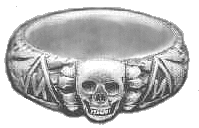
The ring was at first presented to
senior officers of the Old Guard who had displayed extraordinary
valiance and leadership skill in battle. Later, as the
entrance requirements of the undermanned SS were lowered,
so were those of the Totenkopfring. It was soon available
to any officer with 3 years service in the SS.
The runed design of the
ring reflects Himmler's interest for mythology
and the occult. The skull (or Totenkopf)
was the traditional symbol of the SS, taken
from other German and Prussian military units
of the past, The two Sieg (victory) runes
represent the lightning flash runes of the
Schutzstaffel, while the Hagall rune represents
the faith and camaraderie that was idealised
by the leaders of the organisation. The
Hakenkreuz or swastika was originally a rune meaning light and hope.
However, the SS liked to portray this as
another influential symbol of the power
of the Aryan race. The Heilzeichen, on the
rear of the ring, was a creation of the SS
designers rather than a historical rune.
It symbolises all the ideals of the SS,
from camaraderie to their belief that SS
men should sacrifice all for their brothers,
as is emphasised by the SS motto “Give
death and take death.”
At the end of the war, Himmler,
seeing the ring as a personification of
all he believed, had all the remaining rings
blast-sealed into a mountain near Wewelsburg,
where one of his significant castles was
situated. All rings were to be returned to
the Reichsfuehrer upon the bearer's death
or when they left the SS. Around 14,500
rings are thought to be in existence today,
and therefore are very rare, collectable
items, often reaching up to £4,500
in sales. Copies are widely available and
are very affordable and convincing. The rings
show the name of the bearer, the date of
presentation, and a facsimile of Himmler's
signature, plus the abbreviations. S Lb.
for “Seinen lieben” or “to
dear.”