Artur Seyss-Inquart
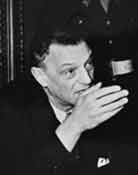
Within the Nazi conspiracy Seyss-Inquart became the expert manipulator and subjugator
of countries to be invaded or already invaded
by the Nazi conspirators, first of Austria,
later of Poland and The Netherlands. For the
benefit of the Nazi conspirators he enslaved
these countries, making them vassals of the
Nazi regime.
A. POSITIONS HELD BY SEYSS-INQUART.
(1) Positions Held by Artur Seyss-Inquart in the Order Set Forth
in the Indictment.
(a) Member of the NSDAP (Nazi Party), 13 March 1938 to 8 May 1945.
(b) General in the SS, 15 March 1938 to 8 May 1945.
(c) State Councillor of Austria, May 1937 to 12 February 1938.
(d) Minister of Interior and Security of Austria, 16 February 1938
to 11 March 1938.
(e) Chancellor of Austria, 11 March 1938 to 15 March 1938.
(f) Member of the Reichstag, April 1938 to 8 May 1945.
(g) Member of the Reich Cabinet, 1 May 1939 to 1945.
(h) Reich Minister without Portfolio, 1 May 1939 to September 1939.
(i) Chief of the Civil Administration of South Poland, early September
1939.
(j) Deputy Governor-General of the Polish Occupied Territory, 12
October 1939 to 18 May 1940.
(k) Reich Commissar for Occupied Netherlands 18 May 1940 to 8 May
1945. (2910-PS)
(2) Positions Held in Addition to Those Set Forth in the Indictment.
(a) Reich Governor of Austria, 15 March 1938 to 1 May 1939. (2910-PS)
(b) President of the German Academy, Munich, 1943. (3457-PS)
(3) Previous Occupations of Seyss-Inquart.
(a) Commissioned officer in a Tyrol-Kaiserjaeger Regiment of the
Austrian Army in World War I, 1914- 1918.
(b) Lawyer in Vienna, Austria. (3425-PS)
B. SEYSS-INQUART USED HIS POSITIONS AND INFLUENCE SO AS TO PROMOTE
THE NAZI SEIZURE AND CONSOLIDATION OF CONTROL OVER AUSTRIA.
(1) Seyss-Inquart was a member of the Nazi Party and held the rank
of General in the SS. Seyss-Inquart has admitted that he became
a member of the Nazi Party on 13 March 1938; that he was made a General
in the SS on 15 March 1938, and held both membership and rank until
8 May 1945. (2910-PS)
Seyss-Inquart, in a letter to Goering, on 14 July 1939, asserted that
he had been a member of the Nazi Party since 1931. The following is
an excerpt from that letter:
"Until July 1934, I conducted myself as a regular member of
the Party. And if I had quietly in whatever form paid my membership
dues, the first one according to a receipt, I paid in December 1931."
(2219-PS)
In a voluntary statement signed by Seyss-Inquart, with the advice of
his counsel, he discussed his affiliation with the Nazi Party as follows:
"I supported also the National Socialist Party as long as it
was legal, because it declared itself with particular determination
in favor of the Anschluss. From 1932 onward I made financial contributions
to this Party, but I discontinued financial support when it was declared
illegal in 1934." (3425-PS)
In contrast with the foregoing assertions of the defendant, Seyss-Inquart
wrote a letter to Heinrich Himmler on 19 August 1939 in which he confirmed
the-fact that he became a member of the Nazi Party in 1931 and also
stated that he continued his membership in the Nazi Party even after
it was declared illegal in Austria. The following is an excerpt from
that letter:
"Concerning my membership in the Nazi Party, I want to state
that I never was asked to enter the Nazi Party but I asked Dr. Kier
in December 1931 to take care of my relation to the Party. At that
time I saw the basis of the solution of the Austrian question only
in the Party. I wrote this already in the year 1929 to Dr. Neubacher
to adjust his hopes which he had put in the Austria-German Volksbund.
After that, I paid my membership fees and, as I remember, direct to
the Gau Wien. The payments were made even after the party was forbidden.
Some time later, I got in direct touch with the Ortsgruppe in Dornbach.
The membership fees were paid by my wife but the Blockwart couldn't
possibly have any doubt that those payments were for my wife and myself
since the amount of the fees, S 40 [40 Schillings] a month, was a
sure indication of this fact and I was treated in every respect as
a Party member. Besides that, I was, since 1932, a member of the Steirischen
Heimatschutzes Kammerhofer. In this organization I made every effort
to absorb the Steirische Heimatschutz in the Party and mainly on account
of my efforts, von Habicht declared that the members of the Steirische
Heimatschutz were members of the Party. That proves that I felt myself,
in every respect, as a member of the Party and I was regarded as belonging
to the Party and as I said before, already in December 1931."
(3271-PS)
(2) Seyss-Inquart, even before he became a member of the Nazi Party,
belonged to an organization conceived and founded upon principles which
later became those of the Nazi Party.
Seyss-Inquart has stated in writing that he had been a member of a
secret organization known as the "German Brotherhood" (Deutsche
Gemeinschaft). This is evidenced by the following excerpts from his
letter to Himmler of 19 August 1939:
"It must be known to you that at the time of the Black- Red
Coalition, there existed an extremely secret organization under the
name of 'German Community.' Here met all sorts of Nationalists and
Catholic elements who, at least at that time, were anti-Semitic and
anti- Marxists. Dr. Doelter, who was my office chief, was one of the
leaders of this association and through him I came into this movement.
Dolfuss was also active here. He was of my age and was a very active
anti-Semitic. It is through success of the activities of this organization
that the Black-Red Coalition was broken and the Marxists never came
back in the government. After the establishment of National Socialism,
this organization was dissolved." (3271-PS)
The secret organization, "German Brotherhood" (Deutsche Gemeinschaft),
was organized to promote the anti-Semitic and anti-Free Mason doctrines
later adopted by the Nazi Party. This fact is evidenced by Seyss-Inquart's
copy of the minutes of a meeting of this organization on 28 December
1918 and by it constitution and by-laws, a portion of which appear in
the following quotation:
"The purpose of this organization is the liberation of the German
people from Jewish influences, and combat against Jewry with all available
means. The organization is secret. Since a contact of the organization
with the public can't be avoided it has to be done under pretense
of unsuspicious purposes and without showing the actual set-up."
(3400-PS)
New members of this organization were required to make a sworn statement,
i.e.:
"As a German man, I assure with my honor, as far as I know,
there is no Jewish blood in my descendency. Furthermore, I am not
connected by marriage with a wife or other companion of Jewish descendency,
and I never will have relation with one of those. I am not a Free
Mason, I assure to be forever a good member of the Deutsche Gemeinschaft
and I will always represent the interest of the German people against
the Jewish people and I am willing to fight the Jewish people with
all my power, any place and at any time. I promise to obey all orders
and decrees of the leadership of the organization and to preserve
complete secrecy about their institution, about the persons of the
organization, and the events within it, as long as I live." (3400-PS)
New members were also asked the question: "In case you will be
accepted, are you willing to employ only Aryan physicians, attorneys,
and businessmen?" (3400-PS)
(3) Seyss-Inquart, after the Austrian Nazi Party was declared illegal
in July 194, posed as a non-member of the Nazi Party but continued to
support it in its activities, principles, and objectives in a subversive
manner.
Seyss-Inquart has stated that:
"Before the Anschluss, I worked for the legal, political activities
of the Austrian Socialists under the conditions laid down in the Austrian
Constitution. *** From 1932 onwards I made financial contributions
to this party but I discontinued financial support when it was declared
illegal in 1934. From July 1934 until the year 1936 I supported individual
National Socialists as lawyer and in collaboration with the welfare
work Langoth in Linz. From July 1936 onwards, I endeavored to help
the National Socialists to regain their legal status and finally to
participate in the Austrian Government. *** I was sympathetic towards
the efforts of the Austrian Nazi Party to gain political power and
corresponding influence because they were in favor of the Anschluss.
*** On 10 March 1938 I suggested to Chancellor Schuschnigg, as a solution
to the difficulties resulting from his plebiscite plan, that the National
Socialists be appointed to the Cabinet, after I became in May 1937
State Councillor and then on 16-2-1938 Minister of Interior and Security."
(3425-PS)
Seyss-Inquart was an official in the Austrian Government, yet he rendered
services, and physical and moral support to the illegal Austrian Nazi
Party during those years, knowing that the radical elements engaged
in terroristic acts.
"During this time, particularly after the Party was forbidden
in July 1934, I knew that the radical element of the Party was engaged
in terroristic activities, such as the attacks on railroads, bridges,
telephone communications, etc. I knew that the governments of both
Chancellors Dolfuss and Schuschnigg, although they held the same total
German viewpoint in principle, were opposed to the Anschluss then
because of the National Socialist regime in the Reich. I was sympathetic
towards the efforts of the Austrian Nazi Party to gain political power
and corresponding influence, because they were in favor of the Anschluss.
On the day of the unsuccessful 'putsch,' 25 July 1934, I was at my
home in Stannern near Iglau, Czechoslovakia. I learned later that
the murder of Chancellor Dolfuss on that day was the outcome of a
'putsch' plan, in which SS circles were mainly involved, to arrest
the Chancellor and put in an Austrian government with National Socialist
participation. Eight or ten days before this unsuccessful 'putsch'
Chancellor Dolfuss sent for me. We discussed the disturbances and
troubled state of affairs created in Austria by the radical element
of the Austrian National Socialists. I advised Chancellor Dolfuss
to make an arrangement with Hitler because the Austrian National Socialists
and even this radical element would obey Hitler's orders. I conjectured
-- later I found confirmation that these terroristic activities had
a certain support from the Reich. Chancellor Dolfuss told me he would
think the matter over and made a tentative future appointment for
a further discussion. I informed among others, also acquaintances,
of this conversation whom I knew had influence among the Austrian
National Socialists. About one week later Chancellor Dolfuss informed
me that at the moment he had no time for further discussion."
(3425-PS)
(4) Seyss-Inquart derived personal benefits and political power
as the result of the subversive manipulations and terroristic activities
of his fellow Nazi collaborators. He was appointed State Councillor
of Austria in May 1937, and Minister of the Interior and Security of
that country as the direct result of Nazi manipulation. These facts
he has admitted:
"My appointment as State Councillor was the result of an agreement
between Austria and Germany on 11 July 1936. My appointment as Minister
of the Interior and Security was one of the results of the conference
between Chancellor Schuschnigg and Hitler at Berchtesgaden on 2 December
1938." (425-PS)
Another result of the Berchtesgaden conference was that Austrian Nazis
were thereafter allowed openly to demonstrate their conviction, an advantage
which they exploited to the full.
"The Austrian National Socialists must certainly have taken
my appointment as Minister of Interior and Security as an indication
of their right to activity. Still more, however, the outcome of the
agreement of 12 February 1938 allowed them to demonstrate their convictions.
This right they utilized in more and more widespread demonstrations."
(7425-PS)
(5) Seyss-Inquart used his affiliation with the Nazis to promote
the absorption of Austria into the Greater German Reich according to
plan as conceived by his fellow Nazi conspirators. Seyss-Inquart
had had a continuous and constant interest in the union of Austria and
Germany for twenty years, and during all that time worked, planned,
and collaborated with others until the union became an accomplished
fact.
"In 1918 I became interested in the Anschluss of Austria with
Germany. From that year on I worked, planned, and collaborated with
others of a like mind to bring about a union. *** It was my desire
to effect this union of the two countries -- in an evolutionary manner
and by legal means. Among my Austrian collaborators were Dr. Neubacher,
City Councillor Speiser, the University Professor Hugelmann, and Dr.
Wilhelm Bauer, Professor Wettstein and others. Later, during the rise
of National Socialism, Dr. Friedrich Rainer, Dr. Jury, Glaise-Horstenau,
Major Klausner, Dr. Muehlmann, Globotschnigg, and others. *** After
I became State Councillor, I discussed several tires with von Papen,
the German Ambassador, the possibilities of an understanding between
the Austrian government and the Austrian National Socialists, respectively
the Reich. We did not talk of the Anschluss as an actual program.
However, we were both of the opinion that a successful understanding
would bring about in the course of time the Anschluss by evolutionary
means in some form. The last time I spoke to von Papen was in January
1938 in Garmisch where I met him by chance." (3425-PS)
Seyss-Inquart contributed his efforts to revive the Austrian Nazi Party
after the unsuccessful "putsch" of 25 July 1934, and to provide
relief for the families of arrested and condemned Nazis. He has described
these activities in the following words:
"The effect of the 'Putsch' was a complete catastrophe to the
National Socialist Camp. Not merely the leaders, but party members
were arrested in so far as they did not escape; the confiscation of
their fortunes was announced; the revolt which led to military actions
in Steiriermark, Karnten and Oberoesterreich did cost victims; the
political management was seriously compromised by the Nazis and above
all, a most sinister looking situation was created in regard to foreign
politics. In any case, the idea of a union had suffered a severe setback.
was in agreement about the effect with Dr. Neubacher, and it was our
desire to assist easing the tension. Following this situation I felt
urged to take up politics beyond the question of the 'Anschluss.'
*** The former National delegate to the 'Langoth' in Linz was working
with Rheintaller. Dr. Neubacher and myself contacted this circle and
met there some other men whose names I have forgotten, but who later
did not play a particular role. After some time, the lawyer applicant
from Linz, Dr. Kaltenbrunner, joined this circle. He was said to be
an SS man. The main activities consisted in organizing an institution
to succor the needy families of those arrested and condemned Nazis.
*** As matters calmed down, the Austrian National Socialists collected
themselves again into an illegal party, the organization was built
up for better or worse according to the old schedule, those who returned
from the Reich were considered to be more 'in the know' and authoritative.
The institution of succor, 'Langoth,' remained outside the party organization.
But here were also men in the Nazi circles who considered an absolute
dependence on the Reich as politically wrong and endeavored for an
independent Austrian National Socialist Party. In effect, Dr. Rainer
from Karnten belonged to those, and by his influence the future Gauleiter
Klausner who is now dead; also Globotschnigg was in it, though I doubt
he was sincerely convinced, and also others. Dr. Neubacher took a
keener interest in political affairs and entered into relation-ship
with the proper Party circles." (3254-PS)
The defendant submitted his plans to Hitler, Hess, and Goering for
their approval, and contacted other German Nazis.
"After my appointment as State Councillor, Wilhelm Keppler,
the German Secretary of State for Austrian affairs, arranged a visit
for me with Hess and Goering. I explained my intentions and plans
to them, namely, the attainment of the legal activity for the Austrian
National Socialist, independent of the Reich Party. Hess expressed
his interest and said to me among other things: he regretted that
I was not one of the original 'old fighters.' I believe that at that
time Goering had already established direct connections with the Austrian
State Secretary, Guido Schmid. After my appointment as Minister of
Interior and Security of Austria, I went to Berlin to visit Hitler.
I arrived in Berlin on 17-2-1938 where I was met by Keppler who took
me to Himmler. This visit was not anticipated in my program. Himmler
wanted to talk over police matters, I informed him, however, that
I was not conversant to speak about them. I did not follow the suggestions
which he made. I greeted Hitler with raised hand -- permissible after
the agreement of 2-12 -- advised him, however, immediately that as
Austrian Minister, my responsibility lay with Austria. I explained
to Hitler my plans, namely: I was to be the living guaranty for Dr.
Schuschnigg of the evolutionary way. The Austria National Socialists
must only conduct their activities according to the Austrian Constitution
and on those lines find their way to the Reich; they must not make
any totalitarian claim nor conduct a cultural struggle. The leadership
of the Austrian National Socialists must be independent of the Reich
and remain responsible to Austria. I would have, as Minister of Security
to oppose any kind of illegal activity. Against this the Austrian
National Socialist would be permitted full freedom of activity to
work for the closest cooperation of Austria and Germany. Hitler agreed
to my plans but expressed certain doubts whether Dr. Schuschnigg would
be willing to go so far. During my conference with Hitler, Keppler
and Ribbentrop waited in the ante-room of Hitler's office." (3425-PS)
Seyss-Inquart's fellow Nazi conspirators regarded his position as Councillor
of State in the Austrian Government as most important to them, because
he had a mandate from the German Nazis in power, which he was attempting
to carry out. Because his negotiations with Chancellor Schuschnigg seemed
to be running aground, Seyss-Inquart sent a report of that fact to Keppler
by courier, stating that he felt compelled to return his mandate, and
expressing a desire to discuss the matter before acting accordingly.
Keppler immediately sought advice from Goering in a letter dated 6 January
1938. On that same day Goering's secretary was instructed to telephone
instructions to Keppler to do anything to avoid the resignations of
Councillor of State Dr. Seyss-Inquart and State Minister Glaise von
Horstenau. Keppler received this telephone message on 7 January 1938,
and on 8 January 1938 wrote a letter to Seyss-Inquart informing him
of Goering's instructions and relaying Goering's request not to give
up the mandate under any circumstances without discussing the matter
with Goering. (5473-PS; 3397-PS)
Despite assertions, in statements since his arrest and indictment,
to the effect that he desired a union of Austria and Germany in an evolutionary
manner and by legal means, Seyss-Inquart has on other occasions made
statements to the contrary. His letter of 14 July 1939 to Goering is
particularly illuminating on this point:
"I told myself in July 1934 that we must fight this clerical
regime on its own ground in order to give the Fuehrer a chance to
use whatever method he desires. I told myself that this Austria was
worth a mass. I have stuck to this attitude with an iron determination
because I and my friends have had to fight against the whole political
church, and Free Masonry, the Jewry, in short, against everything
in Austria. The slightest weakness which we might have displayed would
undoubtedly have led to our political annihilation; it would have
deprived the Fuehrer of the means and tools to carry out his ingenious
political solution for Austria as became evident in the days of March
1938. I have been fully conscious of the fact that I am following
a path which is not comprehensible to the masses and also not to my
party comrades. I have followed it calmly and would without hesitation
follow it again because I am satisfied that at one point I could serve
the Fuehrer as a tool in his work, even though my former attitude,
even now, gives occasion to very worthy and honorable Party comrades
to doubt my trustworthiness. I have never paid attention to such things
because I am satisfied with the opinion which the Fuehrer and the
men close to him have of me." (2219-PS)
Another statement of the defendant, which throws some light on this
point, is found in his letter to Himmler dated 19 August 1939:
"On 8 November 1938, the Fuehrer invited several political leaders
for supper. The Fuehrer asked me to be next to him. We discussed the
situation in Ostmark. I told him that in accordance with his order,
we started to dissolve the competence of the Austrian government by
giving the powers partly to the Gauen and partly to the central leaders.
But there still would remain certain affairs which would be common
for all Gauen." (5271-PS)
Furthermore, Seyss-Inquart has made the following statement:
"I was happy that the Anschluss of Austria with the German Reich
had come at last after so many vain endeavors since 1918 because I
was in favor of the Anschluss of Austria with the Reich under many
conditions. I was aware at least to a certain extent of the harshness
of the National Socialist regime, but I was of the opinion that these
two German countries belonged together and that the German people
should solve their own internal affairs and difficulties. I was convinced
that the harshness of the National Socialist regime chiefly because
of its achievement of the National aim -- cancellation of discriminatory
peace treaties and achievement of the right of self- determination
would in time be surmounted." (425-PS)
The subversive machinations of the Austrian Nazis to bring about the
absorption of Austria by the Greater German Reich was described in detail
by Dr. Friedrich Rainer, a leading Austrian Nazi and a collaborator
of Seyss-Inquart who became one of Hitler's Gauleiters, in a report
prepared by him and forwarded to Buerckel. A copy of this report accompanied
by a letter of transmittal was later sent to Seyss-Inquart by Dr. Rainer.
In substance, the report related how the Nazi party lost a parliamentary
battle in 1933, continued its efforts to force admission of its representatives
into the Austrian government, and finally flowered into the unsuccessful
"Putsch" of July 1934, which, in effect, destroyed the Nazi
organization. Following the unsuccessful "Putsch" Hitler liquidated
the first stage of the battle, and instructed Franz von Papen to restore
normal relationships between the two countries. Accordingly, a new method
of political penetration was adopted. The result was that Hinterleitner,
an Austrian Nazi got in touch with the lawyer Seyss-Inquart, who had
connections with Dr. Wachter originating from Seyss-Inquart's support
of the July uprising. Seyss-Inquart also had a good position in the
legal field and especially well established relations with Christian
Social politicians. Dr. Seyss-Inquart came from the ranks of the "Styrian
Heimatschutz" and had become a Nazi party member when the entire
"Styrian Heimatschutz" was incorporated in the NSDAP. The
reason for utilizing Seyss- Inquart appears in the following excerpt
from the covering letter which accompanied Dr. Rainer's report to Reich
Commissar Gauleiter Josef Buerckel, dated 16 July 1939:
"I think the main reason for the fact that the person of Dr.
Seyss-Inquart seemed to Hitler and to public opinion to have stepped
in the limelight in those March days, was that no position existed
in the party which one might have presented oneself to the public,
and that there was no man who had the guts to let himself be presented.
The actual reason was that the party leadership had to remain secret
during the whole illegal fight, secret even from the Reich German
public." 812-PS)
Thus it is clear why Seyss-Inquart was surreptitiously a member of
the Austrian Nazi Party after it was declared illegal in 1934.
Dr. Rainer goes on to report that full recognition of the party leadership
was given by Seyss-Inquart and also that the defendant was in permanent
contact with Captain Leopold, who became a member of the staff of Hess.
After Hinterleitner was arrested, Dr. Rainer became his successor as
leader of the Austrian Nazi Party, and, on 16 July 1936, Dr. Rainer
and Globocnik visited Hitler at Obersalzburg, where they received a
clear explanation of the situation and the wishes of the Fuehrer. Subsequently,
on 17 July 1936, all illegal Gauleiters met in Anif near Salzburg, where
they received a complete report from Dr. Rainer on the statement of
the Fuehrer and his political instructions for carrying out the fight.
After the agreement between Germany and Austria on 11 July 1936, Hitler
appointed Wilhelm Keppler as Chief of a mixed commission to supervise
the execution of the agreement. At the same time Keppler was given full
authority for the Nazi Party in Austria. (812-PS)
(6) The activities of Seyss-Inquart and his fellow Nazi coconspirators
and collaborators forced the then Austrian government into a critical
situation and a struggle for survival. As the result of the plans,
maneuvers, and disturbances created by the Nazis in Austria, Schuschnigg,
Chancellor of Austria, accompanied by his State Secretary, Guido Schmid,
conferred with Hitler at Berchtesgaden on 12 February 1938. Dr. Muehlmann
was also present but not as a member of the Schuschnigg delegation.
At this meeting the possibilities for military action by Germany against
Austria were demonstrated to the Chancellor. The ultimate result was
that Chancellor Schuschnigg had no choice but to accept the demands
of Hitler that the Austrian Nazi Party be legalized; that amnesty be
granted to Austrian Nazis already convicted for illegal activities;
and that Seyss-Inquart be appointed Minister of the Interior and Security
in the Austrian cabinet, (2995-PS; 3254-PS; 3425-PS; 2469-PS; 2464-PS)
A few days after the Berchtesgaden meeting of Hitler and Schuschnigg,
and immediately after his appointment as Minister of the Interior and
Security of Austria, Seyss- Inquart went to Berlin for a conference
with Hitler. Upon arrival in Berlin he was met by Keppler, Hitler's
special delegate on Austrian affairs, who took him to Himmler. After
a short conference with Himmler, the defendant was conducted to Hitler,
to whom he gave the Nazi salute and with whom he had a conference lasting
two hours and ten minutes. Foreign Minister von Ribbentrop and Keppler
waited in the ante- chamber during the conference. Seyss-Inquart first
offered Hitler an explanation for greeting him with the Hitler salute,
by saying: "I consider him as the Fuehrer of the German people
who led us out of the discriminations of the peace treaties." During
the conference, he rendered a report to Hitler concerning the Austrian
situation since June of 1934 and presented his own program for Hitler's
approval. Hitler expressed his approval of the plan but told Seyss-
Inquart that he doubted whether Chancellor Schuschnigg would be willing
to go so far. It seems clear that Hitler's doubt concerning Schuschnigg's
approval of the Seyss-Inquart plan referred solely to Seyss-Inquart's
proposal to allow Austrian Nazis to "conduct their activities according
to the Austrian Constitution and on those lines find their way to the
Reich," because all other portions of his plan had previously been
adopted as a result of the Berchtesgaden Agreement. (3254-PS; 3425-PS;
2484-PS)
Seyss-Inquart has asserted that, upon his return to Vienna after his
conference with Hitler, he reported to Chancellor Schuschnigg the content
of his discussion and urged the Chancellor to make a decision about
the Austrian National Socialist question. He then attended rallies of
the Austrian National Socialists held in various places in Austria to
inform them of the content of his conference with Hitler. Two of the
principal meetings were held at Graz and Linz (3425-PS; 3254-PS). Considerable
doubt is cast upon the truth of Seyss-Inquart's assertions that he reported
the contents of his conference with Hitler to Chancellor Schuschnigg
and in public meetings of the Austrian Nazis, by a statement contained
in a letter written by Seyss-Inquart to Himmler on 19 August 1939. The
statement is as follows:
"I had a conversation of over two hours with the Fuehrer on
17 February 1938, in which I explained to him my point of view. I
would only be able to make statements about the content of this conversation
if the Fuehrer would grant me permission. I left this discussion as
a very sincere man and with a feeling of great happiness to be of
help to the Fuehrer." (3271- PS)
(7) Finally Chancellor Schuschnigg determined to go before the people
for a decision on the question of Austrian independence. Chancellor
Schuschnigg planned to hold a plebiscite on that precise question and
fixed 13 March 1938 as a date upon which the plebiscite would be held.
The Chancellor took Seyss-Inquart into his confidence and discussed
the matter of the plebiscite with him. The Chancellor requested Seyss-Inquart
to keep the matter a secret until noon of the next day, and the defendant
promised to do so. Thereafter, Seyss-Inquart prepared a letter to Schuschnigg
objecting to the plebiscite on constitutional grounds and alleging that
the manner in which the plebiscite was to be held would not allow the
Austrians to express their own desires. Seyss-Inquart admits that a
copy of his letter was delivered to Hitler in Berlin by Globotschnigg.
(254-PS; 425-PS)
On 9 March 1938, a meeting of the Austrian Nazis was held because they
had learned, through an illegal information service, that a plebiscite
was to be held. Dr. Rainer describes this meeting in the following
"The 'Landesleitung' received word about the planned plebiscite
through illegal information services on 9 March 1938 at 10 a. m. At
the session, which was called immediately afterwards, Seyss-Inquart
explained that he had known about this information only a few hours,
but that he could not talk about it because he had given his word
to keep silent on this subject. But during the talks he made us understand
that the illegal information we received was based on truth, and that
in view of the new situation, he had-been cooperating with the 'Landesleitung'
from the very first moment. Klausner, Jury, Rainer, Globotschnigg,
and Seyss- Inquart were present at the first talks which were held
at 10 a. m. There it was decided that first, the Fuehrer had to be
informed immediately; secondly, the opportunity for the Fuehrer to
intervene must be given to him by way of an official declaration made
by Minister Seyss-Inquart to Schuschnigg; and thirdly, Seyss-Inquart
must negotiate with the government until clear instructions and orders
were received from the Fuehrer. Seyss-Inquart and Rainer together
composed a letter to Schuschnigg, and only one copy of it was brought
to the Fuehrer by Globocnik, who flew to him on the afternoon of 9
March 1938."
Seyss-Inquart himself admits that he attended this meeting, which was
held at the Regina Hotel, Vienna (3425-PS; 3254- PS). The defendant
was informed at this meeting that he would receive a letter from Hitler
by messenger the next morning. (3425-PS; 3254-PS).
Early on the morning of 11 March 1938, Seyss-Inquart received Hitler's
letter. He describes it as having contained several erroneous statements
and containing a demand that a decision should be arrived at before
noon; that in case of rejection the Reich Government would denounce
the agreement of 12 February 1938 and military action must be understood.
According to Seyss-Inquart, Hitler also gave expression to his belief
that there would be disturbances in Austria if Chancellor Schuschnigg
would not relent and that the Reich would come to the help of Austria
if Austria demanded go. Glaise-Horstenau arrived by plane in Vienna
early that same morning with the information that Berlin was greatly
excited and that military steps were in preparation. (3254-PS; 3425-PS)
(8) Seyss-Inquart then proceeded to carry out Hitler's orders and
to fulfill the plans made by himself and his fellow Nazi conspirators. Dr. Rainer in his report to Reich Commissar Gauleiter Josef Buerckel,
and in his covering letter dated 6 July 1939, related his version of
the sequence of events during this period and described the precise
role of Seyss-Inquart, as he viewed it. He complained about the fact
that Hitler and the general public seemed to give Seyss-Inquart all
the credit for the annexation of Austria by Germany. The following quotation
from this letter and report is significant:
"Soon after taking over in Austria, Klausner, Globocnik, and
I flew to Berlin to report to Hitler's deputy, Hess, about the events
which led to our taking over the government. We did this because we
had the impression that the general opinion, perhaps also Hitler's
own, was that the liberation depended more on Austrian matters of
state rather than the Party. To be more exact, Hitler especially mentioned
Dr. Seyss- Inquart alone; and public opinion gave him alone credit
for the change and thus believed him to have played the sole leading
role." (812-PS)
Dr. Rainer then proceeded to describe just what happened in those critical
days, and outlined the final instructions given by him for Friday, 1
March 1938. He explained that three situations might develop within
the following days:
"1st Case: The plebiscite will not be held. In this case, a
great demonstration must be held.
"2nd Case: Schuschnigg will resign. In this case, a demonstration
was ordered in taking over the government power.
"3rd Case: Schuschnigg will take up the fight. In this case,
all party leaders were ordered to act upon their own initiative, using
all means to capture the position of power." (812-PS)
Dr. Seyss-Inquart took part in these talks with the Gauleiters.
"On Friday, 11 March, the Minister Glaise-Horstenau arrived
in Vienna after a visit with the Fuehrer. After talks with Seyss-Inquart
he went to see the chancellor. At 11:30 a.m. the 'Landesleitung' had
a meeting at which Klausner, Rainer, Globocnik, Jury, Seyss-Inquart,
Glaise-Horstenau, Fishboeck and Muehlmann participated. Dr. Seyss-Inquart
reported on his talks with Dr. Schuschnigg which had ended in a rejection
of the proposal of the two ministers.
"In regard to Rainer's proposal, von Klausner ordered that the
government be presented with an ultimatum, expiring at 1400 hours,
signed by legal political, 'Front' men, including both ministers and
also State Councillors Fishboeck and Jury, for the establishment of
a voting date in three weeks and a free and secret ballot in accordance
with the constitution.
"On the basis of written evidence which Glaise- Horstenau had
brought with him, a leaflet, to be printed in millions of copies,
and a telegram to the Fuehrer calling for help, were prepared.
"Klausner placed the leadership of the final political actions
in the hands of Rainer and Globocnik. Schuschnigg called a session
of all ministers for 2:00 p.m. Rainer agreed with Seyss-Inquart that
Rainer would send the telegram to the Fuehrer and the statement to
the population at 3:00 p.m. and at the same time he would start all
necessary actions to take over power unless he received news from
the session of the ministers' council before that time. During this
time all measures had been prepared. At 2:30 Seyss-Inquart 'phoned
Rainer and informed him that Schuschnigg had been unable to take the
pressure and had recalled the plebiscite but that he had refused to
call a new plebiscite and had ordered the strongest police measures
for maintaining order. Rainer asked whether the two ministers had
resigned, and Seyss-Inquart answered: 'No.' Rainer informed the 'Reichskanzlei'
through the German Embassy, and received an answer from Goering through
the same channels that the Fuehrer will not consent to partial solutions
and that Schuschnigg must resign. Seyss-Inquart was informed of this
by Globocnik and Muehlmann; talks were had between Seyss- Inquart
and Schuschnigg: Schuschnigg resigned. Seyss- Inquart asked Rainer
what measures the party wished taken. Rainer's answer: Reestablishment
of the government by Seyss-Inquart, legalization of the party, and
calling up of the SS and SA as auxiliaries to the police force. Seyss-Inquart
promised to have these measures carried out, but very soon the announcement
followed that everything might be threatened by the resistance of
Miklas. Meanwhile word arrived from the German Embassy that the Fuehrer
expected the establishment of a government under Seyss-Inquart with
a national majority, the legalization of the party, and permission
for the legion to return, all within the specified time of 7:30 p.m.;
otherwise, German troops would cross the border at 8:00 p.m. At G:00
p.m. Rainer and Globocnik, accompanied by Muehlmann, went to the Chancellor's
office to carry out this errand.
"Due to the cooperation of the above-mentioned people with group
leader Keppler and other officials of the Reich and due to the activities
of other contact-men in Austria, it was possible to obtain the appointment
of Seyss-Inquart as 'Staatsrat' [councillor of State] in July 1937.
Due to the same facts, the Chancellor Dr. Schuschnigg was forced to
take a new so-called 'satisfactory action'. Through all this a new
and stronger political position was won in the Austrian system. The
National-Socialist Party became acceptable again in the political
field and became a partner with whom one had to negotiate, even when
it was not officially incorporated into internal Austrian political
developments. This complicated political maneuver, accompanied by
the steadily increasing pressure from the Reich, led to talks between
the Fuehrer and Schuschnigg at the Obersalzberg. Here Gruppenfuehrer
Keppler presented the concrete political demands of the fighting underground
movement, which he estimated according to his personal experiences
and the information he received. The results of these talks were the
right of a free acknowledgment of the National Socialist movement
on the one hand and the recognition of an independent Austrian state
on the other hand, as well as the appointment of Seyss-Inquart as
Minister of Interior and Public Safety, as a person who will guarantee
to both sides the proper carrying out of the agreements. In this way
Seyss-Inquart occupied the key position and was in the center of all
obvious political actions. A legal base in the government was won
for the party. This resulted in a paralysis of the 'system apparatus'
[Schuschnigg government] at a time when a revolution needed to be
carried out. Through this, the basis for a new attack on the Schuschnigg
government was won.
"Situation: Miklas negotiated with Ender for the creation of
a government which included, blacks, reds and National Socialists,
and proposed the post of Vice- Chancellor to Seyss-Inquart. The latter
rejected it and told Rainer that he was not able to negotiate by himself
because he was personally involved, and therefore a weak and unpleasant
political situation might result. Rainer negotiated with Zernette.
Director of the cabinet Huber, Guido Schmid, Glaise-Horstenau, Legation
Councillor Stein, Military Attache General Muffe, and the 'Gruppenfuehrer'
Keppler, who had arrived in the meantime, were also negotiating. At
7:00 Seyss-Inquart entered the negotiations again. Situation at 7:30
p.m.: Stubborn refusal of Miklas to appoint Seyss-Inquart as Chancellor;
appeal to the world in case of a German invasion.
"Gruppenfuehrer Keppler explained that the Fuehrer did not yet
have an urgent reason for the invasion. This reason must first be
created. The situation in Vienna and in the country is most dangerous.
It is feared that street fighting will break out any moment because
Rainer ordered the entire party to demonstrate at 3 o'clock. Rainer
proposed storming and seizing the government palace in order to force
the reconstruction of the government. The proposal was rejected by
Keppler but was carried out by Rainer after he discussed it with Globocnik.
After 8:00 p.m. the SA and SS marched in and occupied the government
buildings and all important positions in the city of Vienna. At 8:30
p.m. Rainer, with the approval of Klausner, ordered all Gauleiters
of Austria to take over power in all eight 'gaus' of Austria, with
the help of the SS and SA and with instructions that all government
representatives who try to resist should be told that this action
was taken on order of Chancellor Seyss-Inquart.
"With this, the revolution broke out, and this resulted in the
complete occupation of Austria within three hours and the taking over
of all important posts by the party ***.
"The seizure of power was the work of the party supported by
the Fuehrer's threat of invasion and the legal standing of Seyss-Inquart
in the government. The national result in the form of the taking over
of the government by Seyss-Inquart was due to the actual seizure of
power by the party on one hand, and the political efficiency of Dr.
Seyss-Inquart in his territory on 1;he other; but both factors may
be considered only in the relation to the Fuehrer's decision on 9
March 1938 to solve the Austrian problem under any circumstances and
the orders consequently issued by the Fuehrer." (812-PS)
Seyss-Inquart's own story of the events on 11 March 1938 is not fundamentally
different, although he does show a marked tendency to minimize his role
in the planning, precipitating, and accomplishment of the annexation
of Austria by Germany, in a statement signed by him after his arrest
and indictment:
"At 10 o'clock in the morning Glaise-Horstenau and I went to
the Bundes Chancellery and conferred for about two hours with Dr.
Schuschnigg. We told him of all that we knew, particularly about the
possibility of disturbances and preparations by the Reich. The Chancellor
said that he would give his decision by 1400 hours. While I was with
Glaise-Horstenau and Dr. Schuschnigg, I was repeatedly called to the
telephone to speak to Goering. He informed me, (the demands of the
Reich steadily increasing) that the agreement of 2/12 had been cancelled,
and demanded Dr. Schuschnigg's resignation and my appointment as Chancellor.
I delivered this information verbally to Dr. Schuschnigg and withdrew
from the conference.
"In the meantime Keppler arrived from Berlin and had a conference
in the Bundes Chancellery, I believe also with President Miklas. The
latter refused to concede to the demands and sought to find various
other solutions. When Keppler arrived from Berlin he showed me the
contents of a telegram which I, as leader of the provisional Austrian
Government, was to send to Hitler and in which I was to request sending
of German troops to Austria to put down disorders. I refused as I
did not want to establish myself as head of a provisional government,
and there were no disorders in Austria. Keppler repeatedly urged me
about the telegram. Around 6 p.m. I told him that he knew my standpoint
and should do what he wished with Berlin. Keppler, as I have been
able to confirm from records available, understood my answer and did
not send off the telegram at that time. Around 7:30 p.m. a frontier
police post announced that German troops were crossing the frontier.
Thereupon Dr. Schuschnigg gave his well known farewell speech over
the radio. Upon-requests from various sides I followed with a speech
over the radio, stating that I was still functioning as Minister of
Interior and Security, requesting preservation of peace and order,
and gave directions that no resistance should be offered.
"As I am able to gather from the records available, I was again
requested about 10 p.m. to give my sanction to another somewhat altered
telegram, about which I informed President Miklas and Dr. Schuschnigg.
Finally President Miklas appointed me Chancellor and a little while
later he approved of my proposed ministers." (3425-PS)
However, Seyss-Inquart displayed undue modesty in this statement. His
letter to Himmler indicates how active he was on 11 March 1938, and
reveals that he was not satisfied with making demands upon Chancellor
Schuschnigg, but also handed an ultimatum to President Miklas:
"It is only possible that Buerckels made a statement that in
the critical hours it was hard to find me.
After I had handed an ultimatum to Miklas which was respited until
5:45 p.m. I took a recess of about a half hour to catch some fresh air.
I conceded that I was, in a way, exhausted from the things which happened
just a few hours before that and I tried to find recreation in the fresh
air. Besides that I planned to take a look at the situation on the streets.
Furthermore, I wanted to make a phone call to Berlin, not from the Chancellery,
but from some other place. Phone calls from the Chancellery were always
tapped whereas they were only sometimes tapped from other places. I
was sure they didn't need me until 5:30 p.m., because the men of the
old system would not make a decision a second earlier than they had
to." (3271-PS)
A stenographic transcript of Goering's telephone conversation with
Seyss-Inquart confirms the fact that Seyss- Inquart was ordered to demand
Chancellor Schuschnigg's resignation and the appointment of himself
as Chancellor. (2949-PS)
This stenographic record of Goering's conversations also reveals that
Seyss-Inquart had an agent keep in contact with Goering during the negotiations
with Chancellor Schuschnigg. Seyss-Inquart was given an order by Goering
through this agent to report by 7:30 p.m., 11 March 1938, that he had
formed a new government. He was informed that the foreign political
aspect would be handled exclusively by Germany and that Hitler would
talk with him about this matter at a future date.
In addition the stenographic transcript of these telephone conversations
show that the selection of individual members of the cabinet of the
new government to be established by Seyss-Inquart was to be made by
the Nazi conspirators in Berlin. (2949-PS)
At 1726 hours on the night of 11 March 1938, Seyss-Inquart reported
to Goering by telephone as ordered. He reported that President Miklas
had accepted the resignation of Chancellor Schuschnigg but wanted to
appoint a man like Ender to the Chancellorship. He further reported
his suggestion to the President that the Chancellorship be entrusted
to him -- Seyss-Inquartand also reported that "We have ordered
the SA and the SS to take over police duties." Thereupon Goering
ordered Seyss-Inquart to go with Lt. Gen. Muff to President Miklas and
inform him that if the demands were not met immediately German troops,
already advancing to the frontier, would invade Austria that night and
Austria would cease to exist. An audience with the President was to
be demanded. The invasion would be stopped only if President Miklas
entrusted Seyss-Inquart with the Chancellorship. Seyss-Inquart was also
instructed to call out the National Socialists of Austria all over the
country, because Austrian Nazis should even then be in the streets.
Seyss-Inquart was to report again at 7:30 p.m. (2949-PS)
The telegram, already prepared, asking Hitler to send German troops
into Austria, over the defendant Seyss-Inquart's signature, was transmitted
as ordered and agreed upon. (2463- PS)
Even before Seyss-Inquart received his appointment as Chancellor of
Austria he dispatched a telegram using that title. An affidavit of August
Eigruber states as follows:
"On the evening of 11 March 1938 at between 8 and 9 o'clock
p.m. he received two telegrams; one of which came from Dr. Seyss-Inquart,
as Bundes Chancellor of Austria, and the other from one Dr. Rainer;
that the telegram from Dr. Seyss-Inquart appointed the affiant as
temporary Landeshauptmann in Upper Austria; and that the telegram
from Dr. Rainer appointed the affiant temporary leader of the National
Socialist Party in Upper Austria." (2909-PS)
Schuschnigg presented his resignation, which was accepted by President
Miklas. The appointment of Seyss-Inquart as Chancellor came late on
the evening of 11 March 1938. (2465- PS)
(9) Having infiltrated into the Austrian Government of Chancellor
Schuschnigg according to plan, Seyss-Inquart exploited his opportunities
to carry out the plan to is ultimate conclusion, i.e. German annexation
of Austria. The first act of Seyss-Inquart as the new Chancellor
of Austria was to hold a telephone conversation with Hitler early in
the morning of 12 March 1938. He has described the substance of this
telephone conversation as follows:
"During the morning of 12 March I held a telephone conversation
with Hitler in which I suggested that while German troops were entering
Austria, Austrian troops as a symbol should march into the Reich.
Hitler agreed to this suggestion and we agreed to meet in Linz, Upper
Austria, later on that same day." (3425-PS)
Thereafter, on 12 March 1938, Seyss-Inquart greeted Hitler on the balcony
of the City Hall of Linz, Upper Austria. In his ensuing speech, Seyss-Inquart
announced that Article 88 of the Treaty of St. Germain, which provided
that "the independence of Austria is inalienable otherwise than
with the consent of the Council of the League of Nations," was
no longer operative.
"I then flew to Linz with Himmler, who had arrived in Vienna
from Berlin. I greeted Hitler on the balcony of the City Hall, and
said that Article 88 of the Treaty of St. Germain was now inoperative."
(3425-PS; L-231)
In his memorandum entitled "The Austrian Question" Seyss-
Inquart describes his meeting with Hitler as follows:
"In the afternoon, I flew with Himmler to Linz and drove then
to meet Hitler. Hitler entered Linz in the evening. I never saw such
an enthusiasm. The welcome was spontaneous and of no precedence. In
my (welcome) speech I declared that Article 88 of the St. Germain
Treaty was no longer binding." (3254-PS; 2485-PS)
Seyss-Inquart then drove back to Vienna on the morning of 13 March
1938. His Secretary of State for Security begged that he be allowed
to resign, a decision he reached as a result of a conversation with
Himmler, which had caused him to fear for his own personal welfare.
Seyss-Inquart then nominated Kaltenbrunner for State Secretary for Security,
and the nomination was accepted by President Miklas. About noon State
Under Secretary Stuckart of the German Reich Ministry of the Interior
brought a proposal for a reannexation act uniting Austria to Germany,
and announced Hitler's wish for prompt execution of it. Seyss-Inquart
then called a meeting of his Council of Ministers, and on his proposal
the council adopted the act. (3254-PS)
Seyss-Inquart, realizing that if the President of Austria resigned
his office, then he, Seyss-Inquart, would be the successor, went to
President Miklas with the information about the action of the Council
of Ministers. Seyss-Inquart describes this meeting with President Miklas
as follows:
"In the case where the Bund President would, for any reason,
either have resigned his functions or be, for some time, impeded in
fulfilling them, his prerogatives were to go over to the Bund Chancellor,
I went to the Bund President with Dr. Wolff. The President told me
that he did not know whether this development would be of welfare
to the Austrian Nation, but that he did not wish to interfere and
preferred to resign his functions, so that all rights would come into
my hands, according to the Constitution. The possibility of my dismissal
or resignation were only slightly mentioned and recognized as inopportune
in the prevailing situation." (3254-PS)
President Miklas then resigned and Seyss-Inquart succeeded to his office.
(2466-PS)
Thereafter Seyss-Inquart signed the Act uniting Austria with Germany
and hurried back to Linz to report this news to Hitler: "Then there
were some letters exchanged between the Bund President and myself, confirming
our conversation and his retirement. Thereafter I drove to Linz, where
I arrived around mid-night and reported to the Fuehrer the accomplishment
of the Anschluss Law. Hitler was very much impressed by it; for a while
he remained quiet, then tears dropped from his eyes down his cheeks.
He said then that he was especially happy because his Motherland had
achieved her annexation to the Reich without any shedding of blood."
(3254-PS)
On 14 March 1938 Hitler entered Vienna. On 15 March 1938 there was
a public demonstration in Vienna- and Hitler introduced Seyss-Inquart
as "Reich Statthalter for Austria." Hitler then put him in
charge of the Civil Administration of Austria, while political matters
were assigned to Gauleiter Josef Buerckel, who shortly thereafter was
made Reich Commissar for the Anschluss. (3425-PS)
(10) Despite Seyss-Inquart's modesty since arrest and indictment,
his fellow Nazi conspirators recognized the importance of his part in
the Austrian Anschluss.
Goering made a speech in Vienna on 26 March 1938 in which he said:
"At this moment [announcement of the plebiscite in Austria it
has been established that now the decision really came. A complete
unanimity between the Fuehrer and the N.S. confidants inside of Austria
existed. According to their opinion also the hour of action had come,
but they thought they could not use any more democratic methods in
negotiations and they took the law of action in their own strong hand
and forced the others to retreat. If the N.S. rising succeeded so
quickly and thoroughly without bloodshed, it is first of all due to
the intelligent and decisive firmness of the present Reichsstatthalter
Seyss-Inquart and his confidants. But this too proved the correctness
of the previous continued politics because if our confidants had not
been in the government, this whole course of events would not have
been possible." (3270-PS)
According to Dr. Rainer, Hitler and the general public gave Seyss-Inquart
credit for playing the leading role in the annexation of Austria by
Germany. This is evidenced by the covering letter' written by Dr. Rainer,
dated 6 July 1939, to Reich Commissar Gauleiter Josef Buerckel:
"We had the impression that the general opinion, perhaps also
Hitler's own, was that the liberation depended more upon Austrian
matters of state rather than the Party. To be more exact, Hitler especially
mentioned Seyss-Inquart alone; and public opinion gave him alone credit
for the change and thus believed him to have played the sole leading
role." (812-PS)
In his report to Reich Commissar Buerckel, Dr. Rainer said:
"But as a result of the agreement at Berchtesgaden and the statement
of the Fuehrer made to him during his state visit to Berlin, Seyss-Inquart
was the personal trustee of the Fuehrer and directly responsible to
him for the illegal NSDAP in Austria within the confines of his political
sphere. *** The seizure of power was the work of the party supported
by the Fuehrer's threat of invasion and the legal standing of Seyss-Inquart
in the government.
"The national result in the form of the taking over of the government
by Seyss-Inquart was due to the actual seizure of power by the Party
on one hand and the political efficiency of Dr. Seyss-Inquart in his
territory on the other." (812-PS)
Hans Frank recognized the importance of the services rendered by Seyss-Inquart
to the Nazi cause in Austria. When Seyss-Inquart was about to leave
Poland to become Reich commissar of the Occupied Netherlands Territories,
Frank extolled him as follows:
"But your name without that is shining like a light through
the history of the Third Reich, since you are the creator of the National
Socialist Austria." (3465- PS)
(11) The Nazi conspirators within the German Reich evidenced their
intentions of annexing Austria in many ways. Hitler, on the first
page of Chapter 1 of Mein Kampf, said:
"Today it seems to me providential that Fate should have chosen
Braunau on the Inn as my birthplace. For this little town lies on
the boundary between two German states which we of the younger generation
at least have made it our life work to reunite by every means at our
disposal.
"German-Austria must return to the great German Mother Country,
and not because of any economic considerations. No, and again no:
even if such a union were unimportant from an economic point of view;
yes, even if it were harmful, it must nevertheless take place. One
blood demands one Reich. Never will the German Nation possess the
moral right to engage in Colonial politics until, at least, it embraces
its own sons within a single state. Only when the Reich borders include
the very last German, but can no longer guarantee his daily bread,
will the moral right to acquire foreign soil arise from the distress
of our own people. Their sword will become our plow, and from the
tears of war the daily bread of future generations will grow."
Seyss-Inquart devoted his efforts to legalize the sale and circulation
of Mein Kampf in Austria. His letter to Keppler, German Secretary of
State for Austrian Affairs, contained the following passage.
"The Teinfaltstrasse is very well informed even if not in detail
about my efforts regarding the re-permission of the book 'Mein Kampf'."
(3392-PS)
Goering-and Schacht both told an American diplomat that it was Germany's
determination to annex Austria and Sudetenland to the Reich. (L-151)
One of the missions of von Papen, as German Ambassador to Austria,
was to effect a change in the personnel of the Austrian Cabinet headed
by Chancellor von Schuschnigg and to eliminate anti-Nazi opposition,
particularly in the Ministry of Interior and Security. (2246-PS)
The German Reich applied economic pressure upon Austria. One of the
means adopted was the law of 24 March 1933, which required payment of
1,000 Reichs Marks by every German crossing the border into Austria
(3467-PS). Kurt von Schuschnigg, former Chancellor of Austria, in his-affidavit
of 19 November 1945, described this economic pressure upon Austria by
Germany in the following words:
"During my tenure of office as Federal Chancellor of Austria,
more particularly on 11 July 1936, I negotiated with the then existing
government of the German Reich, and with Adolf Hitler, an Agreement
more particularly known as the Agreement of 11 July 1936.
"I further depose and say that prior to the consummation of
the aforesaid Agreement, the German Government had placed certain
economic barriers against trade between Germany and Austria such as
-- to-wit -- the 1,000 mark barrier which said barrier provided that
any German citizen who crosses the border of Germany into Austria
is obliged to pay to the German Government the sum of 1,000 German
Reichs Marks for the privilege thereof -- Austria had been accustomed
before this edict of the German Government to receive into Austria
some one hundred thousand visitors from Germany annually.
"I further state that the aforesaid barrier placed against Austria
was extremely injurious to Austrian agriculture and industrial interests."
(2994-PS)
Jodl stated in his diary that in 1938 the aim of German policy was
the elimination of Austria and Czechoslovakia. The will of resistance
in both countries was undermined by pressure on the government as well
as by propaganda and the fifth column. At the same time German military
preparations for attack were worked out (1780-PS). ("Case Otto"
was the code name for the Austrian campaign, and "Case Green"
was the code name for the battle plans against Czechoslovakia.)
Jodl also stated in his diary that when Chancellor von Schuschnigg
announced the proposed plebiscite for 13 March 1938, Hitler was determined
to intervene. Goering, General Reichenau, and Minister Glaise-Horstenau
were called before Hitler. "Case Otto" was to be prepared,
and the mobilization of army units and air forces was ordered on 10
March 1938. The march into Austria took place on 11 March 1938. (1780-
PS)
(12) Hitler and the Nazi conspirators completed the annexation of
Austria by decree. On 11 March 1938 Hitler issued a directive regarding
"Case Otto" addressed to the German armed forces, classified
Top Secret, in which he stated that, if other measures proved, useless,
his intentions were to invade Austria with armed force. The directive
prescribed operational duties and assigned objectives. It further provided
that resistance was to be broken up ruthlessly with armed force. (C-102)
Later on that same day, at 8:45 p. m., Hitler issued a second directive,
which stated in substance, that the demands of the German ultimatum
to Austria had not been fulfilled, and for that reason the entry of
German armed forces into Austria would commence at daybreak on 12 March
1938. He directed that all objectives were to be reached by exerting
all forces to the full as quickly as possible. (C- 182)
On 13 March 1938 Germany in violation of Article 80 of the Treaty of
Versailles, formally incorporated Austria into the Reich by decree and
declared- it to be a province of the German Reich. (2307-PS)
Officials of the Province of Austria were then required by decree to
take an oath of personal obedience to Hitler. Jews were barred from
taking this oath, and thus could not retain offices and positions previously
held. (2311-PS)
Members of the Austrian Army were required to take an oath of personal
allegiance to Hitler as their Supreme Commander. (2936-PS)
Compulsory military service was instituted in Austria by law, which
provided the Greater German Reich with additional man-power for its
armed forces. (1660-PS)
(13) Seyss-Inquart participated in the execution of the plans for
aggression against Czechoslovakia. In an official report to Viscount
Halifax, Basil Newton, an official of the British Government, related
some of the "gangster methods employed by the Reich to obtain its
ends in Czecho- Slovakia." The part played by Seyss-Inquart was
described in this report in the following words:
"On M. Sidor's return to Bratislava, after he had been entrusted
with the Government in place of Mgr. Tiso, Herr Buerckel, Herr Seyss-Inquart
and five German generals came at about 10 pm on the evening of Saturday,
the 11th March, into a Cabinet meeting in progress at Bratislava,
and told the Slovak Government that they should proclaim the independence
of Slovakia. When M. Sidor showed hesitation, Herr Buerckel took him
on one side and explained that Herr Hitler had decided to settle the
question of Czecho-Slovakia definitely. Slovakia-ought, therefore,
to proclaim her independence because Herr Hitler would otherwise disinterest
himself in her fate. M. Sidor thanked Herr Buerckel for this information,
but said that he must discuss the situation with the Government at
Prague." (D-571)
Hitler expressed his intention to crush Czechoslovakia in the following
language:
"At Munich I did not take Bohemia and Moravia into the German
territorial sphere ["Lebensraum" I left the Czechs only
another five months, but for the Slovaks I have some sympathy. I approved
the Award of Vienna in the conviction that the Slovaks would separate
themselves from the Czechs and declare their independence, which would
be under German protection. That is why I have refused Hungarian demands
in respect of Slovakia. As the Slovaks appear to be agreeing with
the Czechs it looks as though they have not respected the spirit of
the Vienna Award. This I cannot tolerate. Tomorrow at mid-day I shall
begin military action against the Czechs, which will be carried out
by General Brauchitsch' (who was present and to whom he pointed).
'Germany,' he said, 'does not intend to take Slovakia into her "Lebensraum,"
and that is why you must either immediately proclaim the independence
of Slovakia or I will disinterest myself in her fate. To make your
choice I give you until to-morrow mid-day, when the Czechs will be
crushed by the German steam-roller." (D-571)
Ribbentrop and von Neurath also participated in the execution of the
Nazi plot to obliterate Czechoslovakia as a nation. (D-571 )
The use of pressure, fifth columnists, and propaganda to undermine
resistance in Czechoslovakia, and the preparation of military plans
for the attack upon that country were all noted by Jodl in his diary.
(1780-PS)
Before the annexation of Austria by Germany Seyss-Inquart was in communication
and contact with Konrad Henlein, the leader of the Sudeten German Nazis
in Czechoslovakia. On 29 December 1937 Seyss-Inquart wrote a letter
to Henlein in encouraging terms and extended his warmest sympathy and
hope for the success of the Sudeten Germans (3523-PS). Henlein thereafter
replied in a letter to Seyss-Inquart dated a few days after the German
annexation of Austria had been accomplished. In this letter Henlein
expressed his pride in the fact that Seyss-Inquart, born a Sudeten German,
had fulfilled the task determined by the Fuehrer in the most decisive
hour of German history. He also thanked Seyss- Inquart for the elect
and influence the developments in Austria would have in the Sudetenland.
(3522-PS)
C. SEYSS-INQUART PARTICIPATED IN THE POLITICAL PLANNING AND PREPARATION
OF THE NAZI CONSPIRATORS FOR WARS OF AGGRESSION AND WARS IN VIOLATION
OF INTERNATIONAL TREATIES, AGREEMENTS, AND ASSURANCES SET FORTH IN COUNTS
ONE AND TWO OF THE INDICTMENT.
The German Reichstag came under the control of the Nazi conspirators
with the advent of Hitler into the German Government and became a willing
tool in the hands of Hitler and the conspirators. (See Sections 2, 3,
and 4 of chapter VII on the acquisition and consolidation of totalitarian
political control, and terrorization of political opponents.)
The members of the Reich Cabinet were the accomplices, aiders and abettors
of Hitler and his closest Nazi lieutenants in the political planning
and preparation for Wars of Aggression and Wars in Violation of International
Treaties, Agreements and Assurances. (See section 3 of chapter XV on
the Reich Cabinet.)
Seyss-Inquart was a member of the Reichstag and of the Reich Cabinet
before the invasion of Poland, and occupied those positions until the
unconditional surrender of Germany. Thus he is equally responsible for
the acts and decisions of the members of those governmental bodies concerning
the political planning and preparation of the Nazi Conspirators for
Wars of Aggression and Wars in Violation of International Treaties,
Agreements and Assurances set forth in Counts One and Two of the Indictment.
(2910-PS)
D. SEYSS-INQUART AUTHORIZED, DIRECTED, AND PARTICIPATED IN THE
CONSPIRACY TO COMMIT WAR CRIMES AS SET FORTH IN THE INDICTMENT.
(1) Austria.
(a) Position and authority of Seyss-Inquart. Seyss-Inquart was
appointed Reich Governor of Austria by Hitler on 15 March 1938, and
was put in charge of the Civil Administration. Austria had then ceased
to exist as an independent nation and was a province of the German Reich.
(2910-PS; 3425-PS)
Goering, as Delegate for the Four-Year Plan, commissioned Seyss-Inquart,
who was then Reichsstatthalter in Austria, jointly with the Plenipotentiary
of the Reich, to consider and take any steps necessary for the "Aryanization
of business and economic life, and to execute this process in accordance
with our laws" (Laws of the Reich) (3460-PS)
Seyss-Inquart participated in the drafting of laws for the sequestration
and confiscation of property of the so-called "enemies of the people
and State." Evidence of this fact is found in the correspondence
between Seyss-Inquart and Dr. Lammers, Chief of the Reichs Chancellery.
On 24 October 1938 Seyss-Inquart wrote a letter to Dr. Lammers stating
in substance that the law providing for the sequestration and confiscation
of the property of enemies of the State was almost completed and ready
for the signature of the Fuehrer, and expressing hope that the signature
would be obtained soon. Dr. Lammers replied to Seyss-Inquart that the
decree would be issued by the Reichsminister of the Interior, a copy
of which had been submitted to Hitler, who had expressed no objections.
(3448-PS; 3447-PS)
The power and authority of Seyss-Inquart with respect to the sequestration
and confiscation of the property of "enemies of the State"
stemmed from a decree empowering the Reichsstatthalter in Vienna, or
the office designated by him, to confiscate property of persons or societies
which had promoted efforts inimical to the people of the State. This
decree also attempted to legalize the confiscation of property ordered
by the Secret State Police prior to the issuance of the decree. (3450-PS)
This decree appeared to be a secret law, because it was not published.
Yet it existence as law is evidenced by a letter written to the Reichsfuehrer
SS and Chief of the German Police, Himmler, in January 1939, which shows
that the decree was in fact issued on 18 November 1938. (3449-PS)
(b) Murder and illtreatment of civilians. Seyss-Inquart was
aware that so-called enemies of the State were imprisoned in concentration
camps. His knowledge of this matter is evidenced by his claim of credit
for the transfer of his predecessor -- Chancellor of Austria, von Schuschnigg
-- from one concentration camp to another in south Germany which was
in the path of the armed forces of the United States. (254-PS) L One
of the most notorious concentration camps was Mauthausen, located in
Austria and in existence while Seyss-Inquart was the Reich Governor
of the Province of Austria. As has t already been shown, this camp became
noted as an extermination center. (2176-PS)
(c) Plunder of public and private property. Even before the
issuance of the above decree for the sequestration and confiscation
of the property of the so-called enemies of the State, Seyss-Inquart
wrote a letter to Hitler indicating that he had come into possession
of from 700 to 900 valuable tapestries. Seyss-Inquart offered to display
the most beautiful pieces so that the Fuehrer might make a selection.
In this same letter Seyss-Inquart expressed his pride and wonder over
the manner in which Hitler had "solved the Sudeten problem."
While Seyss-Inquart was Reich Governor of the Province of Austria a
large quantity of valuable property, including works of art, belonging
to the so-called enemies of the State, was seized, sequestered, and
confiscated. A partial list of such property is found in a memorandum
which referred to a report of the Reich Fuehrer SS and Chief of the
German Police submitted with a letter dated 10 August 1938 and received
in Berlin 26 September 1938. This inventory listed a total of 162 cases
of confiscation, of which 113 cases had a value of some 93,366,358.24
marks. It is significant that the former owners of this property were
Jews and political opponents of the Nazis. (3446-PS)
(2) Poland.
(a) Position and authority. Seyss-Inquart was appointed Deputy
Governor General of the Polish Occupied Territory by Hitler's decree
of 12 October 1939, which also appointed Hans Frank Governor General
of the Polish Occupied Territory. The official title of the government
of Poland under the Nazi conspirators was the "General Government"
(3147-PS). Prior to his appointment as Deputy Governor General of the
Polish Occupied Territory from the early part of September 1939 to 12
October 1939, Seyss-Inquart was Chief of the Civil Administration of
South Poland (2910-PS). Seyss-Inquart as Deputy Governor General of
the Polish Occupied Territory was second only to the Governor General,
Frank. (2283-CC-PS)
The Chief of the Office of the Governor General of the Polish Occupied
Territory and the Higher SS and Police Leaders were directly subordinate
to the Governor General and his representative. In turn the leaders
of the General and Security Police were subordinated to the Higher SS
and Police Leaders. (3468-PS)
According to Hans Frank, Seyss-Inquart organized the General Government
of Poland. When Seyss-Inquart was about to depart to assume his new
duties as Reich Commissar for the Occupied Netherlands, Frank eulogized
Seyss-Inquart as follows:
"In the construction of the General-Government, your name will
forever take a place of honor as originator of this organization and
State system. I express our thanks, Mr. Reichsminister, for your collaboration
and for your creative energy in the name of all officers, employees,
and laborers, of all SS organizations and the whole police force of
the General-Government, and in the name of the District Chiefs, the
Gau and city leaders, in the name of all otherwise on the order of
the Reich and the Fuehrer her active persons. ***"
During November 1939 Seyss-Inquart made a tour of inspection in Poland.
While on this tour he gave lectures to the German officials of the General
Government of Poland concerning their duties and German administrative
policy in that country. He told these officials that the only principal
aim of that policy was to satisfy the interests of the Reich and that
they should promote everything of use to the Reich and hamper all that
might damage the Reich. He instructed the officials that the German
Government must utilize the General Government of Poland for German
economic purposes. (2278-PS)
(b) Murder and illtreatment of the civilian population of occupied
territories. While Seyss-Inquart was on the aforesaid tour of inspection,
a Dr. Lasch, who was a District Governor, reported to Seyss-Inquart
that all criminals found in the penitentiaries were shot. The executions,
however, were conducted in closed-off wooded areas and not in public.
(2278-PS)
In his report concerning his tour of inspection Seyss- Inquart stated
that the intellectuals of Poland were to a greater part locked up. He
also passed on the suggestion made by District Governor Schmidt to use
the "moorish" country around Cychov, Poland, as a reservoir
for Jews because this measure might have a decimating effect upon the
Jewish population of Poland. (2278-PS)
Hans Frank, in his capacity as Governor General of the Polish Occupied
Territory, made an official report to Hitler in which he stated that,
in the course of time, the German rule had led to a substantial deterioration
in the "attitude" of the entire Polish people due to malnutrition,
mass arrests, mass shootings, and rigorous methods used to obtain forced
labor. In this report it was admitted that before 1939 the food supply
of the Polish people was quite adequate to sustain them. (437-PS)
(c) Plunder of public and private property. During the aforesaid
tour of inspection Seyss-Inquart ordered the seizure of all soap stocks,
and informed the German officials that the seizure of soap and tea was
to be regarded as most important. In addition he ordered a marshalling
of goods such as oil, salt, manures, etc., in monopolies such as cooperative
societies. He also directed that the Polish unemployment fund in a considerable
amount be diverted to the repair of damaged buildings. (2278-PS)
Frank in his report to Hitler stated that there had been a confiscation
of a great part of Polish estates, together with encroachments upon
and confiscation of the assets of industries, trades, professions, and
other private property. (437-PS)
(d) Conscription of civilian labor. Seyss-Inquart, as Deputy
Governor General of the Polish Occupied Territory, attended most staff
meetings held by Frank, the Governor General. Among the subjects discussed
and decided upon at those meetings was the conscription and deportation
of vast numbers of Polish nationals to the Reich for forced labor. Some
of these deportees were employed in instruments of war production in
violation of Articles 6, 23h, 46, and 2 of the Hague Regulations 1907,
as well as the Prisoner of War Convention (Geneva 1929). On 11 January
1940 one Frauendorfer reported in the presence of Seyss-Inquart that
daily transports, each carrying 1,000 workers, were going to the Reich.
Thus Seyss-Inquart aided and abetted in these violations.
According to Frank approximately 160,000 agricultural workers and 50,000
industrial workers were conscripted and deported from Poland to the
Reich up to and including 21 April 1940. Because the total quota had
been fixed at 500,000 and because there were not enough "voluntary
enlistments" solution to the problem was sought in the use Of coercive
measures. Seyss- Inquart participated actively in the discussions on
this matter, and thus aided materially in the solution of the problem.
(2233-N-PS)
(e) Germanization of occupied territories. The Nazi government
of the Polish Occupied Territory was determined to make Poland entirely
German. (Evidence of this intention is discussed in Chapter XIII.) In
addition, Frank in his report to Hitler reported that there had been
an expropriation of property and expulsion of Polish nationals therefrom
for German settlements in Poland. (437-PS)
(3) The Netherlands.
(a) Position and authority of Seyss-Inquart. Seyss-Inquart was
appointed Reich Commissar for the occupied Netherlands territories by
decree of Hitler dated 18 May 1940. This decree made Seyss-Inquart "guardian
of the interests of the Reich" and invested him with "supreme
civil authority." Seyss-Inquart was made responsible only to Hitler,
and empowered to promulgate laws by decree for the occupied Netherlands
territories. (1376-PS; 2910-PS)
(b) Abrogation and modification of Netherlands legislation not justified
by military necessity. In his capacity as Reich Commissar of the
occupied Netherlands territories Seyss-Inquart authorized and directed
the abrogation or modification of Netherlands legislation not demanded
or justified by military exigency. This action was in violation of Article
43 of the Hague Regulations, 1907.
The acts abolished included Provincial and Municipal Laws. (3340-PS;
3342-PS)
Ordinary criminal laws not in conflict with the permissible objectives
of the occupying power were abrogated, suspended, or radically changed.
Administrative courts martial were established by decree of Seyss-Inquart
as Reich Commissar which empowered the Leader of the Superior SS and
the Police and Special Agents appointed by the Reich Commissar to deviate
from existing law. This decree also prescribed harsh penalties for misdemeanors,
extending from 10 years to life imprisonment, and include the death
penalty (i) for participation in "activities likely to disturb
or endanger public order and security" and (ii) for intentional
violation of the orders of the Reich Commissar. (2111-PS)
Existing marriage laws were amended by Seyss-Inquart so as to require
approval of the Reich Commissar instead of the consent of parent or
guardian in the case of Dutch girls. The statutory waiting period was
also abolished. Thus, intermarriage of Germans with female persons of
Netherlands nationality were facilitated and promoted. (3339-PS)
Existing legislation concerning Netherlands nationality was modified
by Seyss-Inquart so as to favor Germany. (3341-PS).
Additional decrees not justified or demanded by the military interests
of the occupant were issued by Seyss-Inquart as Reich Commissar. These
decrees amended or superseded and distorted existing laws concerning
press, education, social services, corporate life, trade unionism, medical
care, art, science, and divers phases of the political, social, economic,
and industrial life of the Netherlands. Some of these enactments, including
the discriminatory decrees against the Jews, are considered in greater
detail hereafter. (1726-PS)
(c) Germanization of Netherlands Territory. Seyss-Inquart in
his capacity as Reich Commissar for the occupied Dutch Territory, took
affirmative steps to assimilate the territory under his jurisdiction
politically, culturally, socially, and economically into the German
Reich. This action violated Articles 43, 46, 55, and 56 of the Hague
Regulations, 1907, the laws and customs of war, the general principles
of criminal law, the internal penal laws of | the countries in which
such crimes were committed, and Article 6 (b) of the Charter.
The more of offensive crimes in the above category, such as economic
exploitation and enforced conscription are considered in -detail elsewhere
in this section. Other "Germanization" measures, such as the
decrees promoting marriage between German males and female Netherlanders,
and altering citizenship laws in favor of Germany, have been previously
adverted to.
When he assumed office on 29 May 1940, Seyss-Inquart said in a speech
at The Hague:
"We neither will oppress this land and its people imperialistically
nor will we impose on them our political convictions. We will bring
this about in no other way -- only through our deportment and our
example." (3430-PS)
The bona fides of the above statement is belied by a public statement
made by Seyss-Inquart two years later. In a speech at Hengelo on 19
May 1943 he revealed his true purpose:
"Several times it has been held against me that I have let national
socialism come to the fore in all phases in public life. As far as
I am concerned that is no reproach, it is a historical mission, which
I have to fulfill here." (3430-PS)
Full disclosure of Seyss-Inquart is intentions and actions with respect
to nazification and exploitation of Holland was made in a Top Secret
report prepared by him and sent to Berlin covering the situation in
the Netherlands during the period 29 May 1940 to 19 July 1940. This
report was forwarded by Lammers of the Reich Chancellery to Rosenberg.
Seyss-Inquart prefaces the report by describing his mission as not merely
the guarding of Reich interests and maintaining order, but also the
building of close economic ties between the Netherlands and the Reich.
The report catalogues in considerable detail the measures initiated
by Seyss-Inquart, discusses the building up of the NSDAP in the Netherlands,
and adverts to the proposed creation of Nazi para-military and corresponding
organizations. It also mentions the efforts made to bring about an assimilation
of interests between Holland and Germany in the fields of economics
and agriculture, culture, art, and science. The report points out that
the allocation of supplies made, and financial and currency arrangements
prescribed, were favorable to the Reich; that such transactions were
signed by Dutch officials so that the "appearance of being voluntary"
was preserved. (997-PS)
(d) Spoliation of property. In his capacity as Reich Commissar
for the Occupied Netherlands territory Seyss- Inquart authorized, directed,
and participated in the exploitation of the material resources of the
Occupied Netherlands territory for purposes unrelated to the needs of
the Army of Occupation. These acts were all in violation of Article
6 (b) of the Charter and Articles 43, 46-49, 52 of the Hague Regulations,
1907.
These crimes, for which Seyss-Inquart is responsible not only by virtue
of his position as the dominant civil representative of the Reich Government
in the Occupied Netherlands territory but also because of his direct
participation in the initiation and execution of such criminal policies,
took the following form:
Control and exploitation of the Netherlands economy in the interest
of the German total war effort.
Levy of excessive occupation charges on the Netherlands.
Exaction of large sums of money and gold as "external occupation
costs," or "contributions to the war against Bolshevism."
Requisitioning of gold and foreign exchange of Dutch nationals for
purposes unrelated to the needs of the occupation army.
Use of German reichsmarks as currency in the Netherlands for purposes
unrelated to the needs of the occupation army, with compulsory free
exchange of such Reichsmarks for gulden by the Netherlands Bank.
(Evidence of the foregoing methods of exploitation of the occupied
Netherlands and correlative enrichment of the Reich is discussed in
Chapter XIII.)
The Nazi conspirators were measurably aided in executing the foregoing
policies in Holland by the cooperation of a local Nazi, Rost van Tonnigen,
who was appointed President of the Netherlands Bank and Treasurer in
the Netherlands Ministry of Finance by Seyss-Inquart in the spring of
1941. The cooperative spirit with which van Tonnigen discharged his
responsibilities in these posts was disclosed in the following excerpt
from a report of the German Commissar of the Netherlands Bank:
"The new President of the Netherlands Bank, Mr. Rost van Tonnigen,
is, in contrast to a large part of the leadership, penetrated in his
movements and his official acts by the greater German thought, and
convinced of the necessity of the creation of a greater European economic
space. This ideological attitude in itself gives him the correct position
on financial and monetary policy questions for his country in relation
to the greater German economic space. Furthermore it makes easier
cooperation with my office, a fact which deserves special mention
in consideration of the frequently observed impossible conduct of
the Netherlands agencies before the entrance into office of the new
President. I consider as a fortunate solution the fact that the Reichskommissar
for the Occupied Dutch Areas has also entrusted Mr. Rost van Tonnigen
with the Treasury of the Ministry of Finance [Schatzamt des Finanzministeriums].
Mr. Rost van Tonnigen took over this office at the end of the month
of April. Thus there is a guarantee that the financial and monetary
policy of the country will be conducted according to unified points
of view." (ECR-174; see also Verordnungsblatt, No. 22, 24 August
1940 (Fourth Order of the Reich Commissar for the Occupied Netherlands
concerning certain Administrative Measures); Lemkin, "Axis Rule
in Occupied Europe," pp. 455-456.)
In addition to the responsibility which attaches to Seyss- Inquart
as a result of his dominant position in the Netherlands, his appointment
of Nazi-minded individuals to key positions, and his complete knowledge
of and acquiescence in illegal Nazi policies, there is conclusive evidence
of his initiation of such policies. In April 1942 "at the instigation
of the Reich Commissar Seyss-Inquart" the Netherlands began to
pay a "voluntary contribution to the war against Bolshevism"
of 50,000,000 guilders per month, retroactive to 1 July 1941, of which
ten million per month was paid in gold. (ECR-195)
By 31 March 1944, this contribution amounted to 2,150,000,000 RM. (EC-86)
The alleged "voluntary" character of the contribution is
to be taken with considerable reserve in view of the admission contained
in Seyss-Inquart's Top Secret report of 29 May 1940 to 19 July 1940,
that the voluntary nature of previous financial and economic measures
was in reality fictional. (997-PS)
However, the question whether or not the contribution is to be deemed
at the direction of Seyss-Inquart or was in fact "voluntary"
is immaterial. It is manifest that the then President of the Netherlands
Bank and Treasurer in the Ministry of Finance, van Tonnigen, acted in
the German interest and to the detriment of the Netherlands. His acts
are attributable to the responsible head of the German Civil Administration
in the Netherlands and the individual to whom he owed his appointment,
Seyss-Inquart.
(e) Participation in activities of Einsatzstab Rosenberg. Seyss-Inquart,
in his capacity as Reich Commissar for the Occupied Netherlands territory,
also cooperated with and acquiesced in the activities of the Einsatzstab
Rosenberg in the territory under his jurisdiction. He is therefore responsible
for his actions in this regard, which constituted crimes under Article
6 (b) of the Charter and violations of Articles 46, 47, and 56 of the
Hague Regulations,
(The Einsatzstab Rosenberg, which commenced as a research library project,
developed into a systematic program for the wholesale looting of art
treasures and cultural objects in the conquered territories. Its activities
are discussed in Chapter XIV.)
Implication of Seyss-Inquart in the criminal activities of the Einsatzstab
Rosenberg is revealed in a detailed progress report of its chief Netherlands
representative, Schimmer. The first paragraph of this report states
as follows:
"The Working Group Netherlands of the Einsatzstab Reichsleiter
Rosenberg began its work in agreement with the competent representative
of the Reichskommissar during the first days of September 1940. The
execution of the post, conforming with the Fuehrer's orders, coordinated
itself with the liquidation, that is confiscation, according to civil
law, of the various subversive institutions -- as set forth in the
circulars of the OKW, dated 5 July 1940, and of the Chief of the OKW
to the Commander in Chief of the Wehrmacht in France, dated 17 September
1940, as well as to the Commander in Chief of the OKW in the Netherlands,
dated October 1940. The screening of the material of the various Masonic
lodges was taken care of primarily, and the library and the archives
of the following lodges were sifted and all useful material was packed."
(176-PS)
There follows the specification of some 92 Masonic IOOF Lodges and
Rotary Clubs which were screened and yielded 470 cases of valuable objects.
Also, a large number of libraries and scientific and cultural institutions
were listed with the statement that all books and archives contained
therein were being catalogued preparatory to shipment to Germany. (176-PS)
The report concludes with the following statement indicating close
integration in the Netherlands between Rosenberg's program of grand
larceny and Seyss-Inquart's anti-Jewish program, viz:
"The Working Group, in executing the afore-mentioned tasks,
is bound strictly to the pace set by the Reichskommissar for the handling
of the Jewish questions and that of the international organizations.
This pace again is determined by the political evolution which is
taking shape according to decisions made on a higher level, and which
must not be hampered by individual acts." (176-PS)
Other documents captured from Rosenberg's files remove any doubt whatever
as to Seyss-Inquart's full knowledge of the criminal activities of the
Einsatzstab Rosenberg in Holland and his participation therein. On 11
September 1944 Rosenberg informed Seyss-Inquart by letter that orders
had been issued for the seizure and transportation to Germany of the
library of the Social Institute in Amsterdam. (091-PS; see also 1621-PS,
a secret letter from Reichsfuehrer SS (Himmler) ordering SS Gen. Rauter
in the Hague to seize medical apparatus at the Universities of Leyden
and Utrecht with the aid of Seyss-Inquart.)
(f) Conscription of civilian labor. In his capacity as Reich
Commissar for the occupied Netherlands territories Seyss- Inquart authorized
and directed the deportation of vast numbers of Netherlands nationals
to the Reich for forced labor in the instruments of German war production.
These acts were all in violation of Articles 6 (b) and (c) of the Charter;
Articles 6, 23h, 46, and 2 of the Hague Regulations, 1907 (3737-PS);
and the Prisoner of War Convention, Geneva, 1929.
The deportation program in the Netherlands was initiated on 20 June
1940, five weeks after the occupation of that country. The Germans at
first deported only the unemployed, threatening them with curtailment
of their dole for refusal. Thereafter in 1942 measures were taken to
draft employed workmen. Dutch business concerns were combed in "Sauckel-
actions" for available workers, who were forced to register at
the labor offices. Workmen who refused were prosecuted by the SD, committed
to one of the prisoners' camps in the Netherlands, and eventually put
to work in Germany. By the end of April 1942 the program was in full
operation, and not less than 22,000 workers were deported that month.
Many Belgian concerns not considered essential were closed down to release
manpower for deportation to Germany or for work in Dutch industries
deemed essential to the German war effort. New measures of a drastic
nature were inaugurated in the spring of 1943. All males between 18
and 35 were forced to register for "arbeitseinsatz" (war effort),
which was synonymous with deportation. As time elapsed and the German
military situation deteriorated, the measures taken became increasingly
more ruthless. Whole sections of a town were lined off and people were
seized in the streets or in their homes and transported to Germany.
A total of approximately 431,500 Netherlands workers were deported to.
Germany and other foreign countries. (1726-PS)
Illustrative of the participation of Seyss-Inquart in the slave labor
program are four proclamations which he caused to be issued, calling
up Dutch civilians between certain ages for forced labor and threatening
them with shooting in the case of noncompliance. (1162-PS)
Sauckel, General Plenipotentiary for the Employment of Labor, on 5
October 1945 disclosed, under oath, the part played by Seyss-Inquart
in the forced recruitment of Dutch workers for German war production.
The following is an excerpt from an interrogation of Sauckel:
"Q. For a moment I want to turn our attention to Holland. It
is my understanding that the quotas for the workers for Holland were
agreed upon, and then the numbers given to the Reichskommissar Seyss-Inquart
to fulfill. Isn't that correct?
"A. Yes, that is correct.
"Q. After the quota was given to Seyss-Inquart, it was his mission
to fulfill it with the aid of your representatives, was it not?
"A. Yes. This was the only possible thing for me to do and the
same applied to the other countries." (3722-PS)
Seyss-Inquart has himself acknowledged under oath his active participation
in deporting 250,000 Netherlands workmen between the ages of 17 and
42 toward the end of 1944, although he attempted to shift responsibility
by stating that the order was issued by the Wehrmacht and that "I
can't intervene against the Wehrmacht." However, he admitted:
"I didn't oppose it. I helped to carry it out in my province."
(Transcript of Interrogation of Seyss- Inquart, afternoon session,
18 September 1945, pp. 19- 20.)
(g) Murder and treatment of civilian population, including killing
of hostages. Seyss-Inquart, in his capacity as Reich Commissar for
the Occupied Netherlands Territory, authorized and directed the exaction
of collective penalties, murder, and illtreatment of the civilian population
of the Netherlands, and the killing of hostages. All these actions constituted
war crimes and crimes against humanity within the meaning of Article
6 (b) and (c) of the Charter, and violated (i) the Hague Regulations,
1907, Articles 46 and 50, (ii) the laws and customs of war, (iii) the
general principles of criminal law as derived from the criminal laws
of all civilized nations and (iv) the internal penal laws of Netherlands.
Public utterances of Seyss-Inquart reveal his determination to resort
to ruthless measures for the purpose of intimidating and repressing
the civilian population. In a speech commemorating the 10th Anniversary
of Germany's coming into power, at Weert on 29 January 1943, before
workers and trades of the NSDAP, he spoke in part as follows:
"I will give my instructions. They must be executed by all.
In the present situation a refusal to execute such instructions could
be regarded only as sabotage. It is also clear, now more than ever,
that every resistance which is directed against this fight for existence
must be suppressed. Some time ago the representatives of the churches
had written to the Wehrmacht commander and to me, and they presented
their conception against the execution of death sentences which the
Wehrmacht commanders announced in the meantime. To this I can only
say the following: The moment in which our men, fathers and sons with
iron determination look towards their fate in the east and unflinchingly
and steadfastly perform their highest pledge, it is unbearable to
tolerate conspiracies whose goal is to weaken the rear of this eastern
front. Whoever dares this must be annihilated. We must be severe and
become even more severe against our opponents, this is the command
of a relentless sequence of events, and for us perhaps humanly hard,
but our holy duty. We remain human because we do not torture our opponents,
we must remain firm by annihilating them." (3430-PS)
Endorsement of the policy of holding innocent persons responsible for
the misconduct of others beyond their control is implicit in the following
public statement of Seyss-Inquart made at Weert on
"I have given orders to suppress all appearances with a severeness
corresponding to the brutality of the crime. If in connection with
these measures Dutch citizens are affected and have to undergo difficulties
and limitations of special nature, then they have to seek the cause
therefor solely in these eruptions of the anarchistic mental attitude
of a few culprits and he just-as-criminal-tolerance or apathy within
their own circles." (3430-PS)
Evidence of Seyss-Inquart's application of this doctrine of vicarious
responsibility is contained in a poster signed by him and warning the
Dutch population to expect reprisals in the event of sabotage. The poster
reads as follows:
"NOTICE
"I consider all inhabitants responsible for the destruction
or damage to railroad installations, waterways with their installations,
telephone cables and Post Offices occurring within the boundaries
of their locality.
"The population of such localities may therefore expect reprisals
in the form of seizure of property and destruction of houses or groups
of houses.
"I therefore advise the population to protect the means of transportation
and communications by means of patrols or other appropriate measures.
"The Hague 24 September 1944
"/s/ Seyss-Inquart
"The Reich Commissar for the
Occupied Netherlands Territories." (1163-PS)
Another poster issued by the Superior SS and Police Chief publicized
with remarkable candor the fact that 12 Netherlanders were executed
"independent of further investigation" as reprisals for the
killing of two Germans. That poster reads as follows:
"NOTICE
"The Superior SS and Police Chief gives notice that on 20 November
1944 Schutzgruppenmann Janssen and on 13 December 1944 the Senior
Officer Candidate Guse were shot in the back by criminal Netherlands
elements. Both were robbed of their pistols.
"Independent of further investigation of the perpetrators, two
houses. were blasted and 12 Netherlanders were executed at the place
of one of the crimes as reprisals.
"The Hague, 16 December 1944." (1163-PS)
In an interrogation under oath Seyss-Inquart has acknowledged that
Netherlanders were shot as hostages without trial. While he sought to
shift responsibility to the SS he admitted that upon one occasion the
SS called on him to furnish 50 hostages and that he gave five instead,
all of whom were shot. (Transcript of interrogation of Seyss-Inquart,
18 September 1945, p. 20)
Other crimes against humanity are documented in the statement of the
Dutch Government. The vastness of the scale of the commission of such
crimes and the necessary notoriety thereof [| clearly implicate Seyss-Inquart
as the responsible civil head of the German Government in the Netherlands
territory. (1726-PS)
E. SEYSS-INQUART PARTICIPATED IN THE CONSPIRACY TO COMMIT CRIMES
AGAINST HUMANITY AS SET FORTH IN THE INDICTMENT.
(1) Austria.
(a) Persecution of the Jews. While Seyss-Inquart was the Reich
Governor of the Province of Austria, laws were issued against Jews and
against those who opposed the Nazi Regime politically. As has been shown,
this usually took the form of decrees providing for the sequestration
and confiscation of the property of these so-called "enemies of
the State."
In the early days of November 1938, pogroms against the Jews took place
all over the German Reich, including Austria. These pogroms resulted
from the killing of von Rath, a diplomatic official at the German Embassy
in Paris, by a young Jew named Grynszpan. Jewish synagogues, homes and
shops were smashed and destroyed by fire. Large numbers of Jews were
arrested, jailed, or placed in concentration camps. A partial report
as to what occurred during 9 November 1938 and 10 November 1938 is found
in a letter written by the Reich Commissar for the Reunion of Austria
with the German Reich, Josef Buerckel, to Goering, dated 18 November
1938. This report reveals that the fire department was not utilized
to control the flames consuming Jewish homes, stores, shops, and synagogues.
The school children in Vienna were given an opportunity to participate
in the demonstration "according to the order." Buerckel's
report also discloses that enormous quantities of valuables, jewelry,
and merchandise were stolen from the Jews during these pogroms. (2237-PS)
A more detailed description of what happened in Vienna during the 9th
and 10th of November 1938 is found in the stenographic report of a meeting
on "The Jewish Question" under the Chairmanship of Goering
(1816-PS). This meeting was held on 12 November 1938. It appears from
this report that altogether 101 synagogues were destroyed by fire 76
synagogues demolished, and 7,500 stores ruined in the Reich, including
Austria. In this same meeting, a member of the official family of Seyss-Inquart
(Reich Governor of the Province of Austria) related the efficiency with
which the Civil Administration in Austria dealt with the so-called "Jewish
Question." This official was Fischboeck, and in his verbal report
to Goering he said:
"Your Excellency,
"In this matter we have already a very complete plan for Austria.
There are 12,000 Jewish artisans and 5,000 Jewish retail shops in
Vienna. Before the National Revolution, we had already a definite
plan for tradesmen, regarding this total of 17,000 stores. Of the
shops of the 12,000 artisans about 10,000 were to be closed indefinitely
and 2,000 were to be kept open. 4,000 of the 5,000 retail stores should
be closed and 1,000 should be kept open, that is, were to be Aryanized.
According to this plan, between 3,000 and 3,500 of the total of 17,000
stores would be kept open, all others closed. This was decided following
investigations in every single branch and according to local needs,
in agreement with all competent authorities, and is ready for publication
as soon as we receive the law which we requested in September; this
law shall empower us to withdraw licenses from artisans quite independently
from the Jewish Question." (1816- PS)
To this Goering replied:
"I shall have this decree issued today." (1816-PS)
The stenographic report of this meeting further reveals that the solution
of the so-called "Jewish Problem" adopted in Austria by Seyss-Inquart
and his official family was most efficient from the viewpoint of Nazi
objectives. The plan adopted in Austria became a model for the entire
Reich. (1816-PS)
A report of the Bureau of Statistics for the Provinces of Austria on
the Jewish population in Vienna and in Austria, dated 15 December 1939,
shows that after the Nazi conspirators assumed power in Austria, the
Jewish population in that country decreased approximately 100,000.
While the reasons for the decreases in the Jewish population of Austria
would seem to be obvious, yet tangible evidence of at least one reason
is provided by Seyss-Inquart himself in a letter written by him to Himmler,
dated 4 November 1939. In substance Seyss-Inquart, while Deputy Governor
General of the Polish Occupied Territory, stated that an official in
Cracow had informed him that there was a plan to send Jews from Vienna
to Poland, whereupon he gave instructions that such action should be
carried out only in cooperation with the SD and by the SD, since he
would not permit wild-cat actions. (3398-PS)
(b) Persecution on political grounds. Seyss-Inquart has supplied
evidence that the SS in Austria was responsible for the murder of Chancellor
Dolfuss on 25 July 1934. (3425-PS)
Seyss-Inquart has also supplied evidence that his predecessor as Chancellor
of Austria, von Schuschnigg, had been confined in a concentration camp
after his forced resignation from office. (3254-PS)
(2) Poland. The manner is which Polish Jews were treated and
given "special handling" by the Nazi conspirators, although
a matter of common knowledge, was described in detail in the "Black
Book of Poland." This document tells of the establishment of special
reservations for the Jews as well as ghettos in various parts of Poland.
The report also relates how the Jews were starved and exterminated in
large numbers. A great portion of these crimes were committed in Poland
by the Nazis while Seyss-Inquart occupied the position of Deputy Governor
General of the Polish Occupied Territory. (2613-PS)
During the time that Seyss-Inquart held this high office in the Nazi
government of Poland, a special decree was issued by Frank, dated 26
October 1939, which required compulsory labor for Jews domiciled in
the General Government of Poland. The decree was to take effect immediately
and the Jews were to be formed in forced labor groups. The execution
of the decree was placed in the hands of the Higher SS and Police Leaders.
(2613-PS)
(3) The Netherlands. Seyss-Inquart, in his capacity as Reich
Commissar of the occupied Dutch territory, bears full individual responsibility
for the execution in the Netherlands of the Nazi program of persecution
of Jews. Acts against the Jews authorized, directed, or condoned by
Seyss- Inquart, which constitute war crimes and crimes against humanity
as defined in Article 6 (b) and (c) of the Charter, included: stigmatization;
disfranchisement; denial of civil rights, personal liberty, and economic
freedom; religious and cultural persecution; use of organized "spontaneous
violence" against persons and property of Jews; ghettoization;
starvation; enforced labor; enslavement; mass deportation, and annihilation.
The intentions of Seyss-Inquart with respect to treatment of the Jews
is a matter of record. In a speech before a gathering of all workers
and trades of the NSDAP at Amsterdam on 13 March 1941 he left no doubt
as to where he stood on the Jewish question.
"The Jews are the enemy of national socialism and the national
socialistic Reich. From the moment of their emancipation, their methods
were directed to the annihilation of the common and moral worth of
the German people and to replace national and responsible ideology
with international nihilism. The fatal meaning of Judaism became completely
clear to the German people during the years of the world war. It was
really they, who stuck the knife in the back of the German army which
broke the resistance of the Germans, and in the year 1918, it was
they who wanted to dissolve and decompose all national tradition and
also moral and religious beliefs of the German people. The Jews for
us are not Dutchmen. They are those enemies with whom we can neither
come to an armistice nor to peace. This applies here, if you wish,
for the duration of the occupation. Do not expect an order from me
which stipulates this, except regulations concerning police matters.
We will beat the Jews wherever we meet them, and those who join them
must bear the consequences. The Fuehrer declared that the Jews have
played their final act in Europe, and therefore they played their
final act." (3430-PS)
Following his assumption of office in the Netherlands on 29 May 1940,
Seyss-Inquart, pursuant to the authority vested in him as Reich Commissar
of the Netherlands by the Fuehrer decree of 18 May 1940, systematically
promulgated decrees designed to implement the Nazi program of persecution
and elimination of Jews. He promulgated a law which prohibited the Jewish
ritual slaughter of animals in the Netherlands Occupied Territories,
thus making it impossible for devout orthodox Jews to live in accordance
with their religious dietary laws. (2705-PS)
Other anti-Semitic decrees of a like nature, all of which were signed
by Seyss-Inquart and published in the Verordnungsblatt fuer die besetzen
niederlandischen Gebiete (VOBL), may be summarized as follows:
Publication Date and No. of VOBL.
Summary of Subject Matter
3333-PS, Verordnungsblatt, No. 33, p. 546, 26 October 1940.
Order to register all businesses belonging to Jews, joint stock
corporations including either one Jewish partner or one Jewish member
in their Board of Directors, or those of which more than 25% of
the capital stock belong to Jews or those in which half of all votes
are to be exercised by Jews, or in general, businesses which in
fact are placed under predominatingly Jewish influence. Section
4 defines the quality of a Jew. Property situated abroad is to be
embodied in the declaration of registration. Failure willfully of
declaration is punished by imprisonment not exceeding 5 years and
by a fine not exceeding 100,000 guilders or either of these penalties,
while the same due to negligence entails an imprisonment not exceeding
one year or a fine not exceeding 10,000 florins; in addition confiscation
of the property concerned may be ordered.
3334-PS, Verordnungsblatt, No. 42, p. 701, 17 December 1940.
Prohibition to employ German citizens or persons of cognate blood
in Jewish households under a penalty not exceeding one year imprisonment
and a fine of 10,000 guilders or either of these penalties.
3323-PS, Verordnungsblatt, No. 6, p. 19,13 January 1941.
Registration of all persons of part or full Jewish blood. Sec.
2 defines as a Jew any person one of whose grandparents was a fullblooded
Jew. Any grandparent who belonged or belongs to the Jewish religious
community is considered as such. Failure to register entails an
imprisonment not exceeding 5 years and the confiscation of property
(Sec. 10).
3325-PS, Verordnungsblatt, No. 6, p. 99, 14 February 1941.
Limitation of registration of Jewish students in Dutch universities
and colleges.
2112-PS, Verordnungsblatt, No. 34, p. 655, 16 August 1941.
Obligation to register real estate, mortgages and real property
belonging to Jews, other than farming estates and lands regulated
by a previous ordinance. Power granted to the Dutch administration
of real property to take over directly or through persons appointed
for the purpose, the management of Jewish real property, with the
right to alienate it in part or in whole.
3326-PS, Verordnungsblatt, No. 39, p. 785, 20 September 1941.
Freezing of property belonging to Jews who have emigrated from
Holland which is located in Holland.
3334-PS, Verordnungsblatt, No. 44, p. 846, 23 October 1941.
Prohibitions to employ a non-Jew in households headed by a Jew
or where a Jew is a member of the family, whether permanently or
temporarily but for an unbroken term of more than four weeks. Any
contract contrary to this provision is inoperative. Penalties for
the employer: imprisonment up to one year and a fine up to 10,000
florins.
3328-PS, Verordnungsblatt, No. 44, p. 841, 23 October 1941.
No Jew can exercise any profession and trade without authorization
from the administrative authorities which may refuse it or set up
special conditions for its exercise. Administrative authorities
may order the determination or the liquidation of any employment
contract concerning a Jew. Any employer may terminate a contract
with a Jew by giving notice on the first day of any calendar month
if the general legal provisions of the contract provide for a longer
term of notice, or if the contract is to expire normally at a date
after 31 January 1942. An indemnity ranging from one to six times
the monthly salary of the dismissed Jew may be, under certain circumstances,
allocated as a settlement of all claims against the employer.
3329-PS, Verordnungsblatt, No. 47, p. 901, 25 November 1941.
Exclusion of Jews from Dutch Chamber of Arts in which membership
is compulsory for all those active in the field of sculpture, architecture,
artisan arts, music, literature, theater, film industry and the
press. Prohibition for a Jew or a person related to a Jew to be
a member of an association affiliated with the Chamber of Arts,
to found or to take part in the foundation of such an association
or to establish a foundation or to take part in its establishment
or to benefit directly or indirectly from its property where such
associations or foundations are affiliated with the Chamber of Arts.
Penalty: not exceeding 5,000 florins.
3325-PS, Verordnungsblatt, No. 11, p.211, 1 May 1942.
Exclusion of Jews from the Dutch Arbeitsfront (N.A.F.).
3336-PS, Verordnungsblatt, No. 13, p.289, 23 May 1942.
Compulsory written declaration by Jews of claims of any kind of
which they are beneficiaries to be made at banking firm Lippman,
Rosenthal & Co., Amsterdam. Titles and other documents proving
the claims are to be delivered to the bank at the time of the declaration,
all rights to such claims being vested in the above mentioned bank.
The debtor can liberate himself only in the hands of the bank and
by so doing is released. The declaration embodies also rights on
property or chattels real, participations as in corporations and
partnerships; reversions, expectancies.
Collections of all kinds of art objects, art articles, articles
of gold, platinum, silver, as well as polished or rough diamonds,
semi-precious stones and pearls, belonging in part or in whole,
legally or "economically" to a Jew, must be delivered
to said bank, with exception of wedding rings and those of a deceased
husband, silver watches, used table silver, provided that each person
belonging to the family of the owner may keep only a cover consisting
of 4 pieces, a knife, a fork, a spoon and a dessert spoon; teeth-
fillings of precious metals.
A full recapitulation of the crimes perpetrated against the Jews by
the German civil occupation authorities through the instrumentality
of orders, decrees, and laws is contained in the statement of the Netherlands
Government Commissioner for Repatriation. (1726-PS)
The above statement is also evidence of the fact that in February 1941
the first mass deportation of Jews from the Netherlands took place.
On that occasion 1000 Jews were arrested and within a few months sent
to Buchenwald and/or Mauthausen. Subsequently their ashes were returned
to their relatives in Holland, against a payment of 75 florins for each.
Deportation continued until September 1943, when the last of the Jews
composed of the Jewish Council were sent to Westerbork (Holland). Of
140,000 registered "full" Jewish Netherlanders, 117,000 were
deported to the East. (1726-PS)
Sources: Nizkor.
Nazi Conspiracy & Aggression, Volume II,
Chapter XVI, pp.956-1004. Photo Harry S. Truman
Library, courtesy of the USHMM.
|