
The European Parliament passed resolutions on April 29, 2026, condemning Palestinian Authority (PA) textbooks for the seventh consecutive year over content containing anti-Semitism, incitement to violence, and the glorification of jihad and martyrdom. The resolutions called on the PA to remove educational material that fails to meet UNESCO standards, “particularly those encouraging anti-Semitism,” and stressed that future European Union funding for the PA’s education sector should be conditioned on textbook reform.
The resolutions were adopted as part of the European Union’s budget procedure examining how EU taxpayer funds are spent. Parliament approved language recalling “the necessity for the Palestinian Authority to remove all educational materials and content that fails to adhere to UNESCO standards, in particular those containing anti-Semitism, incitement to violence, glorification of jihad and martyrdom, and the rejection of peaceful conflict resolution.” Another resolution similarly emphasized the need for the PA to remove educational content “particularly those encouraging anti-Semitism.”
The vote came despite a 2024 agreement between the PA and the European Union committing to curriculum reform. Under that framework, textbooks for grades 1-4 were supposed to be fully aligned with UNESCO standards of peace and tolerance by September 2025, while grade 12 textbooks were scheduled for reform by December 2024. According to IMPACT-se’s review of the PA’s 2025-2026 curriculum, those reforms were never implemented. The U.S. State Department also cited IMPACT-se findings in a report to Congress issued the previous day, stating that PA textbooks for grades 1-12 “continue to glorify jihad and incitement to violence.”
In February 2026, the Palestinian Authority’s Education Ministry acknowledged in a formal statement that “the textbooks currently used by students in all various governorates have not been revised at all” and urged the Palestinian public “not be drawn into rumors and false information that are being spread.”
The European Parliament also approved a report from the European External Action Service (EEAS) calling for conditionality on future funding to the PA, stating that “financial support from the [European] Union for the Palestinian Authority in the area of education should be provided on the condition that textbook content is aligned with UNESCO standards.”
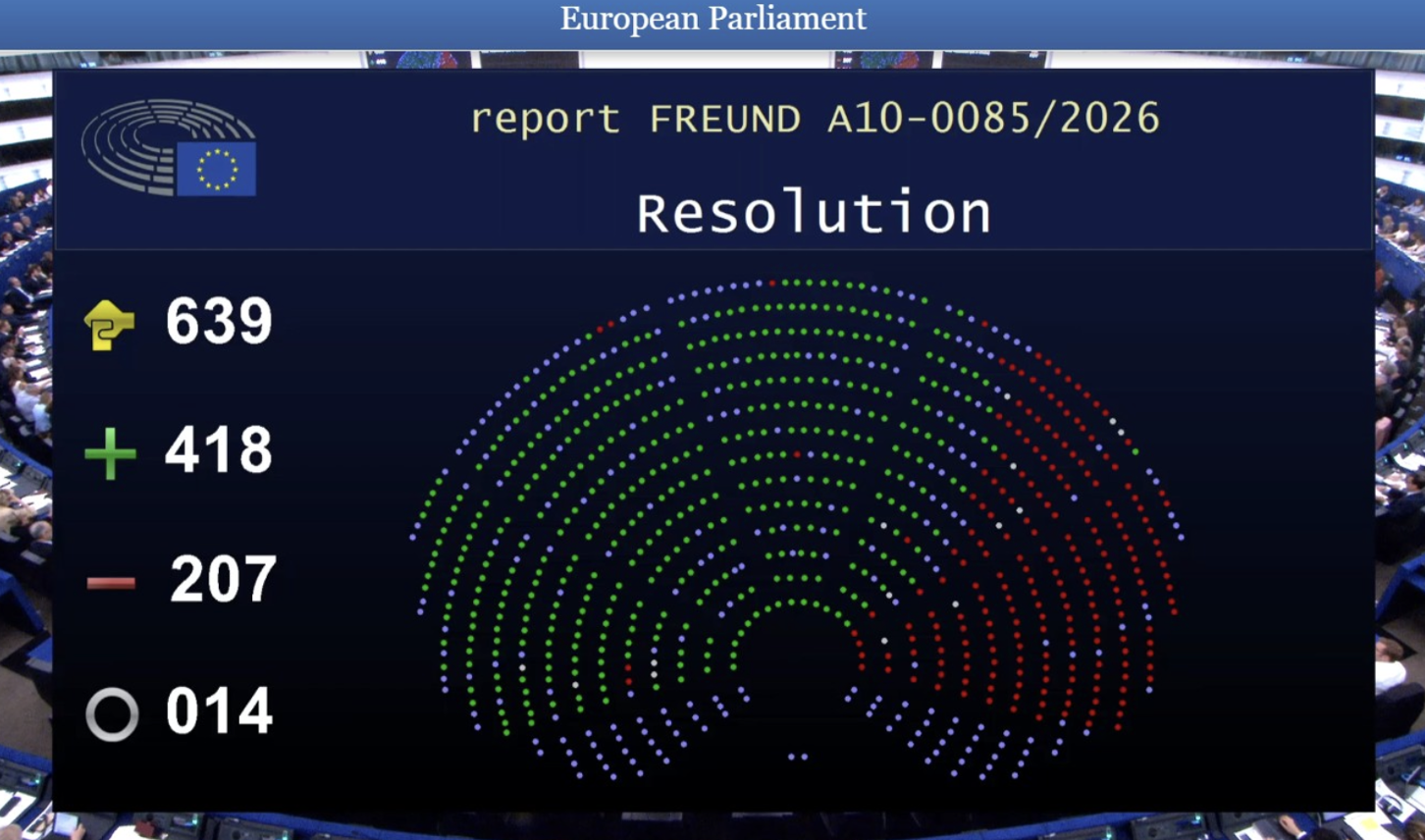
The resolutions passed by a margin of 418-207, with 14 abstentions, reflecting support from lawmakers across the political spectrum, including center-left parties.
IMPACT-se CEO Marcus Sheff welcomed the vote, saying the Parliament had sent “a clear and vital message” to both the Palestinian Authority and the European Commission. “It is unthinkable that after the October 7 massacres, the PA’s curriculum remains infected with hatred, violence and anti-Semitism,” Sheff said, adding that the PA’s reform pledges had “proven to be an empty promise.”
Several members of the European Parliament also commented on the resolutions. Bert-Jan Ruissen of the European Conservatives and Reformists Group said that “EU support should remain firmly conditional on full alignment with UNESCO standards and the removal of incitement.” Joachim Streit of the Renew Europe Group said textbook reform represented “an important opportunity to ensure that every child receives an education grounded in tolerance and coexistence” and argued that international funding should support “a future built on peace rather than division.”
Source: “European Parliament urges funding freeze over PA textbook hate,” IMPACT-se, (April 29, 2026).