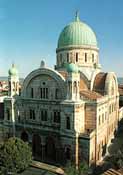
Florence, Italy
Jewish
merchants, doctors and bankers began settling in Florence in the late
14th and early 15th centuries. In 1396, the Commune of
Florence permitted Jews to practice banking in Florence. An assembly
of the Jews of Italy met in Florence in 1428 and gathered funds to
give to Pope Martin V in return for his protection. City authorities
requested Jewish bankers in 1430 because they believed that they would
be easier to control than their Christian counterparts. In 1437, the
Jewish community was officially established because of the need for
Jewish moneylenders in the city.
The fate of the Jewish community was tied to the
fate of the Medici family in
Florence. Lorenzo il Magnifico defended the Jewish community from
expulsions and from the aftermath of vitriolic sermons given by
Bernardino da Feltre. A Catholic theocracy was installed in the 1490's
under the Dominican friar Girolama Savonarola, who decreed that both
the Jews and the Medici family be expelled from Florence. A loan from
the Jewish community to the republic postponed the expulsion for a
short period of time. The Medicis returned to power in 1512 and the
Jewish ban was lifted, until the next Medici expulsion in 1527.
Alessandro de Medici regained influence as a duke, in 1531, and
abolished anti-Jewish acts
In
1537 Cosimo de’Medici gained power in the Florentine government. He
sought the advice of Jacob Abravanel, a Sephardic Jew living in
Ferrara. Abravanel convinced Cosimo to guarantee the rights and
privileges of Spanish and
Portugese Jews, and other Levantines who settled on his borders. This
was the start of the growth of the Sephardic Jewish community in
Florence. Refuge was given to Jews from other papal states who left
due to Pope Paul IV’s anti-Jewish measures, which were not enacted
in Florence. Once Cosimo received the title of grande duke of Tuscany,
his policies toward the Jews changed for the worse. He forced Jews to
wear badges in 1567, closed the Tuscan border to non-resident Jews in
1569, shut down Jewish banks in 1570 and established a ghetto in 1571.
Jewish religious, social and cultural life
continued to flourish inside the ghetto. Two synagogues were built, an Italian one in 1571 and a Spanish/Levantine one at the
end of the 16th century (the ark from this shul can be
found today at Kibbutz Yavne in Israel). There were also Jewish
schools, a butcher, a bakery, a ritual bathhouse and other social and
philanthropic organizations. The Jews were allowed to elect their own
council and the rabbinical courts had jurisdiction, recognized by the
state authorities, over all legal problems. Jews had a special status
in criminal law; they were not tried by common judges, only by the
Supreme Court of the Republic. Restrictions were placed on Jewish
trade in the ghetto barring them from selling wool or silk or trading
in precious objects.
A
certain level of tolerance existed for the Jewish community, despite
being forced to live in the ghetto. During the rule of Cosimo’s son,
Ferdinand I, Jews were allowed to expand their trade to the East. Some
of the wealthy Levantine Jews were even permitted to live outside the
ghetto; however, the Italian Jews were not allowed to leave the ghetto
or join any of the city’s guilds and had to work as second-hand
dealers. This unequal treatment led to disagreements between the two
communities, which were eventually resolved.
The community decreased in size and, by the 18th century, the community numbered less than a thousand individuals.
The Jews of Florence were emancipated and given
civic rights when Napoleon’s army entered the city on March 25,
1799. The grand dukes were restored in 1814 and Jews had to return to
the ghettos. In 1848, the ghetto was abolished and a new city center
was constructed; Jews also achieved equality in the constitution under
Grand Duke Leopold II.
In 1861, Florence became part of the kingdom of
Italy and Jews were recognized as citizens. The ghetto was demolished
at the end of the 19th century, when the city started a
redevelopment program. Plans for the great temple were approved in
1872, but it took eight years to build and was not inaugurated until
1882. The building of the temple far away from the old ghetto marked
the beginning of assimilation of Florentine Jews.
The rabbinical college of Padua (Collegio Rabbinco
Italiano) was transferred to Florence and placed under the leadership
of Samuel Hirsch Margulies in 1899. Samuel Margulies (1858-1922) was
not accepted by the community, at first, because of his Zionist views,
but he became popular with the young generations. Rabbi Margulies
worked at the head of the institution until his death in 1922. His
student, Carlo Alberto Viterbo, helped turn Florence into a hub of
Jewish culture.
Nearly 3,000 Jews lived in Florence in 1931. The
Nazis occupied Florence in the autumn of 1943. Most Jewish families in
Florence lost a family member due to the Fascists or the Nazis. The
first deportation took place on November 6, 1943, and a second one
occurred five days later. Rabbi Nathan Cassuto, physician and
spiritual leader of the Florentine Jewish community, was sent with the
second group. In a third deportation, on June 6, 1944, sixteen elderly
Jews were taken from the old age home to Germany.
The temple was damaged by the Germans in August
1944, when they detonated several mines in the interior. Some of the
synagogue’s treasures, which were confiscated by the Nazis, were
recovered. A total of 243 Jews were deported from Florence, only 13
returned. After the war, Florence’s Jewish population numbered
1,600.
The Jewish community began the process of
rebuilding after the war. The synagogue was restored to its former
glory. A home for the elderly was built in 1957 and a new school
building was erected in honor of Rabbi Nathan Cassuto in 1964.
A
terrible flood broke out in 1966 and damaged the synagogue, including
furniture, frescoes, the historical library and 90 torah scrolls.
Repair and restoration began immediately and today it is fully
restored.
Today the community of 1,000 has two synagogues,
the Sephardic temple and a smaller Ashkenazi prayer house, as well as
a kindergarten, elementary school, high school, youth club, Jewish
cultural center, a sports club, a home for the aged, a museum and
chapters of B’nai Brith and ADEI-WIZO.
Jewish Tourist
Sites
The Synagogue of Florence
The
building, which used a Moorish style, was designed by three
architects: Treves, Falcini and Micheli, who were inspired by
Constantinople’s Byzantine church of Hagia Sophia. It opened to the public in 1882. The interior
is inspiring with wood and bronze carvings, marble floors, mosaics and
long stained glass windows. The Nazis used the Temple as a garage for
military vehicles. There were two restorations, one after the Second
World War and another after a devastating flood in 1966. A plaque commemorating the 248 Jews who were deported by the Nazis from
Florence has been placed in the building.
The Jewish Museum
The Florence Jewish Museum was inaugerated in 2007 and is located in a building adjacent to the city's synagogue. The museum provides a history of the Jewish community in Florence from 1437 to the present and houses artifacts dating back to the 16th century. Its collection includes ritual objects, silver
ornaments and embroidery.
The Ghetto
Florence’s ghetto no longer exists, but one can
find streets or squares that were once within the walls. One
inscription on the entrance door to the bathhouse read, "The Jews
were separated from the union with Christians but not turned
out." Another, above the arch in Piazza della Repubblica, says,
"The old centre of the city restored from age-long squalor to a
new life."
Sources:
“Florence.” Encyclopedia
Judaica. CD-ROM edition. 1996.
Jews and Synagogues: A practical Guide. EdizioniStorti Venezia.
1999.
The
Medici Archive Project: The Jews and the Medicis.
The Synagogue of
Florence.
Tuscany
Jewish Itineraries: Place, History and Art. Edited by Dora
liscia Bemporad and Anna Marcela Tedeschi Falco.Marsilio Publisher
1997.
The Jerusalem Report. (April 30, 2007)
Photo: Florence Synagogue Copyright � Jewish
Italy |