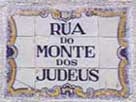
The capital of Northern Portugal, Porto stands proudly above the river Douro, because of its markedly commercial and bourgeois traditions, it was one of the major centres of attraction for Jewish traders, particularly during the middle ages. The earliest known Jewish quarter was built inside the old city wall, in what is now Rua de Santa Ana, close to Rua Escura and Largo do Colegio. it is still possible today to appreciate the mediaeval layout of these streets, not very far from the Cathedral, a masterpiece of Romanesque-Gothic architecture. Later, in 1386, Dom Joao I gave the Jews some land on which to build themselves a new quarter, so that a small Jewish village was created in the streets which today surround the church of Nossa Senhora da Vitoria, between the Monastery of Sao Bento and Rua de Belmonte. The synagogue was situated on the Escadas da Vitoria, a set of steps which the local people still refer to as "Escadas da Esnoga" (the Steps of the Synagogue, a linguistic distortion of the correct word Sinagoga) and where there still remains a plaque with this name. A little further to the north, in Passeio das Virtudes, was the Jewish Cemetery. Attention is also drawn in this area to the Latin inscription in the church of Sao Bento da Vitoria, which testifies to the memory of the old .Jewish quarter. Moving southwards and passing by the Palacio da Bolsa (Stock Exchange) with its exotic Arab Room (decorated in thc popular 19th century revivalist style), it is worth paying a visit to the Ribeira (riverside district), where the centuries-old hustle and bustle of commerce takes place against the backdrop of the areas's medieval architecture and the unforgettable beauty oft he river, further enhanced by the barcos rabelos (the typical old boats used for transporting Port Wine). Here in the Ribeira and in Rua da Alfandega, in the heart of the historical centre which UNESCO has classified as World Heritage, the Jews opened their warehouses and shops, side by side with one of the most beautiful churches in Porto (the Basilica of Sao Francisco, Gothic in origin, but with a Baroque interior, full of exuberant carved gilded woodwork). Almost opposite this church stands the Casa do Infante whose archaeological centre and museum underline the importance of Infante Dom Henrique (Prince Henry the Navigator) as the mentor of the Portuguese Discoveries. The close relationship that existed between Prince Henry and certain illustrius Jews is well known, for the latter provided an important part of the commercial and financial backing that Portugal needed for such a momentous enterprise. The Jewish quarter of Monchique once stood in the Bairro de Miragaia to the north of Rita da Alfandega, next to the Convento de Monchique. One part of the former mediaeval town centre that still Survives today is Rua do Monte dos Judeus, where, in 1826, one of the most important Hebraic inscriptions in Portugal was discovered: the Monchique stone, which is now exhibited at the Museu Arqueologico do Carmo, in Lisbon.
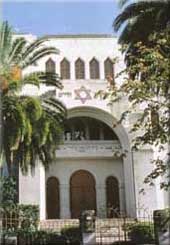
To the west of the riverside area is the district known as Foz, with its promenade and elegant mansions built at the turn of the century. Returning to the center and to the north of Rua de Belmonte, there are many other points of interest to be found. Passing by the Torre dos Clerigos (a Baroque tower that is the very symbol of the city), the visitor comes to the the Avenida dos Aliados, where the town hall is to be found, and off which run the lively shopping streets, such as Rua de Santo Antonio and Rua de Santa Catarina. In addition to the rich collection of decorative art exhibited at the the Museu Nacional dos Reis, there are also sone interesting collections of 19th and 20th century Portuguese painting and sculpture. In the area of Boavista, at No. 340 Rua Guerra Junqueiro, is the present-day synagogue, the "Mekor Haim" (Fountain of Life), built in 1929 by the Jewish Community of Porto. On the opposite bank of the river Douro, which offers the visitor a panoramic view of the city of Porto, it difficult to resist the attractions of paying a visit to the Port Wine cellars, where you can also sample this unique wine. Viana do Castelo
Ponte de Lima
Amarante
Other places of interest
Sources: Journey to Jewish Portugal courtesy of the Portuguese National Tourist Office; Photos by Paulo Magalhaes |