|
[By: Jacqueline Shields]
The first Jews arrived in Costa Rica from islands in the surrounding Caribbean in the 19th century. Today, Costa Rica's Jewish population is approximately 2,500, though thousands of Israeli tourists visit the country each year.
- Early History
- Mid-20th Century
- Jewish Community Today
- Relations with Israel
Early History
The first Jewish settlers in Costa Rica were Sephardim from Curacao, Jamaica, Panama and the Caribbean who arrived
in the 19th century. Most of these Jews mixed with the local population
and settled in Cartago, San Jose, and Puerto Limon. Although most no
longer practice Judaism, some families
still recognize their Jewish origins. The Turkish and East European Jewish immigrants, who reached
Costa Rica during the post-World War I period and who were followed
after 1933 by German refugees,
founded the present-day community. Although one of the most enlightened
of the Central American republics, Costa Rica has traditionally looked
askance at its foreign population, and its restrictive immigrant legislation
affected Jewish settlement in the country.
The Mid-Twentieth
Century
In 1937, when the Refugee Economic Corporation acquired
land around the area of Guanacate for the purpose of settling Jews from
Central Europe, a court ruling decreed that the purchase of land by
a foreign company for settlement purposes was illegal. Jewish economic
security was also endangered in 1941 in the wake of the official nationalization
of all foreign-held commercial establishments, but the legislation was
not enforced. In 1944, an attempt was made to prohibit peddling, which
would have been a blow to the economic position of many Jews, but this
endeavor was not successful.
Anti-Semitism intensified
after the April 1948 political revolution and culminated in the federal
investigation of Jewish legal status and immigration permits, despite
the Constitution of 1949, which guarenteed freedom of speech, assembly,
and protection of citizens and residents of Costa Rica. In 1952, nationalist
activists tried to pass a law restricting commercial activities only
to native Costa Ricans, and Jewish homes and institutions in San Jose
were attacked. The situation began to improve in 1953 with the presidency
of Jose Figueres, who publicly affirmed the principle of equal rights
for all Costa Rican citizens from the constitution.
Jewish Community Today
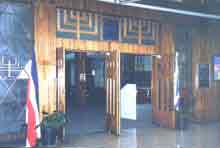 Shaare Zion Synagogue
 |
Jewish life in Costa Rica today is very vibrant and
caters to the 2,500 Jews in the country. All denominations of the community
revolve around the Centro Israelita Sionista founded in 1930, which
includes a WIZO, B'nai B'rith, La Sociedad de Damas Israelitas de Beneficencia,
several Zionist and youth groups, and
a social and sports club. The Centro publishes a monthly newletter called Hayom which includes a bulletin devoted to improving Jewish-Christian
relations. New buildings for the Shaare Zion Synagogue and the Community Center were inaugerated in September, 2004 on a 17,000 square meter plot. The new buildings house the new synagogue, the Hanoar HaTzioni youth organization's headquarters, a community museum and library, a kosher restaurant, and three mikvahs, one for women, men, and khelim. These buildings also house administrative offices for all active Jewish organizations in Costa Rica, including the Asociacion Ciudadano de Oro House, the Golden Citizen Association for the elderly.
The Haim Weizmann Comprehensive School is an Orthodox day school located in San Jose and has more than 200 pupils in kindergarten,
primary, and secondary grades; the languages of instruction are Spanish
and Hebrew. Most Jewish children attend the Haim Weizmann primary and
secondary school.
There is a Chabad House in San Jose. The main synagogue in San Jose, however, is the Orthdox Shaare Zion congregation. Shaare Zion oversees and upkeeps the Jewish cemetery in San Juan,
which has a Holocaust memorial to Jewish
victims.
B'nai Israel is a Reform synagogue, which meets Friday nights at 7:30. This community also has
a youth group, cultural events such as lectures and movies, and a bulletin
called Koleinu on synagogue activities.
 The Haim Weizman School
 |
Kosher food
is readily available in San Jose with a kosher butcher shop, and a delicatessen
run by Orthodox Jews that carries kosher products. There are two kosher
hotels in Costa Rica, one in San Jose, and another in Camino Real. Until 2010, a kosher Burger King even existed in one San Jose shopping mall.
In February 2006, two members of Costa Rica’s
small Jewish community, Clara Zomer and Masha Ofelia Taitelbaum, won
seats in the country’s Legislative Assembly and will begin serving
four-year terms when the new legislature takes office in May. Their
party will have the largest bloc in the legislature and both are expected
to have leadership roles within the bloc.
Relations With Israel
Diplomatic relations between
Costa Rica and Israel are friendly, and
the former was among the first nations to
recognize the State in 1948.
For years, the Costa Rican embassy was one
of only two embassies (El
Salvador is the
other) that remained in Jerusalem,
but, in 2006, it was moved (and El Salvador
announced plans to do the same) to Tel
Aviv where the rest of the embassies
are located.
An estimated 300 Israelis live permanently in Costa
Rica. These include Israelis who married Costa Rican Jewish girls to
enter the family business or to establish one. Other Israelis simply
found Costa Rica a pleasant and beautiful place to make a living and
settle down.
In July 2015 Costa Rica's parliament launched an official Israel Allies Caucus, becoming the thirty-third country in the world to do so. Facilitated by the Israel Allies Foundation, Costa Rica's Israel Allies Caucus further affirms their support of the establishment of Israel as a homeland for the Jewish people. During the hearing in which the Caucus was created, twenty members of the Costa Rican Parliament signed a document stating their support for “the right of the State of Israel and the Jewish People to Jerusalem as its eternal capital.” The Costa Rican Israel Allies Caucus consists of Legislative President Rafael Ortiz, as well as a dozen other Parliament members from various political parties.
Sources: “Costa Rica Announces Launch of Israel Allies Caucus in Parliament,” The Costa Rica News, (July 5, 2015)
Beker, Avi. Ed. Jewish
Communities of the World. Lerner Publications Company; Minneapolis,
1998.
"Costa Rica." Encyclopedia
Judaica.
Zaidner, Michael. Jewish
Travel Guide 2000. Vallentine Mitchell Co, Portland, 2000.
Jerusalem
Center for Public Affairs
JTA, (February 7, 2006)
Map: CIA
World Fact Book
Photo of ark courtesy of B'nai
Israel Synagogue
Photo of Costa Rica courtest Rainbow
Computer Works
School and Shaare Zion photo courtesy Centro
Israelite
Photo of Chabad House in
San Jose courtesy of HaChayim
HaYehudim Jewish Photo Library (Jono
David Media) |
