The Kishinev Massacre
The Kishinev
Massacre of 1903, in which
forty-nine Jews were murdered and hundreds
were wounded, aroused universal condemnation
and protest. For the first time, Jews in
the United States took the lead in organizing
nationwide protests. In addition to hundreds
of demonstrations and meetings held throughout
the nation, a massive petition drive protesting
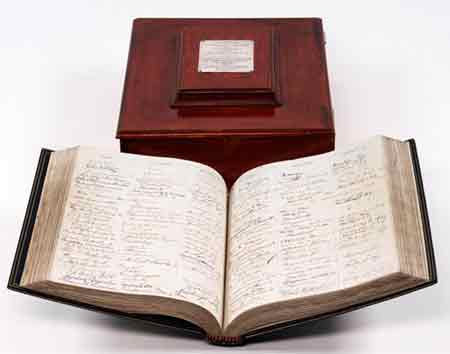
the slaughter was organized. Since the
Russian authorities refused to accept the
petition, it was deposited instead in the
State Department's vault in a special box
constructed to house it. In his letter
accepting the petition, Secretary of State
John Hay wrote: “It is a valuable addition
to the public literature and it will be sacredly
cherished among the treasures of the Department.”
|
“Kishineff” Petition,
1903
Wood case with bound manuscript petition
Courtesy of the National Archives and Records Administration,
Washington, D.C. |
In the print below, which appeared after
a 1905 pogrom in Kishinev, a “Russian Jew” carries
on his back a large bundle labeled “Oppression;” hanging
from the bundle are weights labeled “Autocracy,” “Robbery,” “Cruelty,” “Assassination,” “Deception,” and “Murder.” In
the background, on the right, a Jewish community
burns, while in the upper left corner, President
Theodore Roosevelt asks the Emperor of Russia,
Nicholas II, “Now that you have peace without,
why not remove his burden and have peace
within your borders?”
|
Emil
Flohri (1869-1938).
Stop
Your Cruel Oppression of the Jews, 1904.
Chromolithograph.
Ben and Beatrice Goldstein Foundation Collection.
Prints and Photographs
Division |
In the drawing below by
Homer Davenport, Lady Columbia, resplendent
in patriotic attire, rebukes Czar.Nicholas
II, who averts his eyes and appears embarrassed.
Behind them is a poster with several skulls
and bones, reading “Kishenev Massacre
of 400 Jews — 700 Jewish Homes Looted —Dead
Left Bleeding in the Streets. Tirospol — General
Slaughter of Jews — Young and Old Killed
and Wounded.”
|
Homer
Davenport (1867-1912).
The
Crime of the New Century, 1903.
Pen and ink drawing.
Prints and Photographs
Division |
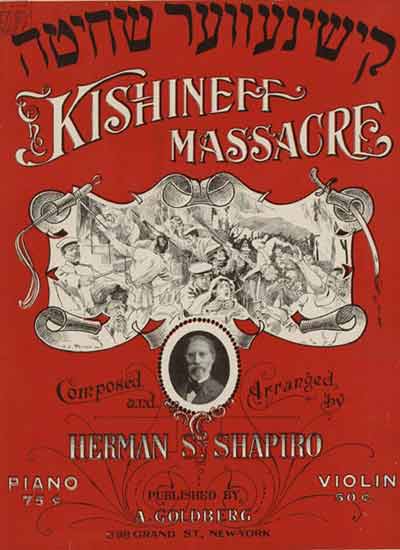
The illustration in the
center of the elegy below depicts the April
1903 Kishinev massacre. The elegy is in seven
parts, including “First
signs of storm,” “The luckless in despair,” “The
bugle call of the rioters to one another,” “The
victims in their agony,” “The wailings of
women and children,” “The devilish work in
full force,” and “The survivors beg for bread.”
|
Herman
S. Shapiro.
“Kishinev
shekhita, elegie”
[Kishinev Massacre Elegy].
New York: Asna Goldberg, 1904.
Irene Heskes Collection.
Music Division |
Sources: Library
of Congress
|