A Century of Immigration, 1820-1924
In
the century spanning the years 1820 through
1924, an increasingly steady flow of Jews
made their way to America, culminating in
a massive surge of immigrants toward the
beginning of the twentieth century. Impelled
by economic hardship, persecution, and the
great social and political upheavals of the
nineteenth century — industrialization,
overpopulation, and urbanization — millions
of Europe's Jews left their towns and villages
and embarked on the arduous journey to the
“Golden Land” of America.
In the first
half of the nineteenth century, Jewish immigrants
came mostly, though not exclusively, from
Central Europe. In addition to settling in
New York, Philadelphia, and Baltimore, groups
of German-speaking Jews made their way to
Cincinnati, Albany, Cleveland, Louisville,
Minneapolis, St. Louis, New Orleans, San
Francisco, and dozens of small towns across
the United States. During this period there
was an almost hundred-fold increase in America's Jewish
population from some 3,000 in 1820
to as many as 300,000 in 1880.
Between 1881
and 1924, the migration shifted from Central
Europe eastward, with over two-and- one-half
million East European Jews propelled from
their native lands by persecution and the
lack of economic opportunity. Most of those
who arrived as part of this huge influx settled
in cities where they clustered in districts
close to downtowns, joined the working class,
spoke Yiddish, and built strong networks
of cultural, spiritual, voluntary, and social
organizations. This period of immigration
came to an end with the passage of restrictive
laws in 1921 and 1924. Jewish emigration
from Eastern Europe to the United States
never again reached the levels that it did
before 1920.
|
|
|
|
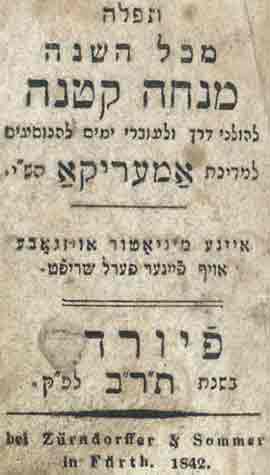
This
miniature daily prayer book was printed
in Germany in 1842, "especially for
travelers by sea to the nation of America." It
is the first of three editions of this
tiny prayer book published between
1840 and 1860 — a period when
Jews from German lands immigrated to
this country in the tens-of-thousands.
Between 1840 and 1860 the Jewish population
of this country ballooned from 15,000
to 150,000. Political unrest and economic
hardship were primary motivating factors
for this migration.
Tefilah
mi-kol ha-shanah: Minhah Ketanah
[Prayers of the Entire Year: Minor Offering].
Fürth: Zurndorffer & Sommer, 1842.
Hebraic Section |
|
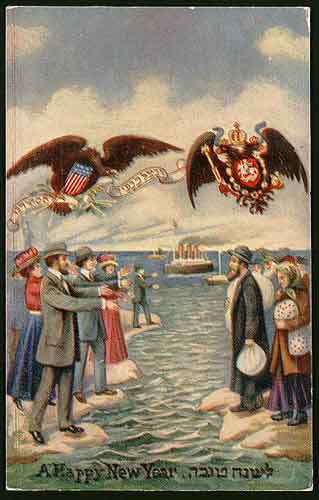
Under
the Imperial Russian coat of arms,
traditionally dressed Russian
Jews, packs in hand, line Europe's
shore as they gaze across the ocean.
Waiting for them under an American
eagle holding a banner with the legend "Shelter
me in the shadow of your wings" (Psalms
17:8), are their Americanized relatives,
whose outstretched arms simultaneously
beckon and welcome them to their new
home.
A
Happy New Year.
Hebrew Publishing Company, between 1900 and 1920.
Offset color lithograph postcard.
Alfred and Elizabeth Bendiner Collection.
Prints and Photographs Division |
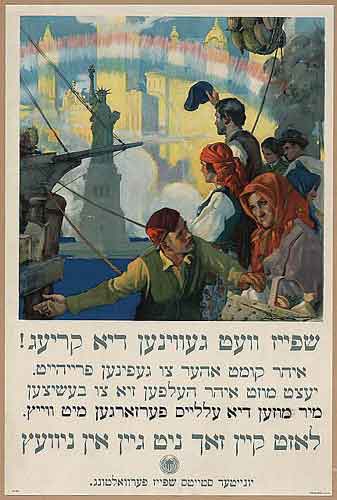
This
World War I poster, published by the
United States Food Administration,
appeals in Yiddish to the patriotic
spirit and gratitude of the new arrivals
to America. Its message reads, "Food
Will Win the War! You came here seeking
freedom, now you must help to preserve
it. We must provide the Allies with
wheat. Let Nothing Go To Waste!" Versions
of this poster were issued in English
and Italian as well.
Charles
Chambers (1883-1941).
Food Will Win the War--You
Came Here Seeking Freedom, Now
You Must Help Preserve It. .
. .
New York: Rusling Wood, Litho., 1917.
Color lithograph poster.
Prints and Photographs Division |
|
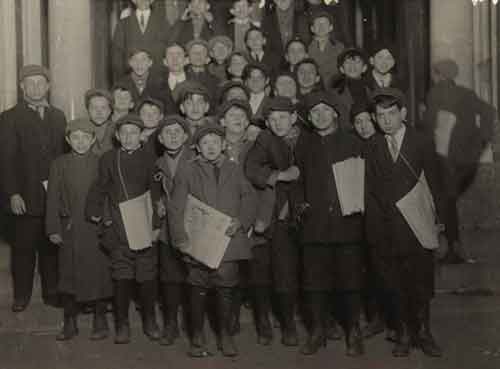
This
photograph of newsboys Waiting
for the "Forwards," was taken
by Lewis Hine at 1:15 a.m. on the
steps of the building where the Jewish
daily the Forward was produced
on New York's Lower East Side. According
to Hine, the group included a number
of boys as young as ten years-old.
The newsboy in the first row is holding
copies of Wahrheit [Truth],
a Yiddish daily newspaper that stressed
Jewish national aspirations.
Lewis
Hine (1874-1940)
Waiting
for the "Forwards" -
Jewish paper at 1 A.M.
New York, March 1913
Gelatin silver print from photographic
album
Prints and Photographs
Division |
Jewish
women made up the majority of workers
in the garment industry, especially in
the dress and shirtwaist trade. Poor working
conditions, low wages, and frequent layoffs
propelled many into the International Ladies'
Garment Workers Union. On March 25, 1911,
146 garment workers lost their lives in
the Triangle Shirtwaist factory fire in
New York's Greenwich Village. Many were
trapped inside because the escape exits
had been locked to keep the girls in and
the union organizers out. The fire was
one of New York's worst industrial accidents
and was covered by newspapers across the
nation, including the Oklahoma State
Capital, which is displayed here.
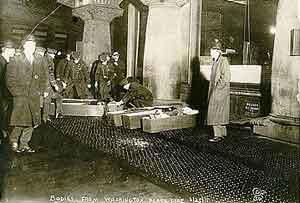
Bain News Service.
Bodies from Washington Place Fire,
March 25, 1911.
Gelatin silver print.
George Grantham Bain Collection.
Prints and Photographs
Division |
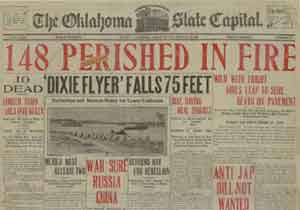
“148
Perished in Fire,”
Oklahoma State Capital (March
26, 1911).
Newspaper front page.
Serial and Government
Publications Division |
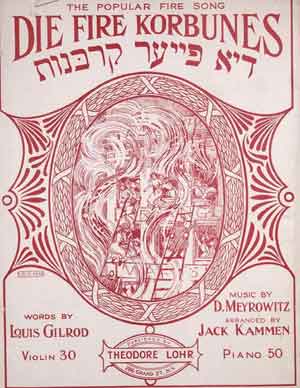
Yiddish
American popular song was rooted
in Eastern European Jewish minstrelsy,
which had long addressed current
social, economic, and political themes. "Die
Fire Korbunes" [The
Fire Victims] is an elegy to the
146 victims, mostly young Jewish
and Italian immigrant women, who
perished in the March 25, 1911 fire
at the Triangle Shirtwaist Company
factory, a New York City garment
sweatshop.
David
Meyrowitz (1867-1943) and
Louis Gilrod (1879-1930).
Die Fire Korbunes
[The Fire Victims].
New York: Theodore Lohr Co., 1911.
Sheet music cover.
Irene Heskes Collection.
Music Division
|
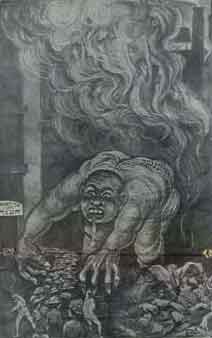
A salivating demonic figure, labeled
the Triangle Waist Company, draws
a long line of women into his factory.
There they are consumed by the fire's
raging inferno and drift upward towards
heaven in the smoky aftermath of
the fire. Public sympathy and outrage
over the tragedy led to the establishment
of a Factory Investigating Commission
that was instrumental in drafting
new legislation that mandated improved
working conditions.
Lola
[Leon Israel].
Der
Groyser Kundes
[The Big Stick].
Vol. 3, no. 14 (April 7, 1911).
New York: Jewish Publishing
and Advertising Co., 1911.
Hebraic
Section
|
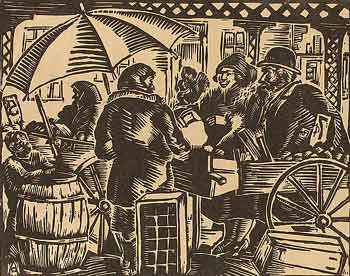 |
Albert Potter (1903-1937)
Eastside
New York,
between 1931 and 1935
Woodcut print
Ben and Beatrice Goldstein
Foundation Collection
Prints and Photographs
Division
Sources: Library
of Congress
|