From Haven to Home: Becoming American
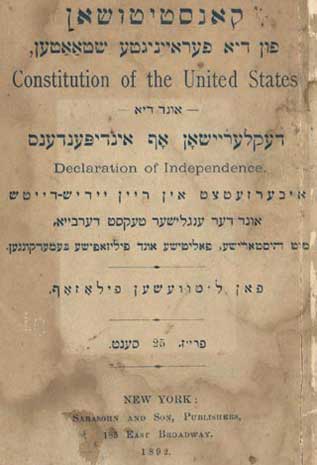
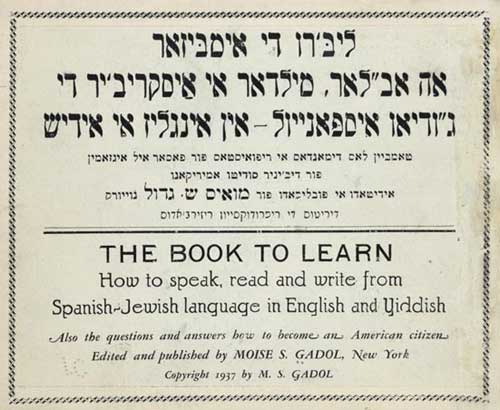
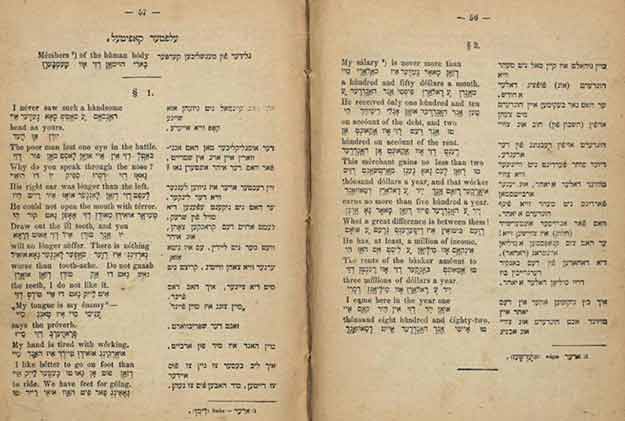
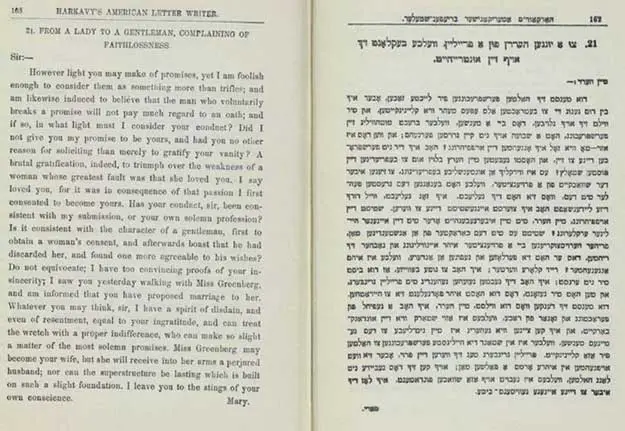
A variety of publications were issued to help Americanize new immigrants. Bilingual Yiddish-English versions of the Constitution and the Declaration of Independence were published for the new Americans, as were phrase books in Yiddish, English, and Ladino (Judeo-Spanish) — all intended to help the immigrants function in their new environment. Alexander Harkavy's English-Yiddish letter writing guides were especially popular, selling thousands of copies in multiple editions. Shown here is Harkavy's American Letter Writer, opened to a sample letter “From a Lady to a Gentleman, Complaining of Faithlossness (sic).”
Konstitushon fun di Fereynigte Shtaten
und Deklereyshon of Indipendens
[Constitution of the United States
and the Declaration of Independence].
New York: Sarasohn and Son, Pub., 1892.
Hebraic Section
Moise S. Gadol (1874-1941).
Libro de Embezar, The Book to Learn How to Speak, Read and Write from Spanish-Jewish Language in English and Yiddish.
New York: 1937.
Hebraic Section
Hirsh Vand (b.1847).
Der Englisher Tolmatsh.
Warsaw: Gebruder Shuldberg, 1891.
Hebraic Section
Alexander Harkavy (1863-1939).
Harkavy's Amerikanisher Briefenshteler
[Harkavy's American Letter Writer].
New York: Hebrew Publishing Co., 1902.
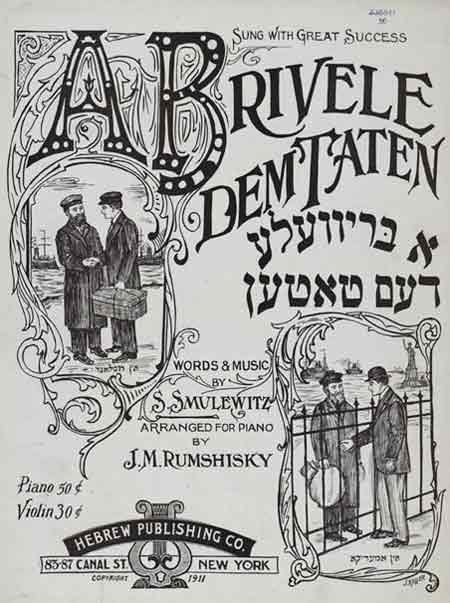
Hebraic SectionPictured on the sheet music cover below are two scenes: a father and son parting in the Old World, and the same pair meeting at Ellis Island. Solomon Smulewitz's lyrics recount a familiar tale of woe: “Mother has died in loneliness and poverty. Write a letter to father and send money for him to come to America. Alas, father is too ill to be admitted here. He is permitted to see his son at the gate of Ellis Island, and then will be sent back to Europe.”
Solomon Smulewitz (1868-1943)
and J.M. Rumshisky (1879-1956).
A Brievele dem Taten
[A little letter to my father].
New York: Hebrew Publishing Co., 1911.
Sheet music cover.
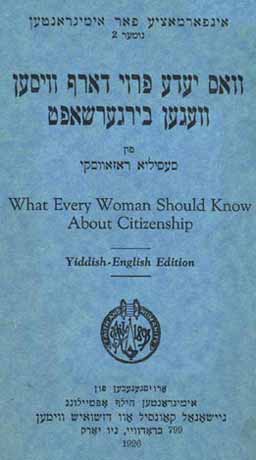
Hebraic SectionThe Immigration Assistance Section of the National Council of Jewish Women issued the citizenship guide below for women in both English and Yiddish. Founded in 1893, the Council focused on helping unmarried women immigrants learn English, secure citizenship, and find employment.
Cecilia Razovsky (1891-1968).
Vos Yede Froy Darf Visen Vegen Birgershaft, What Every Woman Should Know about Citizenship.
New York: Department of Immigrant Aid,
National Council of Jewish Women, 1926.
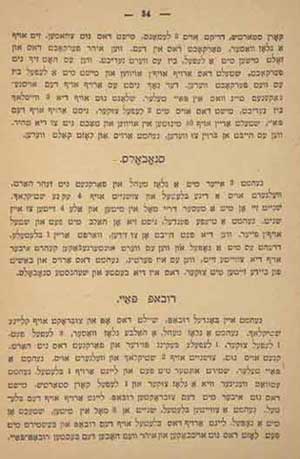
Hebraic SectionWritten in Yiddish, the language understood by the majority of newly arriving Jewish immigrants, the cookbook below served as an introduction to American as well as traditional Jewish cuisine. The recipes, which are based on Hinde Amchanitzki's forty-five years of experience in European and American kitchens, include traditional Jewish dishes as well as American fare. In her introduction, the author promises that using her recipes will prevent stomach aches and other food-related maladies in children. This first American Yiddish cookbook pictures the author on the cover. Displayed on the accompanying page are recipes in Yiddish for two desserts, “Snowballs” and “Rhubarb Pie.”
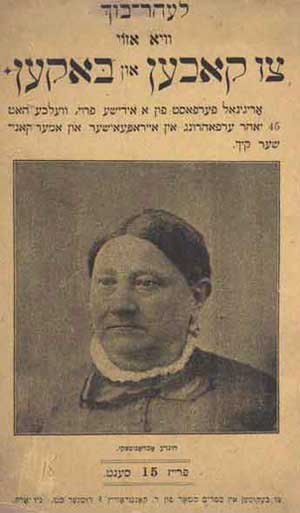 |  | 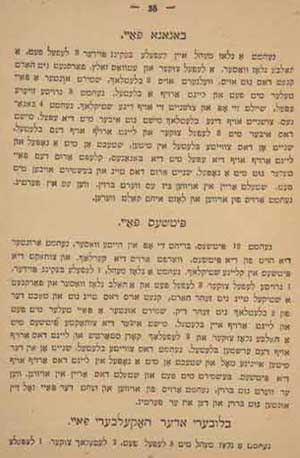 |
Hinde Amchanitzki.
Lehr-bukh vi azoy tsu kokhen un baken
[Textbook on How to Cook and Bake].
New York: ca. 1901.
Hebraic Section
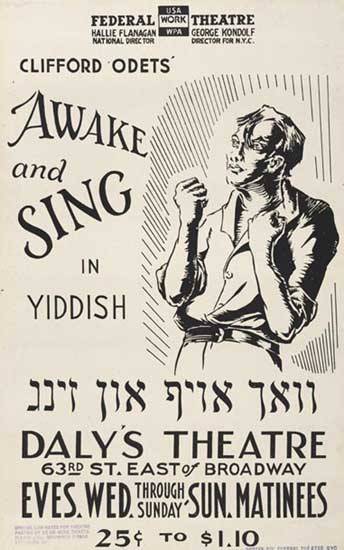
The Federal Theater Project produced a Yiddish language version of Clifford Odets's groundbreaking depiction of a Jewish family living in the Bronx during the Depression years. Burdened with financial difficulties, the family struggles to survive. In the play's climax, the socialist grandfather delivers the central message of the play, calling his family to action and urging them to “Go out and fight so life shouldn't be printed on dollar bills.” The title is from Isaiah (26:19): “Awake and sing, ye that dwell in the dust.”
Clifford Odets (1906-1963).
Awake and Sing.
Federal Theatre, New York City.
Offset lithograph poster.
Federal Theatre Project Collection.
Music Division
Sources: Library of Congress

Download our mobile app for on-the-go access to the Jewish Virtual Library