The Surviving Remnant
The ardor against the Talmud among reactionary religious and political spokesmen did not abate in the twentieth
century. One hundred and one years after Pinner's publication one could find in Berlin and in other German cities
a new edition of a small work on the Talmud, Unmoral im Talmud (Immorality in the Talmud, Munich, 1943), by Adolf Hitlerœs appointed Kulturleiter, Alfred Rosenberg, the most influential philosopher of Nazism. As one looks at
its garish cover and leafs through its contents, one wonders why this anti-Semitic diatribe was republished at that
time in the birth city of Nazism. In the year 1943, the height of the Holocaust, what need to further malign a
people being brutally and efficiently put to death? Who was questioning the deed? Who was demanding
justification of it? Was it directed to the perpetrators and their cohorts, or to those indifferently standing by at
home and abroad?
Three years later, in summer 1946, two volumes of the Talmud, tractates Kiddushin and Nedarim, were
published in Munich by "Rabbinical Representative [sic] by Central Committee of Liberated Jews in the
American Occupied Zone." The "Rabbinical Representative" were Rabbis Samuel Abba Snieg, head of the
Rabbinical Association of the Zone, and his young colleague, Samuel Jacob Rose. The two were survivors of
both the notorious Kovno ghetto and the Dachau concentration camp. Liberated by the American Army and
restored to health, they succeeded "after great exertions" in publishing these volumes by photo offset "to slake the
great thirst for holy books" among Jewish survivors. This project accomplished, they embarked upon a far more
ambitious one, the publication of the entire Talmud in a sixteen-volume edition.
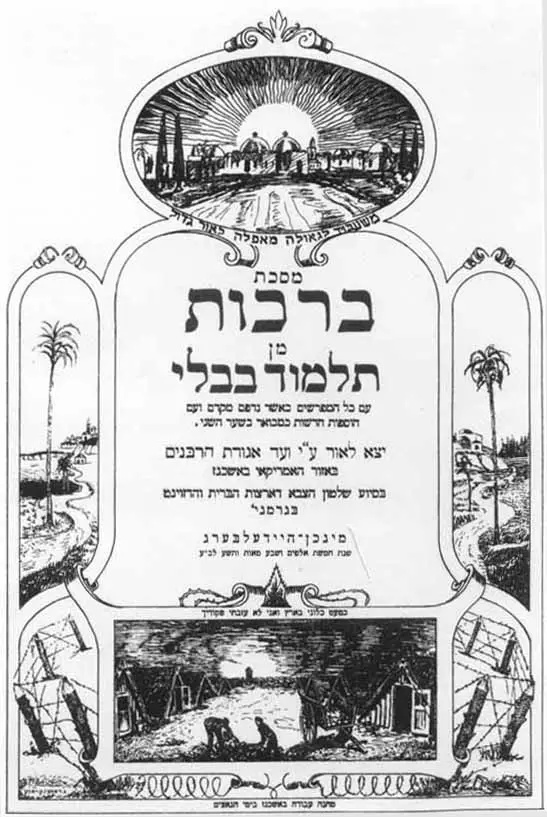
The title page of the first volume of nineteen, an edition of the complete Talmud published in Munich- Heidelberg in 1948, only three years after the Holocaust, by the Rabbinic Organization in the American sector "with the aid of the American Military Command and the American Jewish Joint Distribution Committee in Germany." It is appropriately dedicated to the "United States Army," which provided the opportunity and the means for its publication. At the bottom of the page is a depiction of a Nazi slave labor camp flanked by barbed wire; above are the palm trees and the landscape of the Holy Land. The legend reads: "From bondage to freedom; from deep darkness to a great light" (Hebraic Section, Library of Congress Photo).
 |
This project they proposed to the recently arrived American Advisor on Jewish Affairs, Rabbi Philip S.
Bernstein. Their argument and plea was that, true, yeshivot had been established in the American Zone, but there
were no books to study from. None could be found in the makeshift synagogues serving the survivors. If one was
found, a hundred hands stretched out to it. In a moving memorandum to commanding General Joseph McNarney,
Rabbi Bernstein described the Talmud as one of the source springs of Jewish religion and tradition over which
Jews have pored in every land and age. Hitler's hordes, the rabbi explained, had tried to destroy the Talmud by
ordering Jews, upon pain of death, to carry their copies of the Talmud to the Nazi bonfires and personally
consign them to the flames. Would it not be in the best tradition of American democracy, the rabbi urged, for the
army which liberated the survivors to now help restore their spirits by participating in rebuilding their religious
culture, which the Nazis had sought to obliterate. "A 1947 edition [of the Talmud] published in Germany
under the auspices of the American Army of Occupation," Rabbi Bernstein proclaimed, "would be an historic
work." General McNarney read the memorandum, heard the impassioned plea of the rabbis, and was persuaded.
There followed a heroic effort on the part of all. Everything was in short supply, if available at all-paper, offset
facilities, binding materials, and, not least of all, a complete set of the Talmud. A few volumes were found in a
Munich cemetery, a half dozen more were obtained from France and Switzerland, but two complete sets had to
be brought from New York. The number of volumes projected to complete the set was nineteen, and the number
of sets the army was ready to publish was fifty. By 1950, when the edition was completed, many more volumes
had come off the presses, but complete sets are a rarity. It is most appropriate that among the treasures of the
Library of Congress's Hebraic Section is such a complete set.
The illustrated title pages of each volume have at the top a drawing of a Holy Land vista and the inscription,
"From bondage to redemption; from deep darkness to a great light" (The Passover Haggadah). At the bottom, a
depiction of a slave labor camp and a verse from Psalms (119:87): "They all but obliterated me from the earth;
but 1, 1 forsook not Thy precepts." On the reverse side, Rabbis Snieg and Rosen tell the story of its publication:
Through the mercies of the Blessed One, we have been enabled to publish this edition of the Talmud, a work of
beauty and splendor... Engraved in our memories is that bitter day in the ghetto, when the decree came from the
Nazis, may their memory be blotted out, to gather up all the books into one place to destroy them. The peril of
death hung over those who would dare hide a book.... All our holy books were taken from us for abuse and set
afire. Now, because of the Lord's great mercies, a remnant of His people remains, saved from the sword of their
accursed destroyers, but without a book in their hands.... We therefore turned to the American Army Command
in Germany to help us, and through the intercession of Dr. Rabbi Philip Bernstein, our desire was with God's help
fulfilled.... During our overlong exile, our holy books were burned once and again by monarchs and
governments. This is the first time in the long history of the Jewish people, that a government has helped us to
publish the books of the Talmud, which are our life and length of days. Armies of the United States brought us
from death to life, and they now protect us in this land. Through their aid the Talmud now appears again in
Germany.
The page is in Hebrew, the Dedication, in English:
This edition of the Talmud is dedicated to the United States Army. This Army played a major role in the rescue
of the Jewish people from total annihilation, and after the defeat of Hitler bore the major burden of sustaining the
DPs of the Jewish faith. This special edition of the Talmud published in the very land where, but a short time
ago, everything Jewish and of Jewish inspiration was anathema, will remain a symbol of the indestructibility of
the Torah. The Jewish DPs [Displaced Persons] will never forget the generous impulses and the unprecedented humanitarianism of
the American forces, to whom they owe so much.
The publication date is 1948, just three years after the cessation of hostilities and the liberation of Shearit
Hapleta, the "surviving remnant."
Sources: Abraham J. Karp, From
the Ends of the Earth: Judaic Treasures of the Library of Congress,
(DC: Library of Congress,
1991).
|