Witnesses to History: And May the Messiah Come Soon
In every generation it is the duty of a Jew to regard himself as if he personally went forth from Egypt.
-- The Passover Haggadah
History is remembering and re-experiencing: of the two, the latter is the more rewarding. For the student of Jewish history, the Library of Congress offers a sumptuous feast; solid fare and occasional delicacies making for a rich, variegated menu. Classic works in Hebrew, Yiddish, Latin, English, German, French, Spanish, and Russian abound. Multivolume works of the great historians, from first century Josephus writing in Greek to twentieth-century Salo Baron writing in English, share the shelves with communal and topical histories, anthologies, periodicals, and monographs, from classic pioneering studies to sophisticated contemporary works on the cutting edge of the discipline.
For both researcher and reader the most exciting finds are those works-book, broadside, and manuscript-which witnessed and recorded history in the making or which themselves partook in the unfolding of the Jewish historical experience. We can offer only a small sampling of the rich lode of primary source materials, printed and written, which enable us, fortified with knowledge and imagination, to re-experience historic events.
“And May the Messiah Come Soon, in Our Time”
The grandest of prophetic visions is of the "end of days," the days of the Messiah, as envisaged by the prophet Isaiah:A scion of the house of Jesse ...
Filled with the spirit of the Lord ...
Who with righteousness shall judge the poor ...
And with the breath of his lips slay the wicked ...
And the wolf shall dwell with the lamb ...
Nation shall not lift up sword against nation
Neither shall they learn war anymore ...
They shall not hurt nor destroy ...
For the earth shall be filled with the presence of the Lord.
Isaiah (Ch. 11 and 2)
Among the saddest chapters in Jewish history are those which tell the tales of messiahs.In February 1524, there arrived in Rome an exotically dressed figure riding on a white horse, who announced himself to be David Reuveni, brother to Joseph, King of a Jewish kingdom in the heart of the Arabian peninsula. At an audience granted him by Pope Clement VII, Reuveni stated his mission, which was to effect an alliance between that kingdom and the Christian world against the Moslems. Intrigued by the prospect, the Pope gave him a letter to the King of Portugal, who received him warmly. He received an even greater welcome from the Portugese Marranos, Christians in name only, who still adhered to their ancestral faith despite having formally surrendered it. These Marranos saw Reuveni as a herald of the Messiah.
None was more taken than a brilliant young man, Diogo Pires, born in Lisbon of Marrano parents, who at age twenty-one was appointed secretary to the king's council and recorder at the court of appeals. His meteoric rise did not assuage young Diogo's spiritual malaise. Obsessed by a yearning for the faith of his father, Pires met Reuveni in 1525 and hearing Reuveni's tale of Jewish dominion and aspirations, decided to return to the ancestral faith and asked to be circumcised. Reuveni warned him against it, pointing to the peril to his life from the Inquisition, so Pires circumcised himself, almost bleeding to death in the process. He took the Hebrew name Shlomo Molcho and fled Portugal to wander in the Near East--Damascus, Safed, and Jerusalem--studying and to a remarkable degree absorbing the teachings and mysteries of his reacquired faith.
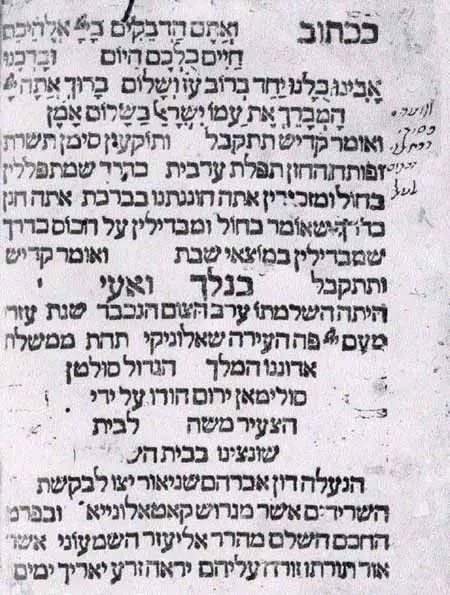 |
He went to Salonica to study Kabbalah, Jewish mysticism, and soon student became teacher, During the fifteenth and into the sixteenth century Salonica was a haven for Jewish exiles fleeing the Iberian peninsula and Italy. Of Salonica, the haven, Portuguese Marrano chronicler Samuel Usque writes in his Consolacam as tribulacoems des Israel (Consolation for the Tribulations of Israel) Ferrara, 1553 (English edition, translated and edited by Martin A. Cohen, Philadelphia, 1965): "the largest number of the persecuted and banished sons from Europe and other places have met therein and have been received with loving welcome, as though it were our venerable mother Jerusalem." it was a community of communities living with historic memories and messianic expectations. In 1527, the year Molcho arrived in Salonica, Catalan Jews who had fled from that Spanish province and its major city Barcelona, in order to retain their historic identity, published a Mahzor L'Nusach Barcelona Minhag Catalonia (Festival Prayer Book, According to the Custom of Barcelona of the Catalonian Rite) whose colophon records: "The work was completed before the Great Fast, here in the city of Salonica, under the sovereignty of our great king, Sultan Suleiman, by the young Moses Soncino in the printing establishment of the noble Don Abraham Seneor, at the behest of the survivors of the expulsion from Catalonia, especially the sage Eliezer Shimoni, the light of whose Torah shines upon them, may he see progeny and length of days." The Library of Congress copy of this exceedingly rare volume bears the ownership inscription of Moshe bar Shmuel Falcone.
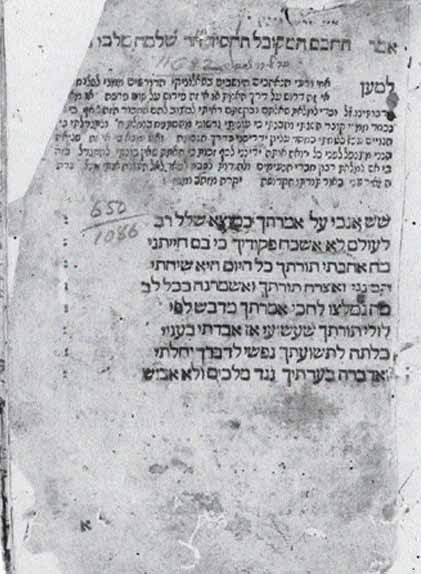
A coterie of disciples gathered about Molcho, before whom he preached eloquent sermons announcing the certainty of an imminent messianic redemption. His disciples prevailed upon Molcho to permit publication of some of those sermons, as Molcho states in the Introduction: "For my dear brothers and friends living in Salonica, who ask of me to send them some expositions and explanations of biblical verses and rabbinic sayings. To fulfill their request I write this work, though I lack the requisite knowledge and understanding, for my sins cast me out of the inheritance of the Lord [i.e., the Jewish people], yet I trust that His divine mercy will lead me along the correct path." Molcho sees the history of the world as a struggle between Esau and Israel. "The evil decrees which befall the Jewish people," he proclaims, "are sent to try them, not to destroy them." The war of Gog and Magog, prelude to the coming of the Messiah, had already begun in 1527, in the sacking of Rome by German and Spanish soldiers; in 1529 when Derashot, later called Sefer Ha-Mefo'ar appeared, Molcho was certain the Messiah would soon appear, probably in 1540; and he began to entertain the idea that he had been chosen for that role.
 |
In a letter to his disciples in Salonica, Molcho wrote: "Seir [the Christian world] will fall into the hands of its enemies. The people of Israel will reveal its power. God will have mercy upon His servants ... I will take vengeance and pay to each his deserts."
Molcho saw visions, announced prophecies-at least two of which, a flood in Rome and an earthquake in Portugal, came to pass-and, in fulfillment of a Talmudic depiction of the Messiah, sat fasting and praying for thirty days with the beggars and the afflicted at the gates of Rome. As he began to act the Messiah, adherents multiplied, and the Pope offered his protection. Together with David Reuveni, Molcho approached the Emperor Charles V, who decided to put an end to this messianic adventure. The emperor took Molcho to Mantua, where he was tried as a heretic, convicted and, after refusing to recant and return to the Christian faith, was burned at the stake. At his martyrdom, Molcho was only thirty-two years old. Many of his disciples were certain that he had survived the flames and awaited his advent as the Messiah in 1540, the promised year of redemption. We look at Molcho's only monument, his Derashot (Sefer Ha-Mefo'ar), a small, worn volume of consolation and hope, a work which bolstered the spirits of a generation painfully recovering from the trauma of apostasy and expulsion, and we shudder at the martyr's death imposed on this well-born, gifted, and favored young man, who gave up all for the love of God and His people Israel.
Sources: Abraham J. Karp, From the Ends of the Earth: Judaic Treasures of the Library of Congress, (DC: Library of Congress, 1991).

Download our mobile app for on-the-go access to the Jewish Virtual Library