Bucharest, Romania
BUCHAREST (Rom. Bucureşti), capital of Romania. Before the union of the Danubian principalities (Moldavia and Walachia) in 1859, it was the capital of the principality of Walachia. Up to the 19th century almost the entire Jewish population of Walachia was concentrated in Bucharest, where the great majority continued to live subsequently. Thus the history of the Jewish community in Bucharest is essentially the history of Walachian Jewry. The community, consisting of merchants and moneylenders from Turkey and the Balkan countries, is first mentioned in the middle of the 16th century in the responsa of several Balkan rabbis (e.g., Samuel de Medina, nos. 5, 54). When Prince Michael the Brave revolted against the Turks in November 1593, he ordered the massacre of the Jews in Bucharest along with the other Turkish subjects. Toward the middle of the 17th century, a new community, now predominantly Ashkenazi, was established. In the 18th century the Jews were concentrated in the suburb of Mahalaua Popescului, but as the community grew, a number began to move to other parts of the city, where they even established synagogues; however, these were closed by the princes. The populace, afraid of Jewish economic competition, was intensely hostile toward the Jews, and in 1793 the residents of the Razvan suburb petitioned Prince Alexander Moruzi to remove Jews who had recently settled there and demolish the synagogue they had erected. The prince ordered the synagogue to be closed (January 1794), but refused to have the Jews removed from the suburb, and a few days later even issued a decree affording them protection. In 1801 there were anti-Jewish riots following blood libel charges, and 128 Jews were killed or wounded. The community again suffered persecution during the Russian occupation of Bucharest from 1806 to 1812, and in particular during the Greek revolt (Hetairia) under Alexander Ypsilanti and its suppression by the Turks in 1821. During this period, the Bucharest Jews, like those elsewhere in Walachia and Moldavia, were organized as an autonomous Breasla Ovreilor ("Jewish corporation") headed by a Staroste ("provost"). The head of the Bucharest community also acted as the deputy of the hakham bashi (Jassy rabbi and Jewish leader of Moldavia), whose authority extended over Walachian Jewry as well. In 1818–21, the Staroste of Bucharest seceded from the authority of the Moldavian hakham bashi and assumed the title independently. The few Sephardi Jews, whose numbers began to increase only at the end of the 18th and the beginning of the 19th century, did not then constitute a separate community, although they had their own synagogue in a rented house in Mahalaua Popescului and in 1811 established their own burial society. In 1818 they were granted permission to build a synagogue. The Bucharest community grew rapidly in the 19th century through immigration. From 127 families registered in Bucharest in 1820 and 594 in 1831, the community grew to 5,934 persons in 1860 and 40,533 (14.7% of the total population) in 1899. (See Table: Bucharest Jewish Population). Under the capitulations system foreign subjects were free from the regular taxation and jurisdiction in Romania. Hence the immigrants questioned the authority of the community leadership and refused to pay the tax on kosher meat, which constituted its sole income. The authorities, drawn into the conflict, at first upheld the traditional rights of the Breasla Ovreilor. Following repeated complaints from both sides, however, as well as constitutional changes in the principality resulting from the promulgation of the Organic Statute (see
*Romania
) in 1832, the community was given a new constitution in that year which severely curtailed its autonomy and placed it under the direct authority and close supervision of the municipality. The Ashkenazi community was again reconstituted in 1843, and the new statute, which further curtailed the community's autonomy, was confirmed with slight changes by the reigning prince in 1851; although never formally abolished, it fell into disuse in the second half of the century. In the meantime the Sephardi Jews (numbering about 150 families in 1854) had founded their own community. Within the Ashkenazi community, the conflicts between the native and foreign-born members continued. Finally, in 1851, the Prussian and Austrian subjects (about 300 families) were permitted to found a separate community. In 1861, a bitter conflict broke out between the native community and the Russian subjects because some articles had allegedly been removed from the Russian synagogue.
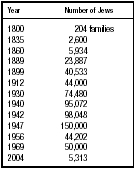 Bucharest Jewish Population Bucharest Jewish Population
| Year |
Number of Jews |
| 1800 |
204 families |
| 1835 |
2,600 |
| 1860 |
5,934 |
| 1889 |
23,887 |
| 1899 |
40,533 |
| 1912 |
44,000 |
| 1930 |
74,480 |
| 1940 |
95,072 |
| 1942 |
98,048 |
| 1947 |
150,000 |
| 1956 |
44,202 |
| 1969 |
50,000 |
| 2004 |
5,313 |
At that time, the Bucharest Ashkenazi community was also torn by violent strife between the Orthodox and Progressive wings (the latter led by
Julius *Barasch
and
I.L. *Weinberg
).
The controversy centered around the modern school opened in 1852 (a year earlier a similar school had been established by Austrian and Prussian subjects) and a proposal in 1857 to build a Choir Temple and introduce certain reforms into the service. The dissension reached its peak when, in 1858,
Meir Leib *Malbim
was called to the rabbinate. He placed himself at the head of the Orthodox wing and a fierce struggle ensued. The conflict also had a social character since the Progressives were drawn mainly from the well-to-do, while the masses were Orthodox. In 1862 the Progressives achieved success; the government deposed Malbim from the Bucharest rabbinate, and in 1864 he was arrested and expelled from the country. The Temple project was resumed in 1864; it was completed in 1866 and became the center of Progressive Jewry and the focus of a variety of cultural and educational activities. Continued quarrels within the community and repeated complaints to the authorities by each of the competing factions brought about in 1862 the government's decision (which applied to the whole country) not to interfere any more with the internal affairs of the Jewish communities and to withdraw from them their official status. The decision, reiterated in 1866, led to the gradual disorganization and dissolution of the Ashkenazi community in Bucharest, which in 1874 had ceased to exist as as organized entity. Several attempts were later made to reconstitute the community, the most serious in 1908. However, it was only in 1919 that an organized Jewish community was again established in Bucharest. Until then various benevolent societies and organizations undertook educational and social welfare activities. Chief among them were the Choir Temple Congregation, formally constituted in 1876 as a separate and independent organization levying its own tax on kosher meat, and the Brotherhood Zion of the B'nai B'rith, founded in Bucharest in 1872 by the American consul B.F.
*Peixotto
. These succeeded in setting up and maintaining a network of educational and charitable institutions, including, in 1907–08, 15 schools, filling the void created by the lack of an organized community. Cultural bodies were also established, and a number of Jewish journals and other publications made their appearance. Bucharest also became the center of Romanian Jewry's political activity and the struggle for emancipation. National Jewish bodies, among them the Union of Native Jews, established their headquarters there. Among the most prominent spiritual and religious leaders of the community before World War I were Antoine Levy and
Moritz (Meir) *Beck
, rabbis of the Choir Temple Congregation from 1867 to 1869 and 1873 to 1923, respectively, and
Yitzhak Eisik *Taubes
, rabbi of the Orthodox congregation from 1894 to 1921. The most prominent lay leader was
Adolf *Stern
. In the 19th century, a high proportion of the Jews in Bucharest were occupied in crafts. There were 2,712 Jewish artisans in the city in 1899. Others engaged in commerce and several, notably Sephardi Jews, were prominent in banking. During the second half of the 19th century a number of anti-Jewish outbreaks occurred in Bucharest. In 1866, when the legislative assembly was discussing the legal position of the Jews, an excited mob started a riot in which the new Choir Temple, then under construction, was demolished. Another serious riot took place in December 1897, when hundreds of Jewish houses and shops were attacked and looted.
After World War I
In the period between the two world wars the Bucharest community grew in both numbers and importance. The Jewish population of the city, now the capital of greater Romania and attracting settlers from all parts of the country, increased from 44,000 in 1912 to 74,480 (12% of the total population) in 1930, and to 95,072 in 1940. About two thirds of those gainfully employed were occupied as artisans, workers, clerks, and shop assistants; others were active in the liberal professions, especially medicine and law. In 1920, the statute of the reconstituted Ashkenazi community was officially approved, and in 1931, following the publication of the new law for the Organization of the Cults, the community was officially recognized as the legal representative of the city's Ashkenazi Jewish population; at the same time the community's statute was amended to conform to the requirements of the law. The organization of the community was again modified by a new statute in 1937. With the reconstitution of the organized community, all Jewish institutions were brought under its jurisdiction. The community's religious, educational and welfare institutions included over 40 synagogues, two cemeteries, 19 schools, a library and historical museum, two hospitals, a clinic, two old-age homes, and two orphanages. The spiritual head of the Ashkenazi community during this period was rabbi
J.J. *Niemirower
, while the outstanding lay leader was
W. *Filderman
. Like many other Jewish communities in Romania, the Bucharest community and its leaders continued to play an important role in the social and political life of Romanian Jewry, representing in particular the attitude of the Jews from the Old Kingdom.
Holocaust Period
In 1941, 102,018 Jews lived in Bucharest, although possibly there were more, due to the influx of refugees from other parts of Romania. Many Jewish properties were "Romanized." Jewish professionals were not allowed to work, and Jewish pupils were excluded from public schools. On January 21, 1941, when the Iron Guard rose in rebellion against Antonescu, Jewish districts, institutions, and persons became victims. The legionnaires robbed Jewish shops, homes, and synagogues. Among the destroyed synagogues was the Sephardi ("Spanish") Great Temple ("Kahal Grande"), considered the most beautiful synagogue in the city. One hundred and twenty-five Jews were murdered; some of the bodies were carried to the slaughterhouse and the words "kosher meat" were written on them. Order was reestablished after three days, but the legal status of the Jews did not improve. The Federation of Jewish Communities was dissolved and its place the Centrala evreilor (Jewish Center) was set up. The only Jewish journal published was Gazeta evreiasca, which was censored. The Jews of Bucharest were obliged to pay high taxes. Many Jewish men were taken
to forced labor. Due to the pauperization of many Jews, the community had to help them. However, Jewish schools – primary, secondary, and higher – were founded. A Jewish theater was opened. A Jewish canteen for the poor also operated. Zionist leaders made efforts to prepare the Jews for emigration to Ereẓ Israel and dealt with the Romanian government in order to enable emigration. At the end of 1943 and in the beginning of 1944 the situation began to improve.
Communist and Post-Communist Period
After a short period of democratization (August 23, 1944–December 30, 1947), and the establishment of the Communist regime in 1947, all Jewish national, cultural, and welfare institutions in Bucharest were gradually closed down. The welfare institutions were nationalized and the schools absorbed in the general educational network. A state Yiddish school was opened in 1949, but closed a few years later. Communal activity was organized by the Federation of Jewish Communities in Romania. Jewish cultural activities centered on the Yiddish theater taken over by the state in 1948. Two Jewish newspapers, the Romanian Unirea, followed later by Viaţa Noua and the Yiddish Ikuf Bleter were published, but both were discontinued in 1952–53. From October 1956 a periodical (sometimes biweekly, sometimes monthly) in Romanian, Yiddish, and Hebrew, Revista Cultului Mozaic ("The Review of Jewish Religion") was published on behalf of the Federation of Jewish Religious Communities. It continued until 1994, when it was superseded by Realitatea Evreiasca, a cultural biweekly in Romanian, Hebrew, and English. The Federation also cared for the religious needs of its members, supplying them with matzot, prayer shawls, prayer books, etc. In the late 1960s, there were 14 regular synagogues in Bucharest, including the Choir Temple. There was also a talmud torah, a "Hebra-Shas" (weekly courses in Talmud), a Yiddish theater, and a kosher restaurant. About 400 Jewish students participated in courses in Hebrew and Jewish history organized by the religious community. Of the 44,202 Jewish (3.6% of the total population) registered in the city in the 1956 census, 4,425 declared Yiddish to be their mother tongue. In 1969 it was estimated that 50,000 Jews lived in Bucharest. After the 1989 revolution, Jewish communal property nationalized by the Communist regime was returned to the Federation of Jewish Communities. Jewish life was re-born. A Jewish publishing house, Hasefer, was founded and many books on Jewish subjects were published. The Center of Jewish History in Romania, founded in 1976 but lacking legal status, obtained legal standing. A department of Jewish studies was founded at Bucharest University. In 2004, 5,313 Jews lived in Bucharest, where three synagogues, a community center, a youth club, an old-age home, a kosher restaurant, three cemeteries, and other institutions operated.
BIBLIOGRAPHY:
M.A. Halevy, Comunitatile Evreilor din Iasi si Buchuresti, 1 (1931); idem, in: Sinai (Bucharest), 2 (1929), xxix–xxxi; 3 (1931), xvii–xxxiv; 5 (1933), lviii–lxiv; idem, Monografia istorica a Templului Coral din Bucuresti (1935); idem, Templul Unirea-Sfanta din Bucuresti (1937); E. Schwarzfeld, in: Anuar pentru Israeliti, 9 (1886), 70–83; 19 (1898), 55–62; M. Schwarzfeld, ibid., 9 (1886), 1–30; 10 (1887), 195–99; J. Barasch, in: Kalendar und Jahrbuch fuer Israeliten (1854), 245–80; idem, in: AZDJ, 8 (1844), 750–1; 9 (1845), 94–5, 108–11, 177–79, 444–47, 480–82; E. Feldman, in: Zion, 22 (1957), 214–38; Anuarul Evreilor din Romania (1937), 161–83; Comunitatea Evreilor din Bucuresti. Raport asupra activitatii cultului mosaic (1943; ms. in: Jewish Historical Archives, Jerusalem, and in: J. Ancel, (ed.), Documents concerning the Fate of Romanian Jewry during the Holocaust, I (1985)); M. Carp, Cartea neagra, 3 vols. (1946–48), index; Herbert, in: Journal of Jewish Bibliography 2 (1940), 110ff.; Ariel, in Analele Societatii Istorice I. Barasch, 2 (1888), 187–208. ADD. BIBLIOGRAPHY: L. Rotman (ed.), Toledot ha-Yehudim be-Romanyah, 5 vols. (1995–2004), index; J. Ancel, Toledot ha-Sho'ah, Romanyah, 2 vols. (2002), index; PK Romanyah, I, 40–76; FEDROM-Comunitati evreiesti din Romania (Internet, 2004).
[Eliyahu Feldman / Lucian-Zeev Herscovici (2nd ed.)]
Source: Encyclopaedia
Judaica. © 2008 The Gale Group.
All Rights Reserved.
|