 |
BIBLE
THE CANON, TEXT, AND EDITIONS
CANON General Titles The Canon THE SIGNIFICANCE OF THE CANON THE PROCESS OF CANONIZATION CONTENTS AND TITLES OF THE BOOKS The Tripartite Canon THE CANONIZATION OF THE TORAH (PENTATEUCH) THE CANONIZATION OF THE PROPHETS THE CANONIZATION OF THE KETUVIM (HAGIOGRAPHA) The Hellenistic Canon The Number of Books The Order of the Books The Languages of Scripture TEXT The History of the Biblical Text THE EARLIEST PERIOD (up to c. 300 B.C.E.) THE SECOND PERIOD (c. 300 B.C.E.-First Century C.E.) THE THIRD PERIOD † (First Century C.E.–Ninth Century C.E.) PRINTED EDITIONS (HEBREW) † TRANSLATIONS ANCIENT VERSIONS Aramaic: the Targumim ORIGIN OF THE TARGUMS MANNER OF USAGE DATE OF TARGUM LITURGICAL USE OF THE TARGUM Targums to the Pentateuch TARGUM ONKELOS PALESTINIAN PENTATEUCH TARGUMS Codex Neofiti I Targum Yerushalmi I (Pseudo-Jonathan) Targum Yerushalmi II (the Fragmentary Targum) The Targums to the Prophets TARGUM JONATHAN TARGUM YERUSHALMI TO THE PROPHETS Targums to the Hagiographa JOB PSALMS PROVERBS FIVE SCROLLS CHRONICLES R. JOSEPH AND THE AUTHORSHIP OF THE HAGIOGRAPHA TARGUMS † Greek: The Septuagint † Old Latin / Vulgate † Samaritan † Syriac Aramaic: Peshitta and Other Versions THE CHRISTIAN-PALESTINIAN VERSION THE PHILOXENIAN VERSION THE SYRO-HEXAPLA † Ethiopic † Egyptian (Coptic) † Armenian † Arabic PRE-SAADIAN TRANSLATIONS SAADIAH's TRANSLATION KARAITE TRANSLATIONS SHARḤ GLOSSARIES † MODERN VERSIONS Introduction FEMINIST SENSITIVITIES OF TRANSLATION JEWISH SENSITIVITIES OF TRANSLATION (NEW TESTAMENT) TRANSLATING THE NAME OF GOD THE NATURE OF BIBLE TRANSLATION Jewish Languages JUDEO-PERSIAN JUDEO-TATAR LADINO (JUDEO-SPANISH) YIDDISH English EARLIEST VERSIONS THE LOLLARD BIBLE THE 16TH–17TH CENTURIES TYNDALE AND HIS SUCCESSORS ANGLICAN, CALVINIST, AND CATHOLIC BIBLES, 1560–1610 THE KING JAMES, OR "AUTHORIZED," VERSION, 1611 1611–1945 ANGLO-JEWISH VERSIONS SINCE WORLD WAR II Introduction Major Versions since World War II Knox Bible [= Knox] (1949) Revised Standard Version [= RSV] (1952) and New Revised Standard Version [= NRSV] (1989) Modern Language Bible [= MLB] (1959) New World Translation [= NWT] (1961) Anchor Bible [= Anchor] (1964– ) Jerusalem Koren Edition (1964) Jerusalem Bible [= JB] (1966) and New Jerusalem Bible [= NJB] (1985) New American Bible [= NAB] (1970) New English Bible [= NEB] (1970) and Revised English Bible [= REB] (1989) New American Standard Bible [= NASB] (1971; rev. 1995) Living Bible [= LB] (1971) Today's English Version [= TEV] also called Good News Bible [= GNB] (1976) New International Version [= NIV] (1978) Other Protestant Translations New Jewish Version [= NJV] (1985) Torah Translations by Jews Conclusion VARIATIONS IN ENGLISH VERSIONS OF PSALM 23 Arabic Catalan Danish Dutch Finnish French and Provençal FRENCH PROVENÇAL German BEFORE LUTHER LUTHER AND THE PROTESTANT BIBLES CATHOLIC BIBLES JEWISH BIBLES IN GERMAN Hungarian Icelandic Italian Norwegian Portuguese Romanish (Raeto-Romance) Romanian Slavonic BULGARIAN CHURCH SLAVONIC CZECH AND SLOVAK POLISH RUSSIAN AND UKRAINIAN SERBIAN AND CROATIAN; WENDISH Spanish Swedish Other Languages In Cyberspace † EXEGESIS AND STUDY TALMUDIC LITERATURE † MEDIEVAL RABBINIC COMMENTARIES The Work of Saadiah Gaon and Its Influence In Spain Literal Commentary Synthetic Commentary Later Commentary † ALLEGORICAL INTERPRETATIONS † EXEGESIS AMONG JEWS IN THE MODERN PERIOD † BIBLE RESEARCH AND CRITICISM Early Moves Toward Critical Study Nineteenth-Century Pentateuch Criticism and Wellhausen The Influence of Archaeology Gunkel and "Form" Criticism "Biblical Theology" Archaeological Evidence Developments in the 1970s Developments in the Late 20th Century † RELATED EPIGRAPHIC FINDS † SOCIOLOGY OF THE BIBLE † RELIGIOUS IMPACT IN JUDAISM In Hellenistic Judaism Talmud and Medieval Times In the Middle Ages and After Modern Times † IN CHRISTIANITY † IN ISLAM † IN THE ARTS LITERATURE MUSIC ART Islamic Art ILLUSTRATED BIBLES IN MEDIEVAL ILLUMINATED MANU-SCRIPTS Illuminated Hebrew Manuscripts ORIENTAL SPANISH ASHKENAZI ITALIAN † This entry is arranged according to the outline below. Bibliography for a section is indicated by (†). THE CANON, TEXT, AND EDITIONSCANONGeneral TitlesThere is no single designation common to all Jews and employed in all periods by which the Jewish Scriptures have been known. The earliest and most diffused Hebrew term was Ha-Sefarim ("The Books"). Its antiquity is supported by its use in Daniel in reference to the prophets (Dan. 9:2). This is how the sacred writings are frequently referred to in tannaitic literature (Meg. 1:8; MK 3:4; Git. 4:6; Kelim 15:6; et al.). The Greek speaking Jews adopted this usage and translated it into their vernacular as τἁ βιβλία. The earliest record of such is the Letter of *Aristeas (mid-second century B.C.E.) which uses the singular form (v. 316, ὲν τῇ βίβλε) for the Pentateuch. The translator of The Wisdom of *Ben Sira into Greek (c. 132 B.C.E.) similarly employs "The Books" to designate the entire Scriptures (Ecclus., prologue, v. 25 "καὶ τἁ λοιπἁ τῶν βιβλίων"). It is from this Hellenistic Jewish usage of τἁ βιβλία, which entered European languages through its Latin form, that the English "Bible" is derived. The term Sifrei ha-Kodesh (Sifre ha-Qodesh; "Holy Books"), although not found in Hebrew literature before the Middle Ages, seems to have been used occasionally by Jews even in pre-Christian times. The author of I Maccabees (12:9), who certainly wrote in Hebrew (c. 136–135 B.C.E.), speaks of "the Holy Books". In the early first century C.E., the Greek writer of II Maccabees 8:23 mentions "the Holy Book" (…τὴν ὶερἁν βίβλον) and toward the end of that century, both Josephus (Ant., 20:261) and Pope Clement I (First Epistle, 43:1) refer to "the Holy Books" (αὶ ὶεραὶ βὶβλοι). The appelation is rare, however, since the increasing restriction of sefer in rabbinic Hebrew to sacred literature rendered superfluous any further description. On the other hand, Kitvei ha-Kodesh (Kitve ha-Qodesh; "Holy Writings"), is fairly common in tannaitic sources as a designation for the Scriptures (Shab. 16:1; Er. 10:3; Yad. 3:2, 5; 4:6; BB 1:6; Par. 10:3). Here the definition is required since the Hebrew כתב (ktb) did not develop a specialized meaning and was equally employed for secular writing (cf. Tosef., Yom Tov 4:4). The title "Holy Writings" was also current in Jewish Hellenistic and in Christian circles, appearing in Greek as αὶ ὶεραὶ γραφαὶ (Philo, Fug. 1:4; Clement's First Epistle 45:2; 53:1), as τἁ ἱερἁ γράμματα (Philo, Mos. 2:290, 292; Jos., Ant., 1:13; 10:210; et al.). Closely allied to the preceding is the title Ha-Katuv ("The Scripture"; Pe'ah 8:9; Ta'an. 3:8; Sanh. 4:5; Avot 3:7, 8, et al.) and the plural Ha-Ketuvim ("The Scriptures"; Yad. 3:5 et al.). These, too, were taken over by the Jews of Alexandria in the Greek equivalent, probably the earliest such example being the Letter of Aristeas (vv. 155, 168, διἁ τῆς γραΦῆς). This term was borrowed by the early Christians (ὴγραΦή John 2:22; Acts 8:32; II Tim 3:16 et al.; αὶ γραφαί Mark 12:24; I Cor. 15:34 et al.; τἁ γράμματα John 5:47). These uses of the Hebrew root ktb ("to write") to specify the Scriptures have special significance, for they lay emphasis on the written nature of the text in contradistinction to the oral form in which the rabbinic teachings were transmitted. In the same way, Mikra (Miqraʾ; lit. "reading"), another term for the Bible current among the rabbis, serves to underline both the vocal manner of study and the central role that the public reading of the Scriptures played in the liturgy of the Jews. The designation is found in tannaitic sources (Ned. 4:3; Avot 5:21; TJ, Ta'an, 4:2, 68a), but it may be much older, as Nehemiah 8:8suggests. It is of interest that Miqraʾ as the Hebrew for "Bible" achieved wide popularity among Jews in the Middle Ages The acronym תנ״ך (TaNaKh), derived from the initial letters of the names of the three divisions of the Bible (Torah, Neviʾim, Ketuvim), became similarly popular. Still another expression for the Scriptures is *Torah, used in the widest sense of the term as the revelation of religion. While it is only occasionally so employed for the Bible in rabbinic literature (cf. MK 5a with respect to Ezek. 39:15; Sanh. 91b citing Ps. 84:5; PR 3:9, in reference to Eccles. 12:12), the fact that νóμος, the Greek rendering of Torah, is found in the New Testament in the same way (John 10:34, quoting Ps. 82:6) indicates that it may once have been in more common use among Jews. Thoroughly Christian is the characterization "Old Testament" (i.e., Covenant; II Cor, 3:14; cf. Heb. 9:15–18). This term is used to distinguish the Jewish Bible from the "New Testament" (i.e., Covenant; I Cor. 11:25; II Cor. 3:6; Christian interpretation of Jeremiah 31:30–32). At the same time, it is possible that the designation "Testament" (i.e., "Covenant," Gr.: διαθήκη) may have been a reflection of an extended use among Jews of the Hebrew berit ("covenant") or Sefer ha-Berit ("Book of the Covenant"; Ex. 24:7; II Kings 23:2, 21). Jeremiah (31:30–32) himself uses "covenant" and "Torah" synonymously, and the "Book of the Torah" found in the Temple (II Kings 22:8, 10) is alternatively styled the "Book of the Covenant" (ibid. 23:2, 21). The Wisdom of Ben Sira (24:23) actually uses the latter term βιβλως διαθήκης) parallel with Torah (νóμος), and a similar usage is found in I Maccabees 1:56–57. [Nahum M. Sarna] The CanonThe term as applied to the Bible designates specifically the closed nature of the corpus of sacred literature accepted as authoritative because it is believed to be divinely revealed. The history of the word helps to explain its usage. "Canon" derives ultimately from an old Semitic word with the meaning of "reed" or "cane" (Heb. קנה), later used for "a measuring rod" (cf. Ezek. 40:5), both of which senses passed into Greek (κάννα, κανών). Metaphorically, it came to be used as a rule or standard of excellence and was so applied by the Alexandrian grammarians to the Old Greek classics. In the second century, κανών had come to be used in Christian circles in the sense of "rule of faith." It was the Church Fathers of the fourth century C.E. who first applied "canon" to the sacred Scriptures. No exact equivalent of this term is to be found in Jewish sources although the phrase Sefarim Ḥiẓonim ("external books"; Sanh. 10:1), i.e., uncanonical, is certainly its negative THE SIGNIFICANCE OF THE CANONThe concept enshrined in the "canon" is distinctively and characteristically Jewish. Through it the canonized Scriptures were looked upon as the faithful witness to the national past, the embodiment of the hopes and dreams of a glorious future, and the guarantee of their fulfillment. They constituted, in time, the main source for the knowledge of Hebrew and typified the supreme standard of stylistic excellence. Through the instrumentality of the Oral Law they represented the force of truth, wisdom, law, and morality. In short, the development of the canon proved to be a revolutionary step in the history of religion, and the concept was consciously adopted by Christianity and Islam. THE PROCESS OF CANONIZATIONIt should be noted, however, that the above refers to the canon solely in respect of its religious connotation. There is evidence that as early as the second half of the second millennium B.C.E., the classical literary texts of Mesopotamia were beginning to assume standardized form. There emerged a widely diffused, recognizable body of literature with fixed authoritative texts, the sequence and arrangement of which were firmly established. This discovery is significant because it provides an important precedent for the external features of canonical literature, and it means that the process of canonical development could have begun quite early in Israel's history. Unfortunately, there is no direct information about the origins of the canon, nor can the criteria of selectivity adopted by those who fixed it be ascertained. It is clear that the books that make up the Bible cannot possibly have contained the entire literary production of ancient Israel. The Scriptures themselves bear testimony to the existence of an extensive literature which is now lost. The "*Book of the Wars of the Lord" (Num. 21:14) and the "*Book of Jashar" (Josh. 10:13; II Sam. 1:18) are certainly very ancient. Prophetic compositions are ascribed to Samuel, Nathan, and Gad (I Chron. 29:29) of the early monarchy period and to Ahijah, Jedo/Iddo, and Shemaiah from the time of the division of the kingdom (II Chron. 9:29; 12:5; 13:22). The references to the chronicles of King David (Chron. 27:24), of Solomon (I Kings 11:41), and of the Kings of Israel and Judah (ibid. 14:19, 29; I Chron. 9:1; II Chron. 16:11; 20:34; 27:7; 32:32; 33:18) all bear witness to royal annalistic sources no longer extant. A category of literature called "Midrash" (II Chron. 13:22; 24:27) is also ascribed to the times of the monarchy, and a book of dirges to the end of that period (II Chron. 35:25). While it is true that in many of these instances it is possible that the same work has been referred to under different titles and that the caption sefer might indicate a section of a book rather than the whole, it cannot be doubted that numerous other works must have existed which were not mentioned in the Bible. In fact, the very concept of a scriptural canon presupposes a process of selection extending over a long period. The quantitative disproportion between the literary productions and the literary remains of ancient Israel is extreme. The main factor at work was the natural struggle for survival. The absence of mass literacy, the labor of hand copying, and the perishability of writing materials in an inhospitable climate all combined to limit circulation, restrict availability, and reduce the chances of a work becoming standard. In addition, the Land of Israel was more frequently plundered and more thoroughly devastated than any other in the ancient Near East. At the same time, in the historical realities of the pre-Exilic period Israel's cultural productions had scant prospects of being disseminated beyond its natural frontiers. Developments within Israel itself also contributed. The change of script that occurred in the course of Persian hegemony doubtless drove out of circulation many books, while the mere existence of canonized corpora almost inevitably consigned excluded compositions to oblivion. Certainly there were other books, including some of those cited above, which were reputed holy or written under the inspiration of the divine spirit, but why they did not enter the canon cannot be determined. The possibility of chance as a factor in preservation cannot be entirely dismissed. Some works probably survived because of their literary beauty alone. A very powerful instrument must have been scribal and priestly schools which, by virtue of their inherent conservatism, would tend to transmit the basic study texts from generation to generation. Similarly, the repertoire of professional guilds of Temple singers would be self-perpetuating, as would the liturgies recited on specific occasions in the Jerusalem Temple and the provincial shrines. Material that appealed to national sentiment and pride, such as the narration of the great events of the past and the basic documents of the national religion, would, particularly if employed in the cult, inevitably achieve wide popularity and be endowed with sanctity. Not everything that was regarded as sacred or revealed was canonized; but sanctity was the indispensable ingredient for canonicity. It was not, in general, the stamp of canonization that conferred holiness upon a book – rather the reverse. Sanctity antedated and preconditioned the formal act of canonization, which in most cases, simply made final a long-existing situation. Of course, the act of canonization, in turn, served to reinforce, intensify, and perpetuate the attitude of reverence, veneration, and piety with which men approached the Scriptures, CONTENTS AND TITLES OF THE BOOKSThe Jewish Bible is composed of three parts, designated in Hebrew: Torah (תורה), Neviʾim (נביאים), and Ketuvim (כתובים). The earliest name for the first part of the Bible seems to have been "The Torah of Moses." This title, however, is found neither in the Torah itself, nor in the works of the pre-Exilic literary prophets. It appears in Joshua (8:31–32; 23:6) and Kings (I Kings 2:3; II Kings 14:6; 23:25), but it cannot be said to refer there to the entire corpus. In contrast, there is every likelihood that its use in the post-Exilic works (Mal. 3:22; Dan. 9:11, 13; Ezra 3:2; 7:6; Neh. 8:1; II Chron. 23:18; 30:16) was intended to be comprehensive. Other early titles were "The Book of Moses" (Ezra 6:18; Neh. 13:1; II Chron. 35:12; 25:4; cf. II Kings 14:6) and "The Book of the Torah" (Neh. 8:3) which seems to be a contraction of a fuller name, "The Book of the Torah of God" (Neh. 8:8, 18; 10:29–30; cf. 9:3). With the widespread dissemination of the Torah in the generations following the activities of *Ezra and *Nehemiah, it became customary, for strictly nonliturgical purposes and for convenience of handling, to transcribe the work on five separate scrolls; hence the Greek name ή πεντάτευχος (βίβλος), "the five-volumed [book]," which has passed into English as Pentateuch. In rabbinic literature the Hebrew equivalent is "The Five Books of the Torah" (Ḥameshet Sifrei Torah; TJ, Meg. 1:7, 70d; Ḥamishah Sifrei Torah; TJ, Sot. 5:8, 20d), or "The Five Fifth-parts of the Torah" (Ḥamishah Ḥomshei (popularly, but inaccurately called Ḥumshei) Torah; Ḥag. 14a; TJ, Sanh. 10:1, 28a; Sanh. 44a). The English names for the books of the Torah – Genesis, Exodus, Leviticus, Numbers, and Deuteronomy – derive from those of the Latin Bible which, in turn, have their origins in titles current among the Greek-speaking Jews, who translated Hebrew designations in use among their coreligionists in Palestine. These titles are descriptive of the contents or major theme of the respective books and they have partly survived in rabbinic literature and medieval Hebrew works in these forms: Sefer Beriʾat ha-Olam ("The Book of the Creation of the World"); Sefer Yeẓiʾat Miẓrayim ("The Book of the Exodus from Egypt"); Torat Kohanim ("The Book of the Priestly Code"); Ḥomesh ha-Pekuddim (Ḥomesh ha-Pequddim; "The Book of the Numbered"), Mishneh Torah ("The Repetition of the Torah"; cf. TJ, Meg. 3:7, 74b et al.). Another method of naming was to entitle a book by its opening word or words, or by its first significant word; cf. the Babylonian "When on High" and "Let me Praise the Lord of Wisdom." This was common in rabbinic sources (Elleh ha-Devarim; "These Are the Words" = Deuteronomy, Sot. 7:8; Gen. R. 3:5; TJ, Meg. 3:1, 74a) and has remained the most popular mode of designation in Hebrew to the present time. Finally, there is also evidence that ordinal numbers were used (cf. Gen. R. 3:5; TJ, Meg. 3:1, 74a). The second division of the Bible is known as Neviʾim ("Prophets"), later subdivided into "Former Prophets" and "Latter Prophets." This distinction, one of convenience only, serves to differentiate between the narrative, historical works – Joshua, Judges, Samuel, and Kings – and the (largely poetic) literary creations of the prophetic orators Isaiah, Jeremiah and Ezekiel, and the Twelve "minor" prophets – Hosea, Joel, Amos, Obadiah, Jonah, Micah, Nahum, Habbakuk, Zephaniah, Haggai, Zechariah, and Malachi. The popular epithet "minor" in connection with these twelve has a solely quantitative connotation and is no indication of relative importance. The names of the books are based upon the central figure or reputed author. The subdivision of the Prophets into "Former" and "Latter" was not known in the modern sense in talmudic times. The rabbis employed "former" in reference to the prophets up to the destruction of the First Temple (Sot. 9:12; Ta'an. 4:2; Sot. 48b; cf. Zech. 1:4; 7:7, 12), and reserved "latter" exclusively for the postexilic prophets; Haggai, Zechariah, and Malachi (Tosef., Sot. 13:2; Sot. 48b). The Ketuvim ("Writings," Hagiographa), the third division of the Bible, is a varied collection composed of liturgical poetry – Psalms and Lamentations; secular love poetry – Song of Songs; wisdom literature – Proverbs, Job, and Ecclesiastes; and historical works – Ruth, Chronicles, Ezra, Nehemiah, Esther, and a blend of history and prophecy in the Book of Daniel. This tripartite division of the Scriptures is simply a matter of historical development and does not, in essence, represent a classification of the books according to topical or stylistic categories. The Hellenistic Jews, apparently sensitive to the more or less random nature of the organization of biblical literature, attempted to effect a more systematic arrangement (see Hellenistic Canon, below). The Tripartite CanonThe earliest sources consistently refer to the three corpora of scriptural books. *Ben Sira, approximately 180 B.C.E., speaks of "the Law of the Most High," "the wisdom of the ancients," and "prophecies" (Ecclus. 39:1). His grandson who wrote the Prologue to the Book of Ben Sira (c. 132 B.C.E.) refers explicitly to "the Law and the Prophets and the others that followed them," "the law and the prophets and the other books of our fathers," "the law…, the prophecies and the rest of the books." The author of II Maccabees (2:2–3, 13) mentions "the Law," "the kings and prophets, the writings of David…." *Philo is familiar with the Law, the "Prophets and the Psalms and other Writings" (Cont. 25). Josephus knows of the "five books of Moses," "the Prophets" and "the remaining… books" (Apion, 1:39–41). The same threefold arrangement is specified in the New Testament. To the author of Luke (24:32, 44) the Scriptures consist of "the Law of Moses and the Prophets and the Psalms." From these sources it becomes clear that the third collection of Scriptures was not known by any fixed name. In fact, it was often not referred to by any name at all. IV Maccabees (18:10) mentions simply the "Law and the Prophets" even THE CANONIZATION OF THE TORAH (PENTATEUCH)Where is this differentiation more applicable than in respect of the Torah. A clear distinction must be made between the literature of the Torah and the Torah book. Whatever the details of the incredibly complex history of the pentateuchal material, it is beyond doubt that much of it is of great antiquity and was venerated at an early period. The traditional doctrine of Mosaic authorship of the entire Torah has its source in Deuteronomy 31:9–12, 24, more than in any other passage. But the reference here seems more likely to be to the succeeding song (Deut. 32), as is indicated by verses 19 and 22. The Torah itself contains no explicit statement ascribing its authorship to Moses, while Mosaic attribution is restricted to legal and ritual prescription and is hardly to be found in connection with the narrative material. Moreover, the term "Torah" (which means "teaching," as well as "rule" and "law," has to be examined in each case in its own context and in no instance can it be unequivocally understood in its later, comprehensive sense. In fact, the phrase "Torah of Moses" is not pentateuchal. An important stage in the history of the pentateuchal canon is the tale of the chance finding of the "book of the Torah" in 622 B.C.E. as described in II Kings 22–23; II Chronicles 34. It is highly significant that there is no suggestion that the book is new. Indeed, given the renewed interest in antiquity, and the veneration of the past that marked the Near East of the seventh century B.C.E. and the following two or three centuries, newness would have been no virtue. The enquiry of the prophetess Huldah and her reply serve to authenticate the book and its message. The "Torah" was publicly read and accepted as binding in a national covenant ceremony. The identity of the book is not given, nor is it termed Mosaic in direct speech (II Kings 23:25 and II Chron. 34:14 are editorial remarks). Yet insofar as the ensuing reform of the cult expresses precisely the leading motifs of *Deuteronomy, it may be assumed that the ceremony described represents the beginning of the formation of the Pentateuch, not as literature, but as a sacred book.
The first report of the reading of the Torah in public assembly subsequent to Josiah comes from the post-Exilic period, namely, the ceremony conducted in Jerusalem by Ezra, approximately 444 B.C.E. (Neh. 8–10). This ceremony cannot be the occasion of the canonization of the Pentateuch, as has often been claimed, since the initiative for the public reading comes from the people and there is no hint that the promulgation of a new law is involved. The book is called "the book of the Torah of Moses which the Lord commanded Israel" (Neh. 8:1) and the emphasis is on its dissemination and exposition. It would appear that the Torah, or at least some form of it, had achieved canonical status. Further evidence that the Torah had already been canonized by this time is provided by the Chronicler and by Samaritan It may safely be assumed that the work of collection, fixing, and preservation of the Torah took place in the Babylonian exile (cf. Ezra 7:14, 25). But our extant sources preserve no recollection of a formal canonization. THE CANONIZATION OF THE PROPHETSThe existence of the Torah Book served as a stimulus to the collection and organization of the literature of the prophets. A consistent tradition, repeatedly formulated in rabbinic sources, regards Haggai, Zechariah, and Malachi as the last of the prophets, the "divine spirit" having ceased to be active in Israel with their death (Tosef., Sot. 13:2; Sot. 48b; Yoma 9b; Sanh. 11a). Indeed, the absence of prophecy was regarded as one of the features that characterized the Second Temple period as opposed to the First (TJ, Ta'an. 2:1, 65a; Yoma 21b). Josephus, too, reflects this same tradition (Apion, 1:39–41). By the middle of the second century B.C.E., the institution was accepted as having lapsed (I Macc. 9:27; cf. 4:46; 14:41). That contemporary prophecy was falling into discredit soon after the return from the exile is clear from Zechariah 13:2–5, and it is quite likely that the closing verses of the last prophetic book (Mal. 3:22–24) are actually an epilogue to the entire collection indirectly expressing recognition of the cessation of prophecy and the hope of its eschatological renewal (cf. I Macc. 4:45; 14:41; 1QS 9:11). The cessation of prophecy could thus be understood ideologically as part of the spiritual punishment that Israel must endure for its sins (Jer. 18:18; Ezek. 7:26; Amos 8:11–12; Micah 3:6–7). More important was the ironic fact that once the writings of the great prophets of the past became immortalized in written form, it became increasingly difficult for living prophets to compete with them. The tradition declaring the prophetic canon to have been closed during the era of Persian hegemony, i.e., by 323 B.C.E., can be substantiated by several unrelated facts. That Chronicles belongs to the Ketuvim and neither displaced nor supplemented Samuel-Kings in the Prophets is best explained on the assumption that the latter were already sealed at the time Chronicles was canonized. Similarly, the omission of Daniel from the Prophets (cf. Sanh. 94a) would be inexplicable if their canonization occurred in Hellenistic times. The absence from the Prophets of Greek words or of any reference to the historical fact of the downfall of the Persian empire and the transition to Greek rule provides further evidence. Notwithstanding assertions to the contrary, the tannaitic discussions about Ezekiel (Ḥag. 13a) have nothing to do with the history of canonization. The suggestion to relegate the book to the bibliocrypt (lignoz) was intended solely to remove it from common use. In fact, only sacred things could be so treated. Apparently, some time must have elapsed between the canonization of the Torah and that of the Prophets, since only the former and not the latter were publicly read at the great assemblies described in Nehemiah 8–10, while the Samaritans, who became schismatic in the days of Ezra or soon after, received the Torah but not the Prophets. THE CANONIZATION OF THE KETUVIM (HAGIOGRAPHA)The third collection of biblical books does not constitute a unified entity either contextually or ideologically. Many of the books were certainly written while prophets were still active and the books were individually canonized quite early. They were excluded from the prophetic collection because their inspiration appeared to be human rather than Divine, or because they did not otherwise conform to the special ideological content or historical-philosophic framework of that corpus. This would be true of such works as Psalms and Proverbs. Other books, like Ezra, Chronicles, and Daniel, must have been written too late for inclusion in the Prophets. They were certainly canonical, as was Job too, by the generation before the destruction of the Second Temple (Yoma 1:6). At the same time, there is plenty of evidence to show that the collection of the Ketuvim as a whole, as well as some individual books within it, was not accepted as being finally closed until well into the second century C.E. As noted above, the practice of calling the entire Scriptures the "Torah and Prophets" presupposes a considerable lapse of time between the canonization of the second and third parts of the Bible. The fact that the last division had no fixed name points in the same direction. Even the finally adopted designation "Ketuvim" is indeterminate, since it is also used in rabbinic Hebrew in the two senses of the Scriptures in general and of individual texts in particular. Other indications of lateness in Ketuvim are that the Song of Songs contains two Greek words (3:9, אַפִּרְיוֹן = palanquin; 4:4, תַּלְפִּיוֹת = τηλῶπις = far-off), as does Daniel (3:5, 15, סוּמְפֹּנִיָה= συμφωνία = bagpipe; 3:5, 7, 10, 15, פְּסַנְתֵרִין = Ψαλτήριον), קיתרס = κίθαρις which even refers to the break-up of the Greek empire (by name 18:21; 11:2) and which most likely did not achieve its final form before approximately 167 B.C.E. (For the influence of Persian and Greek on the Book of Ecclesiastes see *Ecclesiastes.) Ben Sira (c. 180 B.C.E.), who shows familiarity with all other biblical books, does not mention Daniel or Esther. The latter book, in fact, seems not to have been accepted among the sectarians of Qumran; at least no fragments of it have yet turned up among the scrolls from the Judean Desert. Indeed, that there was once a certain reserve in respect of the sanctity of the Book of Esther is apparent from rabbinic discussion (Meg. 7a; cf. Sanh. 100a). The ambivalent attitude on the part of the rabbis to the It is true that in the generation after the destruction of the Temple the author of IV Esdras 14:41–46 (cf. Joseph., Apion, 1:39–41) seems to imply a closed biblical canon of 24 books; nevertheless, tannaitic and amoraic disputes about the canonicity of Proverbs, Song of Songs, and Ecclesiastes (Eduy. 5:3; Yad. 3:5; ARN 1:2), as well as of Esther (Meg. 7a), show that the widely held, though unsupported, view that the formal and final canonization of the Ketuvim occurred at the Synod of Jabneh (c. 100 C.E.) has to be considerably modified. More probably, decisions taken on that occasion came to be widely accepted and thus regarded as final in succeeding generations. The Hellenistic CanonThe needs of the Hellenistic Jews, whether of Alexandria in particular or of the Greek-speaking Diaspora in general, led to the translation of the Bible into Greek. Beginning with the Torah about the middle of the third century B.C.E. the process took many centuries to complete. The formation of much of the Greek canon was thus coeval with the emergence of the Hebrew Bible as a sealed collection of sacred literature. The final product, however, diverged from the Hebrew – apart from the problem of the text – in two important respects. It adopted a different principle in the grouping and sequence of the biblical books, and it included works not accepted into the normative Hebrew canon. It must be understood, however, that, with the exception of a few fragments, all extant manuscripts of the Greek Bible are of Christian origin, and while it is reasonable to assume a Jewish prototype, the content and form of the Hellenistic Jewish canon cannot be known with certainty. The Greek Ben Sira (prologue) clearly shows that the Palestinian tripartite division of the Bible was known in Alexandria in the second century B.C.E.; yet the Greek Bible does away with the Ketuvim as a corpus and redistributes the books of the second and third divisions according to categories of literature, thus creating a quadripartite canon of Torah, history, poetic and didactic writings, and prophecy. The sequence of books in the Greek Bible varies greatly in the uncial manuscripts and among the different patristic and synodical lists of the Eastern and Western churches. The Torah, however, always takes priority, followed by the Former Prophets. Ruth is attached to Judges, sometimes before, sometimes after it. The Minor Prophets invariably appear as a unit, though in slightly different order (Hosea, Amos, Micah, Joel, Obadiah, Jonah, etc.) and frequently preceding the three major prophets. Lamentations is affixed to Jeremiah, its reputed author. Of those books excluded from the Hebrew canon but included in the Greek Bibles, the number varies, but the following are found in the fullest collections: I Esdras (Ezra), Wisdom of Solomon, Wisdom of Ben Sira, Judith, Tobit, Baruch, the Letter of Jeremiah, I–IV Maccabees, and the Psalms of Solomon. The order of the books in the Greek Bibles is illustrated in the table below:
The Number of BooksBy dividing Samuel, Kings, and Chronicles into two books each, and by individually enumerating Ezra, Nehemiah, and the twelve minor prophets, English Bibles usually list 39 books. This reckoning, however, is not traditional, for the twelve were written on a single scroll and counted as one; Ezra and Nehemiah were likewise treated as a unit, and the convenient bisection of Samuel, Kings, and Chronicles was unknown in Hebrew Bibles before the Bomberg edition of 1521 (see Editions, below). In this way the traditional total of 24 books is obtained. This number is consistently specified in the literature of the amoraim (cf. Ta'an. 5a) and is implicit in the tannaitic listing of the biblical books (BB 14b). It must be quite ancient for it is expressly mentioned as something well understood n IV Ezra 14:45, a passage deriving from about 100 C.E. From about this same period derives a variant tradition of Josephus limiting the canon to 22 books (Apion 1:39–41). It is possible that the Song of Songs and Ecclesiastes were not yet included in Josephus' Bible. More likely, however, the difference is to be explained by the practice of attaching Ruth to Judges or Psalms, and Lamentations to Jeremiah. Since many of the Church Fathers also mention a 22-book canon (cf. Origen in Eusebius, Historia Ecclesiastica 6:25, 1), it must be assumed that the observation of Josephus reflects a fairly widespread, if minority, Jewish scribal tradition that persisted for several centuries. Either way, the specified number really refers to the sum of separate scrolls used in transcribing the corpus of canonized literature. The artificiality of the number 24 and the absence of any authentic tradition to explain its origin are clear from the homiletics of the amoraim, who variously connected it with the like number of ornaments in Isaiah 3:18–24 (Ex. R. 41:5; Song. R. 4:11; Tanḥ. B., Ex. 111–117), of priestly and levitical courses in I Chron. 23:28; 24:4 (Num. R. 14:18; Eccles. R. 12:11; PR 3:9), and of the bulls brought as dedicatory offerings by the chieftains of the tribes (Num. 7:88; Num. R. 14:18). It has been suggested, but with little probability, that Jewish practice may have been influenced by the pattern set by the Alexandrian division of the Odyssey and Iliad of Homer into 24 books each, an innovation itself dictated as much by the practical consideration of avoiding the inconvenience of handling a scroll containing more than 1,000 verses as by the desire to create a correspondence with the number of letters in the Greek alphabet. The 24-book division may have been regarded as a model for the national classics, especially because it is a multiple of 12, a number which was charged with special significance in the ancient world, even in the literary sphere. This is evidenced by the 12-tablet division of the Gilgamesh Epic, the 12 sections of the Theogony of Hesiod and the Laws of the Twelve Tablets. The 22-book division might well have been an adaptation of Greek practice to the Hebrew alphabetic enumeration. The Order of the BooksIn considering the arrangement of the biblical books in a specific sequence, two distinct problems have to be differentiated. The first relates to the very meaning of "order," the second to the underlying rationale of the diverse arrangements found in literary sources and manuscripts. The earliest list of biblical books is that preserved in an anonymous tannaitic statement (BB 14b):
The question of "order" would normally apply to books produced as codices, rather than scrolls. However, the above-cited baraita cannot be later than the end of the second century C.E., whereas the codex was not accepted by Jews until many centuries later. Sarna seeks the solution in the library practices of the Mesopotamian and Hellenistic worlds. The steady growth of collections, whether of cuneiform tablets or papyrus rolls, necessitated the introduction of rationalized and convenient methods of storing materials in ways that facilitated identification and expedited usage. At the same time, the requirements of the scribal schools engendered an established sequence in which the classic works were to be read or studied. This combination of library needs and pedagogic considerations would then be what lies behind the fixing of the order of the Prophets and Ketuvim as recorded in the list above. The reference would be to the order in which the individual scrolls in these two corpora were shelved and cataloged in the Palestinian archives and schools. Haran has challenged Sarna's theory on the grounds that the small number of the books of the Bible made literary cataloguing unnecessary. It would have been simple to follow Roman practice and lay out the scrolls on shelves divided by panels. Alternatively, scrolls might have been tagged as they were
at Qumran, and much earlier in Mesopotamia. Haran suggests instead that the baraita reflects a time when scribes had begun to resort to larger scrolls containing several books rather than using one scroll per book. This technological change would have necessitated a fixed order. The silence about the Pentateuch in the baraita is due to the fact that its priority in its long fixed order was so universally known as to make it superfluous. As to the underlying principles that determined the sequence, it is clear that the historical books of the prophetical division are set forth as a continuous, consecutive narrative with Jeremiah and Ezekiel following in chronological sequence. The anomalous position of Isaiah after Ezekiel (reflected also in some manuscripts) (see Table: Order of the Latter Prophets) has been variously explained. According to the Gemara (BB 14b) contextual considerations were paramount:
This explanation is hardly adequate since Jeremiah contains prophecies of comfort and the observation on Isaiah applies only to chapters 40–66. Nor is it likely that the late exilic origin of the last 27 chapters of Isaiah determined its place after Ezekiel, since there is no evidence that the rabbis recognized the heterogeneous nature of the book. More persuasive, perhaps, is the thesis that the sequence Jeremiah, Ezekiel, Isaiah, and the Twelve was conditioned by their respective lengths in decreasing order. There may have been a tendency to place in close proximity prophets who were considered to have been contemporaries so that the great similarity between Isaiah 1:1 and Hosea 1:1 might well have been responsible for the juxtaposition of the books of Isaiah and the Twelve. The baraita gives no list of the Minor Prophets. It simply designates them "the Twelve," implying that the order was well-known and universally accepted. The same conclusion is to be drawn from Ben Sira's reference to "the twelve prophets" (Ecclus. 49:10). Doubtless, the arrangement of the 12 small books, always written on a single roll, was based on chronological principles as understood by the religious authorities responsible for the canonization of the prophetic corpus. The present sequence is uniform in all Hebrew manuscripts and printed editions. No reason for the tannaitic order of the Ketuvim is given in the Gemara, but it may be noted that the 11 books are arranged chronologically in groups according to rabbinic notions of their authorship. Ruth, which closes with the genealogy of David, precedes Psalms, which was ascribed to that king. Job follows, probably because of a tradition assigning the book to the time of the Queen of Sheba (BB 15b; cf. Job 1:15). Proverbs, Ecclesiastes, and Song of Songs were all attributed to Solomon; Lamentations was thought to have been written by Jeremiah; Daniel was credited to the exilic period and the last two to the Persian era. Notwithstanding the tannaitic notice, it would seem that the sequence of the Ketuvim was never really fixed, for the manuscripts and printed editions exhibit a variety of systems (see Table: Order of the Hagiographa). Nevertheless, the differences are restricted to specific books or clusters of books. In the manuscripts and early editions, Chronicles never appears other than at the beginning or end of the corpus. Ezra-Nehemiah is invariably either the penultimate or final book depending on the position of Chronicles. The three larger works: Psalms, Job, and Proverbs, always constitute a group, with Psalms invariably first and the other two interchanging. The Talmud itself lists the "three larger books The most unstable books in respect of their order in the Ketuvim are the five Scrolls (Megillot). Their position varies in the manuscripts and printed editions both as part of the corpus of Ketuvim and as separately attached to the Pentateuch (see Table: Order of the Megillot). Nowhere in rabbinic sources are all five listed in immediate succession, nor is the term "Five Megillot" used. The chronological sequence, according to reputed author, that underlies the tannaitic listing is essentially reflected in another talmudic source which identifies "the three smaller books of the Ketuvim" as the Song of Songs, Ecclesiastes, and Lamentations, in that order (Ber. 57b). In fact, six of eight main variations basically preserve this chronological principle (see Table: Order of the Hagiographa, cols. 1–5, 7). The practice of grouping all five Megillot together has its origin in the custom of reading these books on festival days: the Song of Songs on Passover, Ruth on Pentecost, Lamentations on the Ninth of Av, Ecclesiastes on Sukkot, and Esther on Purim (cf. Soferim 14:1, ed. Higger, p. 251–2). This is the order as it crystallized in the early printed Hebrew Bibles and in some manuscripts and early printed editions of the Pentateuch, to which all five Megillot have been attached.
The final position of Chronicles is most remarkable since Ezra-Nehemiah follows naturally in continuation of the narrative. The anomaly is emphasized by the widespread support it received in the manuscripts and early printed editions. It would appear that the New Testament, too, reflects this arrangement (Matt. 23:35; Luke 11:51). As an explanation, it might be suggested that the position of Chronicles represents the chronology of canonization, though there is no evidence to support this. More likely, it resulted from a conscious attempt to place the biblical books within a narrative framework. Genesis and Chronicles both begin with the origin and development of the human race and both end with the promise of redemption and return to the Land of Israel. The two books actually employ the same key verbs in this connection (Gen. 50:24–25; II Chron. 36:23; עלה, פקד; pkd (pqd), ʿlh). Indeed, the messianic theme of the return to Zion as an appropriate conclusion to the Scriptures was probably the paramount consideration in the positioning of Chronicles. Further evidence that the arrangement of the Scriptures was intended to express certain leading ideas in Judaism may be sought in the extraordinary fact that the initial chapter of the Former Prophets (Josh. 1:8) and of the Latter Prophets (Isa. 1:10) and the closing chapter of the prophetical corpus (Mal. 3:22), as well as the opening chapter of the Ketuvim (Ps. 1:2), all contain a reference to Torah, a conscious assertion of the theological priority of the Torah. The Languages of ScriptureThe books of the Bible have come down in the Hebrew language with the exception of two words in Genesis (31:47), a single verse in Jeremiah (10:11), and sections of Daniel (2:4b–7:28) and Ezra (4:8–6:18; 7:12–26), all of which are in Aramaic. The problem of the language of Scripture is, however, more complicated than would appear on the surface and it constitutes part of the larger issue of the history of the growth and formation of the canon. Some scholars, for instance, regard Job, Ecclesiastes, and Chronicles, as well as the Hebrew sections of Daniel and Ezra-Nehemiah as translations, in whole or part, from Aramaic. This implies that the original is lost, and at once raises the possibility of error in the course of rendition from language to language. It should be noted, though, that in dealing with the problem of translation care must be taken to distinguish between Aramaisms and Aramaic influence on Hebrew style on the one hand, and a translation that may betray its Aramaic substratum on the other. Even works unquestionably composed in Hebrew are not without their linguistic history. In dealing with biblical Hebrew it must be remembered that the language of Scripture represents a period of creativity covering several hundred years during which internal development inevitably took place. In general, it may be said that the poetic texts in the historical books have preserved the earliest strata of the language (Gen. 49; Ex. 15; Num. 23–24; Deut. 32; 33; Judg. 5), while the Hebrew of those works deriving from the postexilic period – like Haggai, Zechariah, Malachi, Ecclesiastes, Chronicles, Ezra-Nehemiah, and Daniel – exhibits features that distinguish the known characteristics of postbiblical Hebrew. In between there are several linguistic layers, the isolation of which is complicated by the relatively small amount of material available for comparison, the difficulties in dating the different documents, and the problem of distinguishing between the age of the material and the period of the final stage of its redaction. Much scholarly effort in recent years has been directed to identifying the specific linguistic features of Late Biblical Hebrew (LBH). Also, it is not known to what extent the editors "modernized" the language of the material they worked with. Comparative Semitic phonology and morphology make it certain that the present system of vocalization of the Hebrew consonants reflects the stage of Hebrew TEXTThe History of the Biblical TextIn the medieval codices of the Hebrew Bible, as in the printed editions to the present times, the text generally comprises three distinct components. These are the consonants, the vowel symbols, and the liturgical, diacritical notations. The latter two elements were invented by the masoretes (see *Masorah) while the history of the consonantal text, with which this section is exclusively concerned, represents the crystallization of a textual critical process of very great antiquity and of remarkable complexity. The second edition of the Rabbinic Bible, edited by Jacob b. Ḥayyim and published by Daniel *Bomberg (Venice 1524/25), served as the model for all future printed editions (see Printed Editions, below). Between this date and that of the most ancient fragments of the Hebrew Scriptures found in the Judean Desert intervenes a period of approximately 2,000 years, and many more centuries of textual transmission separate the earliest documents from the editio princeps of a biblical book. THE EARLIEST PERIOD (up to c. 300 B.C.E.)It is no longer possible to reconstruct the textual evolution of the Hebrew Scriptures between the time of the composition of an individual work and the age of the first known witnesses, approximately 300 B.C.E. The existence of divergent texts of the same books may be postulated since this is the only way to explain the variants in the many passages duplicated in the Bible. (II Sam. 22 = Ps. 18; II Kings 18:13–20:19 = Isa. 36–39; II Kings 24:18–25:30 = Jer. 52; Isa. 2:2–4 = Micah 4:1–3; Ps. 14=53; 40:14–18=70; 57:8–12 = 108: 2–6; 60:7–14 = 108; 7–14; 96 = I Chron. 16:23–33; Ps. 105:1–15 = I Chron. 16:8–22; 106:1, 47–48 = I Chron. 16:34–36; the parallels between Sam.-Kings and Chron.). As late as the 13th century traditions were still preserved about a period of disorder in biblical texts and the textual-critical activities of the "Men of the Great Assembly" (David Kimḥi, preface to his commentary on Joshua). This conclusion is reinforced by the findings from caves in Qumran. Here a plurality of text-types has been discovered – a situation which must represent a state of affairs much older than its earliest documentation. Indeed, it may be argued that the very idea of canonicity carries with it an attitude of reverence for the text and fosters care and accuracy in its transmission. This would be particularly true of a written text since scribal activities would naturally be restricted to a relatively small circle of specialists. Furthermore, the use of sacred literature in public worship and in the curriculum of influential schools would tend to endow a certain version of a scriptural text with greater prestige. All these factors would tend to work in the direction of inhibiting the multiplication of textual versions and would serve to give some text-types greater prominence than others. The situation presupposed here finds support in the history of Mesopotamian literature, where all the evidence points to the emergence of authoritative standard versions of the classical texts by the end of the second millennium B.C.E. As a consequence of this development, the great cuneiform literary texts appear in very limited editions despite wide geographic distribution and considerable chronological variability. A similar state of affairs is discernible in connection with the Greek classics. As early as the sixth century B.C.E. the production of a definitive text of the Odyssey and the Iliad was commissioned by Pisistratus, tyrant of Athens, though this is not necessarily the text that finally became predominant. From the third century B.C.E. on, considerable textual-critical work on the manuscripts of Homer to determine the correct readings was undertaken by scholars at the museum library of Alexandria. There is no reason why the textual history of the sacred Scriptures of Israel should have been more anarchic than that of the Mesopotamian and Greek classics. In fact, the existence of a fixed text of at least part of the Torah before the close of the pentateuchal canon is presupposed by the injunction in Deuteronomy (17:18–19) that the king have a copy of the law transcribed for himself for purposes of regular study, as well as by the prescription to hold a periodic public reading of the Law from an official copy deposited in the central sanctuary (Deut. 31:9–12, 26). There is no way of knowing, however, whether any one recension achieved greater national importance or prominence within this period. It can only be concluded that since the prototype of the text-family that ultimately achieved hegemony is present at Qumran, the history of that text must be much older. THE SECOND PERIOD (c. 300 B.C.E.–First Century C.E.)The starting point, it should be noted, is somewhat arbitrary and is conditioned by the fortuitous existence of manuscript documentation; and the limiting point is fixed by the observation of a radical change after the destruction of the Temple. The evidence for development within this period involves Hebrew sources and Greek translations and is both direct and indirect. It is characterized by the diversity of text-types, though the number seems to have been very limited and each family of manuscripts appears to have maintained its homogeneity over a long period of time. Until the discovery of the *Dead Sea Scrolls, the evidence of textual diversity in this period consisted mainly of the Samaritan *Pentateuch and the Septuagint; the latter must have been translated from a Hebrew source at variance This fluidity of text is precisely the situation that was revealed at Qumran, particularly Cave IV which has yielded about 100 manuscripts, complete or fragmentary. The outstanding phenomenon is the ability of the sect to tolerate, with no apparent disquiet, the simultaneous existence of divergent texts of the same book, as well as verbal and orthographic variety within the scope of a single recension. Clearly, an inviolable, sacrosanct, authoritative text did not exist at Qumran. Whether the identical conclusion is also valid for the normative Jewish community of Palestine in this period is less certain. It is true that there is nothing specifically sectarian about the Qumran Bible scrolls, either in the scribal techniques and conventions employed or in the nature of the divergent readings, which are decidedly neither tendentious nor ideological. Nevertheless, caution must be exercised in the use of the Qumran evidence for reconstruction of a generalized history of textual development in this period. The lack of more examples of the masoretic text-type may be solely accidental. It is also possible that this is less a library than a genizah which would tend to preserve discarded texts and so present a distorted picture. In many instances, the fragments are very small and are only disjecta membra, making the derivation of overall characteristics very hazardous. Finally, the isolated, cloistered, and segregated existence led by the sect of "covenanters," with its implacable hostility to the Jerusalem religious establishment, could well have insulated Qumran from normative developments elsewhere in Judea, where a less tolerant approach to textual diversity may have prevailed. In fact, the rabbinic testimony cited above demonstrates the existence of a movement away from a plurality of recensions and toward textual stabilization. The textual-critical activities of the soferim are all directed to this end and they are expressly reported to have worked on a text fixed even in respect of the number of its letters (Kid. 30a). Whatever its intrinsic worth this talmudic tradition could not have arisen among the rabbis had the fixing of the text been recent. The presence of Temple-sponsored "book correctors" implies the acceptance at some point in the Second Temple period of an authoritative text by which the accuracy of other scrolls was measured (Ket. 106a; TJ, Shek. 4:3, 48a; Sanh. 2:6, 20c). The record of the variant Temple scrolls is a tradition concerned with an attempt to ensure just such a standardized recension. Indeed, that there existed an official Temple Scroll (Sefer ha-Azarah) which enjoyed high prestige is amply attested in rabbinic sources (TJ, Sanh. 2:6, 20c; Shek 4:3, 48a; MK 3:4; Kelim 15:6; cf. Jos., Wars, 7:150, 162), though it is not possible to tell exactly to what period they refer. Certainly, the seven rules of biblical hermeneutics, compiled but not invented by Hillel the Elder (Tosef., Sanh. 7:11; ARN1 37, 110; cf. Pes. 66a; TJ, Pes. 6:1, 33a), take the history of the attempt at textual stabilization at least back to the time of Herod. Soon after the destruction of the Temple, Josephus (Apion, 1:8) wrote about the inviolate nature of the text of the Jewish Scriptures and it is clear that he regarded this as a virtue of long standing. Further proof for the existence of the notion of an authoritative text is provided by the Letter of Aristeas which is well aware of the circulation of carelessly written books of the Law (Arist. 30) and has Ptolemy send to the high priest in Jerusalem for a Hebrew text from which to make the Greek translation (ibid., 33–40, 46; cf. 176). Once produced, this translation itself came to be regarded as sacrosanct by the Jews of Alexandria (ibid., 311). Nevertheless, there is evidence from Qumran that the Greek translation was the object of much recensional activity, the purpose of which was to bring it into line with developments in the Hebrew texts current in Palestine. This phenomenon reveals, once again, both that the Hebrew text was still fluid and that there was a movement toward textual stabilization. Within this period the notion of an authoritative text was well rooted outside the Qumran community. A very limited number of textual families is discernible, probably each having achieved local authority. Each family, however, exhibits internal textual variety. The religious leadership in Jerusalem appears to have recognized a fixed text and to have been engaged in textual-critical activity aligning divergent exemplars with it. The beginnings of this movement may possibly be traced to the Maccabean victories. At any rate, the recensional family that ultimately crystallized into what came to be known as "masoretic" is well represented among the Qumran collection, the most outstanding example being the Isaiah scroll (1QIsb). THE THIRD PERIOD † (First Century C.E.–Ninth Century C.E.)The existence of an official text with binding authority from the generation of the destruction of the Temple is clearly reflected in halakhic discussions. Zechariah b. ha-Kaẓẓav, who was apparently a priest in the Temple (cf. Ket. 2:9), based legal decisions on the presence of a conjunctive vav (Sot. 5:1). *Nahum of Gimzo, of the first generation of tannaim, employed the principle of "extension and limitation" in the interpretation of certain Hebrew particles (Ḥag. 12a; Pes. 22b), a hermeneutical system later developed to the full by R. *Akiva to whom not a word of the Torah, nor even a syllable or letter, was superfluous. Hence, he could derive a multiplicity of rules from each tittle on the letters of the Torah (Men. 29b). He, It is true that in the generation after R. Akiva copies of the Torah made by R. Meir might still contain a few textual oddities (Gen. R. 9:5; 20:12), and medieval tradition could retain a record of variant readings found in a Torah scroll stored in the synagogue of Severus in Rome (Bereshit Rabbati, ed. Albeck, p. 209). It is also true that rabbinic literature has preserved several hundred deviations from the received text in scriptural quotations and in reconstructed readings underlying a specific piece of midrashic exegesis, while the same phenomenon may be discernible in citations in Jewish Palestinian apocryphal and pseudepigraphical literature, in the New Testament, and in the Church Fathers. Even in the third century C.E., R. Ammi, a Palestinian amora, might still find it necessary to warn against the retention of "uncorrected books" for more than 30 days (Ket 19b). Nevertheless, at this period all this constitutes a survival and not a living tradition. The hegemony of the masoretic-type text is amply attested, apart from halakhic sources, by two independent classes of witnesses. On the one hand, the Hebrew biblical scrolls and fragments discovered at Masada (66–73 C.E.), at Wadi Murabbaʿat, and at Naḥal Ḥever (both from c. 132–35 C.E.) are all practically identical with the received text. On the other hand, the Jewish Greek translation of the Minor Prophets found in Naḥal Ḥever, and the second-century Greek translations of the Bible attributed to *Aquila, *Symmachus, and Theodotion all testify to revisions of the Septuagint attempting to bring it closer to a masoretic-type Hebrew text which had become exclusively authoritative. Whether this development resulted from an official promulgation by accepted religious authorities, or whether it was the culmination of a long period of growth during which the masoretic type had always represented the mainstream of tradition can no longer be determined. Whatever the case, no further developments of any significance in the biblical Hebrew consonantal text took place during the 600 years that elapsed between the latest manuscripts from the tannaitic period (c. 200 C.E.) and the earliest medieval ones (c. ninth century C.E.). None of the medieval manuscripts and codices, and not even the thousands of Bible fragments from the Cairo *Genizah represent a recension different from the received text. See also *Masorah, *Poetry in the Bible. BIBLIOGRAPHY:F. Buhl, Canon and Text of the Old Testament (1892); C.D. Ginsburg, Introduction to the Massoretico-Critical Edition of the Hebrew Bible (1897), repr. 1966 with a prolegomenon by HM Orlinsky; V. Aptowitzer, Das Schriftwort in der rabbinischen Literatur (1906–15); H.E. Ryle, The Canon of the Old Testament (1909); H.B. Swete, An Introduction to the Old Testament in Greek (19682); L. Ginsberg, in: JBL, 41 (1922), 115–36; M.L. Margolis, Hebrew Scriptures in the Making (1922); G.F. Moore, Judaism… (1927–30); A. Geiger, Urschrift und Uebersetzungen der Bibel… (1928); S. Zeitlin, in: PAAJR, 4 (1932), 169–223; R. Gordis, Biblical Text in the Making (1937); J. Ph. Hyatt, in: BA, 6 (1943), 71–80; E. Urbach, in: Tarbiz, 17 (1945/46), 1–11; B.J. Roberts, Old Testament Text and Versions (1951); Y. Kaufmann, Toledot; E.A. Parsons, The Alexandrian Library (1952); M.H. Segal, in: JBL, 72 (1953), 35–47; idem, Mevo ha-Mikra (1956); L.J. Liebreich, in: HUCA, 25 (1954), 37–40; C.H. Robert, in: British Academy Proceedings (1954), 169–204; M. Weitemyer, in: Libri, 6 (1955–56), 217–38 (Eng.); M. Greenberg, in: JAOS, 76 (1956), 157–67; P. Katz, in: ZNW, 47 (1956), 191–217; M. Haran, in: Tarbiz, 25 (1955/56), 245–71; I.L. Seligmann, ibid., 118–39; P.W. Skehan, in: VT Supplement, 4 (1957), 155–60; W. Hallo, in: IEJ, 12 (1962), 13–26; idem, in: JAOS, 83 (1963), 167–76; 88 (1968), 71–89; S. Lieberman, Hellenism in Jewish Palestine (1950); D. Barthélemy, Les Devanciers d'Aquila (1963); F.M. Cross, in: HTR, 57 (1964), 281–99; idem, in: IEJ, 16 (1966), 81–95; idem, in: BA, 28 (1965), 87–100; E. Wuerthwein, Text of the Old Testament (1957); M.H. Goshen-Gottstein, Text and Language in Bible and Qumran (1960); idem, in: Textus, 2 (1962), 28–59; 5 (1966), 22–23 (Eng.); idem, in: A. Altmann (ed.), Biblical and Other Studies (1963), 79–122; idem, in: Biblica, 48 (1967), 243–90 (Eng.); P. Kahle, The Cairo Geniza (19592); S. Talmon, in: Textus, 1 (1960), 144–84; 2 (1962), 14–27; 4 (1964), 95–132 (Eng.); F.G. Kenyon, Our Bible and the Ancient Manuscripts (19654); N.M. Sarna, in: Essays in Honor of I.E. Kiev. ADD. BIBLIOGRAPHY: Traditional commentaries on the Torah: Torat Ḥayyim: Ḥamisha Ḥumshe Torah (Genesis-Deuteronomy complete in 7 vols), Jerusalem: Mosad Harav Kook: 1986–1993; The English translation of the Bible by the Jewish Publication Society of America was completed as follows: Torah: 1962; The Prophets: 1978; The Writings: 1982. The entire work is now in one volume: Tanakh: A New Translation of the Holy Scriptures According to the Traditional Hebrew Text, Philadelphia/New York/Jerusalem: Jewish Publication Society, 1985. All of the following contain extensive bibliographies. The most recent work on the textual history and criticism of the Bible is: Emanuel Tov, Textual Criticism of the Hebrew Bible, Minneapolis: Fortress Press and Assen/Maastrict: Van Gorcum, 1992. A major reference work in biblical studies is the now-complete Enẓiklopediyyah Mikra'it in Hebrew: E.L. Sukeinik (dec.), U.M.D. Cassuto (dec.), H. Tadmor, and Sh. Ahituv, editors, Enẓiklopediyyah Mikra'it (= Encyclopaedia Biblica), Vols. 1–9, Jerusalem: Mosad Bialik, 1950–1988. Other reference works in biblical studies are: David Noel Freedman, editor-in-chief, Anchor Bible Dictionary, complete, Vols. 1–6, New York/London/Toronto/Sydney/Auckland: Doubleday, 1992; G.J. Botterweck, Helmer Ringgren and, Heinz-Josef Fabry, editors, Theological Dictionary of the Old Testament, Volumes 1–7 covering א through ל, Grand Rapids, MI: Eerdmans, 1974–1995 (trans. of Theologisches Wörterbuch zum Alten Testament, [Nahum M. Sarna / S. David Sperling (2nd ed.)] PRINTED EDITIONS (HEBREW) †The story of the printing of the Hebrew Bible begins with the 1477 edition of the Psalms, most probably produced at Bologna. Each verse is followed by the appropriate passage from David *Kimḥi's commentary, an arrangement which does not appear again in Hebrew Bibles. Since the first printers had considerable difficulty with the vowel-points, they abandoned them after Psalm 4:4, excepting only three consecutive verses, 5:12–6:1. Many words are printed plene (with vowel letters (matres lectionis, Heb. immot ha-keri'ah)), including even yod for segol. There are frequent errors, whole verses (108), half verses (3), and odd words (43) are omitted, and there are dittographs both of letters and of words. The next venture was due to the ẓedakot ("charities") of the rich and pious Joseph b. Abraham Caravita. Knowing that the vigor of Judaism depends on serious and continued reading and study of the Bible, many wealthy Jews employed scribes to copy manuscripts in order to foster this study. In Spain they continued using scribes, but Jews in Italy quickly realized that the invention of printing with movable type would enable them to ensure the more effective dissemination of the Bible. In 1479–80 Joseph b. Abraham invited from Ferrara to Bologna Abraham b. Ḥayyim di Tintori, a master craftsman who had largely solved the problems of both vowel-points and accents. The result of this move was the Bologna Pentateuch of 1482, which set the pattern for many future editions, culminating in the Bomberg rabbinic Bibles of the next century. The folios consist of Rashi's commentary across the page, top and bottom, with the Hebrew text in the inner and wider column and Targum Onkelos in the outer column. The type is larger than that of the 1477 psalter, but, as in some Ashkenazi manuscripts, the final letters kaf, nun, and pe do not extend below the base-line of other consonants, so that it is virtually impossible to distinguish between dalet and final kaf. A little later, a certain Israel Nathan b. Samuel moved to Soncino, a small town in the duchy of Milan. There he set up a printing press for his son, and this was the beginning of the great firm of Joshua Solomon *Soncino and his nephews, Moses and Gershom. Attracting Abraham b. Ḥayyim from Bologna, they produced the first complete Bible, the Soncino Bible of 1488, with vowels and accents, but without a commentary, as was the custom of the Soncinos. The Soncino brothers also were responsible for the 1491–93 Naples Bible, in which the vowel-points and accents are better placed than before. Gershom Soncino moved to Brescia, where he produced the 1495 Brescia Bible, an improved edition of the 1488 Soncino Bible, but, more important, in small octavo format, making it a pocket edition specifically produced for the persecuted Jews who, perpetually moving from place to place, found it difficult to carry the huge and costly folio Bibles. It was this edition which Martin Luther used when he translated the Bible into German. In Spain a Hebrew Pentateuch with Targum and Rashi was printed by Solomon Salmatic b. Maimon in 1490 at Ixar (Hijar). There were also printing presses in Portugal, where in 1487 the Faro Pentateuch was produced. In this edition the printer was unable to solve the problem of placing a dot in the middle of a consonant, so there is no dagesh. This was followed in 1491 by the Lisbon Pentateuch in two volumes with the Targum and Rashi's commentary, and in the next year by Isaiah and Jeremiah at Lisbon and Proverbs at Leira. The expulsion of the Jews from Spain (1492) put an end to the printing of new editions of the Bible, both in Portugal and Italy, for wealthy Jews needed all their means to help the refugees, over a quarter By the year 1511 the Soncinos, now at Pesaro, were able to make a new start and in stages they completed a fourth edition of the complete Bible. Gershom had used the interval to perfect his technique and this edition is the best produced by Ashkenazi Jews in Italy. Around this time Daniel *Bomberg, a Christian merchant of Amsterdam, arrived in Venice and established his printing office there. In 1516–17 he published the first Great Rabbinic Bible, edited by Felix Pratensis, who was born a Jew but was baptized in 1506. The work is in four volumes, with Targums and commentaries. For the first time the kerei is given, but in the variants in the margin (see *Masorah). The last volume contains additional material, notably Maimonides' "Thirteen Articles" and the treatise on accents entitled Dikdukei ha-Te'amim said to be by *Ben Asher and here printed for the first time. Here also for the first time in Hebrew Samuel and Kings were each divided into two books in imitation of the Vulgate. The strangest thing about this edition is the statement made to the pope when his imprimatur was sought; it claimed that the many previously printed Bibles "contain as many errors as words" and that "no one had attempted it before." Daniel Bomberg and Felix Pratensis duly received the pope's blessing, though it proved more of a hindrance than an asset. Even before this four-volume Bible was published, Bomberg realized that he had made two bad mistakes: employing an apostate Jew as his editor, and requesting the pope's imprimatur. He therefore remade the columns as soon as the folios of the large Bible had been run off and issued a quarto edition at the same time, this time without any mention of either editor or pope. A second edition was called for within four years, when the whole was reset; on this occasion the two sons of Baruch Adelkind were mentioned as printers, and great emphasis was laid on the fact that they were Jews, thoroughly Orthodox and already engaged in printing the whole of the Talmud. However, something had to be done about the Great Rabbinic Bible, and, as though divinely guided and certainly opportunely, Jacob b. Ḥayyim ibn Adonijah arrived in Venice after his family had been driven out of Spain and again out of Tunis. After seven penurious years of wandering Jacob b. Ḥayyim found work with Bomberg in Venice. The chief fruit of the partnership was the second Great Rabbinic Bible of 1524–25, the text of which became the standard masoretic text and continued as such for 400 years. Jacob b. Ḥayyim was very conscious of the importance of the masorah as the guarantee of the correct text, and he went to great pains and undertook several journeys to secure as many codices with a masorah as possible. Thus, for the first time, there was a printed Hebrew Bible with a marginal masorah. As the editor discovered that "the masorah did not harmonize with the majority of the codices," he had to exercise his discretion. The edition was in four volumes, with Targums, and with commentaries by Rashi, Ibn Ezra, David and Moses Kimḥi, and Levi b. Gershom. A third Bomberg quarto edition appeared in 1525–28, the text being a combination of that of Felix Pratensis and that of Jacob b. Ḥayyim. Daniel Bomberg's tribulations were not over, for soon after 1525 Jacob b. Ḥayyim became a Christian. In 1527 Elijah *Levita, a refugee originally from Neustadt near Nuremberg, came to Venice and found employment with Bomberg. No more is heard of Jacob b. Ḥayyim, Elijah Levita being henceforth chief adviser to the Bomberg firm. In subsequent reprints of the 1524–25 Bible, there is no mention of the editor. Bibles printed after 1525 all follow substantially the text of Jacob b. Ḥayyim ibn Adonijah until *Buxtorf's small-format Bible of 1611 and his four-volume rabbinic Bible of 1618–19, printed at Basle, in which the text was influenced by Sephardi traditions, and not dominated by the Ashkenazi ones as were all previous editions printed under Jewish auspices. The text was edited by Jablonski in 1699, but the most important edition based on the Buxtorf text is that of J.H. Michaelis in 1720. It is a critical edition, quoting 19 printed editions and five Erfurt manuscripts, especially the very important Erfurt 3 with its masorah, and containing also Okhlah ve-Okhlah, an 11th-century masoretic work of great importance then printed for the first time. The critical notes and the variants provided by Michaelis indicate a masoretic tradition different from that of the 1524–25 Bible of Jacob b. Ḥayyim. They form a pattern, already discernible in Jablonski's 1699 edition, but more clearly in *Lonzano's Or Torah and *Norzi's Minḥat Shai. Norzi depended mostly on the de'Rossi codex 782, which had a strange, disturbed history, though *de'Rossi (vol. 1, p. 128) recognized it as "the most perfect examplar of the masoretic text." This tradition must have come to Spain at a comparatively early date, and it is firmly established in Sephardi tradition. It is responsible for at least some of the differences between the Complutensian Polyglot and the standard text based on Ashkenazi codices. Michaelis' critical edition is an early and neglected precursor of the modern editions of the Hebrew Bible, those by P. Kahle and N.H. Snaith. The story of modern times begins with Seligmann *Baer, who published the Hebrew Bible in single volumes with notes, except for Exodus to Deuteronomy (for which see the Roedelheim Pentateuch, a popular edition without notes). The dates of these volumes are 1869–1895. Baer believed that the masorah is supreme, that firm rules can be established, and that The 1928 Foreign Society (N.H. Snaith) edition was based mainly on British Museum's mss. Orient. 2626–28, a beautifully illustrated codex, close to the notes of Lonzano, Norzi, and the tradition found in the 1720 Michaelis Bible. The text, though compiled from completely different sources, is very close to the Kahle text. This indicates that the Ben Asher text is to be found not only in Leningrad manuscript but also in the best Sephardi manuscripts (in the first hand, and not as corrected by a second hand to the Ben Ḥayyim tradition, as often happened after 1492 when the exiled Jews came into close contact with the other traditions). Recent years have witnessed great progress towards the production of a truly critical edition of the Hebrew Bible. Despite its superiority to previous efforts the numerous shortcomings of BH3 pointed out by reviewers necessitated a fourth edition (including variants from biblical manuscripts from Qumran), Biblia Hebraica Stuttgartensia (BHS) published in 1977. Differing in kind from its predecessors a new Biblia Hebraica edition Quinta (BHQ) is appearing in fascicles. (Megilloth appeared in 2004). In the manner of of its predecessors BHQ uses Leningrad as a base text, but includes the large and small masorah with the text accompanied by a single critical apparatus. When completed BHQ will be printed as a single volume, accompanied by a separate volume with translations, notes, and commentary on the masorah. Even more ambitious is the multi-volume Hebrew University Bible Project (HUBP), based on the excellent but incomplete Aleppo codex (ca. 925). HUBP has four separate apparatuses and suggests no conjectural emendations. Of special note is the inclusion of variants recovered from biblical citations in rabbinic literature. Thus far three volumes have appeared: Isaiah (1995), Jeremiah (1997), and Ezekiel (2004). Of interest too is N. Ben-Zvi (ed.), Jerusalem Crown: The Bible of the Hebrew University of Jerusalem (2000), Not to be confused with HUBP, Jerusalem Crown is an aesthetically pleasing "scholarly manipulation" (Sanders 2004) of the Aleppo and Leningrad codices into a rabbinic Bible. Bibles containing the original Hebrew text (or Greek in the case of New Testament) together with the important ancient versions arranged in parallel columns are termed polyglots. They were at one time important in ascertaining correct readings or meanings of the text. The oldest one in print is the Complutensian Polyglot, mentioned above containing the Hebrew masoretic text, the Vulgate, the Aramaic Targum (with a Latin translation), and the Septuagint (with a Latin translation). The most comprehensive are Brian Walton's London Polyglot (1654–57) which contained texts in Hebrew, Samaritan, Aramaic, Greek, Latin, Ethiopic, Syriac, Arabic, and Persian (all with Latin translations), and Samuel Bagster's Polyglot (1831) in Hebrew, Greek, Samaritan, Latin, Syriac, German, Italian, French, English, and Spanish. More modern polyglots have contented themselves with giving the texts in Hebrew, Greek, Latin, and a modern language. BIBLIOGRAPHY:C.D. Ginsburg, Introduction to the Massoretico-Critical Edition of the Hebrew Bible (1897), repr. 1966 with introd. by HM Orlinsky; E. Levita, Massoreth ha-Massoreth and the Introduction of Jacob ben Chayyim ibn Adoniyah to the Rabbinic Bible of 1525, ed. by C.D. Ginsburg, introd. by N.H. Snaith (1967). ADD. BIBLIOGRAPHY: M. Haran, in, JANES, 22 (1993), 51–61; M. Cohen, www.cs.anu.edu/au…cohen art; A. Hurvitz, in, SVT, 80 (2000), 143–60; L. McDonald and J. Sanders (eds.), The Canon Debate (2002); J. Sanders, in: JBL, 118 (1999), 518–26; idem, Review of Biblical Literature 03/2004 (at www.bookreviews.org); E. Tov, "Writing of Ancient Biblical Texts," in: C. Cohen et al (eds.), Sefer Moshe (FS Weinfeld; 2004), 445–58. [Norman Henry Snaith / S. David Sperling (2nd ed.)] TRANSLATIONSANCIENT VERSIONSAramaic: the TargumimThe word targum (תַּרְגּוּם) means "translation," corresponding to the verb tirgem (תרגם; "translate"), of which passive participle, meturgam, occurs in Ezra 4:7: "The letter was written (katuv) in Aramaic and translated" (meturgam; the second mention of "Aramaic" in the verse is a note to the reader that the Aramaic version of the letter follows (Blenkinsopp 109–10)). There are no other biblical attestations of trgm. In Jewish Babylonian Aramaic the verb trgm means "translate into Aramaic," "explain." In Syriac the verb means "explain," "translate" (Sokloff DJBA, 1231–32). In Jewish Palestinian Aramaic trgm means "translate" into any language (Sokoloff, DJPA, 591). In Samaritan the verb means "translate," "relay the message" (Tal, DSA, 963). Tirgem is a denominative verb, being derived from the noun turgeman. The term may have entered Hebrew and Aramaic through Akkadian targumānu ("interpreter") whence, ultimately, the English dragoman. The ORIGIN OF THE TARGUMSThe Jewish diaspora in Babylonia must have exchanged Hebrew for Aramaic as its vernacular in only a few generations. In Palestine the process was much more gradual, but Aramaic was probably the language of the majority of Jews there before the end of the Persian period. During the period of Persian domination (539–333 B.C.E.), Aramaic was the language of the Persian administration and the lingua franca of southwestern Asia. The bilingual character of the books of Ezra and Daniel is due to the attempt to make these books more "biblical" by providing them with Hebrew beginnings, but they reflect a period of Aramaic dominance. The practice of translating the Bible reading into Aramaic in the synagogue is attributed to Ezra by *Rav (third century C.E.), who interprets the word meforash in Nehemiah 8:8 to mean an interpretation of the Hebrew text of the Bible in Aramaic translation (Meg. 3a; Ned. 37b; cf. TJ, Meg. 4:1, 74d), but both the meaning of the word and the reliability of the account in Nehemiah 8 are subjects of controversy. At any rate the custom of interpreting the synagogue reading of the Bible text with the Targum after each verse (or after each three verses) in the presence of the congregation, so as to permit a translator to repeat it in Aramaic, is attested in the Mishnah (Meg. 4:4). MANNER OF USAGEThe professional translator of the Hebrew Bible text in the synagogue was called meturgeman (Meg. 4:4). His oral explanations were given along with the reading of the Sabbath lesson. The rules for reading the Targum are formulated in the halakhah (Meg. 4:4–10; Meg. 23b–25b; Tosef., Meg. 4:20–41). The Targum was to be read after every verse of the parashah of the Pentateuch and after every third verse of the reading from the Prophets. There is no mention in this source of reading from a written Targum, and elsewhere (TJ, Meg. 4:1, 74d) the use of such writings was forbidden, at least for the Pentateuch, for the Sabbath worship service, but the preparation and use of them by individuals for private study and school instruction was permitted. Although certain portions of the Bible were read but were not translated (as Gen. 35:22), others were neither read nor translated (as Num. 6:24–26; II Sam. 11–13). *Judah b. Ilai, a tanna, and a pupil of Akiva rhetorically expressed the difficulty faced by all Bible translators in his declaration that whoever translates (ha-metargem) a verse of Bible literally is is a fictionalizer, while he who makes additions is a blasphemer (Tosef., Meg. 4:41; Kid. 49a). A later anonymous opinion (Kid. 49a) cites Judah's statement as proof that one may not translate the Bible on one's own but must translate only from "our targum," i.e., Onkelos (see below). In Sifrei (Deut. 161), the Targum is mentioned as a branch of study that falls between the Bible and the Mishnah. The Targums as a whole are not always primarily literal translations of the corresponding Hebrew text; they are often intermingled with various paraphrases and aggadic supplements such as one meets in exegetical or homiletic works like the Talmud and the Midrash. They also contain explanations and alterations adapted to secure the sense of the masoretic text current among the rabbinical authorities, offering it to the people in an intelligible form. In this period an important concern of Jewish criticism and exegesis was the need to remove or tone down all references to God that could lead to misunderstanding in the popular mind. The Targum thus employs various devices to obviate the appearance of a very distinct anthropomorphic character of God. These, however, are not consistently applied. Indeed at times anthropomorphic phrases are translated literally or even amplified, e.g., PT to Exod. 15:17 (Klein, 1982; 1986, xxxii). DATE OF TARGUMThere are early indications that the Targum was committed to writing, although for private use only. A tannaitic tradition refers to an Aramaic translation of the book of Job which existed in written form at the time of *Gamaliel I (first century C.E.) and which, after being withdrawn from use, reappeared in the lifetime of his grandson Gamaliel II. Targum Onkelos, which was made the official Targum of the Babylonian schools, was committed to writing and redacted as early as the third century C.E., since there is a masorah to it which dates from the first half of that century (see below). The official recognition of a written Targum and the final redaction of its text, however, belong to the post-talmudic period, thus not earlier than the fifth century C.E. LITURGICAL USE OF THE TARGUMTwo Palestinian amoraim of the third century C.E. (Ber. 8a–b) urged that in private worship the Hebrew text of the weekly parashah be read twice and the Targum once, exactly as was done in public worship. There are still pious Jews who do this before the Sabbath, although Aramaic is no longer the vernacular of the Jews. The Yemenite Jews have even retained the public reading of Targum Onkelos (see below). Targums to all the books of the Bible except Daniel and Ezra-Nehemiah (this constituting in Jewish tradition a single book of Ezra) have survived to this day. Targums to the PentateuchTARGUM ONKELOSThe official Targum to the Pentateuch, the only such Aramaic version that was subjected to a unified The Aramaic of this Targum exhibits a mixture of the Western (e.g., yat as nota accusativi) and Eastern (e.g., ḥzy, "to see") features. This combination gave rise to a variety of opinions about the Targum's place of origin. A. Berliner, T. Noeldeke, G. Dalman, and E.Y. Kutscher believe that it originated in Palestine, while its final redaction took place in Babylonia. The opposing view is held by P. Kahle and his followers, who consider this Aramaic version to have originated entirely in Babylonia. Adherents of Palestinian origin have argued from the content of the Targum that it was composed in Palestine (particularly in Judea) sometime in the second century C.E., since both the halakhic (legal) and aggadic (non-legal) portions betray the influence of the school of Akiva. In addition, they have maintained that the western Aramaic elements, e.g., preservation of the absolute state, are much stronger. Kutscher (11–13) argued that the Aramaic of Onkelos is quite close to that of the Genesis Apocryphon found at Qumran in Palestine; and Greenfield, in the same vein classified both as examples of Standard Literary Aramaic. After the destruction of the Second Temple and the suppression of the Bar Kokhba revolt, which destroyed the cultural centers of Judea, Targum Onkelos disappeared from Palestine. The old Standard Literary Aramaic was superseded by the local Western Aramaic dialects, and since the center of Jewish life shifted to Galilee, a new Targum in the Galilean dialect evolved in the course of time. At the beginning of the Amoraic period (end of second century C.E.), before it had disappeared from Palestine, Targum Onkelos was imported, the argument continues, along with the Mishnah to Babylonia. There it underwent final revision during the third century C.E. and was recognized as the authoritative Aramaic version of the Pentateuch for the local Jewish population. In the Babylonian Talmud (Kid. 49a) it is mentioned as "our Targum" or by the expression "as we translate." A special masorah prepared for it contains statements concerning the divergencies between the Babylonian academies of *Sura and *Nehardea. More recently, however, Mueller-Kessler has argued that the similarity between the language of the targums and the Aramaic literary dialect of the Mesopotamian Jewish Aramaic magic bowls of the fourth-seventh centuries C.E. points to a Babylonian origin of both the Targum Onkelos and Jonathan. This Targum Onkelos is the most literal translation of the Pentateuch. The text from which it was prepared was in all essentials the masoretic one. The principal objective was to conform the Targum as closely as possible to the original text, and the grammatical structure of the Hebrew was thus followed closely. One prominent example of this is the use of the particle yat as a sign of the accusative for the corresponding Hebrew particle ʾet. Yet there are numerous exceptions where the Targum does not adhere to the original. Paraphrase occasionally takes the place of translation: in the poetic portions (e.g., Gen. 49) there are aggadic (non-legal) supplements of moderate size, while halakhic (legal) regulations are often read into the legal portions (e.g., Ex. 21:16). Offensive or disagreeable material is paraphrased or rendered by some sort of circumlocution (e.g., Gen. 20:13; Ex. 24:11). The paraphrastic style of translation affected by the Targums in general, in order to obviate anthropomorphisms and anthropopathisms in reference to God, is quite prominent in the Targum Onkelos. Thus, the embarassing Genesis 20:13 "when the gods (elohim) caused me to wander" (plural verb hitʿû following elohim) is rendered "when the gentiles (ţʿô with tet) strayed after the works of their hands." The rhetorical Exodus 15:11, "Who is like you among the gods Yahweh?" is translated as "There is none other than you, you are God, Adonai." Nonetheless, Onkelos has no problem with the plurals in Genesis 1:26, "let us make the human in our image." Figurative language, as a rule, is not translated literally but is explained (e.g., Gen. 49:25; Ex. 15:3, 8, 10; 29:35). Geographical names are sometimes replaced by those current at a later time (e.g., Gen. 10:10; Deut. 3:17). Apart from Megillah 3a (previously mentioned), all the references to Onkelos as the author of the Aramaic translation of the Pentateuch originated in the post-talmudic period, although they are all based on this passage in the Babylonian Talmud. The earliest of those is in the late midrashic work known as Pirkei de-R. Eliezer (38), where the targumic passage on Genesis 45:27 is cited in the statement "Onkelos has translated." The ninth-century gaon *Sar Shalom (Sha'arei Teshuvah, Noteworthy is the fact that the Jews of Yemen received this Targum, like that of the Prophets, with the Babylonian supralinear punctuation. A critical edition of Targum Onkelos to the Pentateuch (as well as Targum Jonathan to the Prophets) with supralinear punctuation according to Yemenite manuscripts has been edited by A. Sperber (see bibliography. See also Cohen, Haketer: Joshua–Judges, 79*–82). Yemen and Yemenite synagogues in Israel were the only places where the reading of Targum Onkelos continued to accompany that of the Pentateuch on Sabbaths into the 20th century. Elsewhere, some pious Jews still observe the custom of going over the weekly portion of the Torah privately on the eve of the Sabbath, verse by verse in Hebrew, Targum, and Hebrew again (Ber. 8a–b; Sh. Ar., OḤ, 285). PALESTINIAN PENTATEUCH TARGUMSCodex Neofiti ISince 1930, there has been great progress in the recovery of the old "Jerusalem," properly speaking, Galilean, Targums. In that year Kahle edited for the first time some genizah fragments of such Targums (see bibliography) dating from between the seventh and ninth centuries C.E. Because they overlap, they exhibit divergences which show that their text, unlike that of Targum Onkelos, was never fixed. Further texts have since been published by A. Diez-Macho, Y. Komlosh, W. Baars, and M. Klein. In 1956 Diez-Macho, who had studied with Kahle, announced the discovery of a complete Palestinian Targum to the Pentateuch called Neofiti I, which he had found in the Vatican Library (VT Supplement, 7 (1960), 222–245). The text had been incorrectly catalogued as Targum Onkelos. Prior to the discovery of Neofiti I, the Galilean Targum was represented by two main recensions: Targum Yerushalmi I (TY I), also known as Targum Jonathan or Targum Jonathan b. Uzziel in Hebrew and hence as Pseudo-Jonathan in Western languages; and Targum Yerushalmi II (TY II), the socalled Fragmentary Targum. More correct than Targum Yerushalmi, "Jerusalem Targum," is Targum Ereẓ Israel, "the Palestinian Targum," by which it is designated in a responsum by R. Hai Gaon, but it is already called "the Targum of the People of the Holy City" by *Menahem b. Solomon, the 12th-century author of the Midrash Sekhel Tov. With the appearance of Neofiti I, three principal Galilean Aramaic versions of the Pentateuch are now in existence. Whereas Neofiti I is complete, 15 verses are missing from Targum Yerushalmi I, and Targum Yerushalmi II contains only 850 verses of the Pentateuch. Codex Neofiti I differs from other Galilean Targum manuscripts in orthography, grammar, and range of paraphrase. It also contains a large number of marginal and interlinear variants. Targum Yerushalmi I (Pseudo-Jonathan)This targum is quite expansive, being almost twice as long as the Hebrew original. The ascription of this Targum to *Jonathan b. Uzziel is believed to date back to the 14th-century commentator Menahem b. Benjamin Recanati, who erroneously analyzed the abbreviation, ת״י (Targum Yerushalmi) as Targum Jonathan. W. Bacher believed that Recanati probably misinterpreted a passage in the Zohar (1:89a) according to which Jonathan translated ha-mikra (הַמִּקְרָא), which in this case refers to the Prophets rather than to the whole Bible (hence the Pentateuch). The name Targum Ereẓ Israel is found in writers of the 11th century. The Tosafot cite the Galilean Pentateuch Targum variously as Targum Jonathan (to Ḥag. 27a), Jonathan b. Uzziel (to Av. Zar. 59a), and Targum Yerushalmi (to Ber. 8b). The language of this version of the Pentateuch is Galilean Jewish Aramaic (outside the manuscript it was not transmitted in its pure form). Its most distinctive characteristic is the free aggadic handling of the text. Like the other Targums, it sets aside figurative speech and eliminates most anthropomorphic expressions referring to God. Early geographical names are replaced by those current in a later age. This Targum contains abundant information on most of the religious and dogmatic teachings of Judaism of the talmudic period. One finds the Jewish (not always biblical) doctrines of the being of God, His dwelling place, His revelation in the Torah, angels, creation, sin, death, the messianic kingdom, resurrection of the just and the future life, gehenna, and the world to come. This Targum is not earlier than the seventh century C.E., although it contains material which is much earlier than the date of its final compilation and redaction. A very ancient date has been claimed for the following passages: Genesis 15:19, Numbers 24:21, the interpretation of "Kenites" as Salmeans, contemporaries and allies of the Nabateans, and Deuteronomy 33:11, the reference to Johanan (b. Hyrcanus) the high priest. Indications of a late date of composition, however, occur in Exodus 26:9, in which reference is made to the Six Orders of the Mishnah; in Genesis 21:21, where the Hebrew names of the two wives of *Ishmael (regarded as the ancestor of the Arabs) are rendered respectively by עישא or חדישא, i.e., the name of Muhammad's wife Ayesha or of his wife Khadijah, and פטימא, the name of his daughter Fatima; and in Genesis 49:26 and Deuteronomy 33:2, where Edom (i.e., Byzantium or Christian Europe) and Ishmael are spoken of as world powers in a way that was possible only in the seventh century at the earliest. Targum Yerushalmi II (the Fragmentary Targum)This Targum contains renderings of only certain verses, phrases, or words of the Pentateuch, estimated at about 850 verses altogether. Three-fourths of these are on the historical sections of the Pentateuch, while the remaining fourth is on the legislative sections in Exodus, Leviticus, and Numbers. There are about 14 chapters which have no translation at all, while for The fragments are not all contemporaneous. The text of the majority of them is older than Pseudo-Jonathan. Many of these fragments, especially the aggadic paraphrases, agree with Pseudo-Jonathan, which may, on the other hand, be older than some of them. Similarly, aggadic additions were made to the text of the Targum in later centuries, so that a North African manuscript of 1487 alludes to the capture of Constantinople by the Turks in 1453. Early in the 12th century, *Judah b. Barzillai wrote of these additions: "The Jerusalem Targum contains aggadic sayings added by those who led in prayer and who also read the Targum, insisting that these sayings be recited in the synagogue as interpretations of the text of the Bible." These numerous additions to the Jerusalem Targum and the majority of the fragments are all of a later date than Onkelos, yet both Pseudo-Jonathan and the Fragmentary Targum contain much that has survived from a very early period. According to W. Bacher, the nucleus of the Jerusalem Targum is older than the Babylonian one, which was, in his opinion, redacted from it. The Targums to the ProphetsTARGUM JONATHANThis Targum gradually became recognized as the official Aramaic version of the Prophets. According to P. Churgin, its final redaction was accomplished by the seventh century C.E. in the form in which it is now known. Like the Targum to the Pentateuch, it originated in the synagogue, where it was recited after every three verses from the Hebrew text of the Prophets during that part of the service. According to the Babylonian Talmud (Meg. 3a), it was written by Jonathan b. Uzziel "at the dictation of Haggai, Zechariah, and Malachi." The talmudic account thus traces the origin of the Targum of the prophets to the last prophets, making for an unbroken chain of transmission. The account continues to relate that because of this translation the entire land of Israel was shaken and a voice from heaven cried out: "Who has revealed my secrets to man?" The story adds that Jonathan wished to translate the Hagiographa as well, but that a heavenly voice bade him to desist. According to W. Bacher the Targum to Job, which was withdrawn from circulation by Gamaliel I, may have resulted from Jonathan's attempts to translate the Hagiographa. Jonathan b. Uzziel is named as *Hillel's most prominent pupil in the first century B.C.E. and was a contemporary of Gamaliel I. In the Babylonian Talmud, this Targum is quoted quite frequently by R. Joseph b. Ḥiyya (270–333 C.E.), head of the Pumbedita Academy (MK 28b; Sanh. 94b; Meg. 3a). Thus, as early as the beginning of the fourth century, the Targum to the Prophets was recognized as being of ancient authority. Hai Gaon (commentary to Tohorot, quoted in Arukh ha-Shalem, 2 (1926), 293a) regarded R. Joseph as its author, since he cited passages from it with the words "Rav Joseph has translated." Targum Jonathan contains Eastern as well as Western Aramaic linguistic traits. It has a few Persian loan words, such as dasteqa / disteqa ("hilt," "handle." = Syriac dasteqa. Cf. Pahlavi dast, "hand," dastag, "bundle," Farsi daste, "handle," Judg. 3:22) and idron (Persian; andarōn, "inside," "within," Joel 2:16). Its style is very similar to that of Targum Onkelos, especially in the Former Prophets – the historical narratives. In the prose sections one meets an occasional reading which is not in the masoretic text (Josh. 8:12) or an apparent conflation of two variants (ibid. 8:16). Proper names are sometimes transformed into their (often, surely, merely guessed) up-to-date appellations (ibid. 7:21, where Shinar is interpreted as Babel and Jer. 46:25, where No (נֹא) is interpreted as Alexandria), but for the most part they are taken over unchanged from the Hebrew text. The usual rules of targumic interpretation are observed in the rendering of anthropomorphic expressions and figurative language (Hos. 1:3). Poetic passages are drastically paraphrased (e.g., Judg. 5; I Sam. 2:1–10). The same holds true for difficult passages, where paraphrasis is specially employed in an attempt to explain the Hebrew text (cf. I Sam. 15:23; 17:8; II Sam. 14:11; 20:18). The rendering in the Latter Prophets is more paraphrastic on the whole than the Former Prophets, which is to be expected in view of their more exalted and rhapsodic style (cf. Targum Jonathan's amplification of the Heb. text of Isa. 29:1 and Jer. 10:11; for instances of aggadah in this Targum see Isa. 12:3; 33:22; 62:10; Micah 6:4). This Targum is noteworthy for its unity of style and character throughout the historical as well as the prophetic books. This can be seen, as Gesenius pointed out, from a comparison of the passages II Kings 18–19 (= Jer. 36–39) and Isaiah 2:2–4 (= Micah 4:1–3), which are translated alike with only slight variations, and from other features, such as the rendering of Tarshish by Yama, which is common to Jonah, Jeremiah, and Ezekiel. A conspicuous affinity exists between Targum Jonathan and Targum Onkelos, as seen from certain passages which are identical word for word. Most of the early writers on this subject recognized this identity but differed in their conclusions. Thus, while de'Rossi and Herzfeld were certain that Onkelos knew the Targum to the Prophets, L. Zunz took the view that Jonathan and Onkelos before him had quoted it in Judges 5:8 (= Deut. 32:17), I Samuel 12:3 (= Num. 16:15), II Kings 14:6 (= Deut. 24:16), and Jeremiah 48:46 (= Num. 21:28–29). TARGUM YERUSHALMI TO THE PROPHETSThe existence of such a Targum is inferred mainly from the frequent citations from it by early authors, especially Rashi and David Kimḥi. Fragments from the books of Joshua, Judges, Samuel, Kings, Isaiah, Jeremiah, Amos, Jonah, and Zechariah are contained in Codex Reuchlinianus, written in 1105 (ed. Lagarde, Prophetica Chaldaica, 1872), in the form of 80 extracts. W. Bacher investigated their character in his detailed article "Kritische Untersuchungen zum Prophetentargum" (in ZDMG, 28 (1874), 1–58). The language is Palestinian in character, yet its aggadic additions are frequently traceable to the Babylonian Talmud. This Targum thus belongs to a later period, when the Babylonian Talmud began to exercise a considerable amount of influence on Palestinian literature. There are also "Toseftas" (additions) to the Prophet Targum that are similar to the Targum Yerushalmi and are also cited by Kimḥi (see esp. A. Sperber, The Bible in Aramaic, 2 (1959), ix–x, 3 (1962), xi, 23–25, 462–5, 479–80; for Tosefta to Targum Onkelos, see 1 (1959), xvii–xviii, 354–357). For a list of targumic Toseftas see Klein, Genizah, xxix. Targums to the HagiographaAlthough there are extant Targums to the Hagiographa, they did not enjoy official recognition. They did not originate until a later period, and were written at different times by various authors, yet they contain old material. W. Bacher considers them to have originated in Palestine, since they contain expressions known in the Jerusalem Talmud and the Midrash, although in the Targums to the Five Scrolls many linguistic features of the Aramaic of the Babylonian Talmud occur. Their unofficial status was probably due to the fact that they were not used in the public synagogue service (with the exception of Esther, though in later times all Five Scrolls were used in the liturgy of the synagogue) or school. The Targum to the Book of Job, which existed in the first century C.E. according to the Babylonian Talmud (Shab. 115a), cannot be identified with the Targum to this biblical book in existence now, which is a product of a much later period. Its relation to the Aramaic translation of Job from Qumran (see below) is a matter for speculation. The various Targums of this part of the Bible may be conveniently classified into three categories: Targums of Job, Psalms, and Proverbs; of the Five Scrolls; and of Chronicles. JOBThis Targum and that of Psalms may have had a common origin, in view of the many similarities between them. Both aim at giving a fairly faithful rendering of the Hebrew text, and although aggadic additions are present from time to time, they are brief and can easily be separated from the translation itself. Each Targum contains a number of double renderings (Job has between 40 and 50, Psalms has fewer); the second rendering is introduced by ת״א (targum aḥer) and is considered by some the original one. In such cases, one of the translations is generally aggadic, while the other is more literal. About six verses in Job even have a third rendering. An indication of an early date is contained in Job 4:10, where the word שני which the masoretic pointing interprets, in accordance with the context, as shinnei ("the teeth of ") is interpreted by the translator as shenei ("the two"), apparently alluding to Rome and Constantinople as the two capitals of the Roman Empire – a fact which would indicate that the work was composed before the fall of Rome in 476 C.E. (cf. the Targum on Ps. 108:10). Another common feature of these two Targums is the fact that between them they contain about a hundred variants in vowels and even consonants from the masoretic text, a feature not found with such frequency in the other Targums. Since a number of these same variants also occur in the Peshitta and the *Septuagint, they offer adequate proof of an early date of composition for these two Targums. In both the two constant themes are the law of God and its study as well as the future life and its retribution. A Targum to Job was among the many finds discovered among the Dead Sea *Scrolls in 1947. A preliminary study on some of the fragments was published by J.P.M. van der Ploeg (see bibliography; see also A.S. van der Woude, in VT Supplement, 9 (1962), 322–31). This was followed by their editio princeps, and then byan edition by Sokoloff (bibliography) in 1974. A neglected fragment was rediscovered by Reed and Zuckerman in 1992. PSALMSThis Targum is partly allegorical and partly literal; thus it was probably the work of more than one hand. The paraphrase in it is explanatory rather than simply expansive (e.g., 29:1; 46:4). An indication of an early date is Psalms 108:10, which still mentions the Western Roman Empire. In Psalms 18 the targumist has availed himself of the Targum to II Samuel 22, although without adopting the linguistic peculiarities of the Babylonian recension of Targum Jonathan PROVERBSA unique feature of this Targum is its striking similarity to the Peshitta. Various explanations have been offered for this phenomenon (Komlosh, 31–32). Some think that the Targum was influenced by the Peshitta and was actually a Jewish recension of it; others consider the possibility of both versions being separate reworkings of an older Aramaic version. About one third of the verses in this Targum agree with the Peshitta against the reading of the Hebrew original (e.g., 1:7; 4:26; 5:9; 7:22, 23; 9:11; 12:19; 16:4, 25) FIVE SCROLLSThe Targums of these books are essentially a collection of Midrashim, and consequently they are exclusively paraphrastic and verbose in form. Only in a few instances, where no Midrash can be utilized, are they literal in their approach. The exception is the text of the Targum Esther in the Antwerp Polyglot, which is almost a literal translation; the text of the London Polyglot, which is essentially the same as that of the Antwerp Polyglot but has many aggadic additions, is now the standard Targum text to Esther. The Targums of Ruth and Lamentations are somewhat less paraphrastic than those of Esther, Ecclesiastes, and Song of Songs. An additional Targum exists to the Book of Esther (Targum Sheni). It is much more voluminous than the first Targum of this scroll CHRONICLESNo Targum to this book was known to exist until the appearance of the Polyglot Bibles. It was first published, in a somewhat incomplete form, in 1680–83 from an Erfurt manuscript of 1343 and edited with notes and translation by M.F. Beck. In 1715 a more complete form of the text was edited by D. Wilkins on the basis of a Cambridge manuscript of 1347, which contained a later revision of the targumic text. This Targum is essentially a literal rendering of the Hebrew original, although midrashic amplifications are also employed at times (e.g., I Chron. l:20, 21; 4:18; 7:21; 11:11, 12; 12:32; II Chron. 2:6; 3:1; 23:11). Instances where the author made use of "Jerusalem" Targums to the Pentateuch are Genesis 10:20 and I Chronicles 1:21, and Genesis 36:39 and I Chronicles 1:43. Similarly, acquaintance with Targum Jonathan to the Prophets is suggested when one compares the readings from the books of Samuel and Kings to the readings from the Targum in the synoptic passages in Chronicles, only slight variations occurring between them. The date of the Targum may be surmised from the translation of geographical names, as well as their rendering into modern forms. The final redaction of the Erfurt manuscript has been assigned to the eighth century, and that of the Cambridge manuscript to the ninth century C.E. (M. Rosenberg and K. Kohler in bibliography). R. JOSEPH AND THE AUTHORSHIP OF THE HAGIOGRAPHA TARGUMS †The 1680–83 Augsburg edition of Targum to Chronicles carries the title "Targum Rav Yosef." This fact is related to the view that prevailed in early times that R. Joseph b. Ḥama, the Babylonian amora who had the reputation of being thoroughly versed in the Targums of the Prophets, was the author of the Targum of the Hagiographa. Thus, a quotation from Targum Sheni to Esther 3:1 is introduced as kedimtargem Rav Yosef in tractate Soferim 13:6. Furthermore, the Breslau Library manuscript of 1238 appends the following statement to apocryphal additions to Esther known as "Ḥalom Mordekhai": "This is the end of the book of the Targum on the Hagiographa, translated by R. Joseph." The 12th-century commentator *Samuel b. Meir quoted passages on Job and Proverbs in the name of R. Joseph (see Ex. 15:2; Lev. 20:17). In the Talmud, the phrase kedimtargem Rav Yosef, "as R. Joseph has translated," occurs frequently, but it occurs only with reference to passages in the Prophets and once in the Pentateuch (cf. Sot. 48b). It was inferred that R. Joseph was also the author of the known Hagiographa Targums, but on the basis of the basically Palestinian linguistic character of the Hagiographa Targums, as well as the variety of the translation techniques, which mitigate against the view of one author for all of them, this opinion has been rejected as historically without basis. Furthermore, the Tosafot (Shab. 115a) assign the origin of the Hagiographa Targums to tannaitic times (cf. Meg. 21b). BIBLIOGRAPHY:EDITIO PRINCEPS:Targum Onkelos: Bologna, 1482, Sabbioneta, 1557; Targum Pseudo-Jonathan: Venice, 1591; Fragmentary Targum: Rabbinic Bible, Venice, 1518; Targum Jonathan: Leira, 1494, Venice, 1518; Targum to Hagiographa: Venice, 1517; Ms. Neofiti I-Genesis (A. Diez-Macho), Madrid-Barcelona, 1968. CRITICAL EDITIONS:A. Sperber, The Bible in Aramaic, 1–3 (1959–62); M. Ginsburger, Pseudo-Jonathan (1903); idem, Das Fragmententhargum (1899); A. Diez-Macho, Biblia Polyglotta, Matritensia IV/5 Deuteronomium Caput I (1965), 1–23; P. Kahle, Masoreten des Westens, 2 (1930), 1–65; J.F. Stenning, The Targum of Isaiah (19532); P. de Lagarde, Hagiographa chaldaica (1873); R.H. Melamed, The Targum to Canticles According to Six Yemen Mss. (1921). LEXICONS, TRANSLATIONS, GRAMMARS, AND CONCORDANCES:Jastrow, Dict; S. Krauss, Griechische und Lateinische Lehnwoerter im Talmud, Midrasch und Targum, 2 vols. (1898–99); J.W. Etheridge, The Targums of Onkelos and Jonathan ben Uzziel on the Pentateuch with the Fragments of the Jerusalem Targum (1862–65, 1968); G.H. Dalman, Grammatik des Juedisch-Palastinischen Aramaeisch (1905, 1960); H.J. Kassovsky, Oẓar ha-Targum (1940). GENERAL WORKS:Geiger, Urschrift, 159–70; M. Ginsburger, Die Anthropomorphismen in den Thargumim (1891); H.Z. Hirschberg, in: Sefer ha-Shanah shel Bar-Ilan, I (1963), 16–23; M.R. Lehman, in: Revue de Qumran, 1 (1958), 249–63; M. Mc-Namara, in: CBQ, 28 (1966), 1–19; M. Martin, in: Orientalia et Biblica Lovaniensia, 4 (1962), 425–51; S. Maybaum, Die Anthropomorphien und Anthropopathien bei Onkelos und die spaeteren Targumim (1870); A. Sperber, The Bible in Aramaic, 4 (1969); G. Vermes, in: Annual of the Leeds University Oriental Society, 3 (1960–61), 81–114; Zunz, Vortraege; P. Nickels, Targum and New Testament, a Bibliography (1967). TARGUM ONKELOS:A. Berliner, Targum Onkelos, 1–2 (1884); M. Friedmann, Onkelos und Akylas (1896); S.D. Luzzatto, Ohev Ger (1830); A.E. Silverstone, Aquila and Onkelos (1931); A. Sperber, in: Jewish Studies in Memory of G.A. Kohut (1935), 554–64, PALESTINIAN TARGUM:Geiger, Urschrift, 451–80; A. Diez-Macho, in: VT Supplement, 7 (1960), 222ff.; idem, in: CNFI, 13 pt. 2 (1962), 19–25; M. Mc-Namara, The New Testament and the Palestinian Targum to the Pentateuch (1966). TARGUM JONATHAN:Z. Frankel, in: MGWJ, 21 (1872), 192ff.; P. Churgin, Targum Jonathan to the Prophets (1907). HAGIOGRAPHA TARGUMIM:W. Bacher, in: MGWJ, 21 (1872), 408–16, 463–73; 20 (1871), 208–23, 283–4; P. Churgin, Targum Ketuvim (1945); Y. Komlosh, in: Sefer M.H. Segal (1964), 265–70; J.P.M. van der Ploeg, Le targum de Job de la grotte 11 de Qumran (1962); M. Rosenberg and K. Kohler, in: JZWL, 8 (1870), 72–80, 135–63, 263–78; J. Shunary, in: Textus, 5 (1966), 133–44; A.S. van der Woude, in: VT Supplement, 9 (1963). ADD. BIBLIOGRAPHY: D. Barthélemy, Les devanciers d'Aquila (1963); A. Diez Macho, Neophyti I, Targum Palestinense ms. de la Biblioteca Vaticana Vols. I–VI (1968–79); R. le Déaut and J. Robert, Targum des Chroniques (1971); J. van der Ploeg et al., Le Targum de Job del la grotte xi [Bernard Grossfeld / S. David Sperling (2nd ed.)] Greek: The Septuagint †The Septuagint (or LXX) is an important corpus of ancient Jewish writings that includes Greek translations of all of the books of the Hebrew Bible and of other works originally composed in Hebrew or Aramaic, plus several original compositions in Greek. It functioned as Sacred Writ for Greek-speaking Jewish communities from the mid-third century B.C.E. until sometime in the early centuries of the Christian Era. At an early period, Christians adopted the Septuagint as their Old Testament, which led to its losing favor, although not all of its status, among Jews. The Septuagint is important as the first written translation of the Hebrew Bible; as a repository of otherwise unobtainable data about the beliefs, practices, and language of Hellenistic Judaism; and as an influence on the thinking of subsequent, primarily (although not exclusively) Christian religious thinkers. Evidence of the origins of the Septuagint can be found in documents such as the Letter of *Aristeas, which probably dates to the early or mid-second century B.C.E. Although it purports to be an eyewitness account of the events it describes, in all probably it is separated from them by about a century. As related in the Letter, the reigning king of Egypt, *Ptolemy II Philadelphus (285–246 B.C.E.), sought to include in his growing Library at Alexandria, a Greek copy of the Jewish Law; that is, the Torah. To accomplish this, he invites the High Priest in Jerusalem to send 72 elders, of unblemished moral character and outstanding linguistic skills in both Hebrew and Greek, to Alexandria to prepare the desired Greek text. After a series of lavish banquets, distinguished by the depth of conversation as much as the breadth of foodstuffs – the elders/translators go off to palatial quarters to accomplish their task. They work in teams, as is often the case to this day, preparing preliminary drafts and arguing back and forth to arrive at renderings on which they could all agree. When their finished version is read before the assembled Jews of Alexandria, it elicits great acclaim and an anathema/curse is pronounced on anyone who would change even a word of it. This narrative, which describes only the origins of the Greek Pentateuch, contains sufficient historical inaccuracies and inconsistencies to render it impossible to consider the work a product of the reign of Ptolemy II. Over the past century, there has been considerable scholarly debate on how much, if anything, can be salvaged from the Letter that is historically reliable or at least probable. On the positive side, there is firm consensus that the LXX Pentateuch does originate in Alexandria and from a period prior to the mid-third century B.C.E. It is also clear that its translators were indeed Jews who were reasonably well versed in Hebrew and in koine Greek. Additionally, it is certain that the books of the Torah were the first to be translated and that they served as a model (sometimes followed, sometimes ignored) by those responsible for subsequent books of the LXX. Serious doubt, however, has been cast on the Letter's portrayal of royal initiative as the decisive factor in the creation of the text. Does it not, it might be asked, make more sense to seek LXX origins within the Alexandrian Jewish community itself, which saw the need for an authoritative Greek version of Sacred Writ, as fluency in, or even familiarity with, Hebrew became rarer and rarer? But it is most likely that both internal and external causes were responsible for this groundbreaking endeavor (this was the first time, so far as we know, that a "barbarian text" such as Hebrew Scripture was rendered into Greek); such a confluence of interests accords better with both the history of the times and later developments in Bible translation than does a dogmatic either/or formulation. Although Aristeas pictures the LXX Pentateuch as the result of committee actions at one particular time and place, modern scholars detect at least five (and perhaps six) different translators at work on the Five Books of Moses. They are different enough to be identifiable, but all five (or six) were working within the same general parameters: what might be termed reasonable and somewhat flexible literalism, on occasion bending the Greek rather far in the direction of the Hebrew original, at other times showing a deep concern for a Greek-speaking audience. The author of the Letter of Aristeas sees little of what might be called "miraculous" in the production of the LXX Pentateuch. He does note, somewhat sheepishly, that the 72 translators worked exactly 72 days (and nights). Later on, As fully elaborated in the work of the fourth century Christian writer Epiphanius, each of the translators was isolated in a cell and cut off from discussion or comparisons with his colleagues – and yet all 72 produced texts that were identical in every detail (in other forms of the tradition, the translators worked in pairs). This and other "miraculous" occurrences served to demonstrate the sacredness of the text produced and the role it was to play as Scripture for Christians. It is not entirely clear what the author of Aristeas intended in this regard. On the one hand, as noted above, the deliberations of the elders proceeded in much the same way as modern teams of Bible translators operate. Nonetheless, what they produced was accepted as somehow authoritative by the Alexandrian Jewish community and, by extension, the larger Jewish world. This is seen not only in the curse uttered against all who might change it, but also in the deliberate way in which the reception of the Septuagint is modeled on the reception of the Ten Commandments and accompanying laws in the biblical book of Exodus. It is likely that when the author of the Letter of Aristeas fashioned a communal curse on those who would change the Greek Pentateuch, he had some specific concerns in mind that were relevant to his own second century B.C.E. context; that is to say, as early as that date, if not even before then, there were individuals who were revising the Septuagint of the Pentateuch and of other books subsequently translated. Such individuals, who may have come from or worked in Jerusalem, judged most, if not all, differences between the LXX and their Hebrew text as deficiencies in the Greek, and they therefore sought to "correct" the LXX in the direction of the Hebrew text of their community. Although they probably also had some linguistic interests, their goal, as well as their motivation, was primarily what may be described as theological. As noted above, Philo, while also recognizing differences between the Greek and the Hebrew, devised another explanation entirely; namely, that these divergences were as much a part of God's inspired message as were the far more numerous places where the Greek and the Hebrew were in agreement. It may be that the author of the Letter of Aristeas had, in some inchoate sense, a similar intimation; if so, he did not explicitly express it. For most early Christians, the creators of the LXX, whether they knew it or not, were prophetic in the sense that much of their distinctive wording looked forward to the coming of Jesus as Christ. And this was in spite of the fact that the LXX was created for Jews by Jews, almost three centuries before Jesus' birth! We are, it would seem, without much, if any, external information (that is, outside of the text of the LXX itself) on the location, order, or modus operandi of those responsible for the LXX beyond the Pentateuch. With few exceptions, it is reasonable to place these translators within the context of Alexandria. It is also likely that the book of Joshua was translated next after the Pentateuch. Beyond that, there are a few, but only a few, references to historical figures or events that can be gleaned from any of the LXX books; more numerous are likely examples of dependence of one LXX book (or, better, its translator) on another, thereby allowing for some tentative relative, although not absolute, ordering of books chronologically. The task of discerning the history of the creation of the LXX is further complicated by the nature of the evidence. For the most part, our earliest texts for this Greek material derive from codices (manuscripts in book form, rather than scrolls) from the third and fourth centuries C.E.; in particular, Codex Vaticanus, Codex Alexandrinus, and Codex Sinaiticus. The codices are uncials (that is, written in all capital letters) from important Christian scriptoria; therefore, they contain the LXX as part of their "Bible" (the New Testament completes it for them). There is no reason to think that Christian scribes deliberately changed the originally Jewish text for tendentious, theological reasons, although it is certain that all sorts of scribal changes led to many differences, some substantial, between what the codices contain and what the earliest Greek (or Old Greek) read. We are not without earlier evidence in the form of a limited number of Greek texts from Qumran and other Dead Sea locales; citations, allusions, and reworkings in the New Testament; and Qumran scrolls that preserve in Hebrew the likely Vorlage or text that lay before the LXX translators (which, as noted above, is sometimes close to our received or Masoretic Text, but on occasion quite different from it). A reasoned and important conclusion from an analysis of all of this material is that what we term the Septuagint is in fact an almost accidental gathering together of texts from diverse sources. Some of the books of the Septuagint, as in the Pentateuch, appear to be quite close to the Old Greek. In other cases, the earliest form of the translation is lost in almost all sources (as in Daniel), or is entirely lost (as for Ecclesiastes), or is combined with later material (as in Reigns [that is, the books of Samuel and Kings]). Even when due allowance is made for this diversity of origins, scholars are struck by the very different ways in which translators approached their Hebrew. The range runs the gamut from almost wooden literalism to recontextualizing to paraphrase. It used to be argued that the translators of Ketuvim were freer inasmuch as those books were considered somewhat less important that the Torah and Nevi'im. Such a contention does not, however, stand up under close scrutiny. The point needs to be made that we simply do We cannot even be sure of exactly what the LXX "canon" contained. Surely, all the books of the Hebrew Bible were included, as well as additions to Daniel and to Esther that, although attached in one way or another to the earlier Hebrew material, have been preserved only in Greek (whether they were translations of now lost Hebrew or Aramaic texts or original Greek compositions). Other books that apparently were never part of the Hebrew Bible are also found in the fully developed LXX corpus. For the most part, this material is found in the Old Testament of Roman Catholics and Orthodox Christians; Protestants tend to refer to it as the Apocrypha. It is likely that for some communities, this assemblage reflected Scripture. Whether or not that determination comes from Christians, it is important to keep in mind the Jewish origins and early development of the LXX. In the third century C.E., the Church Father *Origen gathered together in his Hexapla as many examples as he could find of the Greek Bible. Among them were three apparently continuous Greek texts later than the Old Greek, all of which seem to have originated within Jewish communities (although ancient evidence and modern scholarship remain ambivalent on key issues). One of these texts is attributed to *Aquila (traditionally dated to the second century C.E.); it is hyperliteral and can almost serve as a primer to the Hebrew language as well as to biblical thought and teaching. Another version is associated with Symmachus (late second century C.E.); it reads well in Greek, but at the cost of linguistic and other departures from the Hebrew original. A third version, attributed to Theodotion (second century CE), seems to balance the often-competing interests of source language (in this case, Hebrew) and target language (here, Greek). It is entirely likely that all three of these individuals, about whom very little can be definitely said, were Jewish, although the ancient (and sometimes modern) connection of each with a particular rabbi or school of rabbinical thought can no longer be held. The case of Theodotion is particularly interesting, since some of his distinctive language found its way into the New Testament – almost two centuries earlier than the "historical" Theodotion is said to have lived. This has led to the supposition of a "Proto-Theodotion," who would have been active in the first century B.C.E. In the case of Aquila, it is accurate to describe him as a reviser; that is to say, he started with an older form of the Greek, which he changed only when he saw a theological or linguistic reason for doing so. Theodotion was also a reviser in some instances; elsewhere as in Daniel, where his text supplanted the Old Greek in nearly all manuscripts, Theodotion appears as a fresh translation, as seems often to be the case with Symmachus as well. The observation that at least some of these later Greek texts are the result of Jewish revision should cause the rejection or at least serious modification of the often-expressed view that Jews abandoned the Septuagint when Christians adopted (or co-opted) it. The very fact that at least some Jewish translators chose to revise the older Greek demonstrates their allegiance to it, even when circumstances led them to change it in a given number of instances. Moreover, as can be seen from fragments preserved in the Cairo Genizah and elsewhere, Greek-speaking Jews continued to rely on a Greek "Bible," in particular a developed form of Aquila, well into the Byzantine era. Nonetheless, it is true that the Septuagint ceased to be a concern for most Jews from the first century of the common era until early in the 19th century, when some Jewish scholars (such as Z. *Frankel) began to look seriously at it as a heritage of their past. In so doing, they uncovered many places where interpretative material in the LXX reflected concerns found in rabbinic discussions. Also fairly numerous are instances of what might be termed rabbinic-like midrash. These findings alert scholars once again to the fact that the Septuagint, as a document of Hellenistic Judaism, is a repository of thought from that period. It is very difficult, often impossible, to determine whether distinctive elements of LXX presentation are the results of "creative activity" on the part of the translators themselves or accurately reflect their Vorlage, which in these cases differed from the MT. Caution is strongly advised when making statements that characterize LXX thought in one way or another, since, as noted above, the LXX is not a unified document, and its translators did not adopt a standardized approach to their Hebrew text. Moreover, it is inappropriate to describe the "world of the LXX or LXX thought" solely in terms of differences between it and our received Hebrew Text, for this would leave out their many points of near or total convergence. It is then not surprising that the rabbis of the early common era had decidedly negative things to say about the LXX (see, for example, Tractate Soferim 1:8) as well as some positive statements about its value (as in Meg. 9 a–b); see also the passages within rabbinic literature that cite a tradition according to which between 10 and 18 alterations were inserted into the Greek translation of the Pentateuch. It is not easy to organize these differing opinions chronologically or geographically – or in any other way. The rabbis, or at least some of them, were open to extra-Jewish (re)sources so long as they were kept subservient to what the rabbis understood as the core values of Judaism. But, as has often been pointed out, a given language cannot be completely separated from the values of the society in which it is spoken. Thus, whatever acceptance the LXX found among the rabbis can be aptly described as grudging. Today the LXX is studied by a growing number of Jewish scholars worldwide. As part of their heritage, Jews in general should not be averse to learning about the Septuagint, its development, and its distinctive features. It is a priceless reminder of a time and place, not unlike our own, when Jews struggled to varying degrees of success with issues of self-identification and accommodation within a cosmopolitan world in and of which they were a creative minority. BIBLIOGRAPHY:S. Jelllicoe. The Septuagint and Modern Study (1968); H.M. Orlinsky, in: Hebrew Union College Annual, 46 (1975): 89–114; S. Tov, in: Journal for the Study of Judaism, 15 (1984): 65–89; M.K.H. Peters, in: Anchor Bible Dictionary 5 (1992): 1093–1104; M. Harl et al. (eds.), La Bible grecque des Septanate: Du Judaïsme hellénistique au Christianism ancien (19942); C. Dogniez, Bibliography of the Septuagint = Bibliographie de la Septante (1970–1993) (1995); J.W. Wevers, in: M. Saebø (ed.), Hebrew Bible, OT: The History of Its Interpretation, vol. 1 (1996), 84–107; E. Tov, The Text-Critical Use of the Septuagint in Biblical Research (19972); N. Fernández Marcos, The Septuagint in Context: Introduction to the Greek Version of the Bible (2000); L.J. Greenspoon, in: A.J. Hauser (ed.), A History of Biblical Interpretation, vol. 1 (2003), 80–113; L.J. Greenspoon, in: A. Berlin and M.Z. Brettler (eds.), The Jewish Study Bible (2004), 2005–20; J.M. Dines. The Septuagint (2004). [Leonard J. Greenspoon (2nd ed.)] Old Latin / Vulgate †The earliest evidence for a Latin translation of the Bible comes from the scriptural quotations of the Christian writer Cyprian of Carthage in the middle of the third century C.E. By the end of the following century, different recensions of the Latin Bible were circulating in Italy, Gaul, and Spain. Whereas some modern scholars believe the evidence indicates that there was a single original Latin text that underwent various developments (corruption, revision, expansion) to produce these recensions, the evidence is inconclusive and there remains no consensus. In the face of such historical obscurity and textual uncertainty, the term "Old Latin" or Vetus Latina (OL) refers not to a single and complete translation of the Bible but rather to the various Latin texts prior to Jerome's new translation from the Hebrew, production on which began in the late fourth century. Until the late fourth century, the OL was constantly being revised based on a growing number of Greek versions produced during the first centuries C.E. (e.g., those of Aquila, Symmachus, and Theodotion). Indeed, Augustine of Hippo complained that in his day so many Christians were inserting Greek-based corrections into the Latin text that there appeared to be as many Latin versions as codices. In contrast to the LXX and the Masoretic Text (MT), the OL has not enjoyed rigorous and systematic study. Thus much of what may be said about the OL in relation to these other ancient translations is subject to revision, particularly as scholars continue to study these ancient translations in light of the biblical texts of the Dead Sea Scrolls. While the OL Pentateuch is assumed to have direct Jewish and Hebrew origins, in general the OL is considered to be a translation of the LXX, and as such, constitutes a secondary witness to the text of the Hebrew Bible. Like the LXX, the OL is not a unified translation, varying from book to book. At times, some texts of the OL can preserve earlier forms of the LXX, often referred to as the Old Greek (OG), that have not survived in Greek manuscript form. It is here that the OL can be an important witness to the textual criticism of the OG. Furthermore, the study of the OL can be particularly valuable when considering a book for which the LXX and MT may vary greatly like Samuel. In these situations, it is possible that the OL can contain an earlier Hebrew text than that found in the MT. In 383, Pope Damasus I commissioned *Jerome (c. 347–420), the leading biblical scholar of the day and his personal secretary, to revise the OL Gospels in light of the LXX. He continued, on his own initiative, by revising the Psalter according to the LXX. This recension became known as the Gallican Psalter because of its use by Charlemagne in Gaul. In 386, shortly after relocating to Bethlehem, where he spent the last part of his life, Jerome discovered Origen's Hexapla in the library of nearby Caesarea. The Hexapla was Origen's edition of the Hebrew Bible / Old Testament presenting most of the books in six parallel columns, the fifth consisting of a critical text of the LXX with signs indicating where the Greek differed from the Hebrew. Jerome used these signs in his amended edition of the Latin versions of the Psalms, Job, Chronicles, and the books attributed to Solomon (viz., Proverbs, Ecclesiastes, Song of Songs). Through this work, Jerome found the LXX increasingly unsatisfactory and became convinced of both the supreme authority of the Hebrew and the necessity of producing a fresh translation based on the original "Hebrew truth" (Hebraica veritas). Jerome embarked on his new Latin translation "according to the Hebrew" (iuxta Hebraeos) around 390 and by 405 had completed his work on the Hebrew Bible. Because he accepted the Hebrew canon as authentic Scripture (i.e., as Hebraica veritas), Jerome did not translate the deuterocanonical books (with the exception of Tobit and Judith). Thus, the Latin version of the Bible that became the official text of the western Church from the early Middle Ages and that was given the name Vulgate in the 16th century was not produced entirely by Jerome. Rather, the Vulgate includes Jerome's translations from the Hebrew text (the Psalter excepted), his versions of Tobit and Judith, his revision of the Gospels, and his revision of the Psalter made from the Hexapla (i.e., the Gallican Psalter). It is now generally believed that the Vulgate version of the epistles, Acts, and the Apocalypse is not the work of Jerome himself but rather that of an unknown hand or hands. From the early medieval period, the biblical text of the Vulgate has exerted an incalculable influence not only on Roman Catholic teaching and piety, but also on the languages and literature of western Europe. This text remains the basis for some modern translations (e.g., that of Ronald Knox into English). In 1979, Pope John Paul II promulgated a new official revision of the Vulgate according to the Hebrew and the Greek. Furthermore, in 1987 Benedictine monks of the Monastery of St. Jerome completed a critical edition of the Vulgate that includes the most certain findings of modern biblical scholarship and exegesis. BIBLIOGRAPHY:J. Trebolle Barrera, The Jewish Bible and the Christian Bible: An Introduction to the History of the Bible, tr. W.G.E. Watson (1998); A. Kamesar, Jerome, Greek Scholarship, and the Hebrew Bible (1993); J.N.D. Kelly, Jerome: His Life, Writings, and Controversies [Franklin T. Harkins and Angela Kim Harkins (2nd ed.)] Samaritan †The Samaritan Bible contains only the *Pentateuch. In many Pentateuch manuscripts the Samaritan Hebrew text is accompanied by a targum into Samaritan, a western Aramaic dialect. Sometimes the targum was copied separately. Tal, who provided the first reliable critical edition, dates the production of the Samaritan targum to the middle of the third century. No manuscripts survive from the time that Samaritan Aramaic was a spoken language. As a result much of the ancient text was corrupted by the penetration of Arabic, which replaced Aramaic as the spoken language, and by Hebrew. Nonetheless, several manuscripts preserve the older Samaritan Aramaic, which is very close to that of the Palestinian targums. The Samaritan targum is more literal than the Jewish targums and usually has one Aramaic word for each Hebrew word. Tal (1988) has shown, nonetheless, that subtle midrashic and paraphrastic interpretations are to be found, especially when it comes to apologizing for the actions of biblical heroes and defaming unpopular characters like Esau and Nimrod, a penchant it shares with Jewish midrash. The younger manuscripts tend to be more paraphrastic than the older. Similarities between the Samaritan targum and Onkelos are probably due the late activity of learned Samaritan scribes (Tal 1989). BIBLIOGRAPHY:A. Tal, The Samaritan Targum of the Pentateuch, 3 vols. (1980–83); idem, in: Rabin (ed.) Bible Translation (1984), 45–8; idem, in: Mulder (ed.), Mikra (1988), 189–216; idem, in: A. Crown (ed.), The Samaritans (1989), 413–67; idem, in: JAB 1 (1999), 297–314; idem, A Dictionary of Samaritan Aramaic (2000); R. Macuch, Grammatik des Samaritanischen Aramäisch (1982); R. Anderson, Encyclopedia of Religion, 13:33–6. [S. David Sperling (2nd ed.)] Syriac Aramaic: Peshitta and Other VersionsThere is no unanimity as to the precise meaning of the term "Peshitta" (pšyţtʾ), the Syriac Bible translation in use in the Church of the East ("Nestorian"), the Syrian Orthodox ("Jacobite") Church, and the Maronite Church. Until the late Middle Ages the Peshitta was also the Bible of the Byzantine Syrian Malkite Church. The Peshitta comprises the Old Testament (diatiqi atiqta), the New Testament (diatiqi ḥdata), and the Apocrypha or deutero-canonical books (on the classification of Syriac within the dialects of Late Aramaic see S. Kaufman, ABD IV, 174–75). Once confined in the main to Asia, Syriac-speaking churches that use the Peshitta are now found in the United States and Europe as well. Grammatically, the feminine form of the passive participle of the verb pešaţ, "stretch out," "extend," "make straight," "Peshitta" has been taken to mean "simple," as opposed to paraphrastic; "in common use," as against the Syro-Hexaplaric translation (see below) and "monolingual edition." (Unlike its Jewish-Aramaic and Middle Hebrew cognate pšţ, the Syriac verb does not mean "explain.") The Peshitta conforms closely to the Hebrew text though it often makes additions for the sake of clarity. (For translation techniques see Weitzman 1996.) Although this version was used by the fourth-century scholars Aphrahat and Ephraim the Syrian and Theodore of Mopsuestia (d. 428) the name Peshitta was first used by Moses b. Kefa (d. 913) and then in the 13th century by *Gregory Bar Hebraeus. Almost every assertion regarding the authorship of the Peshitta and the time and place of its origin is the subject of controversy among scholars. Jacob of Edessa (eighth century) ascribes the origin of the Peshitta to the efforts of Abgar, "the believing" king of Edessa, and Addai the apostle, who are said to have sent scholars to Palestine to translate the Bible into Syriac (cf. Bar Hebraeus, Commentary to Ps. 10). However, this tradition apparently conflates Abgar IX (179–216), who may have been history's first Christian king, with the first century Abgar V, to whom later specious documents attributed epistolary correspondence with Jesus. Addai the apostle is completely legendary. J Other legendary traditions with no historical value assign the work to the time of Solomon, and ascribe the translation to an order of Hiram, king of Tyre, or to the priest Assa (alternative: Asya) sent by an Assyrian king to Samaria (a legend based on II Kings 17:27–28). Although the Peshitta is the Bible of eastern Christians, at least parts of it were known to medieval Jews. *Naḥmanides in his introduction to Genesis cites and translates into Hebrew a long passage that he had seen in a book he calls "The Great Wisdom of Solomon," which he refers to as ha-sefer ha-meturgam, "the translated book." The citation, in Syriac in Hebrew characters, is essentially identical with a verse from Wisdom of Solomon in Peshitta. This same scholar in his commentary to Deuteronomy 21:14 cites a passage from Peshitta Judith 1:8 which he describes as being "in the Aramaic language." As to the origin of Peshitta's Old Testament section, some scholars argue for Jewish translators, others for Christian translators, and still others for Jewish-Christians. The general contemporary consensus that the Peshitta's Old Testament section was directly translated from the Hebrew indicates strongly that the translators had a Jewish background. There are very few obvious Christological elements. For example, the translation, betulah, "virgin," for Hebrew almah, "young woman," in Isaiah 8:14 in line with Matthew 1:23, "behold the virgin shall conceive," may be seen in the light of Biblical Hebrew betulah, "virgin," "young woman," and Greek parthenos with the same meanings. Even if virgo intacta is meant, Peshitta betulta could be a late Christian adaptation (Vööbus 1958), as are the superscriptions of certain Psalms. Evidence for Christian origins has also been adduced from the indifference or negative attitude of the translators to rabbinic and even Pentateuchal legal norms relating to the calendar, sacrifice, and, possibly, the dietary laws. This too is not conclusive. The last few decades of new discoveries and refined scholarly methods have shown the diversity in both Judaism and Christianity and the porousness of the borders between the two religions. Weitzman (1999) The literary relation among the Peshitta and the Jewish Targums has been debated by scholars for 150 years. In his dissertation of 1859 published as Meletamata Peschitthonia, J. Perles collected cases in which Peshitta's translation could only be understood as reflective of Jewish legal and non-legal exegesis, an indication of Jewish origins (e.g., Ex. 22:30 and Ḥul. 102b; Lev. 16:7 and Ḥul. 11a; Lev. 18:21 and Meg. 25a; Lev. 24:8 and Men. 97a). Perles goes as far as to say that the text was used in the synagogue since it was divided into weekly lessons for the Palestinian triennial cycle; the portions read in the synagogue on the festival are indicated (Lev. 23:1; cf. Meg. 30b); and the superscriptions to Exodus 20:1 עסרא פתגמין ("Ten Commandments") and Leviticus 17 נמוסא דקורבנא ודדבחא ("The Law of Offerings and Sacrifices") are in the rabbinical spirit (cf. Meg. 30b). According to Perles, the shared Aramaic Jewish exegetical tradition was available orally. Others (Baumstark, Kahle) accounted for these relations by positing a written west Aramaic Jewish Targum that was brought east and rewritten in Syriac. Vööbus accepted the western origin but saw the transformation as gradual. Still others (Sperber) posited an originally Jewish targum geographically and dialectally closer to Syriac. More recently, in his studies of the Peshitta to the Pentateuch, Maori agreed with Perles that Peshitta did not depend on any particular targum but made use of stylized written literary material as well as oral traditions that had already been stylized. Recent research into the history of the Peshitta text indicates that it was the accepted Bible of the Syrian Church from the end of the third century C.E. Ephraem Syrus, who died in 373, speaks of it as an old translation. In the fifth century theological differences divided the Syrian Christians into two distinct groups, the Nestorians and the Jacobites. Differences were exacerbated by the use of different Syriac scripts. Each group then proceeded to formulate its own Peshitta text based upon previous versions, with the result that there are two different text forms of the Peshitta: Western Syriac and Eastern Syriac. In the fifth and sixth centuries the Melchites (Palestinian Syrians) attempted to make the Eastern Syriac version conform with the Septuagint, the official text of the region, thus creating a text which was a mixture of the Peshitta and the Septuagint. Knowledge of these versions, recently augmented by finds of textual fragment, is important for an understanding of the evolution of the Peshitta and subsequently in the assessment of the masoretic text. The oldest manuscript dates back to 464. It was first published in the Paris Polyglot Bible of 1645. This edition did not contain the Apocrypha, which were later added in the London Walton Polyglot of 1657. In 1823, the Peshitta was printed separately by the British Foreign Bible Society in London and known as the Lee Edition. This edition, in Jacobite characters, practically reproduces the London Polyglot which itself was based on the Paris Polyglot. Two editions were prepared by American missionaries: The Urmia edition of 1852, and the Mosul edition of 1887–91 (19512), both in Nestorian characters: the first work was proved to be influenced by the Lee edition, while the second is dependent on the Lee and Urmia editions and corrected according to the Vulgate. Attempts to publish the Peshitta in Hebrew characters include Hirsch's edition of the Five Scrolls (1866), Eisenstein's edition of the first two chapters of Genesis (1895), and Heller's Genesis (1928). A new era in Peshitta studies began in the late 20th century with the production of reliable texts. The Peshitta Institute in Leiden, Netherlands, is well on the way to the publication of a critical edition of the Peshitta, Vetus Testamentum Syriace (1972ff.) as well as monographs on specific books. The text is based in the main on the Ambrosian manuscript 7a1 accompanied by an apparatus of variants from manuscripts through the 12th century. The project is under the general editorship of K. Jenner and A.v.d. Kooij. THE CHRISTIAN-PALESTINIAN VERSIONAround the fifth century the Melchite Christian in Palestine published a Bible translation in the local western Aramaic dialect, referred to in earlier Anglophone scholarship as Syro-Palestinian but now more accurately referred to as Christian Palestinian Aramaic (CPA). (To refer to this dialect as "Syriac," or "Palestinian Syriac," is erroneous.) The script of CPA is a development from Syriac Estrangelo, which distinguishes it from the closely related western Aramaic dialects of Samaritan and Palestinian Jewish Aramaic. The distinction served to set boundaries among the speakers of these dialects. It is generally admitted that this translation was made from the Greek, rather than the Hebrew, but Jewish Aramaic targums were influential, and perhaps, secondarily, the Peshitta. On the estimate of Mueller-Kessler and Sokoloff only about ten percent of the CPA text of the Old Testament has survived. The apocrypha are represented by fragments of Wisdom of Solomon, Ecclesiasticus, and the Epistle of Jeremiah. [S. David Sperling (2nd ed.)] THE PHILOXENIAN VERSIONIn an attempt to displace the Peshitta, Philoxenus, the Jacobite bishop of Mabbugh, ordered a translation of the Septuagint (Lucian's version) and the Greek New Testament. Polycarp, his coadjutor, finished the work in 508. Of this translation only fragments from the Old Testament (Isaiah) were preserved, while five books from the New Testament entered into the printed edition of the Peshitta. A century later a version with marginal notes, taking into account various Greek manuscripts, was published by Thomas of Heraclea. It is not known whether in this work Thomas revised THE SYRO-HEXAPLA †Commissioned by the patriarch Athanasius I, Paul, the bishop of Tella (near Alexandria), prepared a translation based on the fifth column of Origen's Hexapla. The translations of Aquila, Theodotion, and Symmachus were taken into account in marginal notes. This translation was completed in about 617. A manuscript of this work from the eighth or ninth century is extant in Milan. Paul of Tella's Syro-Hexapla, as it is called, is of great importance since Origen's Hexapla, upon which it was based, was almost completely destroyed. BIBLIOGRAPHY:TEXTS OF THE PESHITTA:A.M. Ceriani Biblia Sacra juxta versionem simplicem, quae dicitur Pschitta (19513); The Peshitta Institute of the University of Leiden, Vetus Testamentum Syrice et Neosyrice (1954); idem, Peshitta… Specimen edition (1969); for biblical Peshitta manuscripts see VT vol 12 and following; T. Noeldeke, in: Archiv fuer wissenschaftliche Erforschung des Alten Testaments, 2 (1871), 246–9; STUDIES:R. Duval, Anciennes Littératures Chrétiennes, vol. 22: La Littérature Syriaque (1899); F.C. Burkitt, Early Eastern Christianity (1904), 39–78; H. Mager, Die Peschittho zum Buche Joshua (1916); A. Baumstark, Geschichte der syrischen Literatur (1922), idem, in: BZ, 19 (1931), 257–70; P. Kahle, Masoreten des Westens, 2 (1930); idem, The Cairo Geniza (19592), 265–313; C. Moss, in: Le Muséon, 46 (1933), 55–110; C. Peters, ibid., 48 (1935), 1–54; 52 (1939), 275–96; idem, in: Biblica, 22 (1941), 25–34; P. Churgin, in: Horeb, 2 (1935), 259–79; I. Nobel, in: ibid., 10 (1948), 77–104; M. Black, in: BJRL, 33 (1950/51), 203–10; A. Vogel, in: Biblica, 32 (1951), 32–56, 198–231, 336–63, 481–502; M. Goshen-Gottstein, in: BJRL, 37 (1954/55), 429–45; idem, Text and Language in Bible and Qumran (1960); A. Vööbus, Peschitta und Targumim des Pentateuchs (1958); idem, in: Le Muséon, 68 (1955), 215–8; E.R. Rowlands, in: VT, 9 (1959), 178–91; J.A. Emerton, The Peshitta of the Wisdom of Solomon (1959); W. Baars, in: VT, 10 (1960), 224–7; 13 (1963), 260–8; 18 (1968), 548–54; P. Wernberg-Møller, in: Studia Theologica, 15 (1961), 128–80; idem, in: JSS, 7 (1962), 253–66; J.A. Emerton, ibid., 204–11. ADD. BIBLIOGRAPHY: J. Bloch, in: AJSL, 35 (1919), 215–22; P. Dirksen, in: M. Mulder (ed.), Mikra (1984), 255–97; idem, An Annotated Bibliography of the Peshitta of the Old Testament (1989); idem and A. van der Kooij, The Peshiţta as a Translation (1995); S.P. Brock, ABD VI, 794–99; idem, Syriac Studies: A Classified Bibliography (1960–1990) (1996); idem, "Syriac," in: S.D. Sperling (ed.), A New Handbook of Aramaic and its Dialects (2006); Y. Maori, The Peshitta Version of the Pentateuch and Early Jewish Exegesis (Heb., 1995); M. Weitzman, in: M. Sæbø (ed.), Hebrew Bible / Old Testament (1996), 587–611; idem, The Syriac Version of the Old Testament (1999); P. Borbone et al. (eds.), The Old Testament in Syriac. Concordance: The Pentateuch (to be extended to cover entire OT; 1997); D. Walter, in:DBI II, 264–67; R. Taylor, in: JAB 2 (update of Peshitta research; 2000), 119–139. THE CHRISTIAN PALESTINIAN VERSION:J.P.N. Land, in: Anecdota Syriaca, 4 (1862–75), 103–224; A.S. Lewis, A Palestinian Syriac Lectionary … (1897); J.T. Milik, in: RB, 60 (1953), 526–39; L. Delekat, in: ZAW, 71 (1959), 165–201. ADD. BIBLIOGRAPHY: F. Schlthess, Grammatik des christlich-palästinischen Aramäisch (1924); M. Goshen-Gottstein, The Bible in the Syropalestinian Version (1973); C. Müller-Kessler, Grammatik des Christlich-Palästinisch Aramäischen (1991), incl. extensive bibl.; idem and M. Sokoloff, A Corpus of Christian Palestinian Aramaic I: The Christian Palestinian Aramaic Old Testament… (1997), incl. glossary. THE PHILOXENIAN VERSION:A.M. Ceriani (ed.), Monumenta Sacra et Profana vols. 1, 2, 3, 5, 7 (1866–74); L. Delekat, in: ZAW, 69 (1957), 21–54. THE SYRO-HEXAPLA:Ceriani, op. cit. vols. 2, 5, 7; A.P. de Lagarde, Veteris Testamenti ab Origene recensiti fragmenta (1880); J.M. Vosté, in: Biblica, 26 (1945), 12–36. ADD. BIBLIOGRAPHY: S. Brock, ABD, VI, 795. [Bernard Grossfeld / S. David Sperling (2nd ed.)] Ethiopic †Christianity arrived in Ethiopia in the fourth century, and the need for a translation of the Bible and the New Testament was felt not long afterward. The original translation into classical Ethiopic (Ge'ez), beginning with the New Testament gospels and the psalms, was probably made during the fifth and sixth centuries, and completed by the mid-seventh century. The translation of the Bible was based on the Greek (Septuagint), the underlying Greek text types varying from book to book. It has commonly been believed that there were also Syriac speaking missionaries involved in the translation, but this is not proven, and seems unlikely; most of the Aramaic loan-words in early Ethiopic likely derived not from Syriac but rather from a "pre-Christian Jewish element in early Christianity" (Polotsky; Knibb). While there are a few 13th- or possibly 12th-century manuscripts of New Testament gospels, there are no known manuscripts of the Ethiopic Old Testament that survive from before the 14th century, at which time, especially during the literary renaissance under King Amda Sion (1314–44), the text was much revised under the influence of a Syriac-based Arabic version of the Bible; this revised text is known as the "vulgar recension." It was probably later still, during the 15th or 16th century (when there was an Ethiopian community in Jerusalem) that further revisions were made to bring the text closer into alignment with the Hebrew masoretic text; manuscripts of this "academic recension" exhibit a number of Hebrew words simply transliterated into Ethiopic (Knibb). In addition to canonical and apocryphal books, the Ethiopic Bible often contains pseudepigraphic works as well, such as Enoch and Jubilees, which are held in the same regard. Translations of the Bible into modern languages of Eritrea and Ethiopia, such as Tigrinya, Tigre, and Amharic, have been produced over the past century, generally by European missionaries. BIBLIOGRAPHY:Ludolf, Psalterium Davidis aethiopice et latine… (1701); A. Dillmann, Biblia Veteris Testamenti Aethiopica (1853–94); J. Bachmann, Dodekapropheton Aethiopum oder die zwölf kleinen Prophenen der aethiopischen Bibelübersetzung. I. Der Prophet Obadia (1892); J. Bachmann, Der Prophet Jesaia nach der aethiopischen Bibelübersetzung (1893); J. Bachmann, Die Klagelieder Jeremiae in der äthiopischen Bibelübersetzung (1893); R.M.J. Basset, Les apocryphes éthiopiens (1893–1900); F.M. Esteves Pereira, Le livre de Job: version éthiopienne (1907); J.O. Boyd, The Octateuch in Ethiopic. Part I: Genesis; Part II: Exodus and Leviticus (all published; 1909–11).; J. Schäfers, Die äthiopische Übersetzung des Propheten Jeremias (1912); F.M. Esteves Pereira, Le livre d'Esther: version éthiopienne (1913); F.M. Esteves Pereira, O livro do profeta Amós e a sua versão etiópica (1917); F.M. Esteves Pereira, Le troisième livre de 'Ezrâ (Esdras et Néhémie canoniques): version éthiopienne (1919); F. Da Bassano (ed.), Beluy [John Huehnergard (2nd ed.)] Egyptian (Coptic) †Coptic versions of biblical literature – that is, the texts of the Bible translated into a late antique form of the Egyptian language, written in an augmented Greek alphabet which includes seven demotic Egyptian characters – began appearing in the third century C.E. and were well established by the fourth century. Coptic was written, and biblical texts have been preserved, in several dialects and dialect families, the most important for the study of biblical literature being Bohairic (Delta region, to the north) and Sahidic (Upper Egyptian, to the south). Important fragments remain in Fayyumic and Akhmimic. It is generally agreed that the Coptic versions have as their source Greek witnesses. Of interest is the richness of the extant versions. For example, the Sahidic witnesses vary from each other, bespeaking independent translators and translation families, as well as, perhaps, differing Greek base texts. It should be noted that a host of literatures and genres related to the Bible (among them apocryphal works, hagiography, liturgical texts, and Gnostic literature) were variously written and preserved in Coptic in late antiquity, and that Coptic remains a language in which biblical and liturgical texts are regularly read, spoken, and sung. BIBLIOGRAPHY:E.A.W. Budge, The Earliest Known Coptic Psalter: The Text, in the Dialect of Upper Egypt, Edited from the Unique Papyrus Codex Oriental 5000 in the British Museum (1898); idem, Coptic Biblical Texts (Deuteronomy, Jonah, Acts, Apocalypse) in the Dialect of Upper Egypt (1912); G.W. Horner, The Coptic Version of the New Testament in the Northern Dialect, otherwise Called Memphitic and Bohairic, 4 vols. (1898–1905); idem, The Coptic Version of the New Testament in the Southern Dialect, otherwise Called Sahidic and Thebaic, 7 vols. (1911–24); W. Till, Die achmîmische Version der zwölf kleinen Propheten (Codex Rainerianus, Wien) (Coptica 4; 1927); W.H. Worrell, The Proverbs of Solomon in Sahidic Coptic according to the Chicago Manuscript (1931); R. Kasser, Évangile de Jean et Genèse I-IV,2 en bohaïrique …, Bibliotheca Bodmeriana series (CSCO 177; 1958); idem, "Les dialectes coptes et les versions coptes bibliques," in: Biblica, 46 (1965), 287–310; M.K.H.Peters, A Critical Edition of the Coptic (Bohairic) Pentateuch (Septuagint and Cognate Series; Society of Biblical Literature), 1983–86; B.J. Diebner and R. Kasser, Hamburger Bapurus Bil, 1: Die Alttestamentlichen Texte… (Cahiers D'Orientalisme 18; 1989), incl. Song of Songs and Lamentations in Fayyumic and Ecclesiastes in both Greek and Fayyumic; F. Feder, Biblia Sahidica: Ieremias, Lametationes (Threni), Epistula Ieremiae et Baruch (TU 147) (2002). In addition, the Biblia Coptica project has begun in earnest to collate and codify the extant witnesses: K. Schuessler, Das sahidische Alte und Neue Testament… (1995– ); vol. 1, parts 1–4 on Old Testament texts was completed in 2000. WEBSITES: P.J. Williams, Coptic Bible Bibliography, at: www.abdn.ac.uk/divinity/williams/CopticBibleBibliography.htm; Forschungsabteilung fuer Koptologie und Aegyptenkunde, at: www.uni-salzburg.at/fka, incl. information about the Biblia Coptica Project as well as links to the Journal of Coptic Studies. [Frederick W. Weidmann (2nd ed.)] Armenian †The need for an Armenian Bible arose once the court converted to Christianity early in the fourth century. According to Armenian tradition the Bible was the first book translated into that language. The translation was undertaken directly after the invention of the Armenian alphabet in 406 C.E.; the story of the translation is preserved in the Armenian tradition for which the prime source is the Varkʿ Maštocʿi, "Life of, Mashtots" (ca. 345–440; after the fifth century the name begins to appear as Mesrop Mashtots) written by Koriwn, his pupil and colleague. Employing the new alphabet, Mashots along with his ecclesiastical patron the Catholicos Sahak Parteʿw and their disciples translated the Bible as well as other Christian religious writings. The initial translation, which according to these sources was made from Syriac, was subsequently revised twice in the light of Greek manuscripts brought from Constantinople and Alexandria. The work was completed by c. 450. The translation of the Bible as preserved by the Armenian Church is predominantly Hexaplaric in character, equipped with Hexaplaric signs and showing a full text. Further relationships of the versions have been studied only for few books, where it has been demonstrated that it reveals relationships with certain non-Hexaplaric Greek text types and with the Peshitta. There is also evidence for the existence of two recensions in certain books, such as Chronicles and Ben Sira, and Revelation in the New Testament. Khalatianz (Moscow, 1899) published a version of Chronicles apparently reflecting the translation made from Syriac prior to the revision according to Greek manuscripts. The translation has been characterized as "queen of the versions" and its closeness to the Greek original The first edition is that of Oskan, published in 1666 in Amsterdam. The best is that published in Venice in 1805 by J. Zabrabian who based his work on eight complete Bible manuscripts and certain additional manuscripts for Isaiah and Psalms. His edition is no longer adequate for scholarly purposes today. There are numerous manuscripts still unstudied. The earliest complete Bible codices date from the 13th century but there are psalters of an earlier date. The canon is substantially that of the Septuagint. IV Ezra, Testaments of the Twelve Patriarchs, and the Book of Joseph and Asenath are often included in Bible manuscripts. The canon of Zabrabian's version however is that of the Vulgate. The Armenian Bible is of great value in textual criticism of the Septuagint. Critical editions of individual books of the Armenian Bible are underway. BIBLIOGRAPHY:F.C. Conybeare, in: DB, 1 (1911), 151–3; H. Hyvernat, in: DBI, 1 (1912), 1010–15; H.B. Swete, An Introduction to the Old Testament in Greek (19142), 118–20; H.S. Gehman, in: ZAW, 48 (1930), 82–99; idem, in: JAOS, 54 (1934), 53–59; B. Johnson, Die armenische Bibeluebersetzung als hexaplarischer Zeuge im 1. Samuelbuch (1968). ADD. BIBLIOGRAPHY: M. Stone, in: C. Rabin (ed.), Bible Translations (1984), 143–47; J.R. Russell, in: Le Muséon 107 (1994), 317–33; C. Cox, The Armenian Translation of Deuteronomy (1981); idem, Hexaplaric Materials Preserved in the Armenian Version; A. Zayt'unyan, Book of Genesis Critical Text (in Armenian); J. Weitenberg and A. de Leeuw van Wennen, Lemmatized Index of the Armenian Version of Deuteronomy (1990); J. Alexanian, in: ABD, VI, 805–8: S. Peter Cowe, The Armenian Version of Daniel (1992); M. Jimbachian, Les techniques de traduction dans la Genèse en arménien classique (1998); V. Nersessian, The Bible in the Armenian Tradition (2001). [Michael E. Stone / S. David Sperling (2nd ed.)] ArabicThe need for translation of the Bible into Arabic arose with the expansion of the Islamic empire. During the eighth century the Arabic language spread and replaced Aramaic as the cultural language of Jews and other non-Arabs living under Islamic rule. Around that time, both scholars and lay people started producing translations of the Bible into Judeo-Arabic using the Hebrew alphabet. Evidence for such translations exists in the various collections of the Ben Ezra Genizah of Cairo as well as other private and public collections. Other translations were preserved and transmitted within the Jewish communities living in the Islamic milieu. Scholars divide these translations into several main categories – pre-Saadian, Saadian, Karaite, post-Saadian sharḥ – and glossaries. PRE-SAADIAN TRANSLATIONSFragments of pre-Saadian translations were identified in the Genizah collections by scholars such as Y. Tobi, J. Blau, S. Hopkins, M. Polliack, and Y. Avishur. These fragments are characterized by their typical Judeo-Arabic phonetic orthography common to texts prior to the 10th century (Blau and Hopkins 2000). This early spelling is solely based on Hebrew orthography and is devoid of any influence of classical Arabic (Blau 1992). In addition, these fragments present a strict literal translation. Hence word order and use of prepositions reflect Hebrew syntax and stand in contrast to Arabic. The preposition that marks the Hebrew definite accusative, which does not exists in classical Arabic, is present in these translations in the form of an artificial morpheme (Tobi 1993). These literal translations are often interrupted in the body of the text by strings of alternative translations for a single word. In some instances expansions of an interpretative nature are also added (Polliack 1998). The pre-Saadian fragments found to date include sections from the Books of Proverbs, Genesis, Exodus, Numbers, and Deuteronomy (Blau 1992). It is very likely that additional fragments will surface in the future as the Genizah material is researched further. Y. Tobi has shown that these translations were initiated in the Arabian Peninsula by and for Jewish communities prior to the rise of Islam (Tobi 2005). They reflect an oral tradition that was subsequently put into writing. SAADIAH's TRANSLATIONBy the 10th century the need for a standard translation of the Bible became apparent. The best-known translation of the Bible into Judeo-Arabic was written by *Saadiah (Gaon) b. Joseph al-Fayyumi (882–942), who was born in Fayyum, Egypt, studied in Palestine, and eventually became the gaon of Sura, Babylonia. His translation of the Pentateuch soon became the most widespread among the various Jewish communities under Islam and continued to be the most authoritative in some communities until our time, in particular among Yemenite Jewry. In his translation Saadiah standardized Judaeo-Arabic orthography and created a spelling system that reflects classical Arabic. The main principles of this system of spelling include choosing phonemes according to their cognates rather than following audible similarities, and using matres lectionis to indicate long vowels in agreement with Arabic orthography. As far as his method is concerned, Saadiah follows Arabic syntax and his translation is anything but literal. He avoids repetitions, and shortens or expands the text for stylistic reasons. To create a coherent text he subordinates originally coordinated clauses. He often changes the legal text by additions and adaptations. At times he alters the text in order to avoid what he deems to be exaggerations. Echoes of the Aramaic translations are detected in his translation as well as an avoidance of anthropomorphism. In fact, Saadiah's translation is one of the most free and individual in the history of Bible translations as it reflects his personal interpretation (Blau, "Saadya …" 1998). Scholars believe that Saadiah completed the translation of the entire Bible; however, so far only the Pentateuch, Isaiah, Job, Proverbs, Psalms, Song of Songs, Ruth, Lamentations, and Esther have been recovered. No autographed manuscripts of Saadiah's translation of the Bible have been found to date. The vast majority of the manuscripts attributed to Saadiah's translation are written in Hebrew characters; however, scholars disagree on the nature of the initial manuscripts. Abraham Ibn Ezra, a medieval Bible commentator, contends that Saadiah wrote his translation "in the language of the Ishmaelites and in their writing (ketivatam)" Manuscripts and printed editions of Saadiah's translation of the Pentateuch were widespread in Yemenite communities until recent times. The most famous of them is the Taj. Two editions of the Taj were printed in Jerusalem, one in 1894 and the other in 1982. N.J. Derenbourg published a critical edition of Saadiah's translation to the Pentateuch in 1893 in Paris. His edition is based mainly on the Jewish polyglot of Constantinople (1546) but also on a Yemenite manuscript and on the Christian polyglot of London (1657) (Blau 1998). Saadiah's translation and commentary to other books of the Bible were less known and of smaller circulation. Some of these manuscripts, which were found in Yemenite collections, were translated into Hebrew and published by Rabbi Y. Kafah. These publications include the Five Scrolls, the Book of Psalms, the Book of Job, the Book of Proverbs, and the Book of Daniel (Kafah 1962, 1965, 1973, 1976, and 1981). KARAITE TRANSLATIONSRejection of rabbinical authority and the Oral Law led the Karaites to reject Saadiah's approach to Bible translation and compelled them to create alternatives. Most Karaite translations of the Bible date back to the 10th and 11th centuries, a time in which scholarly Karaite activity reached its zenith. The Karaites used the same orthography as the one Saadiah standardized. However, they drew upon the pre-Saadian traditions of translation, which they developed further by emphasizing the principles of individualization and pluralism of biblical commentary. Their approach enabled the composition of creative and original translations free from midrashic influence. The Cairo Genizah contains numerous Karaite manuscripts from Egypt and Palestine from the 11th and 12th centuries. It is not quite clear how these fragments ended up in the Genizah of the Rabbanite synagogue of Palestinian Jews in Fustat. It may partially be attributed to the Crusade of 1099, which caused the destruction of the Karaite centers in Palestine and forced the survivors to join their coreligionists in Cairo. Karaite translations of the various books of the Hebrew Bible are known, of which the translations of Psalms, Minor Prophets, the Five Scrolls, and the Pentateuch are the most prevalent. Typically the Karaite translation of the Hebrew Bible is sandwiched between a section of the Hebrew source and an Arabic commentary. This structure is also reflected in Rabbanite exegetical works of the time such as Saadiah's. However, Saadiah's tafsir of the Pentateuch deviates from this formula and his translation is disconnected from his commentary (Polliack 1997). Often these tripartite manuscripts, which were primarily used for the purpose of study, contain the Hebrew Bible text transliterated into Arabic characters. The Arabic translation may also be found written in Arabic letters, however the Karaite Bibles that were used for religious purposes were written in Hebrew. This bilingual orthography reflects the Karaite ambivalence toward the rabbinical masoretic tradition (Polliack 1997). Karaite tradition emphasizes accuracy and the implementation of linguistic knowledge in translation and interpretation of scripture. Linguistic studies were regarded as religious duty, and as a consequence the Karaites created literal translations aimed at reflecting accurately the structures of the Hebrew language. Two distinct features characterize Karaite translations. The first is the occasional rendering of two or three synonyms in translating a single word or phrase. The second is the occasional insertions of small clauses of an interpretative nature into the text. In these respects the Karaites' translations resemble pre-Saadian traditions. The Arabic reflected in Karaite translations is Middle Arabic with a great affinity to classical Arabic, albeit spiced with a limited degree of vernacular features. Polliack speculates that the tradition of literality of translations is characteristic of the region of Palestine as reflected in ancient Greek translations (cf. Aquila) as well as Palestinian Aramaic translations. Karaite translations, mostly created in Palestine, may have also been influenced by this literal approach (Polliack 1997). The single most prolific Karaite translator and commentator who is believed to have translated the entire Bible into Judeo-Arabic is Yefet b. Eli al-Basri (*Japheth ben Ali Ha-Levi) who lived in Jerusalem in the 10th century. The numerous copies of his works found up to date attest to his vast popularity and authority within Karaite circles (Polliack 1997). Yefet's threefold structure, in which his Bible translation was embedded, seems to have been composed in the years 960–990 (Ben Shammai 1976). Furthermore, in the introduction to his work he states his intention to provide a translation of the words of the Book, hence a verbal rendition faithful to the wording of the biblical source. Yefet derives authority from a received tradition of translation, and it is likely that the literal tendencies of his versions do not originate with him. While his literal translation results in often slavish and ungrammatical Arabic it also reflect a conscious interpretative intention and a method intended to demonstrate to the reader the linguistic structure and the basic meaning of the text (Polliack 1997 and Polliack and Schlossberg 2001). Recent publications of *Jeshua b. Judah, an influential scholar and leader of the Karaite community of Jerusalem in the 11th century, wrote both a short and a long commentary to the Pentateuch. His short commentary includes also a translation of the Pentateuch. Jeshua did not intend to produce a comprehensive translation and commentary on the entire Bible; instead he mostly concentrated on the legal material. Nevertheless his translation of the Pentateuch is the second major source for study of the Karaite tradition of translation. Jeshua's translation seems to rely on an already existing tradition of translation rather than being solely his own product. Presumably, he was influenced by the school of Karaite scholarship that existed in Jerusalem in the 11th century (Polliack 1997). SHARḤSaadiah Gaon's monumental translation of the Pentateuch spread quickly throughout the various Arabic-speaking Jewish communities. It was canonized in no time and accepted as the authoritative translation. About one-third of all translations of the Bible into Arabic found in the Genizah are attributed to Saadiah and attest to its great popularity and authority. However, from the 14th century on Saadiah's translation was no longer clear enough to these communities, who had lost their familiarity with the intricate subtleties of classical Arabic. Against this background, popular translations that incorporated features of the local vernaculars began to surface. In a lengthy introduction for his new translation written in the 15th century in Safed, Rabbi Y. ben Susan explains that Saadiah composed his translation in classical Arabic, a dialect no longer understood by Ben Susan's contemporaries, neither by the students nor by the teachers (Doron 1985). Unlike the Yemenite diaspora which adhered to Saadiah's translation until our time, other Jewish communities started creating new translations which are referred to collectively as sharḥ (pl. shurūḥ). These translations were geared more towards the general public in a synagogue setting than to the scholarly oriented. They often include large sections borrowed from Saadiah's translations, however, simplified both in style and language as well as in their religious content (Maman 2000, Avishur 1998, and Bar Asher 1998). They were composed literally, reflecting the original Hebrew word order and they incorporated local linguistic features. The language of the sharḥ stands between middle Arabic and the spoken vernacular. Typically, young school children would recite one verse of the Bible followed by its sharḥ, or they might even alternate reciting one Hebrew word followed by its corresponding sharḥ (Bar Asher 1998). Some sharḥ are found in printed editions while others are still in manuscripts. Recently scholars have been recording oral recitations creating audible collections of sharḥ (Avishur 1988). Fragments of sharḥ manuscripts that were found in the Genizah collections have been dated between the 14th and the 17th centuries (Polliack 1998). While Ben Susan wrote his sharḥ in Palestine there are many other sharḥ found in the communities of North Africa, Egypt, Iraq, Syria, and Yemen. Several studies have been conducted recently concerning this corpus. Y. Avishur has studied the Eastern sharḥ and B. Hary concentrated on the Egyptian while M. Bar Asher, A. Maman, O. Tirosh-Becker, and D. Doron have studied the Western sharḥ of North Africa. It is worthwhile to mention a few sharḥ that have been studied lately by scholars such as the aforementioned Palestinian sharḥ by Ben Susan, the 200-year-old sharḥ of Rabbi Raphael Birdugo of Morocco (Bar Asher 2001), and an Egyptian sharḥ of the Book of Esther probably from the 18th century (Hary 1994). Others include Rabbi Mordecai Hai Dian's of Tunis (Doron 1991) and a more recent one, compiled by Rabbi Joseph David Genasia (1879–1962) of Algeria (Tirosh-Becker 1990). In general, the sharḥ attests to the popular and vibrant culture in which the Bible was translated into Arabic in the pre-modern era (Polliack 1998). While some sharḥ seem to have been adapted from Saadiah's translations others bear similarities to the literal pre-Saadian versions. It is reasonable to assume that a tradition of translation that started before Saadiah survived in the shadow of his translation mostly as oral tradition in the private domain, in schools and synagogues, and surfaced again in the post-Saadian era in the form of sharḥ (Tobi 1996). A thorough study of the language of sharḥ was undertaken by B. Hary who worked mainly on a collection of Egyptian manuscripts called the Cairo Collection dating to the 18th through the 20th centuries. Hary concludes that the language of the sharḥ shows evidence of multiglossia, i.e., that it is composed of several linguistic layers. He further observes that the language of the different sharḥ is not constant and can be placed on a continuum from literary to colloquial Judeo-Arabic (Hary 1992 and 1994). Hary suggests that the language of sharḥ exhibits a constant tension between the intention of the translator to convey the Hebrew text word-for-word and his desire to be understood and to occasionally interpret the text by substituting words, paraphrasing, and adding elements of the local vernacular. Hary proposes that the compelling desire to adhere to word-for-word translation even when it violates Arabic linguistic structures stems from the motivation to preserve the sacred Hebrew text as literally as possible and to maintain links with a Jewish heritage in a foreign environment. He further suggests that because of their close connection to the Hebrew sacred texts sharḥ evolved into sacred texts themselves. Hence they were not updated, and with time they also became unintelligible as the dialects of the old sharḥ and the contemporary readers grew apart (Hary 2000). GLOSSARIES †A special genre, glossaries and word lists, sheds light on the roots of the tradition of Bible translation. Word lists that were found in the Genizah are divided into three groups. The first is a list of Hebrew words taken from a continuous biblical segment along with their translation. These lists when read may seem like an uninterrupted translated BIBLIOGRAPHY:Y. Avishur, in: M. Bar-Asher (ed.), Meḥkarim bi-Leshonot ha-Yehudim (1988), 39–54; idem, in, Te'udah, 14 (1998), 1–18; Y. Avrahami, in: T. Alexander et al. (eds.), Yeẓirah ve-Toladot (1994), 73–88; M. Bar Asher, Masorot u-Leshonot… (1998); idem, Leshon Limudim (2001); H. Ben-Shammai, in, Alei Sefer, 2 (1976), 17–32; idem, in: Pe'amim, 32 (1987), 3–20; H. Ben-Shammai et al., Yefet ben Eli … Genesis (2000); J. Blau, The Emergence and Linguistic Backround of Judaeo-Arabic (1981); J. Blau, in: H. Ben-Shammai et al. (eds.), Genizah Research After Ninety Years (1992), 31–39; H. Ben-Shammai, in Leshonenu, 61 (1998), 111–30; idem, in: J. Krasovec (ed.), The Interpretation of the Bible (1998), 393–98; idem and S. Hopkins, in: Pe'amim, 83 (2000), 4–14; J. Derenbourg, Oeuvres Completes… (1893); D. Doron, in: Sefunot, 18 (1985), 279–98; idem, in: Sefunot, 20 (1991), 171–80; I. Eldar, in: Ha-Ivrit ve-Aḥyoteha, 1 (2001), 23–37; B. Hary, Multiglossia in Judeo-Arabic (1992); idem, in: WCJS, 11, D1 (1994), 25–32; idem, in: B. Hary et al (eds.), Judaism and Islam (2000), 395–407; idem, in, B.H. Hary et al (eds.), Judaism and Islam (2000), 395–407; Y. Kafah, The Five Scrolls (1962); idem, The Book of Psalms (1965); idem, The Book of Job (1973); The Book of Proverbs (1976); idem, The Book of Daniel (1981); A. Maman, in: Pe'amim, 83 (2000), 48–56; M. Polliack, The Karaite Tradition … Translation (1997); idem, in: U. Haxen et al. (eds.) Jewish Studies in a New Europe (1998), 595–620; idem and S. Someh, in: Pe'amim, 83 (2000), 15–47; idem and E. Schlossberg, in: Pe'amim, 89 (2001), 61–82; O. Tirosh-Becker, in: WCJS, 10 (1990), 197–204; Y. Tobi, in: Masorot, 7 (1993), 87–127; idem, in: M. Bar-Asher (ed.), Studies in Hebrew and Jewish Languages (1996), 481–501; idem, in: Y. Tobi et al (eds.), Ben Ever le-Arav, vol. 1 (1998), 53–74; idem, in: Ben Ever le Arav, vol. 2 (2001), 17–60; idem, in: Ha-Ivrit ve-Aḥyoteha, 4–5 (2005), 115–43; M. Zucker, Rav Saadya Gaon's Translation of the Torah (1959); idem, Saadya's Commentary on Genesis (1984). [Ilana Sasson (2nd ed.)] MODERN VERSIONSIntroductionAlthough the translation of the Bible was carried out already in antiquity, in Aramaic, Greek, and Latin, it was the burgeoning Protestant Reformation, some decades after the invention of movable type, which provided the impetus to make the Bible the most translated book in world history. In its desire to bypass the Catholic Church's monopoly on the meaning of the text, the Reformation sought to return "to the source," and the resulting sharpening of focus on the Bible itself, especially for lay people, paved the way for both the modern study of the Bible and its translation into European vernaculars. It is thus the modern period, broadly speaking, that may be described as the energetic, even frenetic, era of Bible translation. Since the 16th century, but especially in the 20th something approaching 3,000 versions of the Bible, including individual books, have appeared, in well over 2,000 of the world's languages, and new ones are continually in preparation. The proliferation of Protestant subgroups, the eventual acceptance of translation by Catholic authorities, and the needs of post-Emancipation (and even traditional) Jews for a fuller understanding of the text in their own tongues, combined with the explosion of knowledge about the biblical world and its languages over the past two centuries, have all played a role in the far-ranging creation and dissemination of multiple Bible translations in modern times. Thus, Franz Rosenzweig's famous phrase, "To translate is to serve two masters," in truth tells only part of the story. The problems facing modern translators of the Bible, as well as those who worked in antiquity, are twofold, reflecting issues of translation in general. The text to be translated, the "target text," must first be understood on its face. For this, multiple tools are necessary: grasping the place of the Bible's language in context, i.e., amid the linguistic heritage of the ancient Near East; noting the usage of specific words and phrases within a book or even across the Bible as a whole; appreciating historical changes with respect to technical terms; perceiving rhetorical devices utilized in the text, such as alliteration, paronomasia, and the use of theme words; and sensing the innate rhythm of the text. All these activities must be accompanied by the painful awareness that they will sometimes fail to be apprehended, or apprehended correctly, and that there are texts which will stubbornly continue to remain obscure. Second, the translator must be able to cast his or her creation, the "receptor text," in such a way as to have the desired effect upon the audience. For some, this will mean producing a Bible that reflects traditional Jewish or Christian interpretation; for others, it will lead to one that speaks in contemporary language; many will seek to give the reader a glimpse, however limited, of the qualities of biblical Hebrew, while others will want to provide a text that transfers old ideas and expressions into easily understandable modern form, "as if it had been written in English." Consequently, translations of the Bible are usually described as occupying one of two poles on a continuum. The first one, variously termed "idiomatic," "dynamic equivalent," or "domesticating," aims to move the text toward the reader, by making it accessible in its language, imagery, and manner of speech. In this mode, the Bible is thus to be read as a text with clear messages, in language that is readily apprehensible. By using contemporary language that tries to produce a reader reaction similar to that imagined in the original, such a translation is willing to sacrifice form in the interests Regarding these two directions of translation, E. Greenstein has noted in the former a tinge of Christian missionizing, which is, to be sure, one of the goals of a number of institutions involved in Bible translation, such as the American Bible Society. The latter methodology he views as more essentially Jewish, concerned as it is with the precise wording and nuances of the Hebrew. Scripture itself seemed to encourage formal correspondence: Deut. 4:2: "You shall not add anything to what I command you or take anything away from it." Consequently, a literal translation alleges exactness. Similarly, for the rabbis, according to Max Margolis, "the multiple sense of the scriptural word was an accepted fact and it is for this very reason that they frowned upon all translation." In a transitional mode, Jerome translated the Vulgate through stages, developing from formal correspondence to a dynamic equivalence. He saw the work of Aquila (a second century C.E. Greek literal translation) as slavish literalism and disparaged "the word for word," seeking instead a "sense for sense" translation. Ultimately, dynamic equivalence was not unappreciated by translators. The 16th-century Martin Luther, who translated the Bible into German, could describe dynamic equivalence:
It may be helpful to visualize the broad spectrum of translation by means of a hypothetical illustration. If one imagines a culture in which the description of a heavy rainfall, whether in everyday language or in a recited story, translates out as "the rains fall rhinos and zebras," there are at least four possibilities that present themselves to the translator: (1) "the rains are falling like rhinos and zebras"; (2) "the rain is like stampeding animals"; (3) "it's raining cats and dogs"; and (4) "It's pouring outside!" It will be observed that the first is rather literal, although not totally so ("like" has been inserted for clarity); the second retains the basic concept but is less language-specific; the third uses a parallel image from the target culture, in this case, American; and the fourth is a clear rendering of the action, but without any reference to the original language or mode of cultural expression. In the end, the degree of literalness or idiomatic fluidity in a translation will depend on the translator's goals and on the audience at which the work is aimed. Broadly speaking, 20th century Bible translations tended in the direction of choices 3 and 4, with some more recent movement back toward the earlier numbers. One specifically biblical illustration of the possible range of translation can be found regarding a common expression, limẓo ḥen be-einei X. Available translations render this across the spectrum from literal to idiomatic; hence, in Gen. 19:19, the New International Version has "Your servant has found favor in your eyes," while the New American Standard Bible, 1995 Revision, renders "Your servant has found favor in your sight"; the Revised English Bible for the same phrase reads "You have shown your servant favor," whereas the New Jerusalem Bible proposes "You have already been very good to your servant" (note also the New American Bible's "You have already thought enough of your servant"). Despite the best of intentions, it will not always be possible to realize the translator's goals. For those committed to a "modern," idiomatic rendering, there will be cases where current language sometimes runs afoul of changes in usage. In this regard, the New Revised Standard Version translators note how they had to change the 1952 Revised Standard Version's rendering of Psalm 50:9, "I will take no bull from your house," to "I will not take a bull from your house," for obvious reasons. Similarly, E. Fox's 1972 translation of Gen. 28:17, "How awesome is this place!," gave way to "How awe-inspiring is this place" (1995), to avoid using what had by then become teenage lingo. Such examples demonstrate that changes in usage and taste dictate changes in performance. At the same time, like any language, biblical Hebrew abounds in idiomatic expressions which pose dilemmas for the literally minded translator. Phrases such as "he lifted up his eyes" or "to fill the hand" (e.g., Ex. 28:41), usually rendered by less literal equivalents such as "he looked up" and "to consecrate," provide one kind of example. Further, yamim will often signify "years" instead of "days" in biblical usage, while leh'em, nominally "bread," in many contexts denotes the broader "food." Another type of construction is that found in Gen. 44:18, literally "like you is like Pharaoh," which virtually all English translators, albeit some with an explanatory note, render as "you are like Pharaoh." The Bible translator therefore must decide where he or she fits along the spectrum; yet since a "pure" translation of one extreme or the other is not possible, decisions, often compromises, must be made on every page, in every verse. Tyndale famously coined many words and phrases in his work which have become standard, not only in the English Bible but in the language in general (e.g., scapegoat, Passover) but he also did not hesitate to be less literal in the many cases where he felt that clarity of style was paramount. Thus he felt no compunction to reproduce biblical Hebrew wordplays FEMINIST SENSITIVITIES OF TRANSLATIONContemporary problems for the translator concern inclusive language that does not neglect more than half the human race. The term "inclusive language" primarily refers to gender concerns; the word, however, also includes the concerns of Jews, handicapped, and people of color. In any case, the modern translator is seriously obliged to bring the right word into the right place. The Inclusive Lectionary has brought the problem of inclusive language to worship services. This lectionary is a collection of fixed readings used for services among Anglican, Protestants, and Roman Catholics. The Inclusive Lectionary modifies the Revised Standard Version (RSV) of Ps.23:1: "God is my shepherd … God makes me lie down …" This avoids the male term "Lord" and the pronoun "he." Other examples are "realm" for "kingdom"; "Abraham and [Sarah]"; "God the [Mother and] Father"; "a person with a disabling condition" for "a cripple"; "the religious authorities" for, when applicable, "Jews," etc. Furthermore, "man" is the celebrated example since the English word is ambiguous, meaning "people," "a human," and "an adult male." A major example of a translation that attempts to adjust the biblical text to such recent concerns is New Testament and Psalms: An Inclusive Version (1995), which is based on New Revised Standard Version. To use its own illustrations, not only is gender-specific language modified – so that, for instance, "son" becomes "child," and in an extreme case, God as "Father" becomes "Father-Mother" – but whenever possible, pejorative references to disability, race, religion, etc., are replaced by more inclusive terms. Thus, in the New Testament, Jews are referred to as "unbelievers," the Pharisees as "the authorities" or "the leaders," and the concept of "darkness" is replaced by "gloom" or "night." In the Psalms, there is a conscious attempt to move away from masculine designations of God (23:2, "God makes me lie down in green pastures," and 8:1, "O God, our Sovereign"). Even the term "right hand," when it denotes power, is designated as the "mighty" or "powerful" hand. This kind of "adjustment" of the text, while jarring to some readers, is but another illustration of the Bible-reading audience's continual need to experience the text on their own terms. Another recent and more modest attempt at gender-neutral language is a revision of the New International Version, Today's NIV (2005); the revised edition of W. Plaut's The Torah: A Modern Commentary (2005) also makes gender-related modifications (see below). Such an approach has, not surprisingly, spawned both acceptance and criticism, often passionately argued. In 1997, a group of evangelical Christian leaders, spearheaded by the group Focus on the Family, issued the "Colorado Springs Guidelines," which sought to mitigate the use of gender-neutral language in English Bible translation, feeling that it distorts the text. The issue will no doubt continue to be debated. JEWISH SENSITIVITIES OF TRANSLATION (NEW TESTAMENT)The second contemporary problem for the translator also concerns the choice either of dynamic equivalence or formal correspondence. Christian translators of the New Testament have options in how to translate the word, "the Jews," especially in the Gospel of John. There are many examples where "the Jews" in John is the equivalent to "the chief priests and elders" in the other Gospels. There are places in John where "the Jews" are spoken of in a positive context, e.g., "salvation is from the Jews" (John 4:22). There are, however, many places in John that could make the reader think that John is antisemitic. The impression is given that John makes Jesus a non-Jew, rather than a Jew, put to death by Jews, rather than by Gentiles. Some proposals to solve this problem are to excise passages. Others wish to use dynamic equivalent expressions for "the Jews," as: "my own people"; "in our law"; "some Jews"; "the Jewish leaders"; "the Judeans"; "those opposing him"; "religious leaders." Some demur and prefer a more formal correspondent rendering of "the Jews" since the substitutes do not express John's dualistic thought or his fondness for collective nouns. Yet others think that it is only part of the overall polemical rhetoric of the day. The Episcopalians have taken a lead on this issue. In their Guidelines for Jewish-Christian Relations of 1988, they state: "It is recommended that in the services of the Church and in church school teaching, careful explanations be made of all the New Testament texts which appear to place all Jews in an unfavorable light, particularly the expression 'the Jews' in the English translations of the Gospel of John and in other references." Other sensitivities are more of an ecumenical nature than a strict translation problem. Some English translations are concerned about the use of the phrase "Old Testament" and have begun to use the phrase the "Hebrew Scriptures." The (NRSV) New Revised Standard Version has on a title page: "The Hebrew Scriptures commonly called The Old Testament." The others have proposed, "First Testament" and "Second Testament" or "Prime Testament" for "Old Testament." Another ecumenical problem is the ordering of the books in the Bible. The Jewish ordering of the books is not maintained in Christian Bibles so that the Major and Minor Prophets remain as an introduction to the New Testament. The Jewish order ends the Old Testament with the Writings. TRANSLATING THE NAME OF GODA third translation problem is the rendering of the Tetragrammaton. Since the Septuagint and through the Vulgate and the KJV, overwhelmingly the translation has been the equivalent of "the Lord." Even before the closing of the Hebrew biblical canon, the divine name was not pronounced, out of reverence. Later in the New Testament, there is a tendency to avoid saying the name by substituting THE NATURE OF BIBLE TRANSLATIONWith all that Bible translation involves detailed philological work, it should not be ignored that it is also, ultimately, about performance in the artistic sense. Many analogies present themselves. One could cite the task of the dramaturg in the theater: establishing a good text, being conversant with historical background and historical performance practice, sensing the proper tone of the work, and monitoring the unfolding of the performance, with the ultimate goal of remaining true to guiding principles and an overall concept of what the work is. Or one could turn to the task of the orchestral conductor, where, once again, it is crucial to establish an accurate working score, to have a sense of past performance history, and to come up with a compelling conception of the piece, marshalling one's forces to present it as clearly as possible. Whether one accepts that the Bible was originally oral or written, it is clear that from antiquity it was recited aloud in some form, whether in public or in private (similar to the Koran), and attention must be paid to this "live" aspect of the text. Many Bible translations have been conceived, as was the King James Version, "to be read in churches," and this fact has had an immeasurable influence on the history of translations. [Everett Fox (2nd ed.)] Jewish LanguagesJUDEO-PERSIANAs *Maimonides (Iggeret Teiman) attests, a Persian translation of the Pentateuch was in existence centuries before Muhammad. In fact, theological works of the Sassanid period (Dinkard and Shikand Gumanik Vigar) contain biblical quotations which point to the existence of a Pahlavi version. Nevertheless, this fact and even the reference to the reading of the Book of Esther in the dialects of Media and Elam (Meg. 18a) provide no firm evidence for the existence of a complete or partial translation of the Bible into these languages. The earliest such text is a Pentateuch of 1319 written in *Judeo-Persian, and there are also manuscripts of the Pentateuch, Psalms, and even fragments of the Apocrypha, all predating the 16th century. Their stylistic uniformity suggests that there may possibly have been a school of Judeo-Persian Bible translation in the 14th–15th centuries. The earliest printed text is the Pentateuch of Jacob b. Joseph *Tavus, apparently based on a 13th-century version, which appeared in the Polyglot Pentateuch of Constantinople (1546); here the Judeo-Persian is printed in Hebrew characters. There are also some modern Bible translations in this dialect, notably versions of Psalms, Proverbs, and Job published by a Bokharian Jew, Benjamin Kohen, in 1883, and Simon *Ḥakham's translation of the Pentateuch (5 vols., 1901–02). See also *Judeo-Persian Literature. JUDEO-TATARThe Bible translations into Judeo-Tatar (not to be confused with *Judeo-Tat, spoken by the "Mountain Jews" of Daghestan and the Caucasus) originated among the Karaites of the Crimea, Russia. Authorship of the Tatar translation claimed by the Karaites has been disputed by the Krimchaks (Rabbanite Jews of the Crimea), who also used such texts. There are manuscript copies of this version in the Firkovich collection (Leningrad Library) and elsewhere. Fragments of the Judeo-Tatar Bible are contained in Benjamin *Mussafia's Zekher Rav (1831), which includes translations of certain words into Turkish by Joseph Solomon of Eupatoria, a Karaite ḥakham. A Hebrew Pentateuch intended for the Karaites of Turkey and the Crimea, containing a translation into Judeo-Tatar (i.e., in Hebrew characters), was published in Constantinople (1836). A complete Judeo-Tatar Bible (ed. Mordecai Tirishkan) followed soon after (4 vols., 1841–42). [Isaak Dov Ber Markon] JUDEO-ROMANCE LANGUAGESDuring the Middle Ages, there were Jewish translations of the entire Bible in the Romance languages. They appear to have a common source – a traditional version of the Bible in Low Latin, which the Jews of imperial Rome used in the synagogue and for the purposes of study. This translation was probably transmitted orally, and in time the text underwent morphological and phonetic modifications as Low Latin developed into the various Romance languages in various countries. The Judeo-Romance Bible translations are therefore as old as the Romance languages themselves, and much older than the manuscripts containing them or the glosses relating to them. This development may be traced most fully in Italy, where the Jews lived uninterruptedly from Roman times. Traces of the old Latin translation have been discovered in Jewish funerary inscriptions at Rome and in southern Italy dating from early Christian times; a novella of Justinian (553 C.E.) mentions a Jewish Bible translation in the vernacular. Hebrew works from the 11th century onward contain glosses, and in the 13th century the rabbis of Rome decided that for liturgical purposes, Italian versions of the Bible might be considered equivalent to the Targum. From the 15th century onward, Romance dialect versions of the Bible and of the prayer book were preserved in manuscript, as well as handwritten glossaries and a Bible dictionary in Hebrew, Italian, and Arabic (Makre Dardeke), Several Judeo-Romance versions of biblical books are extant, including a 14th-century *Judeo-Provençal fragment of the Book of Esther by Crescas du Caylar, and manuscript translations of Song of Songs (the oldest dating from the 13th century) and of the entire Bible written in *Judeo-Italian. Although the Old French versions have been lost, their existence is attested by six 13th-century glossaries and two complete biblical dictionaries in *Judeo-French. There may also have been Jewish translations of portions of the Bible in Catalan, since (as in the case of Old French and Judeo-Provençal) biblical glosses (*La'azim) and glossaries in this dialect have inspired scholarly research (see below). LADINO (JUDEO-SPANISH)Judeo-Spanish translations of the Bible dating from the 13th to 15th centuries were among the earliest Castilian versions of the Bible, and three manuscripts have been preserved in the Escorial Library, Madrid. These early works were invariably written in Latin characters, as was the famous Ferrara Bible (1553), published by Abraham *Usque, of which there were separate editions for Jews and Christians. After the Spanish expulsion, however, Ladino versions of the Bible were mainly printed in Hebrew characters for the use of Jewish refugees in the Sephardi Diaspora. These translations, which were clearly distinguishable from Spanish Christian editions, include Psalms (Constantinople, 1540), the Pentateuch (in the Polyglot Pentateuch, Constantinople, 1546), and Prophets (Salonika, 1572). Judeo-Spanish Bible translations were later produced by Manasseh Ben Israel (1627) and Abraham b. Isaac Assa, whose complete Bible (Constantinople, 1739–45) was long the most popular work of its kind among Sephardi communities of the Orient (see also *Ladino Literature). [Umberto (Moses David) Cassuto] YIDDISHThe oldest Yiddish versions of the Bible stem from the scholarly work of German rabbis who produced Yiddish (or Judeo-German = Juedisch-Deutsch) glosses of biblical texts from the 13th century. These were subsequently inserted in rabbinical commentaries and specialized glossaries were prepared, five dating to the 13th–14th centuries and four to the 14th–15th centuries. Copies of these have been preserved in various German libraries. Prose translations of various biblical books were written from the 14th century onward, and these were specifically designed for the unlearned and for women, in view of the widespread ignorance of Hebrew. Such "Teitsch" versions include a 14th–15th century translation of Proverbs, Job, and Psalms (the oldest extant); one of Psalms (before 1490); and others of Psalms, Proverbs, and the Pentateuch. These are literal and awkward, and appear to derive from a 13th-century source. Rhymed Yiddish translations of the Bible, which also appeared in medieval times, owe their origin to the influence of the Bibles and chronicles in rhyme produced by German writers from the ninth century onward. There are also rhymed Yiddish paraphrases of the Bible, which flourished in the 14th century, predating the rhymed translations. These paraphrases, unlike the translations, go beyond the original text and show the influence of German epic minstrelsy. The best-known work of this type is the socalled *Shemuel Bukh, a rhymed paraphrase of I and II Samuel, the prototype of which appeared no later than about 1400, although the first printed edition is of a much later date (Augsburg, 1543). The Shemuel Bukh served as the model for a host of other biblical paraphrases in rhyme, including: three 14th-century paraphrases of Esther; one of Judges (14th–15th centuries); paraphrases of the five Megillot, which were apparently the work of Abraham b. Elijah of Vilna (15th–16th centuries); paraphrases of Judges and Isaiah by Moses b. Mordecai of Mantua (before 1511); and poetic reworkings of the account of the death of Moses and the Akedah. The last two display great originality, adorning the biblical stories with legendary motifs drawn from the midrashic aggadah, and endowing the biblical personalities and events described with medieval characteristics. By the 15th century there were also prose paraphrases of certain biblical books, most of which have, however, been lost. The existence of such literary works is indicated by the late 15th-century Ma'asiyyot ("tales"), stories in prose about the Akedah, Jonah, and King Solomon. From the 16th century onward no new type of Bible translation made its appearance. The only noticeable development was the steady displacement of other genres by the prose paraphrases. Three notable Yiddish glossaries of the Bible, all rooted in medieval scholasticism, were the socalled Sefer R. Anschel (Cracow, 1584), Moses Saertels' Be'er Moshe (Prague, 1605–05?), and Lekaḥ Tov (Prague, 1604). The same scholastic tradition characterizes the oldest printed Yiddish editions of the Pentateuch with haftarot and the five Megillot, that of the convert Michael Adam (Constance, 1544); another by the convert Paulus Aemilius (Augsburg, 1544); a revision of the Constance edition by Leo Bresch (Cremona, 1560); and a further translation based on the preceding Cremona edition, together with a summary of Rashi's commentary in Yiddish (Basle, 1583). The publishers rarely did more than bring the Yiddish translations up to date, and this was also true of the Yiddish version of Psalms by Elijah *Levita (Venice, 1545), which closely followed earlier editions by Moses b. Mordecai of Brescia (before 1511) and Joseph Yakar (siddur, Ichenhausen, 1544). Two further Yiddish translations of the 16th century were Shalom b. Abraham's Judith and Susanna (Cracow, 1571) and an edition of Isaiah with extracts from Kimḥi's commentary (Cracow, 1586). Toward the end of the 17th century, two complete Yiddish Bibles appeared almost simultaneously: one by Jekuthiel b. Isaac Blitz (Amsterdam, 1676–78) and another by Josef Witzenhausen (Amsterdam, 1679), which was more significant than the first. Rhymed Yiddish translations were rare after the 16th century. Later, Yiddish prose paraphrases of the Bible were much in favor. Some notable examples were the socalled Lang Megile on Esther (Cracow, 1589); the Teutsch-Khumesh by *Isaac b. Samson ha-Kohen of Prague (Basle, 1590), a paraphrase of the Pentateuch with Midrashim; the Ze'enah u-Re'enah (Tsenerene; cf. Song 3:11) by Jacob b. Isaac Ashkenazi (Lublin, 1616), a reworking of the Pentateuch filled with edifying and instructive material drawn from the Talmud, the Midrash, and folklore; and the Sefer ha-Maggid by the same author (Lublin, 1623), an adaptation of the Prophets and Hagiographa with Rashi's commentary. The most famous of these was Ẓe'enah u-Re'enah, which ran to many editions and continued to serve as a second Bible among East European Jewry during the 19th century. An extract was translated into Latin by Johann Saubert in 1661, and the whole work into French by A. Kraehhaus in 1846. A German version (with an introduction by A. Marmorstein) was serialized in 1911. With the decline of Yiddish among German Jewry, from the early 19th century onward, these Bible translations and paraphrases were read only by the Jews of Eastern Europe and the U.S. Mendel *Lefin (of Satanow), an early 19th-century Polish apostle of the Enlightenment, produced an excellent Yiddish version of Proverbs (Tarnopol, 1817). Bible translations of outstanding linguistic and artistic merit were later written by two leading Yiddish poets of the 20th century – I.L. *Peretz (the Five Scrolls, 1925) and *Yehoash (pen name of S. Bloomgarden; Yiddish Bible, 1910ff.). The latter, in particular, was considered a great masterpiece of the Yiddish language. It became a standard work for Yiddish-speaking homes throughout the world. In 1929 Yehuda Leib (Zlotnick) *Avida translated Ecclesiastes into Yiddish. N. Gross published fluid versions of the Five Scrolls (1936) and the Torah (1948). See also *Yiddish Literature. EnglishEARLIEST VERSIONSThe Latin Bible, in an essentially Italian form, first reached England in the sixth or seventh century; however, it should be understood that until the late Middle Ages, the "Bible" of the West comprised, for practical purposes, only the Gospels, Catholic (i.e., canonical) Epistles, and Psalms. Codices of the complete Latin Bible were almost unknown before approximately 800 C.E. From the Latin, the Venerable Bede (d. 735) translated the Gospel according to John into Anglo-Saxon, and Aelfric of Eynsham made abridgments of the Old Testament from Genesis to Judges and of some other books. Caedmon wrote an Anglo-Saxon verse paraphrase of Genesis and other portions of the Bible (c. 670) and Alfred the Great attached an Anglo-Saxon version of the Ten Commandments and parts of the Pentateuch to his legal code. The earliest attempts, however, took the form of continuous interlinear glosses to the Latin, e.g., as in the Lindisfarne Gospels (ca. 700; British Museum, coll. Cotton, Ms. Nero D. IV). Psalters with interlinear glosses seem to have been used, particularly in women's convents (coll. Cotton, Ms. Vespasian A.I. from the ninth century, perhaps being the earliest surviving work). Eadwine's Canterbury Psalter (Trinity College, Cambridge, Ms. R. 17. 1) dates from the middle of the 12th century. The Psalter of Richard Rolle of Hampole (c. 1300–49) enjoyed wide popularity and ecclesiastical approbation up to the Reformation. THE LOLLARD BIBLEThe first comprehensive English translation was produced late in the 14th century; it is connected with the Wycliffite movement, whose adherents were nicknamed Lollards and were treated by the Church as heretics. John Wycliffe (c. 1328–1384) was himself responsible, though not necessarily as a translator, for the earlier version made from the Latin. In his insistence that the Bible, not the Church, was the source of faith, he anticipated the Reformation. The Old Testament part of the translation was done, at least in part, by Nicholas of Hereford, whose translation is characterized by a slavish adherence to the Latin. John Purvey is assumed to have been mainly responsible for the later version (c. 1388), the preface to which acknowledges the use made of *Nicholas de Lyra's commentary on the Old Testament. This version is consequently the first point at which the English Bible was subjected, albeit at one remove, to the influence of Jewish exegesis. Numerous manuscripts of the Lollard Bible are extant, and it was disseminated in part by word of mouth because of ecclesiastical hostility. A measure of the opposition to Wycliffe's work is the fact that in 1425, some four decades after his death, he was denounced at the Council of Constance; three years later, his remains were exhumed and burned. The Lollard Bible received limited circulation due to its predating the invention of movable type; there was no printed English Bible before the Reformation. THE 16TH–17TH CENTURIESSeveral interacting factors afford the background to the "classical" period of English translations, which may be dated from W. Tyndale (New Testament, 1526) to the King James ("Authorized") Version of 1611. A new theology was to lead, in Protestant churches, to the Authorized Version (1611). The revival of learning meant the provision of chairs for teaching Greek and Hebrew at Oxford and Cambridge, as well as the dawning of a critical approach to TYNDALE AND HIS SUCCESSORSIt is primarily to William Tyndale (1494?–1536) that the English-speaking world owes its Bible. He was educated at Oxford, and subsequently at Cambridge, where he learned Greek and was influenced by the writings of Erasmus and, perhaps, by Luther. By the time his revised New Testament appeared in 1535, Tyndale had already learned enough Hebrew on the continent to publish the Pentateuch (1530), followed by Jonah (1531) and further lectionary Old Testament material (1534); the "historical" books of Joshua–II Chronicles, left by Tyndale in manuscript, and somehow preserved after his execution at Antwerp, were printed in 1537 in the Matthews Bible, edited by Tyndale's disciple John Rogers but pseudonymously named after two of the New Testament disciples, Thomas and Matthew. Tyndale's great contribution, along with his impeccable learning, was to create a new and supple English, with a Saxon diction and clarity that encouraged reading aloud. Over two-thirds of the King James Version (properly, of the books he translated), and thus of the English-speaking world's historical experience of much of the Bible, comes from his hand, despite his remove at several generations from the later classic. His ear was unerring, and even those immortal phrases coined by the King James committee, such as "a still small voice" (I Kings 19:12), often owe something to his creativity (in this case, "a small still voice"). It should be noted that, through the medium of the 1917 JPS translation, which is basically the King James-based Revised Version of 1885 in Jewish garb, Tyndale has strongly influenced the ways in which English-speaking Jews have experienced the Torah and Former Prophets, up to the appearance of the NJV ("New JPS Version") in 1962. An illustration of Tyndale's way with language, in modern spelling, may be seen in his rendering of Ex. 4:10–16:
The King James translators follow the Hebrew structure a bit more closely, in such passages as, "neither heretofore, nor since thou hast spoken" (Tyndale: "no not in times past and namely since thou hast spoken"), "send, I pray thee, by the hand of him whom thou wilt send" (Tyndale: "send I pray whom thou wilt"), and "he shall be, even he shall be to thee instead of a mouth, and thou shalt be to him instead of a god" (Tyndale: "he shall be thy mouth, and thou shalt be his God"). Yet Tyndale's natural directness of language is winning, and illustrates his stated goal of helping even the "boy that driveth the plow" to understand the Bible, without sacrificing elegance. It is astonishing that the English of 1530 should be clear and readable basically half a millennium later, yet that is precisely the case with this first "modern" English translation of the Bible. Tyndale's Bible, a factor in promoting the English Reformation, raised hostility less by its content than by its Luther-inspired prefaces and provocative notes, a number of which rail against popes and monks. Ironically, within a year of Tyndale's martyrdom, his famous prayer at the stake – "Lord, open the King of England's eyes" – was answered when Henry VIII broke definitively with the Church of Rome. In 1535 Miles Coverdale, Tyndale's assistant, produced an English Bible under royal auspices, which was actually a private enterprise, and was based not on the original texts but on the Vulgate, together with Pagninus' literal Latin rendering of the Old Testament, and other versions including those of Luther and Erasmus. It was followed by the aforementioned Matthew's Bible of 1537, in which the remaining books were the work of Coverdale himself. This in turn was the basis of the "Great" Bible (so called because of its size, appropriate for public reading) of 1539, known also as Cranmer's from the preface to the 1540 edition, which Henry VIII had ordered to be placed in every parish church. Coverdale was editor, but some of his earlier provocative inclusions were dropped, and although surplus words found in the Vulgate Latin were rendered into English, they were typographically distinguished. Some Latinisms of diction crept in. The translation of the Old Testament was improved by reference to *Muenster's Hebrew-Latin Bible of 1535. This edition's Psalter is the one that has been retained ever since in Anglican church usage. ANGLICAN, CALVINIST, AND CATHOLIC BIBLES, 1560–1610In spite of the radicalism of his ecclesiastical politics, Henry VIII was doctrinally a moderate conservative; the successors of his "Great" Bible, produced under Elizabeth I The next major translation, the Bishops' Bible (1568), was fathered by Archbishop Parker, himself responsible for translating Genesis, Exodus, and some of the New Testament. It was intended to offset the pressures of the returned exiles of Mary's reign for an English church settlement on Calvinistic lines and the popularity of their Geneva version from which, however, the Bishops retained some notes and renderings. The contributors were enjoined to avoid polemical exegesis, and were directed to correct the Great Bible, following Pagninus and Muenster for the Hebrew. This Bible was not a great success; its importance lies in its forming the basis of the Authorized Version of 1611, which, in the opinion of many, would have been better served by taking the Geneva Bible as its model. English Catholics who fled to Flanders under Elizabeth I produced their own New Testament at Rheims (1582), followed by the Old Testament printed at Douai (1609–10). This version – characterized by the outspokenly apologetic tone of its editorial matter – was naturally based on the Latin Vulgate. THE KING JAMES, OR "AUTHORIZED," VERSION, 1611 1611–1945The incomplete success of the Bishops' Bible had made James I sympathetic to pleas from scholars – especially, perhaps, the Hebraist Hugh *Broughton – for a fresh translation; after its publication in 1611, printing of the Bishops' Bible was discontinued, and thus the King James version became – without any explicit declaration – the "Authorized" Version, i.e., that "appointed to be read in churches." The work of translation was done by a team of 54, in Westminster, Oxford, and Cambridge; the 47 identified translators including most of the best English Orientalists (although Broughton was himself too cantankerous to be included) and Greek scholars. By now there were much-improved tools of biblical scholarship in the shape of dictionaries and The Antwerp Polyglot Bible (Biblia Regia) of 1572, and the team included experts in the cognate Oriental languages, particularly Syriac and Arabic. In addition, the translators paid substantial attention to the Latin version of the Hebrew by the apostate Jew Immanuel *Tremellius (1579), who had settled in England and taught at Cambridge. Then, too, the Geneva Bible notes are said to have made James uncomfortable. The Bishops' Bible was the basis of the new work; that of Geneva contributed something in precision, and that of Rheims, some Latinizing vocabulary, although standard Anglican ecclesiastical terms were retained. Caution sometimes relegated the correct translation to the status of a marginal variant. Further editorial treatment – other than chapter summaries and headlines – was excluded a priori; the loss of the Geneva notes is particularly unfortunate. At the same time, some of the translators' own notes have survived, and the full introduction to the translation is immensely illuminating. As for the language of the work, by 1611, the diction and grammar were slightly archaic, and although the Geneva version was far from being superseded – Lancelot *Andrewes, himself one of King James' translators, continued to use it in his sermons, and it is quoted in the introduction to KJV – the Authorized Version ultimately achieved, and has retained, a preeminent and quasi-sacrosanct position within the English-speaking world. Of other unofficial English ventures in translation prior to the late 19th century none achieved widespread popularity save H. Ainsworth's Psalms (1612), introduced by the Pilgrim Fathers to America, and sundry metrical Psalters such as that of Tate and Brady (1696). G. Hammond notes that one of the great merits of the KJV, despite its defects of a tone that is sometimes too lofty and a tendency to flatten the style, so that the entire Bible reads as if it were a uniform text, is that in its "care to maintain verbal equivalence" – that is, to in the main keep key words in English as they repeat in the Hebrew – it manages to both echo Hebrew style and create an equivalent in English. It also, following Tyndale, reproduces the Hebrew copula vav, usually by "and," a practice dropped by many modern translations. 1611–1945. Subsequent nonofficial translations have been inspired partly by doctrinal and sectarian considerations (for Jewish enterprises), partly by a scholarly desire for improved accuracy, and partly by the motive of either "improving" the literary quality of the English (e.g., E. Harwood, New Testament, 1768) or colloquializing it (e.g., D. Mace, New Testament, 1729). A Revised Version of the Bible was published in Britain in 1881 (New Testament) and 1885 (Old Testament) in order to modernize the 17th-century language of the King James and to revise it in accordance with 19th-century scholarship. The American Standard Version, in cooperation with the Revised, appeared in 1901. Both translations soon proved of great importance to scholarship, but were not widely employed in worship. Subsequent versions created by individuals were those of J. Moffatt (1913–24; revised 1935), E.J. Goodspeed ANGLO-JEWISH VERSIONSFrom the early 18th century, progressive anglicization of Jewish settlers in England and America rendered first the Spanish, and ultimately the Yiddish, translations inadequate for educational needs. The King James Version became current in spite of the Christianizing tendency of some of its "headlines" to the Prophets. The Pentateuch with haftarot published in London by David Levi (1787) appears to be the King James Version but without offending captions and with Jewish annotations. An earlier Pentateuch was produced by A. Alexander in 1785. In the U.S. Isaac *Leeser published a Pentateuch (5 vols., 1845) and subsequently a complete Old Testament in English (1853), which incorporated matter from the Mendelssohn school's German translation and included the Hebrew text. Leeser used the KJV as a basis, de-Christianizing some renderings (e.g., substituting "this young woman" for ha-almah in Is. 7:14) and incorporating rabbinic readings of the Bible into his text via parentheses. Leeser's version stood as pre-eminent in the American Jewish community until the appearance of the "Old JPS" translation of 1917. C.G. *Montefiore's Bible for Home Reading was published in 1896. A. *Benisch issued a Jewish School and Family Bible (1851–61) and M. *Friedlaender's Jewish Family Bible (1881) used the Authorized Version. After the Revised Version of 1885 had appeared, the London Jewish Religious Education Board published (1896) a pamphlet listing essential emendations to make that version acceptable for Jewish use. These modifications were among the material utilized for the version published by the *Jewish Publication Society of America in 1917, which also took into account 19th-century Jewish Bible scholarship and rabbinical commentary (e.g., *Malbim); the edition – issued by a committee representative of both traditional and Reform Judaism – was basically the work of Max L. Margolis. The New Jewish Version, in the course of translation by an American Jewish team presided over by H.M. Orlinsky, while probably being more open than any earlier Jewish version to the findings of non-Jewish biblical scholarship, still remains tied to the Masoretic text, even though it incorporated on its margin emendations based on evidence gathered from ancient versions of Hebrew manuscripts. Its Pentateuch, published in 1962, has consequently met with substantial criticism from Orthodox Jewish circles. Two traditional Pentateuchs are the Pentateuch and Haftorahs edited by Chief Rabbi J.H. Hertz (1929–36), which first used the Revised Version and later the 1917 JPS translation – although it was popularly supposed that the translations were Hertz's own – and I. Levi's Hirsch Pentateuch (1958–62), translated from the German [but see Torah Translations by Jews below]. [Raphael Loewe / Everett Fox (2nd ed.)] SINCE WORLD WAR IIIntroductionFrom 1611 to 1900, some 500 English biblical translations were unable to break the dominance of the King James Version [KJV]. The history of Bible translation since World War II primarily consists of further attempts to break away from the KJV. Many, however, continue to prefer the spiritual nostalgia of the KJV, since it has influenced so much of the English-speaking world. President Harry Truman states it bluntly:
Nevertheless, each age has its need for a new translation; textual and philological scholarship make advances, English usage changes, and communities have specific needs. In the case of postwar translations, L. Greenspoon cites the cataclysmic events of the first half of the 20th century, along with the challenge posed by such forces as secularism and Communism, as providing a strong impetus to revisit the Bible, including its retranslation. Thus the last half-century has seen a large number of major renditions of the Bible into English. Major Versions since World War IIThe fact is that since 1945, as many new translations of all or parts of the Bible have appeared in English as in the three centuries preceding. In the following discussion, major post-World War II versions will each be treated in terms of: (1) the history of the translation; (2) the principles of the translation and representative examples; and (3) the acceptance of the translation. It should be noted that many of these are available for instant comparison on popular Bible software programs, with sophisticated search capabilities. Knox Bible [= Knox] (1949)History. The Knox Bible is the work of the writer-scholar, Ronald Arbuthnott Knox. His father was the Anglican bishop of Manchester, and both of Knox's grandfathers were Protestant divines. He was a prizewinning student in classics at Oxford and was to become an accomplished author, writing six detective novels. In 1917, at age 29, he joined the Roman Catholic Church. For nine years he worked an eight-hour-day, six-daya-week schedule, turning out 24 verses a day on the average. He published the New Testament (1945), the Psalms (1947), and the Old Testament (1948–1949), for which he received the Roman Catholic imprimatur (1955). This authorized version came to surpass the Douay-Rheims-Challoner Version for Catholics. Principles and Representative Examples. Although Knox translated from the Vulgate, he took cognizance of the original languages in his footnotes. His knowledge of Greek was better than that of Hebrew. His work, however, is a translation of a translation, and the Clementine Vulgate (1592) at that. He stuck closely to the Clementine Vulgate, even where it was evidently in error. Since Jerome relied heavily on the Septuagint and on the Hexapla (which included various Greek versions), Knox has many deft characteristics in his translation. The poetry of the Bible is not printed as such. Describing parallelism, he said "To our notions of poetic composition, these remorseless repetitions are wholly foreign; when you have read a page or two on end, they begin to cloy." Knox was always looking for "what an Englishman would have said to express this." His translation of the acrostics in the Hebrew Bible (seven Psalms, Prov. 31, and Lam. 1–4) appealed to him. In 1924, Knox had already published A Book of Acrostics and to get a literary taste of the original was his purpose: Ps. 25 (24 in Vulgate) An Alphabet of Trust: "All my heart goes out to thee … Belie not the trust … Can any that trust in the … Direct my way, Lord … Ever let thy truth guide … Forget not …" Knox used "thou" throughout, and Latin spellings of proper names, for example, "Osee" for "Hosea" and "Paralipomena" for "Chronicles." Many of his translations are idiomatically pleasing. For the Song of Songs 1:1: where RSV has "O that you would kiss me with the kisses of your mouth! For your love is better than wine," Knox reads: "A kiss from the lips. Wine cannot ravish the senses like that embrace." Acceptance. In 1943, Roman Catholics were given the freedom to translate from the original Hebrew and Greek. Knox's translation has thus been dubbed the "last translation of the Vulgate." Other Catholic translations (Jerusalem Bible [JB] and New American Bible [NAB]) have overshadowed the work of Knox, although not for their prose style. Knox's aspiration was: "To secure, as far as possible, that Englishmen of 2150, if my version is still obtainable then, shall not find it hopelessly 'dated.'" The translation still reads well, but is at present out of print. Revised Standard Version [= RSV] (1952) and New Revised Standard Version [= NRSV] (1989)History. The RSV is the most scholarly and most modern revision in the tradition of the King James Version. In 1929 the International Council of Religious Education already began to plan a revision of the American Standard Version, which is a 1901 revision of the KJV. In 1937 the council authorized a new version "which embodies the best results of modern scholarship." The continuing committee of the RSV and NRSV has been working and publishing for half a century: the New Testament (1946), the Old Testament (1952), the books of the Apocrypha (1957), a second edition of the New Testament (1957), an Oxford Annotated Bible with a Catholic imprimatur (1966), an ecumenical [for Protestants, Catholics, and Eastern Orthodox] expanded edition with the Apocrypha (1977), a Reader's Digest Bible, which abridged the Old Testament to one-half of its original length (1982), and most recently the NRSV (1989). The RSV's formal correspondent translation lends itself to an effective use of a concordance, and one such was published by Richard Whitaker in 1980. The RSV is a revision in line with the KJV, in contrast to the New English Bible [NEB], which is a completely new translation. In the Preface to the RSV: "The RSV is not a new translation in the language of today… It is a revision which seeks to preserve all that is best in the English Bible as it has been known and used through the years." In committee, a ⅔ vote was needed to change the American Standard Version. The RSV, then, aims to be a formal equivalent translation without being wooden. Principles and Representative Examples. The RSV and NRSV translations are more radical than the slight alterations in the New American Standard Bible [= NASB] or the New King James Bible [=NKJV (1982)], which are both revisions of the KJV. This does not make the RSV a radical translation. Although the RSV is still more often a formal correspondent translation, the guiding maxim seems to be "as literal as possible," and "as free as necessary." Many examples of modernizing the language of the American Standard Version could be cited. At Gen. 31:36: "Jacob was wroth, and chode with Laban," became in RSV (and NRSV): "Then Jacob became angry, and upbraided Laban." New forays into modern scholarship show something more than a conservative attitude. Of 13 emendations of Isaiah from the Dead Sea Scrolls, M. Burrows has changed his opinion, "A brief review will show that even in these 13 places the superiority of the manuscript's reading is not always certain. For myself I must confess that in some cases where I probably voted for the emendation I am now convinced that our decision was a mistake, and the Masoretic reading should have been retained." In the NRSV (1989) there is a new concern for the use of more inclusive language. The NRSV has been even more aggressive than the NEB concerning this point. Ps. 54:3: where the RSV had "insolent men" and "ruthless men" and the word "men" was not actually in the original, the NRSV has rendered "the insolent" and "the ruthless." Ps. 1:1: "Blessed is the man who walks not in the counsel of the wicked," has become in the NRSV: "Happy are those who do not follow the advice of the wicked." The "Fathers" of Israel are now "ancestors." The expression "son of man" in Ezekiel is now rendered in NRSV as "mortal." Yet, masculine metaphors, such as referring to God as "Father," were left intact. There is another type of inclusive language that refers to "people of color" that was also considered in NRSV. RSV had in Cant. 1:5: "I am very dark, but comely," while NRSV has: "I am black and beautiful." RSV retained "thou" in prayer and praise addressed to the Deity. NRSV drops these remaining occurrences of "thou" and "thy" from the RSV. Another interesting update in language includes Prov. 6:6 in the RSV: "Go to the ant, O sluggard; consider her ways, and be wise." while the NRSV has: "Go to the ant, you lazybones; consider its ways, and be wise." In NRSV there are many textual changes, especially in Deuteronomy and Jeremiah. The books of Samuel are most affected by text-critical considerations. The sheer number of Acceptance. The RSV was burned in fundamentalist pulpits and the RSV committee was accused of being in league with the devil, especially because of their translating Isa. 7:14 as "young woman." The Christian Reformed Church rejected the RSV for pulpit use in 1954. The New International Version [NIV] evangelicals felt that all the messianic prophecies were taken out of the RSV Old Testament. Despite all the uproar, in the first year, the RSV sold 2 million copies. Until the appearance of the NRSV, it enjoyed wide use on college campuses, especially in study editions such as the Oxford Annotated Bible. Modern Language Bible [= MLB] (1959)History. This Bible is the work of a Dutch-born American, Gerritt Verkuyl, and 20 Hebrew scholars. In 1894, he came to America, not knowing English, and hired himself out as a farm hand in California. He was later educated at Princeton Theological Seminary and the University of Leipzig and did graduate work in Berlin. He served on the Presbyterian Board of Christian Education and became aware that the KJV "was only in part the language of the people." In 1936, in Berkeley, California, Verkuyl began his work of translating. He finished the New Testament in 1945 and completed the work in 1959. This translation was then known as the Berkeley Version in Modern English. A revised edition in 1969 took the name, The Modern Language Bible, The New Berkeley Version in Modern English: Revised Edition, A Completely New Translation From the Original Languages With Informative Notes to Aid the Understanding of the Reader. Principles and Representative Examples. The editor in chief had a clear notion of his task of translating. He states: "I aimed at a translation less interpretive than Moffatt's, more cultured in language than Goodspeed's, more American than Weymouth's, and freer from the King James Version than the Revised Standard." The KJV, nevertheless, still so held sway that Verkuyl put in brackets translations that were based on unreliable manuscripts, simply because the KJV had them. Verkuyl also stated that the MLB was not to be a paraphrase, for "that leads so readily to the infusion of human thought with divine revelation, to the confusion of the reader." For the most part his translation of the Old Testament was concordant or literal ("a translation of every word"). MLB does emend and does accept the Dead Sea Scroll of Isaiah (Isa. 14:4; 45:8; 56:12). From the conviction of a conservative evangelical, the MLB translates passages using capital letters to point out messianic meanings: Gen. 3:15: "And He will crush your head." Psalm 2 has many capital letters: "The Lord and his Anointed are Supreme…. The Lord said to Me, Thou are My Son." The footnotes are doctrinal and often moralistic: at Gen. 3:12: "Passing the buck is as old as humanity: it shows lack of repentance." At Ps. 23: "One reason this psalm is so deeply loved is that it comes warm from the heart of a man who knew the meaning of sheep and shepherd and who knew the Lord as thus related to him." Acceptance. The MLB has been criticized for its wooden, stilted style. In a competitive market, this evangelical Bible has never been popular. New World Translation [= NWT] (1961)History. This translation is the work of the Watchtower Bible and Tract Society, by a group of scholars who "wish to remain anonymous even after death." They published the New Testament (1950), the Old Testament (1961), and revisions (1970–1971). Principles and Representative Examples. The most obvious characteristic of this translation is the representation of the divine name as "Jehovah." A feature of this translation is the frequent use of capitals for the plural "YOU," and for the plural imperative. Since the English "you" is ambiguous as to singular and plural, the meaning often suffers. One example from the NWT is Hosea 2:1 [Masoretic Text 2:3]: "say to your brothers, 'My people!' and to your sisters, 'O woman shown mercy!'" Another venturesome point in the NWT is that the translators use the term "Hebrew-Aramaic Scriptures" (instead of the deprecating "Old Testament"), and for "New Testament" they use "Christian Greek Scriptures." This is not, however, done in response to sensitivities of Jews, but rather because Witness theology denies that these are "covenants." The translation style is wooden: Ex. 20:3: "You must not have any other gods against my face." Gen. 17:4: "You will certainly become father of a crowd of nations." Another notable feature is the translation's considerable use of the auxiliary verbs "proceeded to," "proved to be," "went on to," and "began" at the beginning of verses, where the Hebrew uses the narrative imperfect with consecutive vav. Acceptance. Being an extremely biased denominational version, this translation is suitable only for the Jehovah's Witnesses, and even they often avoid it. According to the Bible Scholar H.H. Rowley, this version is an example of "how not to translate." Nevertheless, several million copies have been printed. Anchor Bible [= Anchor] (1964– )History. The Anchor Bible was originally intended to be an ecumenical translation of the whole Bible, to be completed in 1970. Under the general editorship of D. Freedman, however, the series has become a scholarly project in which the individual volumes have come to serve as the standard works for study and reference in the field. Each is accompanied by extensive, often exhaustive, introduction, commentary, notes, and bibliography. The Anchor Bible and other sets of commentaries like the Hermeneia Series and Word Biblical Commentary have new translations that are Principles and Representative Examples. The principles of translation are as different as the different authors, although the first workers for the Anchor Bible were students of William Foxwell Albright's methodology. Acceptance. The Anchor Bible volumes are used primarily for study, and thus do not figure in wide public usage such as in congregations. At the same time, they are laboratories for future translations. For the Anchor Bible of the Psalms, E. Speiser's Genesis volume was a fresh approach, strongly influencing the NJV even though it officially appeared after that work. Mitchell Dahood, the author of the Psalms volume, emended extensively, relying on the use of other Semitic languages, especially Ugaritic, for elucidating the Hebrew. W. Propp, in the Exodus 1–18 volume, created a translation that experimentally sought to reflect the stylistic characteristics of the Hebrew text more closely than many of the other contributions to the series. Jerusalem Koren Edition (1964)History. Koren Publishing published the first Hebrew biblical text edited, typeset, and printed in the State of Israel (1962). The Koren text was published with an English text on facing pages (1964) and called "The Jerusalem Koren Bible." (This should not be confused with the The Jerusalem Bible [= JB] (1966) and The New Jerusalem Bible [= NJB] (1985).) The presidents of the State of Israel are sworn in on this Bible. Principles and Representative Examples. The English text is based on the Jewish Family Bible, a translation by Michael Friedlander (1881, 1884, repr. 1953) and edited by Harold Fisch (1964). Salient is its transliteration of Hebrew names such as "Iyyov" for "Job." The Hebrew accents and vowels have been rectified. The Qere is vocalized in the margin, leaving the Ketiv unvocalized in the text. The English text is a formal equivalent translation in line with KJV but follows the paragraphing of the Hebrew text. Acceptance. With the publication of New Jewish Publication Version [NJV] from the years 1962–1982 and its one volume edition (1985), the Koren edition does not have wide circulation. Jerusalem Bible [= JB] (1966) and New Jerusalem Bible [= NJB] (1985)History. The JB is the first complete Catholic Bible translated into English from the original languages; previously, Catholic translators had relied on the Vulgate. JB's history begins at the Ecole Biblique in Jerusalem, which in 1949 was entrusted with the Dead Sea Scrolls. Under the leadership of Père Roland de Vaux in the 1940s and 1950s, the Ecole Biblique published 43 individual fascicles of the books of the Bible (1948–1954), commentaries not entirely unlike the Anchor Bible, World Biblical Commentary, and Hermeneia, mentioned above. The JB (1966) is a derivative of the one-volume abridgment of these French fascicles, La Sainte Bible de Jérusalem (1956). The English JB was translated by Alexander Jones of Christ's College, Liverpool, and 27 principal collaborators. It is a clear departure from the KJV and the Douay-Rheims-Challoner. The JB translation often verges upon a translation of a translation and this French connection is often evident in its choice of words. JB's scholarship benefits from the card catalog of the Ecole Biblique library, which lists every biblical article of the century according to verses treated. The footnotes, marginal notes, introductions, chronological tables, calendar, table of weights and measures, index of biblical themes handled in the notes, and maps, all make this both a study Bible and a translation with commentary. The notes reflect the best Catholic scholarship of its time. The JB weighs in just under five pounds, with some 2,062 pages. The NJB (1985), edited by H. Wansbrough, corrected shortcomings of the JB. The NJB looked more closely at the original languages, reduced the number of Britishisms, depended on newer scholarship both for translation and footnotes, and generally became more readable. Principles and Representative Examples. This dynamic equivalent translation is idiosyncratic for its use of Yahweh, the Tetragrammaton. The decision to translate the unpronounced name of the Lord is described in the introduction: "It is not without hesitation that this accurate form has been used, and no doubt those who may care to use this translation of the Psalms can substitute the traditional 'the Lord.'" Scholarship prevailed over Catholic theology. Many renderings were true to scholarship: Job 19:25: "This I know: that my Avenger lives, and he, the Last, will take his stand on earth," for the KJV: "For I know that my redeemer liveth, and that he shall at the latter day upon the earth." (NJB has "I know that I have a living Defender and that he will rise up last, on the dust of the earth.") The scholars often go to the Greek Septuagint while the NJV stays more closely to the Hebrew, often rearranges verses, and proposes conjectures (e.g., Isa. 53). Acceptance. In 1966 nearly a million copies had been sold by Doubleday. The expense of the NJB, however, has not made it a best seller. Moreover, many comparable scholarly translations, such as NAB, RSV, NJB, REB, and NJV have not become commercial successes. All of these collectively are guessed to be less than 10 percent of the American market. New American Bible [= NAB] (1970)History. The NAB is the first American Roman Catholic translation from the original languages. Originally, the Confraternity of Christian Doctrine [= CCD] asked the members of the Catholic Biblical Association to translate the Vulgate. This was to be a revision of the Douay-Rheims-Challoner English Version, which itself was a translation of the Latin Vulgate. The New Testament (1941) was translated first. As a consequence, however, of Pius XII's liberating encyclical, Divino Afflante Spiritu (1943), Roman Catholics were A revised translation of the New Testament for the liturgical readings appeared in 1987 and was translated with Protestant cooperation. Since the Psalms were actually translated from the New Latin Psalter (1944–1945) of the professors of the Pontifical Biblical Institute at Rome, Psalms is in the process of being newly translated (1990) from the Hebrew. Principles and Representative Examples. There is a strong Catholic bent both to the translation and to the footnotes: the traditional Catholic division of the Ten Commandments is presented (Ex. 20:1–17); Isa. 7:14 is translated as "virgin," and the footnote speaks of a "transcendent fulfillment" of this verse in Matthew; Ps. 51:7 is seen as "foreshadowing the basic Christian doctrine of original sin; the "manna" of Ex. 16:4 is seen as a type of Eucharist; Catholic spelling of proper names ("Isaias," "Osee," "Aggaeus," Paralipomenon," etc., was dropped. The NAB retains "Lord," where the JB/NJB have the Tetragrammaton. The "burnt offering" is rendered infectiously as the "holocaust." The Book of Samuel has been heavily guided by the Cave 4 materials from Qumran and the Greek Septuagint. Acceptance. The NAB is highly respected and has found its place in the English liturgy of the Roman Catholic church. Theophile Meek of the Chicago Bible noted about the Sapiential books: "It is much more modern in its English and much truer to the original than the highly vaunted RSV." James Barr has said about NAB that it is in advance over NEB for its application of comparative philology and of textual study, keeping in step with the accepted opinion of scholars. New English Bible [= NEB] (1970) and Revised English Bible [= REB] (1989)History. The NEB is a complete break from the KJV and is authorized by the main Christian churches of the British Isles. British chaplains during World War II complained that they had to translate the KJV for the soldiers into the current language of the day. The idea of a Bible in contemporary language was proposed by the Church of Scotland (1946). The New Testament (1961) was directed by C.H. Dodd. The Old Testament (1970) was directed first by T.H. Robinson (d. 1957), then by Sir Godfrey Driver, whose use of Arabic for the understanding of difficult Hebrew words was well known in scholarly literature. The Apocrypha was directed by W.D. McHardy and G.D. Kilpatrick. Finally, after 24 years, the Old Testament and the Apocrypha were published (1970), along with a second edition of the New Testament containing 400 minor revisions. A further update of both testaments was published as the REB (1989), a major revision done under the direction of W.D. McHardy. The NEB is a new translation and has departed from the Tyndale-King James tradition. With modernity of speech, with new meanings for words, with translating "sense for sense" not "word for word," with a boldness for emendation – often the easiest way out of a textual difficulty – and with a strong dependence on the versions, English Christians have truly abandoned the KJV. Principles and Representative Examples. The NEB has made wide use of the versions and comparative Semitics, especially the use of Arabic for coming up with new meanings for the Hebrew (e.g., 2 Chr. 34:6: "he burnt down" in both NEB and REB; Num. 16:1: "challenged the authority" in both NEB and REB). Often, these new meanings are proposed to scholars for the first time in the NEB. Furthermore, the NEB has about 50 readings in Isaiah derived from the Dead Sea Scrolls. This boldness with the Dead Sea Scrolls is matched with a timidity in the use of Ugaritic. Some renderings in the NEB engage the reader with its modernity. Ruth 1:1: "Long ago in the time of the Judges;" Ruth 2:1: Boaz is a "well-to-do-man." Some scatological "Driverisms" have made NEB famous or infamous. The most well known concerns Achsah in Judges 1:14: "broke wind," is now changed in REB "she dismounted from her donkey." Some innovative characteristics of the NEB were not carried through to the REB: the single column page of NEB was replaced in REB with the traditional double column page, thus saving paper; NEB's three levels of indentation, reflecting the number of stressed syllables in Hebrew poetry, were not employed by REB; the marginal verse numbers of the NEB are put back inside the text of REB; the omission in NEB of the traditional superscriptions from the Psalter are restored in REB; the Hebrew selah in the Psalms, omitted by NEB, has been restored in the REB; the hybrid word "Jehovah" was used four times for "Lord" (Ex. 3:15; 6:3; 33:19; 34:5–6) in NEB and now in REB all are rendered "Lord"; some of the transpositions of verses in the NEB are returned to their original Masoretic Hebrew order in the REB (e.g., Job 14:21–22; Isa. 5:24–25, etc.); some NEB Britishisms were changed in the REB: "gaoler" in Isa. 10:4 to "prisoners"; "corn" to "grain" in Judg. 15:5. In response to a period of radical change of language used in the churches, this Bible for the 1990s has abandoned the "thou" form of address for God. In addition, "O" as a form of address is mostly abandoned in REB. Numerous topical sub-headings have been added in REB. The REB has also begun to use more inclusive language, especially where "men" applies to both genders. Ps. 8:4 in the NEB: What is man that thou shouldst remember him?" becomes in the REB: "What is a frail mortal, that you should be mindful of him?" Male references to the deity are retained, as are the metaphorical "king" and Acceptance. The NEB sold two million in its first two years; the newer REB became a Book-of-the-Month Club selection, as was the NEB, assuring high sales. This was buttressed by a 1989 poll of British churchgoers under 45 years old, which found that up to 80% preferred the modernized translations of the Scriptures. T.S. Eliot, however, criticized the style, compared with the KJV, as "vulgar, trivial and pedantic." New American Standard Bible [= NASB] (1971; rev. 1995)History. The Lockman Foundation, a non-profit Christian organization from La Habra, California, published NASB New Testament (1963) and Old Testament (1971). The translation was carried out by 58 anonymous conservative Protestants, often teachers in seminaries. The purpose of the translation was to "preserve the scholarship and accuracy of the American Standard Version" and to use "a fluent and readable style." Principles and Representative Examples. This formal equivalent translation is a wooden updating of the American Standard Version of 1901 which has nevertheless been praised for its accuracy. Each verse is printed as a separate paragraph; "Thou" is retained when the Deity is addressed; "Lord" is used for the Tetragrammaton. Acceptance. With the appearance of the NIV, the popularity of the NASB has dropped off, although in 1990 the text has become accessible on computer. F.F. Bruce has said of the NASB: "If the RSV had never appeared, this revision of the American Standard Version would be a more valuable work than it is. As things are, there are few things done well by the NASB which are not done better by the RSV." Living Bible [= LB] (1971)History. The LB grew out of Kenneth Taylor's desire to paraphrase the Bible for his 10 children, because they could not understand the American Standard Version of 1901 (a KJV revision) during family devotions. His vision grew from his Wheaton, Illinois, farmhouse until, like Tyndale – "the Father of the English Bible" – he wanted to bring the Bible to "every plowboy." He first paraphrased the Epistle to Romans (1956), and then the Living Prophecies (1965). The New Testament was finished in the same year as the Living Psalms (1967). Finally, he published the complete Living Bible Paraphrased (1971) in his own Tyndale Press. Principles and Representative Examples. Taylor's work is an evangelical paraphrase – a restatement with the additive of evangelical theology. Some of his renditions that raise eyebrows are the following: Gen. 3:4: "That's a lie!' the serpent hissed"; Ex. 11:8: "Then, red-faced with anger, Moses stomped from the palace"; 1 Kings 4:1: "Here is a list of Solomon's cabinet members"; Judg. 18:25: "Be careful how you talk, mister." Job, Psalms, and the Prophets are entirely in prose format. In the creation story, LB makes an addition to the text that is not internally obvious and for which he offers no explanation: "So he let it shine for awhile, and then there was darkness again." There is much deserved criticism for the antisemitic character of LB's interpretative paraphrases, John 1:17: "For Moses gave us only the Law with its rigid demands and merciless justice, while Jesus Christ brought us loving forgiveness as well." (NRSV: The law indeed was given through Moses; grace and truth came through Jesus Christ.") The word "Messiah" is switched for "Son of Man," "Son of David," and "Lord," to make a theological point. Acceptance. The conversational style made it the best seller of 1972 in America. Evangelist Billy Graham, also of Wheaton, Illinois, dispensed some 600,000 free copies for his television crusade. In seven years, 22 million copies of LB were sold. Scholars have roundly criticized the work for its many errors and rigid evangelical positions. However, Taylor's work has actually licensed every person to make his/her own paraphrase. To this end, in 1974 Tyndale House has published Eight Translation New Testament (= KJV, LB, Phillips, RSV, TEV, NIV, JB, NEB). The year 1996 saw a revision of the Living Bible, The New Living Translation. Today's English Version [= TEV] also called Good News Bible[= GNB] (1976)History. Around 1950, the American Bible Society received requests for a simplified English Version. In 1961 Robert G. Bratcher, an ordained Baptist minister and a research associate on the ABS, was to translate the NT with a team of translators for the Old Testament. First appeared the Gospel of Mark, The Right Time (1964) and then the whole NT The Good News for Modern Man (1966). After some publications of individual books, the Old Testament (1976) was published, and with the Apocrypha, Good News Bible: The Bible in Today's English Version (1979). Some 600,000 were sold very quickly, and by the end of the first year total sales reached 5 million copies. There are some 500 stick-figure line drawings by Annie Vallotton, a Swiss-born artist living in Paris, which reinforce the relaxed and accessible tone of the work. Principles and Representative Examples. The principles of the TEV are basically two, and these constitute a radical break from the KJV First, it is based on the principles of modern linguistics and the ground-breaking work of Eugene A. Nida and his application of the principles of Dynamic Equivalence (cf. Theory and Practice of Translation (1969)). Secondly, the TEV chose simple vocabulary that could even appeal to people to whom English is a second language. Its simplicity, however, should not disguise the gargantuan research and the use of modern knowledge of the world of the Scriptures. The language was to appeal to the educated and the uneducated, new learners of English, and the "unchurched" or "unsynagogued." Given that Hebrew is a language that uses To this end, the translators took advantage of word-frequency lists, such as that used by the United States Information Agency in its program for editing books into Easy English. Technical terms for the biblical institutions were maintained, such as, unleavened bread, Pentecost, Tabernacles, etc., but "council" was used for "Sanhedrin," and "teachers of the Law" for "scribes." In addition, there is a word list in the back of the TEV with definitions of unfamiliar words, e.g., "Abib," "Abyss," "Acacia," etc. Acceptance. As people are becoming more aware of the value of dynamic translation, the TEV is becoming more acceptable. J.B. Phillips, the translator of the Phillips New Testament, favorably describes the translation of New Testament as "ordinary workaday English. If the style is rather of the 'plain Jane' variety, well so long as Jane does her work and speaks the truth, what's wrong with her?" Catholics have been encouraged to use an approved (i.e., with an imprimatur) edition of the TEV that includes the deuterocanonical/apocrypha. The sales of the TEV are extremely numerous, usually sold at prices subsidized by the United Bible Society and the American Bible Society. In total, the United Bible Societies in 1981 distributed some 500,000,000 Bibles or parts of Bibles throughout the world. New International Version [= NIV] (1978)History. The NIV is the Evangelical Christians' answer to their dissatisfaction with the RSV. The 1954 Evangelical Synod advised its consistories that in a number of passages the RSV did not do justice to the unity of Scriptures, the deity of Christ, and messianic prophecy. Therefore, the RSV was unapproved for public worship. After much labor and expense, Zondervan published the NIV New Testament (1973) and completed the Old Testament (1978). The New International Version was to be an international version – avoiding Britishisms and Americanisms – a language that all understand and no one speaks. The work was sponsored by the New York International Bible Society and done by scholars of 34 different religious groups, working in 20 teams. This was the largest committee ever to work on a translation. The actual work of translation took some 11 years. Thirteen denominations were represented; 87 of the 97 scholars were Americans; and seven were from Trinity Evangelical Divinity School in Illinois. The whole project took 25 years, 200,000 hours of work, and $2,000,000. It is estimated that 170 man-hours were invested in translating each chapter of the Bible. To control the total 115 scholars involved an elaborate system of committees was formed: (1) the first draft to be done by two co-translators, two consultants, and an English stylist; (2) an Intermediate Editorial Committee composed of five scholars concerned mainly with exegetical matters; (3) General editorial committees, which included seven scholars to attend to the theology and style; and finally (4) a committee of 15 members, who had the final authority. Principles and Representative Examples. The principles of the translation are, namely, that the NIV is (1) to be faithful to the original; (2) not to be a paraphrase; (3) to be in the language of the people; (4) to be for both public worship and private study; (5) to be translated by scholars who have a high view of Scripture; (6) and to reflect the unity and harmony of Scripture. "The Bible alone, in its entirety, is the Word of God and is therefore inerrant in the autographs." In effect this means that if a translation is to be reliable, the Old Testament must agree exactly with the New Testament. All efforts are made to "harmonize" the texts of the Old and New Testaments. There are many translations that reflect the theological interest of the NIV. Is. 7:14: "The virgin will be with child and will give birth to a son, and will call him Immanuel." This harmonizes with Matt. 1:23. Not even a footnote mentions that the term "virgin" might be rendered "a young woman." Psalm 2 is a parade example of harmonization. Ps. 2:9 rejects the Hebrew MT "you shall break" in favor of the LXX, Vulgate "you shall shepherd," because of the New Testament quotations in Revelations 12:5 and 19:15. At Ps. 2:12 NIV has "kiss the Son" with a marginal note: "son." (RSV has "kiss his feet"; TEV "bow down to him"; NEB "kiss the king.") Through the use of capital letters, Psalm 2 becomes thoroughly messianic: "Anointed One," "King," and "Son," and "Father." Without comment in the footnotes, the order of creation in Gen. 2 is made to harmonize with Gen. 1 by translating 2:8 and 19 as past perfects: "had planted" and "had formed." Thereby, Adam is not made first in the second account, thus agreeing with Gen. 1. Another translation avoids a misunderstanding of Jonah 3:3 (RSV), "Now Nineveh was an exceedingly great city, three days' journey in breadth." Such hyperbole is rendered, "Now Nineveh was a very important city – a visit required three days." In Gen. 3:5: polytheism of the KJV is avoided in "you shall be like God," instead of "as Gods" (KJV). In Job 1:6, "Satan" is so rendered despite the definite article that indicates the meaning as "the adversary" or "the accuser." Theological problems are often relegated to footnotes: Gen. 18:22, "Abraham remained standing before the Lord" instead of the "Lord remained standing before Abraham," which is noted in the footnote. In Job 32:3: "they condemned him (= Job)" with the footnote reading: "condemned God." NIV, at Hos. 4:7, does not follow the tikkun [= a Masoretic correction]. "I will exchange." Instead, NIV has "they exchanged their Glory." Wide scholarship is evident in the NIV. Isa 15:1 translates the Heb. ki as an asseverative (i.e., emphatically) from the understanding of an Ugaritic particle. At Gen. 47:21, NIV follows the Samaritan Pentateuch, the Septuagint (and Vulgate) in correcting the Hebrew: "Joseph reduced the people to servitude." The following sample of interesting translations gives a flavor of the whole: in Isa. 22:5, NIV echoes the Hebrew assonance of "mehumah, mevusah, mevukhah," with "a day of tumult and trampling and terror." For "vanity of vanities" NIV renders Ecc. 1:2: "Meaningless! Meaningless!" says the Teacher. "Utterly meaningless! Everything is meaningless." Acceptance. The NIV has the largest first printing ever for an English Bible. After 4 weeks, 1.2 million copies were sold. These singular sales have continued, and according to the best estimates, they captured some 20–25% of the market in the 1980s, and in the 1990s became the most popular in the U.S. outside of KJV. In spite of its great commercial success, the NIV continues to be criticized for its theological position in translating. Other Protestant TranslationsTwo recent works maintain that they have gone to great pains to create a more literal translation of the Bible. The English Standard Version (2001) aims at being "essentially faithful" to the text, hewing to "the structure and meaning of the original." In fact it is a finely honed version in the tradition of KJV and RSV, with care taken to consult the original languages, and includes a helpful set of notes. Yet it retains "without form and void" in Gen. 1:2, and "sin offering" in Lev. 4:3, to cite a few instances in which traditional English renderings are retained at the expense of both the form and meaning of the Hebrew. The Holman Christian Standard Bible (2004) advertises itself as a cross between dynamic and formal equivalence, coining the term "optimal equivalence" to indicate that it begins with literal understanding and then crafts a readable translation. Produced under Southern Baptist auspices, it does not attempt to introduce modern concepts of gender correctness or to simplify the language (the editors emphasize how the translation retains "rich terms like 'propitiation'…and 'sanctification'"). Its advertising slogan is "Nothing Could Be Closer to the Truth." Recent examples of freer translation, i.e., paraphrase, have enjoyed widespread circulation. In this regard, the 1990s saw a return to the legacy of The Living Bible and TEV. Like other similar works, The New Century Bible (1993), which stemmed from the 1986 International Children's Bible, looked for clarity as its chief goal. Thus its version of Gen. 3:17 reads, "So I will put a curse on the ground, and you will have to work very hard for your food." The Contemporary English Version (1995), designed to be comprehensible by both children and non-native speakers of English, also utilizes colloquial ease, as in Gen. 29:5–6: "'Do you know Laban, son of Nahor?' 'Yes," they replied. 'How is he?' he asked. 'He's fine,' they replied." A trenchant example of paraphrastic variation can be found in considering I Sam. 20:20, which the Living Bible actually renders as "You son of a bitch!" whereas the 1996 New Living Translation uses "You stupid son of a whore" – with the note "Heb. You son of a perverse and rebellious woman." Thus in this kind of translation, the variations, and possibilities, are endless. In yet another attempt at a contemporary language Bible, in 1993 retired minister Eugene Peterson published his fourth and final volume of The Message, which renders the Bible "not in refined language that appeals to our aspirations after the best but a rough and earthy language that captures God's presence and action when we least expect it." This version, clearly born of pulpit experience, seems best suited for the Prophets and the Psalms; his English rhetoric is vivid and colloquial, often verging on the "hip." As an example, Peterson renders the opening of Psalm 1 as "How well God must like you – / you don't hang out at Sin Saloon, / you don't slink along Dead-End Road, / you don't go to Smart-Mouth College." New Jewish Version [= NJV] (1985)History. The Jewish Publication Society Bible [= JPS] of 1917 was only a slight modification of the KJV. The JPS kept the vocabulary and Tudor grammar of the Authorized Version [= The Revised Version (of the KJV) of 1885]. Many of the readings of the Authorized version had been made with the help of David Kimḥi's commentary. This Bible, however, was unsatisfactory, and the idea of a new translation was proposed in 1955. The NJV translation would be completely independent of the KJV and be a rendering in a modern English. In addition, there would be an erudite use of Semitic languages (Akkadian, Aramaic, Syriac, Ugaritic) and of the medieval Jewish scholars (Abraham Ibn Ezra, Kimḥi, Rashbam [Samuel ben Meir], Rashi, and Saadiah). The publication came out in separate volumes over 20 years: The Torah (1962 revised in 1967), The Five Megilloth and Jonah (1969); The Book of Isaiah (1973); The Book of Psalms (1972); The Book of Jeremiah (1974); Nevi'im [= The Prophets] (1978); Job (1980); and The Writings (1982). A one-volume edition was finally published, Tanakh: The Holy Scriptures (1985); a dual-language edition, with Hebrew text from BHS, appeared finally in 1999. The three branches of American Judaism, Orthodox, Conservative, and Reform, were all represented on the translation committees. For the Torah and Nevi'im: Harry M. Orlinsky (Hebrew Union College), editor-in-chief, who had served on the RSV and NRSV Old Testament committees; H.L. Ginsberg (Jewish Theological Seminary); Ephraim A. Speiser (U. of Pennsylvania); Max Arzt (Jewish Theological Seminary); Bernard J. Bamberger (West End Synagogue, N.Y. City); Harry Freedman (Yeshivah University); Solomon Grayzel (editor of the Jewish Publication Society). For the Kethubim: Moshe Greenberg (Hebrew University); Jonas C. Greenfield (Hebrew University); Nahum M. Sarna (Brandeis University); Rabbi Saul Leeman (Conservative); Rabbi Martin S. Rozenburg (Reform); Rabbi David Shapiro (Orthodox); Chaim Potok (Editor of the Jewish Publication Society). Over the years the NJV has appeared in a number of formats and settings, eventually coming to occupy a place of prominence in the Jewish community outside of Orthodoxy. It serves as the English text for the Reform Movement's UAHC Commentary of W.G. Plaut (1981, rev. 2005, with additional revisions to Exodus-Deuteronomy; Genesis was newly translated by Chaim Stern), the Conservative Movement's Etz Ḥayim Torah/Haftarot volume (2001), the JPS Commentary series (1989– ), and The Jewish Study Bible Principles and Representative Examples. There is a plethora of English renderings which are deliberately not literal translations of the Hebrew. The Hebrew word "five" is rendered "several" and "a few"; the Hebrew "ten" is also translated dynamically as "many." Footnotes note the literal Hebrew. The Hebrew torah is translated: "teachings," "instructions," "ritual," "directions," "procedure," "obligation," and "law" (Ex. 12:49). "Ark of the Pact" is used for "ark of the testimony." The Hebrew conjunctive, vav, often slavishly "and" in other English Versions, is rendered "when" or "so" or "then" or "thus" or "although" or "but" or "yet" or "and" or left untranslated. The Hebrew mishpat has a variety of meanings: "norm," "rights," "regulation," "due," "decision," "true way," and "custom." The Hebrew ẓedek is rendered "grace," "victory," "vindication." Ex. 10:19 has "Sea of Reeds." Some Hebrew words are left transliterated: "ephod," and "Ehyeh-Asher-Ehyeh" in Ex. 3:14. The 54 parashiyyot (sections of the Pentateuch) are given with the Hebrew names written in Hebrew. In line with the Vulgate, KJV, RSV, the NJV employs "the LORD" to indicate the personal name of Israel's God. In Ex. 6:3, however, where specific mention is made of the name, the four Hebrew letters, known as the Tetragrammaton, appear in the English text in Hebrew characters. Deut. 6:4: "Hear, O Israel! The Lord is our God, the Lord alone," since monotheism was the issue in a polytheistic society. Isa. 1:8: for the traditional "daughter of Zion," NJV has "fair Zion." The footnotes present consistent and reliable information and an illustrative example is offered by the first verses of the Tanakh: The NJV is the first official (i.e., denominationally approved) translation to read: "When God began to create… and a wind from God…" instead of "In the beginning… the Spirit of God…" The footnotes to this verse are instructive: "When God began to createa the heaven and the earth – the earth being unformed and void, with darkness over the surface of the deep and a wind fromb God sweeping over the water – God said, 'Let there be light'; and there was light." Footnote (a) Or "In the beginning God created" ["Or" is defined: "Indicates an alternative reading that the committee found almost as acceptable as the one adopted for the text."] Footnote (b) Others "the spirit of" ["Others" is defined: "Indicates a well-known traditional translation, especially if it was used in the older (1917) JPS version that the committee does not find acceptable even as an alternative reading."] The footnotes also present renderings from the Dead Sea manuscripts, propose emendations and transpositions in difficult passages (especially in the poetic books), and, unlike most translations, frequently use the intellectually honest term "meaning of Heb. uncertain." In this, the NJV reflects Jewish tradition, with its strong sense of multiple interpretive possibilities and openness to ambiguity. Orlinsky discusses the translation choices in NJV at length in his illuminating Notes on the New Translation of the Torah. Acceptance. NJV's effort to determine the accurate meaning of the Hebrew text has been rewarded with wide acceptance. Theophile Meek, a translator himself, has called the NJV "assuredly the best that has been produced thus far." Most especially, the NIV translators have verified that the Masoretic Text is actually clear in passages where others emend. The acceptance has a broad base among scholars. The reason for its acceptance is conspicuous from the ecumenical words of H.L. Ginsberg: "Our work does not owe all its virtues to our use of sources, mostly Jewish, which others have neglected and to our acumen and ingenuity. Our translation would not be worth the paper it's printed on if we had not drunk deeply at the wells of Gesenius, and Delitzsch, and Driver, and Kittel – aye, and Wellhausen too – and the other Christian scholars who revived biblical and Oriental scholarship while Jewry slept, and are still vigorously cultivating it." Despite praise for the accuracy of and impressive scholarship behind NJV, it has also occasioned criticism on an artistic level, with some feeling that it does not do justice to the rhetorical force of the Hebrew or to some of its stylistic features. It should be mentioned that, outside of the aegis of NJV, numerous other translations of single books have been done by Jewish scholars, usually for a wider audience, either as part of a commentary series (e.g., the Old Testament Library, which includes J. Levenson's Esther (1997) and A. Berlin's Lamentations (2002)) or as free-standing volumes. Some examples of the latter, usually accompanied by commentary, are renditions of the Song of Songs by M. Falk (1982, 1990) and C. and A. Bloch (1995); of Samuel by R. Alter (The David Story, 1999; includes I Kings 1–2) and E. Fox (Give Us a King!, 1999); of Job by R. Gordis (The Book of God and Man, 1965) and R. Scheindlin (1999); of Ecclesiastes by Gordis (Koheleth: The Man and His World, 1968) and M. Fox (A Time to Tear Down and a Time to Build Up, 1999); and of Psalms by M. Rozenberg and B. Zlotowitz (1999). A revised English translation, by Harold Fisch, appeared in 1964. Based on the "Jewish Family Bible" of M. Friedlander, published in 1881, which retained much of the language of the Authorized Version of 1611 but also paid attention to Jewish sentiment and tradition, the language has been modernized where it was felt that the previous linguistic and grammatical forms would cause difficulty to the modern reader. An entirely new system of transcription of proper names has been introduced, providing for the pronunciation of the name to conform exactly to that of the original. A list is given of the new form side by side with that hitherto accepted. Torah Translations by JewsThe Torah's centrality in Jewish life merits separate discussion when considering Bible translation. In recent decades there has been an upsurge of activity in the translation of the Torah into English among Jews. This may be attributed to a number of factors: the desire of "movements" to produce their own commentaries and accompanying translations, the need to incorporate further discoveries in Semitics and archaeology into translations, and the eagerness Aryeh Kaplan, The Living Torah: A New Translation Based on Traditional Jewish Sources (1981, no Hebrew), is an example of a translation wrought in line with traditional Jewish teachings. Kaplan was known for his interpretations of Kabbalah and his expositions of traditional Judaism. In his Introduction to The Living Torah, he cites the Rabbinic tradition against literal translation (Kid. 49a, Tosef., Meg. 3:21), and promotes an idiomatic approach as the one most likely to avoid misreading. Kaplan approaches narrative texts with an eye to making them readable, as in storytelling; in contrast, he treats legal texts primarily in the light of "the final decision in Jewish law." He summarizes his goal as attempting to create a translation that is "accurate, clear, modern, readable, and above all, in consonance with the living tradition of Judaism." As a rule he supplies a healthy dose of translation alternatives in his notes, drawing mostly on ancient versions (especially Targumim) and a wide selection of medieval commentators. Example A: Gen. 35:22, "While Jacob was living undisturbed in the area, Reuben went and disturbed the sleeping arrangements of Bilhah, his father's concubine." Kaplan derives this reading from TB Shabbat 55a, b, as distinct from the usual "Reuben went and lay with Bilhah…," but gives other choices in his notes. Example B: Ex. 33:14, 18, "'My Presence will go and lead you,' replied [God]."…. "'Please let me have a vision of Your Glory,' begged Moses." These passages feature a less formal tone, and offer differing renderings for vayyomar. Samson Rafael Hirsch, The Pentateuch (English Translation by Gertrude Hirschler) (1990, includes Hebrew), an unusual project in that it incorporates a translation of a translation, reflects the 19th-century German Neo-Orthodox leader's approach of deriving "the meaning of the words from the treasure of linguistic explanations which we possess in our traditional literature" and from his own phonetic-etymological system. His lengthy commentary is largely philosophical, and often makes use of biblical language as a springboard for his thoughts. Example A: Gen. 1:26, "'Let Us make an Adam (a deputy) in a form worthy of us.'" Here Hirsch understands adam as flowing from the "majesty of plurality" suggested in na'aseh adam ("Let Us make man"), and notes that "only as a representative of the community as a whole can the sovereign rule over his subjects. In the same spirit, the Creator now wishes to inform the terrestrial world that its [human] master is to be appointed for its own welfare." He also derives adam from adom, red, which, as "the least-broken ray of the spectrum," is "the closest manifestation of the Divine earth." Example B: Ex. 17:12, "The hands of Moshe became heavy; and they took a stone and placed it under him, and he sat upon it. Aharon and Hur supported his hands, the one on the one side and the other on the other side; so his hands remained an expression of trust until the sun went down." Hirsch reads emunah not as the customary etymology would have it, "firm," but rather theologically, "an expression of trust." The Chumash (Art Scroll Series: The Stone Edition; ed. Nosson Scherman) (1993); incorporated in Tanach (The Stone Edition) (1996, includes Hebrew), like the previous two works, translates with an eye to rabbinic understandings of the text and incorporates these into the translation when it feels them to be warranted. Strikingly, the English text is printed entirely in italics. The translation is part of Art Scroll's program of presenting classical Jewish texts in English and Hebrew, accompanied by traditionally-based commentaries. Example A: Deut. 6:5, "You shall love HASHEM, your God, with all your heart, with all your soul, and with all your resources." The choice of "resources" reflects the understanding of me'od found in Targum Onkelos, Sifre (Deut. 32), and M. Ber. 9:5. Example B: Lev. 20:27, "Any man or woman in whom there shall be the sorcery of Ov or of Yid'oni, they shall be put to death." The reader is directed to a note that reads in part, "Ov and Yid'oni were magical means of foretelling the future," differing somewhat from modern scholarly interpretation, which understands them as related to departed spirits. Everett Fox, The Five Books of Moses (The Schocken Bible, Vol. 1) (1995; rev. 1997, no Hebrew), following in the footsteps of the German Buber-Rosenzweig translation (q.v.), seeks to echo rhythms and literary devices of the Hebrew text. While not as radical as the German work, given the less malleable nature of English, it is designed, like its predecessor, to be read aloud and to give the English reader an aural feel for the Hebrew text. Thus it is printed in a form resembling free verse, names retain their Hebrew forms, as in Hirsch, and the principle of "leading words" (Buber) – theme words in the text – is reflected in English. Fox's line divisions do not strictly follow the traditional te'amim, but they often correspond to them. The text is accompanied by commentary on thematic issues, and notes on specific words. Previous versions of his Genesis appeared in 1972 and 1983; of Exodus, in 1986. Example A: Ex. 2:10, "She called his name: Moshe/He-Who-Pulls-Out; / she said: For out of the water meshitihu/I-pulled-him." The translation, using the Hebrew form of Moses's name and the Hebrew phrase attached to it by Pharaoh's daughter, points to the grammatical significance of the form Moshe (in hiph'il) as an active foreshadowing of Moses's future role. Example B: Gen. 6:11, 13, "Now the earth had gone to ruin before God, the earth was filled with wrongdoing. / God saw the earth, and here, it had gone to ruin, / for all flesh had ruined its way upon the earth. / …here, I am about to bring ruin upon them, together with the earth." The repetition of key word "ruin," representing the Hebrew root sh-h'-t, appears to be used by the text to express the biblical concept of the punishment corresponding to the crime. Richard Elliott Friedman, Commentary on the Torah (with a New English Translation and the Hebrew Text) (2001), by a prominent advocate of the Documentary Hypothesis, provides along with his commentary a translation that attempts to be clear and to steer a middle course between English and Hebrew. Friedman also published a version of the Torah with documentary sources demarcated, The Bible with Sources Revealed: A New View of the Five Books of Moses (2003), and included renditions of passages from the Former Prophets in The Hidden Book in the Bible (1998). Example A: Gen. 1:1–3a, "In the beginning of God's creating the skies and the earth – when the earth had been shapeless and formless, and darkness was on the face of the deep, and God's spirit was hovering on the face of the water – God said, "Let there be light." "Skies" reflects the predominant meaning of shamayim in the Biblical world; "shapeless and formless" is meant to echo tohu va-vohu. Example B: Gen. 18:17, "And YHWH had said, 'Shall I conceal what I'm doing from Abraham, since Abraham will become a big and powerful nation, and all the nations of the earth will be blessed through him? For I've known him for the purpose that he'll command his children and his house after him, and they'll observe YHWH's way, to do virtue and judgment….'" Friedman uses italics ("will become") to express the Hebrew form hayoh hayah (lit. "becoming he will become"), utilizes the simple "big" for gadol, and in general adopts a relaxed tone. Robert Alter, The Five Books of Moses (2004, no Hebrew), attempts to elicit rhetorical characteristics of the Hebrew text in a readable English style – "an experiment in re-presenting the Bible…in a language that conveys with some precision the semantic nuances and the lively orchestration of literary effects of the Hebrew and at the same time has stylistic and rhythmic integrity in English." His introduction and accompanying commentary discuss these issues in some detail, following in the footsteps of his books on biblical narrative and poetry. Alter previously published a translation of Genesis (1995). Example A: Gen. 3:6, "And the woman saw that the tree was good for eating and that it was lust to the eyes and the tree was good to look at…." Alter notes, following A. Funkenstein, that le-haskil is connected in the Targumim with "looking, regarding," a reading which parallels "a lust to the eyes" and which is also suggested by the usage of maskil in Psalm 41:2. Example B: Ex. 15:1, "Let me sing unto the lord for He surged, O surged…." Alter understands the use of the verb ga'oh as a pun here, reflecting both the customary "triumphed" and the alternate image of the rising tide, appropriate in the context of the divine victory at the Sea of Reeds. A more direct comparison of the differences between these six works (with the addition of NJV), in approach and tone, might be gleaned from the following table, which presents translations of two passages. The first is Gen. 32:21 (the Hebrew text is:
Clearly, all these translators struggle with how to deal with the multiple uses of the sound and concept of Hebrew panim, coming up with a variety of solutions that present different English tones. They also are compelled to render ki amar in a way that does justice to its semantic range. A second comparison of translations makes use of a legal passage, Ex. 20:9–10 (the Hebrew reads:
In these illustrations, rhythm, style, diction, and vocabulary point up quite different approaches, all along the spectrum from more literal to more idiomatic translation. Some retain key repeating words, preferring even to stretch English style in the process (Fox's "make work" keeps an important verb of Ex. 25–40 intact), while others focus on clarity in English as a major goal (cf. Kaplan's startling "Saturday" for yom hashevi'i). Notable also is the varied treatment of the Tetragrammaton, reflecting different forms of both traditional practice and scholarly convention. What the six translations share, despite their considerable differences, is an essentially Jewish approach to the text: they exhibit a reliance on classical sources (Midrash and medieval commentators) to varying degrees, and more significantly, they share a central commitment to the specific wording of the text, with all of its nuances and ambiguities. A recent entry into Torah translation is the revised edition (2005) of W. Plaut's (UAHC) The Torah: A Modern Commentary. Genesis and the haftarot were translated anew by C. Stern in a "sense for sense" manner; following his death in 2001, the editors decided to lightly revise the NJV of Exodus-Deuteronomy, incorporating some of JPS's own changes since 1962 and adding some of their own, particularly regarding sacrificial terms. Generally speaking, the new edition pays attention to gender-related issues. For instance, "He said," when God is the subject, is rendered "[God] said," and "His covenant" as "the covenant." The editors characterize their approach as "gender accurate" rather than "gender neutral" – that is, they mitigate the maleness of the text when such an interpretation does not intrude upon the Hebrew. At the same time, they seek, for instance, to tone down a negative view of menstruation, which, they point out, is not a stigma but a state of being. An example of Stern's style in Genesis can be seen in 8:20–21: "Noah then built an altar in honor of the Eternal [a change from the NJV "LORD"]; taking some pure beasts and some pure birds, he offered up whole burnt offerings on the altar. The Eternal, inhaling the soothing fragrance, thought: 'Never again will I bring doom upon the world…'" Similarly idiomatic is his rendering of 48:1: "Look, your father is fading" (for Heb. hinneh avikha h'oleh). In discussing Torah translation, one additional body of work is relevant. Translation problems, especially as reflected in German versions since Luther and English ones since King James, are frequently discussed by Nehama Leibowitz in her well-known collections of comments to the weekly parashiyyot of the Torah, based on the insights of classical commentators, Iyyunim Be-sefer Bereshit/Shemot/Vayikra/Bemidbar/Devarim, tr. Studies in Genesis/Exodus/Leviticus/Numbers/Deuteronomy (1976–93). ConclusionThe history of English Bible translation since World War II is a history of Protestants and Jews moving away from the KJV and its English, and of Catholics moving away from the Douay-Rheims-Challoner English translation of the Vulgate. Catholics, after Divino Afflante Spiritu (1943), were free to translate from the original languages, and consequently now use the NAB and NJB in worship. For Protestants, the KJV is still entrenched in the hearts of many people and remains one of the top three in sales. Protestants can now choose among a wide variety of translations. Some, particularly in the evangelical community, in which there exists a "King James Only" movement that regards the 1611 classic as the authentic word of God, choose to read the variously cast new editions of the KJV (in modern spelling and/or vocabulary revised in different degrees), which have been published since the 1980s (e.g., New KJV, KJ2000, KJ21, Revised KJV, Modern KJV, Third Millennium Bible). For others, the RSV and NIV sufficiently echo the KJV. Others still have gone to the opposite extreme, embracing the LB and its paraphrase, or using the TEV, a clean break from the KJV because of its use of dynamic equivalence as a principle of translation. For Jews, the NJV has been a decisive move away from the KJV, or more precisely, away from the Old JPS, which had taken the latter's place since 1917. In their use of different translations, usually based on personal or congregational preference, Jews echo their tradition, present already in biblical literature itself, of multiple voices and multiple understandings of the text. The Bible is the chameleon of world literature, changing in the eyes of readers to accommodate each era. The act of translating it typically reflects profound religious, communal, psychological, and aesthetic trends. As such, to paraphrase Ecclesiastes, of the making of English Bible translations there will be no end. VARIATIONS IN ENGLISH VERSIONS OF PSALM 23In the following list, nine widely used English translations of this famous poem are cited, verse by verse. They represent a broad swath of denominational and stylistic approaches. Omitted are notes, which occasionally give alternate readings, including those from the KJV. The present layout also flattens the line divisions, which differ slightly from translation to translation.
That the different approaches represented by these translations – and here we are only dealing with English! – cannot be fully bridged by one "definitive" work is a testimony to both the richness of the biblical text and its greatly varied post-canonical life. This must lead to the recognition that many translated versions of the Bible are possible and even [Raphael Loewe / Everett Fox (2nd ed.)] ArabicCatholic and Protestant Arabic Bibles were, until the second part of the 19th century, based on the 1671 edition of the (Vatican) Congregation of Propagation of the Faith when three new versions appeared. The American Protestant missionaries in Beirut published in 1864 a translation in modern Arabic, which was started by Eli Smith and finished by C.V.A. van Dyck, with the help of Arab scholars, especially Sheik Nasif el-Yāzijī. This version was reprinted in 1869 and became known as the Oxford Arabic Bible. The Dominicans of Mosul published a four volume Bible based on C.J. David's version (1874–78). About the same time (1876–80) the Jesuits in Beirut published a translation in classical Arabic, in three volumes. The Arabic Bibles in circulation among Christians are based on those versions, although other missionary work has produced more modern renditions (e.g., the Book of Life of 1982/1988, in modern Arabic, and a version published in 2003). CatalanA Catalan Bible, probably based on a French prototype, was prepared in 1281–91 at the request of Alfonso III of Aragon, but this has not been preserved and perhaps remained unfinished. Various Catalan translations – Psalms (14th–15th centuries), part of Genesis (14th century), a complete Bible by Sabruguera (14th century), and other 15th-century Bibles – were made from the Vulgate using the French and Provençal versions. Sabruguera's Bible was revised by Jaime Borrell and by Bonifacio Ferrer (c. 1400), the printed edition of 1477–78 reproducing the work of the latter, which was destroyed by the Inquisition. During the 16th century, some biblical books were translated from the original Hebrew. In 1832 a complete Catalan Bible was made by the Protestant scholar J.M. Prat (published by the British and Foreign Bible Society). Various Catholic translations appeared in the 20th century, including those by Clascar (1915), the monks of Montserrat (1926), and the Catalan Biblical Foundation (1928–48). DanishAlthough Hans Tausen's Pentateuch (Magdeburg, 1535) is thought to have been only part of a complete Danish translation of the Bible, the earliest surviving complete edition – the socalled Christian III Bible (1550; 1950) – was a reworking by Christiern Pedersen of Luther's German Bible. Like its prototype, the latter was written in an extraordinary pithy style and had a significant impact on the Danish language. It was later revised as the Frederick II Bible (1588–89) and the Christian IV Bible (1632–33). Meanwhile, the need for a translation from the original languages had been recognized, and in 1607 Professor (later Bishop) H.P. Resen published an edition of the Bible that was linguistically distinct from its predecessors. Revised by Professor (later Bishop) Hans Savning in 1647, this remained until modern times the "authorized" Danish version of the Bible. There were also innumerable translations of separate portions of the Bible; and various private biblical projects, two of which were a translation by C.A.H. Kalkar (1847), who was a Jew by birth, and a more significant version by the Orientalist and theologian J.C. Lindberg (1837–54). The first Danish Bible to take cognizance of modern biblical criticism was that produced by Frants Buhl and his associates in 1910; this was in part the basis for a new translation, directed by Bishop Goetzsche, of which the Old Testament appeared in 1931. Another new version of the Old Testament in Danish appeared in 1931, and Catholic Bibles based on the Vulgate were published in 1893 and 1931. The most recent version, produced by the Danish Bible Society, appeared in 1992. Another, ongoing project is a scholarly "secular" translation of the Hebrew Bible, begun in 1998, which treats the text as a product of the ancient Near East and eschews the centuries of interpretation based on Western (mostly Christian) religious traditions. It uses Hebrew names for biblical figures, as well as for books (e.g., "When God Began" for Genesis), and retains the Jewish ordering of biblical books. There have also been some Danish translations under Jewish auspices, notably the Pentateuch of Chief Rabbi A.A. *Wolff (1891), published with the Hebrew text. A new edition, revised by the Jewish education authorities and to which the haftarot were added, appeared in 1894. Chief Rabbi Friediger also published Esther with a Danish translation in 1924. DutchThere were several medieval Dutch versions of biblical books, but the first Dutch Bible – the complete Bible except for the Psalms – dates from a Flemish work (c. 1300) and was a translation from the Vulgate (published Delft, 1477). A Dutch version of Psalms, produced by another translator, was frequently reprinted from 1480 onward. Later, there was a Dutch translation of Luther's Bible (Antwerp, 1526), and an Old Testament based on Luther and the Delft Bible appeared in 1525. Claes (Nicholas) van Winghe's Dutch Catholic Louvain Bible (1548) underwent many revisions and remained in use well into the 19th century. The Dutch Protestants – Reformed, Lutheran, and Mennonite – all pursued their own adaptations of the Bible, but the first editions based on the original Hebrew appeared only in 1614 and 1623. Early in the 17th century the Dutch States-General commissioned the famous Statenbijbel (Leyden, 1636–37), the text of which was later published in the German Biblia Pentapla; frequently revised, it remained in use See also *Dutch Literature. FinnishBecause of the linguistic separation of Finland from the rest of Scandinavia, Finnish biblical translation has had an independent history. In 1551 Bishop Michael Agricola published a revised Lutheran version of Psalms, but it was not until 1642 (Stockholm) that a complete Finnish Bible, translated from the original texts, made its appearance. This has since undergone various revisions. A new Finnish Bible translation (Pyhz Raamatta) was published in 1938, and another in 1992. French and ProvençalFRENCHAlthough there were two early French (Anglo-Norman) versions of Psalms (c. 1100) and a 12th-century version of Samuel and Kings, the first to possess a complete and accurate translation of the Old Testament in spoken French – and to make regular use of this in teaching and worship – were the Jews. Religious scruples may have prevented the Jews from setting down their whole text in writing, but it did not preclude their compiling explanatory glossaries in the vernacular (la'azim). A few of those which have survived, in whole or part, contain fairly long Hebrew commentaries. The glossaries were an aid to teachers instructing children in the Bible according to the traditional word for word method; they also served as an aid to scholarly commentators (poterim) working at a higher level, who debated the meaning of a text and, relying upon the glossaries, proposed more subtly phrased translations. Lastly, these glossaries were used by translators officiating in the synagogue. By contrast, the Church always looked askance at unsupervised reading of the Bible. Herman de Valenciennes' metrical version of the Bible (c. 1190) was followed in 1199 by Pope Innocent III's edict prohibiting any reference to the suspect French Bible. Although the Church declared its opposition to the translation of the Bible into any vernacular at the Council of Toulouse (1229), Louis IX commissioned a French version of the complete Bible (c. 1230), and in the 14th century it was revised by order of John II and Charles V. Nevertheless, the biblical text was submerged, during the later Middle Ages, under a mass of scholastic glosses and amplifications. The most famous medieval French version was the late 13th-century Biblehistoriale of Guiard des Moulins, a paraphrase based on the scholastic compilation of Pierre Comestor. This Bible, much revised and often versified, was one of the earliest French printed books (1478). Only the Psalms inspired fairly accurate translations. The first Bible translation of the 16th century, which returned to the original Latin – suppressing accumulated glosses and interpolations – was that of Jacques Lefèvre d'Etaples (1528). It was rightly suspected by Rome, Lefèvre's earlier Psalter (1509) having influenced Martin Luther. In its revised form (Louvain, 1550), Lefèvre's Bible ran to more than 200 editions. However, the Louvain Bible, too, contained borrowings from the first Protestant version by Pierre Rovert Olivétan (Neuchâtel, 1535; rev. 1724), which was based on the original Hebrew and Greek texts. Olivétan's version (known from its place of publication as the Serrières Bible) was the outcome of the religious fervor which the Bible had roused among the Waldenses. The Bible of Sebastian Castellio (Châteillon, d. 1555), the tolerant French humanist and theologian who opposed the severity of Calvin, appeared at Basle in 1555. This was written in a style uniquely designed to convey the original meaning of the Hebrew. In the 17th century the Protestant translation of G. Diodati (Geneva, 1644) is known to have inspired more than one passage in the Jansenist Port-Royal version (Paris, 1672–95), which was mainly the work of Louis Isaac Le Maistre, known as de Sacy. Unfortunately, however, the Bible de Sacy, no less than the many versions subsequently based on it, was no more than a paraphrase, overburdened with notes and commentaries. Among the versions of individual biblical books produced at this time was J.B. Bossuet's French edition of Song of Songs (1695). It was only during the second half of the 19th century that French lay scholars began to devote their attention to the Bible: Ernest Renan published editions of Job (1859), Song of Songs (1862), and Ecclesiastes (1882), and F. Lenormant produced a translation of Genesis (1883). The 19th-century Catholic Bibles of Genoude, J.J.B. Bourassé (illustrated by Doré), Jean Baptiste Glaire, and others possessed little elegance or accuracy and were eventually displaced by better versions: the Bible de Maredsous (1949), the J.T. Crampon Bible (1894–1904; 1960), Despite their wish to preserve textual accuracy, French Protestants were not content with Olivétan's ponderous style and accordingly produced various revisions, the most widely distributed of which were those of D. Martin (Amsterdam, 1707), and J.F. Ostervald (Amsterdam, 1747), and the French Geneva Bible (1802–05); perhaps the most successful was the version of Louis Segond and H. Oltramar (2 vols., 1874). The Segond version has been continually revised (1910, with a thorough revision in 1975 and La nouvelle Bible Segond in 2000). French Protestants generally use the officially approved Version synodale (1910), although the Bible du Centenaire (by Société Biblique de Paris, 1916–47; 1950) is considered to be the finest text produced by the Reformed Church. Some Protestants still treasure the Olivétan translation as revised by J.F. Ostervald (1663–1747) (recent revision 1996). The 19th century also saw the appearance of critical Bible editions, notably that of E. Reuss (11 vols., 1874–81), whose substantial annotations display with unerring, though by now, dated erudition the whole historical and philological background of the biblical text. Two other critical editions are those of P. Giguet (1872), based on the Septuagint, and the more recent, penetrating, and lucid version of E. Dhorme (2 vols., 1956–59). Modern French Jewish translations only appeared toward the end of the 18th century, and these were followed by the biblical passages and books (Psalms, Job, Five Scrolls) which Mardochée Venture included in his siddur (4 vols., Nice, 1772–83). In the 19th century, Samuel Cahen published La Bible, traduction nouvelle (7 vols., 1831–51), a remarkable achievement of its kind, in which he secured the collaboration of other modern Jewish commentators. Half a century later this was superseded by the French rabbinate's own clear translations of the Bible, produced under the supervision of Zadoc Kahn (La Bible du rabbinat français, 2 vols., 1899–1906; 1966). Though without "claims to great learning," this was faithful to the masoretic tradition and to rabbinic interpretation; combining the letter and the spirit of the Bible in a lucid and stirring style, it succeeded in "satisfying the reader who wishes for religious and moral inspiration from the Bible." Partial translations of the Bible under Jewish auspices include L. Wogue's rather constricted version of the Pentateuch (5 vols., 1860–69), and editions of Psalms by A. Ben-Baruch Créhange (1858), B. Mossé (1878), and André Chouraqui (1956). There has been a good deal of biblical translation into French in recent years. This activity in many ways mirrors what has transpired in English, with some attempts that present the text in "today's language" (la Bible en français courant, 1982, 1997, and la Bible Parole de vie, 2000, which uses a 3,500-word vocabulary); renditions under Catholic auspices (La Bible de Jérusalem, above, and La Bible Pastorale de Maredsous (1977), done by Belgian monks in collaboration with French colleagues); and translations that appeal across denominational lines (Traduction oecumenique de la Bible, 1975). A notable and controversial addition is the "Bayard Bible" (La Bible Nouvelle Traduction, 2001), cast in modern French usage, in which each book has been prepared by a biblical scholar teamed with a writer of note. As a result, there is no attempt to smooth the overall text into a unified style, and thus, in the view of the editors, the Bible's own diversity is represented. The text is laid out with a minimum of critical apparatus, heightening poetic effect. In the more literal sphere, one might mention the 1973 translation of E. Osty, and two works by Jews. The first, by Andre Chouraqui (1974–77, including the New Testament!), seeks to bend French toward Hebrew. Thus, for instance, sefat ha-yam is rendered as levre de la mer, as opposed to a more conventional and idiomatic bord de mer or ricage. Of more recent vintage are the translations of the literary critic Henri Meschonnic (The Five Scrolls, 1970; Jonah, 1981; Psalms, 2001; Genesis, 2002; and Exodus, 2003). He characterizes his work as an attempt to "rehebraicize the Bible," using Hebrew names (including those of books; his Genesis is not Genese but Au Commencement) and reflecting Hebrew style (as in such wordplays as tohu va-vohu [vaine et vide]). Meschonnic is less literal than Chouraqui, who frequently lays bare Hebrew etymology in French (his Genesis begins En tete), but both evince an approach and spirit that are akin to Buber-Rosenzweig. See also *French Literature. [Everett Fox (2nd ed.)] PROVENÇALIn southern France the reformist movements of the Albigenses (Cathars) and Waldenses (Vaudois) promoted the translation of the Bible from the 12th century onward. This partly accounts for the hostile attitude toward vernacular Bibles displayed by the Church of Rome. Provençal versions of Psalms and of a portion of Genesis are known from the 14th century, and a translation of the historical books of the Bible was made from the French during the 15th century. As part of the Félibrige movement for the revival of Provençal culture from the mid-19th century onward, Frédéric Mistral produced an original translation of Genesis (1906). The Waldenses, who survived various persecutions to join French Protestantism, were active from the early 14th century as translators of the Bible. Their dialect versions cover Proverbs, Song of Songs, Ecclesiastes, and parts of Genesis and Job. It has been surmised that there were connections between the translators of the Provençal and Vaudois biblical books, and between them and the scholars who prepared the earliest texts in Italian. GermanBEFORE LUTHEROnly a few verses (from Ezra and Nehemiah) are extant of the Old Testament portion of the Bible translation by the Gothic bishop Ulfilas (Gothic Wulfila; 311–383). According to old tradition, Ulfilas (who, according to the Byzantine church historian Socrates (d. c. 450), invented the Gothic alphabet for the purpose of his translation) wrote In fragments of an Old Saxon Genesis in alliterative verse, a parallel to the Teutonic paraphrase of the New Testament Gospels (the socalled Heliand, c. 830) has been found, although it was probably not written by the same author. The surviving fragments cover the biblical narrative from Adam to the destruction of Sodom. Early in the 11th century, Notker Labeo, a monk of St. Gallen, translated the Psalms and the Song of Songs, as well as the Book of Job, which has been lost. Later in the same century, William of Ebersberg also wrote a commentary on Song of Songs (c. 1065) in Middle High German (critical edition, 1967). Subsequently many other partial translations of the Bible appeared, mainly versions of the Psalter. Toward the end of the 14th century, a second German Bible (restricted to the Old Testament), renowned for its improved style, made its appearance; the earliest manuscript copy of this translation, written by Martin Rother, was the socalled Wenzel Bible (Vienna, after 1389). The first German Bible to appear in print was Johann Mentel's edition (Strasbourg, 1466), probably written about a century before. This translation, based on the Vulgate, was frequently revised and reprinted, inspiring 13 further pre-Lutheran editions. In 1477 the first Bible in Low German appeared in print. Johann Rellach of Resoem, who may have prepared the original of the 1466 edition, translated Joshua, Judges, and Ruth. LUTHER AND THE PROTESTANT BIBLESThe classic German Bible is that of Martin *Luther, who transformed it into a German literary work. His translation, which created literary German and consolidated the Reformation, was the basis of all subsequent German versions and also of most other European translations. Luther's Bible, based on the Brescia Hebrew edition of 1495, continued the work of his pioneering New Testament (1522), with the Pentateuch, historical books, Hagiographa (1523–24), Prophets (1532), and Apocrypha (1534). His first complete Bible, Biblia, das ist: die gantze Heilige Schrifft Deudsch (6 vols., Wittenberg 1534), underwent 11 successive revisions during his lifetime. The last of these (1544–45) was reproduced at Halle in seven volumes (1845–55) and later reprinted in 1926–28. Over the years, Luther's Bible, which became the canonical version of the German Protestant church, also underwent linguistic revision. The socalled Lutheran Bibles that followed include the Uniform Bible (Einheitsbibel) of 1581, the Stader Bible of 1695, the socalled Probebibel (1883), and the revised editions of 1892 and 1912. Textual modifications affected not only the German style but also certain concepts that were clarified and explained in the light of later scientific research. While Luther was engaged in his work, an Anabaptist translation of Prophets, by Ludwig Haetzer and Johann Denck, appeared at Worms in 1527. Until Luther's version reached completion there also appeared several, socalled, "Combined Bibles," in which those portions of the Bible which Luther had not yet completed were supplemented by other translations. The Zurich (Swiss-German) Bible (1527–29) of the Swiss Reformed Church largely preserved a suitable text reworked by Luther; the Prophets were translated by the "Zurich preachers"; and the Apocrypha were translated by Leo Jud, who also headed the project. This edition, repeatedly revised (1755–56, 1772, etc.), increasingly deviated from Luther's version. The socalled (Johannes) Piscator Bible (Herborn, 1602–03) was based on Latin translations and became the Berne Church Bible. Other Protestant editions were J.F. Haug's pietistic Berleburg Bible (8 vols., 1726–42), an adaptation of Luther's with reference to the Zurich text, and three others by J. Saubert (Helmstedt, 1665), Triller (Amsterdam, 1703), and Junckkerot (Offenbach, 1732). From the 18th century onward, many other German Protestant Bibles made their appearance. Johann Lorenz Schmidt's socalled Wertheim Bible (1735), the first rationalist translation, again referred to the original Hebrew, as did J.D. *Michaelis' scholarly ecclesiastical edition (Goettingen, 7 vols., 1769–85). The translation produced by J.C.W. Augusti and W.M.L. de Wette (1809–14) was the first Bible to proceed from modern biblical investigation, but another translation by Bunsen (9 vols., 1858–70) was a more popular work. Later German Bibles include the edition of P.W. Schmidt and F. von Holtzendorff (1872); the sectarian Eberfeld Bible (1855); scholarly editions by Eduard Reuss (7 vols., 1892–94) and E.F. Kautzsch (1894; 1900; 1922–234); and two popular works, F.E. Schlacter's Die Heilige Schrift; Miniatur Bibel (1905, 195220) and Hermann Menge's Bible (1929; 1963). There are also scholarly translations in the exegetical works of W. Nowack, E. Sellin, and H.L. Strack and O. Zoeckler; and poetical versions by other scholars, such as H. Ewald's Die Dichter des Alten Bundes (2 vols., 1866–67), J. Wellhausen's Die kleinen Propheten (18932), Duhm's Die poetischen und prophetischen Buecher des Alten Testaments… (4 vols., 1897–1910), and H. Gunkel's Ausgewaehlte Psalmen (19174). Some leading German poets also turned their attention to the Old Testament, Goethe and Herder translating the Song of Songs (1778), and F. Rueckert attempting a metrical version of Isaiah 40–66 and the Minor Prophets (Hebraeische Propheten, 1831). Some current translations are Die Bibel in heutigen Deutsch (1982), the 1984 edition of the Luther Bible, the 1995 edition of the evangelical and quite literal Revidierte Eberfelder Bibel, and the Gute Nachricht Bibel (rev. 1997). CATHOLIC BIBLESThe earliest complete German Catholic Bible was that of Johann Dietenberger (Mainz, 1534), which was partly modeled on the works of Luther and Leo Jud. The second was by Luther's opponent, Johann Eck (Ingolstadt, 1537), who followed the Vulgate. Caspar Ulenberg's edition (Cologne, 1630), based on Dietenberger and the Vulgate, long remained the standard Catholic text and was often revised, the subsequent translations of T.A. Erhard (1722), G. Cartier (1751), Rosalino (1781), Seibt (1781), I. Weitenauer (1777–81), A work of special interest was the socalled Biblia Pentapla of 1710–12 (3 vols.), which compared the texts of Martin Luther, Caspar Ulenberg, and Johannes Piscator, the two remaining columns containing Joseph Witzenhausen's Judeo-German version and the Dutch Statenbijbel version. A parallel Bible of 1887–88 contained Luther's text together with a literal translation in modern German. A translation that has seen widespread use is the Einheitsuebersetzung of 1980 (rev. 1994), which combines the work of Catholic and evangelical translators. JEWISH BIBLES IN GERMANThe first Jew to translate the Bible into High German was Moses Mendelssohn, whose work was fiercely attacked by the rigidly Orthodox (notably Ezekiel Landau and Phinehas Horowitz of Frankfurt) and repeatedly placed under a ban. Mendelssohn's closest collaborators were Solomon Dubno, Hartwig Wessely, Naphtali Herz Homberg, and Aaron Jaroslaw. The translation, printed in Hebrew characters, appeared under the title Netivot ha-Shalom, together with the original Hebrew and a commentary, designated Be'ur (Biur). Mendelssohn himself translated the Pentateuch (1783), Psalms (1785–91), Ecclesiastes (1770), and Song of Songs (1788; ed. J. Loewe and A. Wolfsohn), and he also prepared a version of the Song of Deborah. The project was completed by his collaborators and successors, the "Biurists." Translations of separate portions of the Bible were supplied by various scholars. A complete edition of the Minor Prophets, prepared by Moses Philippson (Arnswalde), Josef Wolf, Gotthold Salomon (S. Lipman), Israel Neumann, and Joel Loewe, appeared as Minḥah Ḥadashah (1805) and reappeared in Moses Israel Landau's edition of the complete Bible (1833–37). Aside from what Mendelssohn had himself prepared, the translation of the remaining biblical books was the work of M.J. Landau, Josef Weisse, Salomon Sachs, Wolf Mayer, Abraham Benisch, and Marcus Goldmann. Mendelssohn's Bible translation also appeared in German orthography (Genesis, 1780; Pentateuch, 1815). In contrast to Luther, who based his rendering of God's name, "der Herr," on the Greek kyrios of the Septuagint and the Latin dominus of the Vulgate, Mendelssohn used "der Ewige" ("The Eternal"), a term which was accepted by German-speaking Jews. Mendelssohn's work was a landmark for his community, providing a medium through which they could assimilate an elegant German and be weaned away from the Judaeo-German which they had spoken heretofore. It is thus forms a kind of opening to the modern German-Jewish experience, enabling the initial integration of Jews into modern German life and culture. The next translator of the Bible was Josef Johlson, who furnished his text with scholarly notes (1831–36; only the first half was actually published). Separate biblical books were translated by A.A. Wolf, Phoebus Philippsohn. A. Bernstein (A. Rebenstein), S.H. Auerbach, L. Herzberg, L.H. Loewenstein, and Heymann Arnheim and Michael *Sachs (the combined work of the latter two was later retained in the Bible of Leopold Zunz). With the support of I.N. Mannheimer, Gotthold Salomon published Deutsche Volksund Schul-Bibel (1837), the first complete German Bible under Jewish auspices. In his Die vierundzwanzig Buecher der Heiligen Schrift (2 vols., 1837; 193517) L. Zunz translated only Chronicles, the remainder being the work of Arnheim, Julius Fuerst, and Sachs. Solomon *Herzheimer's edition (4 vols., 1841–48) was intended for Christians as well as Jews. Jacob Auerbach's Kleine Schul- und Haus-Bibel (1858) had a very wide distribution. Die israelitische Bibel (3 vols., 1839–54) of Ludwig Philippson was revised by W. Landau and S.I. Kaempf and illustrated with pictures by Doré; this had been preceded in 1865 by an Orthodox edition produced under the auspices of Isaac Dov (Seligman Baer) Bamberger, A. Adler, and M. Lehmann. Orthodox approval was also given to I. Cosman's Pentateuch (1847–52) and, above all, to Samson Raphael *Hirsch's translations of the Pentateuch (5 vols., 1867–78; 3 vols., 1956–58) and Psalms (1882; 1960), to which the latter's son, J. Hirsch, added a version of Isaiah (1911). Other editions were an Illustrierte Pracht-Bibel (1874) by J. Fuerst; a Pentateuch (1899, 19397) by J. Wohlgemuth and I. Bleichrode; and a complete Bible (1902; 19295) by Simon Bernfeld and H. Torczyner (4 vols., 1935–37). Apart from the foregoing, there were also many German Jewish translations of individual books of the Bible, such as L.I. Mandelstamm and M. Kirschstein's edition of Genesis (3 vols., 1862–64). H. Graetz's version of Psalms (1881), and D.Z. Hoffmann's translation and commentary on Leviticus (2 vols., 1905–06) and Deuteronomy (2 vols., 1913–22). An isolated modern attempt to reproduce the Old Testament in German verse was that of M.A. Klausner's Die Gedichte der Bibel (1902). Two outstanding modern editions are Lazarus Goldschmidt's Die heiligen Buecher des Alten Bundes (the Pentateuch, historical books, and Prophets having appeared by 1923), which referred to rabbinic exegesis, and Die Schrift (15 vols., 1926–37?, rev. 4 vols., 1954–1968) by Martin *Buber and Franz *Rosenzweig, which endeavored to do justice to the language and rhythm of the Hebrew text. This last work forms a bracket to the history of modern German Jewry; in its conscious departure from Luther and its attempt to "Germanize the Hebrew" (the translators termed the work a "Verdeutschung"), it reversed the usual direction of translation. As mentioned a number of times previously, it has strongly See also *German Literature. HungarianIn the 15th century the Hussite movement assailed the Latinity of the Church. Behind the heresy lay, among other social aims, the wish to make the Bible available to the masses, so that people might know the world of the Bible even in the oppressive reality of feudalism, and so become acquainted with the admonitions of the biblical prophets. The oldest Hungarian Hussite Bible translations are preserved in the late 15th-century Vienna codex (Ruth, Esther, Minor Prophets) and the Apor Codex (Psalms). The Codex of Dobrente contains the translations of the Song of Songs and Job (1508). The first Catholic Pentateuch survives in the Jordanszky Codex (1516–19). The Hungarian reformers translated the Bible in the spirit of Erasmus and also emphasized its social message. Unlike the Catholics, who adhered to the Vulgate, Protestant scholars referred to the Hebrew text of the Old Testament. Gáspár Heltai and four Protestant colleagues translated the entire Bible, but several books of the Hagiographa did not appear in this edition (Kolozsvar, 1552–65). The first complete, and most readable, Bible translation was that of Gáspár Károlyi, a Calvinist preacher (Vizsoly, 1590); revised by Albert Szenczi Molnár (1608), it became the official text of the Hungarian Protestant Church and was the basis of a modern (London) Bible Society version. The Reformation enhanced the ecclesiastical importance of the Psalms, most translations of which were, however, merely paraphrases. Christian terminology and political references were inserted into the text, to the detriment of the original. The first renderings were those of Sztáray (1575), a more poetical version being that of Balint Balassa (1554–94). Accumulated accretions were eliminated by Miklós Bogáti Fazekas, a Unitarian preacher, in his unpublished versified translation of Psalms (1587). Protestant translations of Samuel, Kings, and Job were produced by Peter Melius Juhász in 1565–67. The Bible translations of the 15th and 16th centuries were stimulated by social motives, while in the 17th century religious concern proved to be the creative force. The greatest accomplishment of Hungarian Protestantism at the time was the Psalterium Ungaricum of A. Molnár (Hanau, 1608). This was the first complete Hungarian translation of the Psalms in verse, running to more than 100 editions and it is still extant. It endured because of the beauty of its style and because of its faithfulness to the original text. Simon Péchi, the most renowned member of the Hungarian Szombatos (Sabbatarian) sect, who had a good command of the Hebrew language, interpreted the biblical text and his translation adhered strictly to the original (1624–29). The first complete Hungarian Catholic Bible was published by the Jesuit György Káldi (Vienna, 1626). Toward the end of the 17th century a new Protestant Bible translation was prepared by György Csipkés of Komorn (often called György Komáromi, 1675; published Leiden, 1719), who was widely known for his Hebrew sermons. In time Károlyi's Bible was reworked and his text improved, while Samuel Kámory produced a new version of the Bible for Hungarian Protestants (1870). Poets began to be interested in the Psalms from an aesthetic point of view, the translations of Benedek Virág and Ferenc Versegi having a classical mood in antique verse form. More significant translations of Psalms were those by Károly Kálmán (1883), Sándor Sik (1923), and Béla Teleki (1929). Two versions of the Song of Songs were those of Károly Kerényi, which was based on the Latin text (1941), and István Bernáth (1962). Although Mór Bloch (Ballagi) produced a Pentateuch in 1840, there was for a long time no demand for a Hungarian Jewish Bible, since the Jews of Hungary used Yiddish and German. The first complete Bible translation under Jewish auspices was that of the Jewish Hungarian Literary Society (IMIT), published in 1898–1907 (in 4 vols.), with Vilmos Becher, József Bánóczi, and Samuel Krauss as editors. Earlier partial translations were József Mannheim's Psalms (1865); H. Deutsch's Pentateuch and haftarot (1888); Mór Stern's Psalms (1888); Ignác Füredi's Joshua and Judges (1893); and the Füredi-Stern Pentateuch (1894–95). Bernát Frenkel edited and published the "Holy Scriptures for Family and School" (1924–26) and the IMIT began publishing a Bible for the young, which remained incomplete, only the first and second volumes being printed (1925). During the years 1939–42 the IMIT published a Hungarian version of the Pentateuch edited by Britain's chief rabbi, J.H. Hertz; this was the work of Michael Guttmann, Simon Hevesi, Samuel Loewinger, and others. Hungarian Jewish prose versions of the Psalms began with Mór Rosenthal's translation (1841); later there were versified translations by József Kiss, Immanuel Loew, Emil Makai, and Arnold Kiss. The translations of Attila Gerö (1894) and Endre Neményi (1917) both displayed an original approach. Other versions of individual biblical books include Immanuel Loew's Song of Songs (1885) and Simon Hevesi's versified Lamentations (1916). See also *Hungarian Literature. IcelandicAlthough there was no Icelandic translation of the Bible during the Middle Ages, the Stjórn ("Guidance") was, as a partial paraphrase of the historical books of the Old Testament, woven together with some later biblical books (republished 1956). Following the Reformation, Gudbrandur Thorláksson, bishop of Hólar, made a complete translation of the Bible (Holum, 1584). Like the Danish Bible of 1550 (Christian II Bible), this had marked literary power and mainly drew from Luther's translation. It was revised by a later bishop of Hólar, Torlak Skulasson, who referred to the Danish Christian IV edition of 1644. Bishop Steinn Jonsson's Icelandic version of H.P. Resen's Danish translation was so unsuccessful that the old edition of Skulasson had to be printed. Headed by the philologist S. Egilsson, an Icelandic commission later undertook a ItalianThe earliest Italian versions of the Bible, preserved in manuscript, mostly contain only a traditional text, which perhaps originated in northern Italy during the 13th century, but which was also conceivably derived from Waldensian heretical circles. The version gave rise to the two Italian editions of the Bible (based on the Vulgate), which were published in Venice in 1471. Antonio Brucioli's translation (Venice, 1532) labored under the suspicion of heresy (in fact it inspired the Geneva Protestant Bible of 1562). It was followed by the 1607 Geneva version of the Italian Protestant, Giovanni Diodati, based on the original texts; widely distributed, this version has periodically been republished. Archbishop Antonio Martini's authoritative Catholic translation (based on the Vulgate) first appeared in 1776–81. Translations of separate biblical books include editions by G.B. de Rossi and G. Ugdulena in the 19th century, and modern ones by S. Minocchi, di Soragna, G. Ricciotti, and F. Valente as well as new versions of the complete Bible by the Waldensian Protestant, G. Luzzi (4 vols., 1921–30), and by the Pontifical Biblical Institute (1923–58). More recent works include the ecumenical translation of the Conferenza Episcopale Italiana (1974, along the lines of the Bible de Jerusalem), Traduzione Interconfessionale in Lingua Corrente (1985), La Nuova Diodati (1991), and La Sacra Bibbia Nuova Riveduti (1990 revision of the 1927 Riveduti). The CEI has also produced La Bibbia interattiva (1995), an ecumenical, modern-language version. During the 16th and 17th centuries, Jewish Bible translations in Italian were undertaken by David de Pomis, whose Ecclesiastes appeared in 1571 (Job and Psalms were never printed), and C. Rieti (Proverbs, Venice, 1617). Leone Modena also compiled a glossary of the Old Testament entitled Galut Yehudah (1612). Jewish translations of the 19th century include those of I. Reggio (Pentateuch, 1821), Lelio della Torre (Psalms, 1854), Samuel David Luzzatto (Job, 1853; Isaiah, 1855–67; Pentateuch, 5 vols., 1858–60), and David Castelli (Ecclesiastes, 1866; Song of Songs, 1892; Job, 1897). A complete Bible was produced by Luzzatto and his disciples in 1866–75 and revised in 1960. See also *Italian Literature. NorwegianThe pre-Reformation Stjórn of Iceland (see below) was the first biblical work current in Norway. Norway subsequently turned to Denmark for translations of the Bible, even after the political separation of the two countries in 1814. With minor modifications, Hans Savning's revised Danish Bible of 1647 was Norway's standard text during most of the 19th century (rev. 1819, 1830, and 1873). After many tests the Norwegian Bible Society's new Riksmål (Danish-Norwegian) translation made its appearance in 1891. The scholars collaborating in this project included the theologian and Orientalist C.P. Caspari, who was of Jewish birth. Linguistically, this Norwegian Bible still remained close to literary Danish. A complete Protestant Bible in Landsmål (pure Norwegian) appeared in 1921 (revised in 1938). A Norwegian Catholic Riksmål Bible, based on the Vulgate, appeared in 1902 (revised in 1938). PortugueseThe only notable early Portuguese translations of the Old Testament were the Protestant edition of João Ferreira d'Almeida (Batavia, 2 vols., 1748–53) and a Catholic Bible based on the Vulgate by Antonio Pereira de Figueiredo (Lisbon, 23 vols., 1778–90). A modern edition was published by M. Soares (1927–30), and a new Brazilian Portuguese Bible appeared by the Liga de Estudos Biblicos in 1955. The upswing in evangelical movements in the 1990s has produced or spurred numerous translations, e.g., Nova Versão Internacional (1993/2000), Almeida Revista e Corrigida (1997), and Bíblia na Linguagen de Hoje (1998). See also *Spanish and Portuguese Literature and *Ladino Literature. Romanish (Raeto-Romance)The neo-Latin dialects known as Romansh, Friulian, Ladin(o), etc., once spoken widely in Austria, northern Italy, and Switzerland, gave rise to Bible translations from the 16th century onward. A complete Romansh Bible was prepared by Vulpi and Dorte (1617) and another by later scholars in 1719. RomanianAmong the earliest documents preserved in Romanian are two manuscript versions of the Psalms: the Psaltirea Scheiană (1482) and the Psaltirea Voronet'eană (1580). After the invention of printing, various editions of Psalms appeared. The first (1578, 1580) was produced by Coresi, a friar of Brasov; there subsequently appeared a translation in verse by the Moldavian metropolitan Dosoftei Uniev (1673) and a prose version by the metropolitan Antim Ivireanu (1694). Translations of the Psalter multiplied during the 18th century. The Prophets (1673) were soon followed by the first complete Romanian Bible, Biblia lui Şerban (Bucharest, 1688; revised, 1795), which was based on the Septuagint. This version of the Bible had a decisive impact on the Romanian language and greatly influenced later translations of the Bible. Other Romanian Bibles include those by Samuil Micu (1795), Ion Eliade Rădulescu (1858), and the outstanding modern Orthodox edition by Gala *Galaction and Vasile Radu (1938). The Palia (Paloea), a Romanian version of Genesis and Exodus containing much legendary material, appeared in 1882. A 20th-century Romanian Protestant Bible, printed in both Cyrillic and Latin characters, was published by the British and Foreign Bible Society. The Cornilescu Version of 1923 remains available, including online. Two modern Romanian editions of the Pentateuch intended for Jewish readers were those of A. Gold (1902) and Moscovic. See also *Romanian Literature. SlavonicBULGARIANTranslations of the Bible that have been preserved among the Bulgarians are almost exclusively written in Old Church Slavonic. The revival of the old Bulgarian literary and ecclesiastical tradition had its origin in 16th-century Russia. Two modern Bulgarian Bibles are those of P.R. Slaveykov (Constantinople, 1860–64) and of the Orthodox synod (1925). By 1912, a complete Protestant Bible was published (in Constantinople); revisions followed in 1921 and 1924. Despite the strictures of Communist rule, several Bulgarian translations published abroad in the 1950s and 1960s found their way into the country. In 1995, a new Orthodox translation appeared; three new Protestant revisions were published in 2000–1. CHURCH SLAVONICThe oldest Slavonic version of the Bible is that of the missionary monks Cyril and Methodius (ninth century C.E.). Cyril, who first acquired a knowledge of Hebrew on a journey to the *Khazar kingdom, borrowed some Hebrew characters for the Slavic alphabet which he invented (see *Bulgarian Literature), and it is thus reasonable to suppose that he was familiar with the original Hebrew text of the Old Testament. It was probably toward the middle of the ninth century that the entire Book of Psalms and liturgical extracts from other biblical books (mainly the Pentateuch, Job, and the Prophets) were translated into Old Moravian, almost certainly with the assistance of Cyril. Presumably these Scriptural portions were first rendered into the Old Moravian tongue and only then into Old Bulgarian (Church Slavonic). According to some accounts, the work of Cyril (d. 869) was completed by his brother, Methodius (d. 885). Although neither the text nor the language of these translations has survived, it may be assumed that they were written in Moravian-Bulgarian. The historical influence and dissemination of the socalled Cyril-Methodius translation among the Slavic peoples passed from the Moravians to the Bulgarians, Serbs, and Poles, and then to the Russians. The Old Bulgarian biblical and liturgical texts reached the Russian Slavs in the second half of the ninth century C.E. – the era of Christianity's spread to the Kiev region. A manuscript Bible in Church Slavonic, dated 1499 and named after Archbishop Gennadi of Novgorod, is extant; revised editions of this translation appeared in 1581, 1663, and 1751. CZECH AND SLOVAKThe earliest known translations of isolated biblical books into Czech probably date from the 13th century, but it was only in the 15th century, under the impact of the Hussite movement, that the entire Bible was first translated into Czech. John Huss revised and modernized earlier Czech versions at the beginning of the 15th century. The first Czech printed edition (1475) was based on the Vulgate. An impressive Czech version of the Scriptures, based on the original Hebrew and Greek texts, was Jan Blahoslav's Kralice Bible (1579–93). Another classic Czech translation was the Catholic Bible edited by Durich and Prochaska at the request of Empress Maria Theresa (1778). Other Czech versions include the Jesuit Wenceslas Bible (1677–1715) and that of Sýkora, which was revised by Hejčl and, in 1947, by Col and Josef Heger (1925–48), the latter noted for its stylistic distinction. Recent work continues on the stylistically modern Nova Bible Kralicka (NBK), following the trend in many countries that traditionally have used older, "classic" versions. Also in process is a "study edition," with appropriate software, of a translation by the Christian Mission Society. Also to be noted are the Ekumenická Bible (1985) and Slova na cestu (2000). The first complete Slovak Bible by J. Palkovič (1829–32) was followed by other Catholic versions based on the Vulgate. J. Rohaček's complete Protestant Bible (1926) was also a Slovak translation. POLISHUntil the 13th century, Polish translations of the Bible were, it is believed, written in Polish Cyrillic rather than Latin orthography. By the end of the 13th century the earliest Polish versions in Latin script made their appearance: the socalled Queen Margaret Psalter and the Bible of Queen Sophia (also known as the Szaros Patak Bible). These texts were written in rather clumsy Polish and based on Czech prototypes. Two early Polish biblical translations were the 14th-century Florian Psalter (published 1834; critical edition by W. Nehring, 1883) and the 15th-century Puławy Psalter (published 1880). With the onset of the Reformation in Poland during the 16th century, various printed editions made their appearance: some Psalters, the first complete Bible in Polish, known as the Cracow Bible (or the Leopolita Bible) of Jan Leopolita (1561), the socalled Radziwill or Brésć Bible of the Polish Calvinists (1563), and S. Budny's Unitarian Nieśwież Bible (1572). Budny's was perhaps the most famous of these. They were followed by the classic Catholic edition of J. Wujek (Cracow, 1599), which was also used by Protestants and has been compared with the King James (Authorized Version) Bible in English. Wujek's edition greatly influenced the development of Polish as a literary language. Another Protestant translation was the Gdansk Bible (Danzig, 1639, reprinted in 1944). The Old Testament had a notable impact on many Polish writers from the 16th century onward. Jan Kochanowski's verse rendering of the Psalms (Cracow, before 1578) inspired a later version by Maciej Rybiński (1605) and paraphrases by Mikołaj Sép-Szarzyński (Rytmy, 1601) and other authors. Two 20th-century versions were the Pozńan Bible (1926–32) and the new Cracow Bible (1935; ed. by S. Styś and J. Rostworowski); in 1965 a new edition of the Scriptures was in preparation (to be called the Tyniec Bible). Translation activity since the fall of Communism includes the Polish Millennium Bible (1984) "Polish Bible Translation Project," in process under the auspices of the Evangelical Bible Institute in Poznan. Jewish translations of the Old Testament include those of J. Cylkow (1883–1914); F. Aszkenazy (1927–30); J. Mieses (1931); and S. Spitzer (1937). A modern version of Psalms was written by the émigré poet Janusz Artur Ihnatowicz. See also *Polish Literature. RUSSIAN AND UKRAINIANDuring the early pre-Mongol period of the Church Slavonic Bible in Russia (before 1240), there was, according to the hypothesis of Golubinski, a whole complex of Old and New Testament writings that were adopted by Bible translations of the first half of the 19th century are linked with the activity of the Russian Bible Society. This development was impeded by the political reaction which marked the last years of the reign of Alexander I and the entire reign of Nicholas I. Translations of several biblical books from the original Hebrew, undertaken by the first Russian Hebraist Pavski in the mid-19th century, were placed under a ban. However, the Moscow metropolitan Philaret managed to obtain the Russian Orthodox synod's authorization for a Russian version of the Scriptures in 1860. From 1868 onward a complete translation of the Bible was undertaken by Daniel A. Chwolson; later collaborators in the project included Gulyayev and Bashanov. By virtue of its accuracy and style, this socalled Synodal Bible (1875) is the best available in the Russian language. Canonical books were translated from Hebrew; non-canonical portions, from the Greek and Latin. Ukrainian Bible translations were first attempted in the late Middle Ages, the earliest printed edition being that published at Ostrog in 1581. A Ukrainian version of Psalms appeared at Vilna in 1526, and complete Bibles were printed at Pochayev (1798) and Przemysl (1859), both of these being based on the Russian Czarina Elizabeth Bible of 1751. A 20th-century version was that of P. Kulish, I.S. Levytski, and J. Puluj (1903); another Orthodox Bible was by Metropolitan (John Ohienko) Ilarion (1962); and a third was the Catholic Bible of Ivan Khomenko (1963). All were translated from the original Hebrew and Greek texts. Translation activity has picked up in the 1990s, as in other formerly Communist countries. A Russian Protestant Bible, printed in London in 1875, was first banned in Russia, but a reprint prepared there was later permitted. A new illustrated Russian Old Testament, the first of its kind since the 1917 Revolution, was issued in 100,000 copies by the Soviet State Publishing House in 1967. The translation of the Bible into modern Russian is clouded by a number of issues: the multiplicity of Russian literary styles, questions of authority and distribution, and above all the relatively small role the Bible has historically played in Eastern Orthodox liturgy and tradition (Batalden, 1990). The periodical Mir Biblii (1993– ) contains articles, reviews, and translations of portions of Scripture into Russian by different translators. Among Jewish scholars, various attempts were made from the 1860s onward to produce Russian translations of the Bible. Leon Mandelstamm published a Pentateuch in Berlin (1862), the second edition (1872) being accompanied by his version of Psalms. Pumpyasnski also issued a translation of Psalms (1872), which was followed by Proverbs in 1891. Meanwhile, the Society for the Enlightenment of the Jews in Russia had published a new version of the Pentateuch (1875), which was prepared by J. Herstein with the assistance of the Hebrew poet J.L. Gordon. Another version of the Pentateuch, that of Joshua Steinberg, appeared under the Society's auspices in 1899, and in 1906 Steinberg published translations of Joshua, Judges, and Isaiah. See also *Russian Literature. SERBIAN AND CROATIAN; WENDISHUntil 1847 the literary language of the Serbs was Old Slavonic, and Church Slavonic remained dominant in the Serbian Orthodox Church. The earliest complete translation of the Old Testament was produced by the reformer Primož Trubar in Slovenia during the late 16th century; a Croatian Lutheran edition appeared in Tuebingen (1563), and two 19th-century versions were prepared by Matia Petar Katančić in Croatia (1831) and by G. Daničić in Serbia (1865; revised, 1932, 1933). A popular version is the "Zagreb Bible" into modern language (1968). In 2002, the World Bible Translation Center – once again, an evangelical group! – finished a new Bible translation into Croatian; the Biblija Prijevod KS had appeared in 1988. A modern Serbian Bible was that of Petar Vlasić (1923–25). The oldest Protestant translation of part of the Old Testament into the South Lusatian dialect of the Wends (a declining Slav people isolated in eastern Germany) was an edition of Psalms by Pastor Wille (Guben, 1753); a complete Bible was published by Johann Gottlieb Fritz (Cottbus, 1796). There were earlier translations into the North Lusatian Wendish dialect: Psalms by Paul Pretorius, and later Proverbs, Ecclesiastes, See also *Yugoslav Literature. SpanishTranslations of the bible into Spanish were undertaken in the 13th century, Jews and Christians collaborating in versions antedating 1250. Since the Old Testament translations were based on the original Hebrew rather than on the Vulgate (and perhaps also because of the interreligious scholarly activities), Juan I of Aragon prohibited further Bible translations in 1233, suspecting them of heretical tendencies. However, the more tolerant Alfonso the Wise (Alfonso X of Castile and Leon) encouraged the translation of the Bible into Spanish, but only parts of this version have been preserved. Numerous Bible manuscripts dating from the 14th century onward are extant, and these Spanish versions – some based on the Vulgate, others on the original Hebrew – were the work of Jews or Jewish apostates. The most important of these was the Alba Bible (1422–33), which Moses *Arragel produced at the command of Don Luis de Guzmán, Grand Master of the Order of Calatrava; an edition of this Bible appeared in Madrid in 1920–22. During the 16th–18th centuries, Spanish Catholic scholars only translated the Psalms, the biblical "songs," and the wisdom books, although Fray Luis de León wrote a version of Song of Songs (c. 1561; printed, Madrid, 1798) based on the original Hebrew. Two Protestant translations of the complete Bible (based on the Hebrew text) were Cassiodoro de Reina's (Basle, 1567–69) and an edition by Cipriano de Valera (Amsterdam, 1602). Later Catholic Bibles by Felipe Scio de San Miguel (Valencia, 1790–93) and Felix Torres Amat (1823–25) appeared, as well as translations of separate biblical books by Garcia, Carvajal, and other scholars. The last great Jewish Bible project in Spanish, Abraham Usque's Ferrara edition of 1553, was based on Arragel's 15th-century version and is thought to have inspired translators in Christian Spain. Two modern Spanish Bibles have been produced by E. Nácar Fuster and C.E. Colunga (1944; 19599) and J.M. Bover and F. Cantera Burgos (2 vols., 1947). In 1960 a revision of the classic Reina-Valera version in simple language appeared; it was updated in 1995. The year 1985 saw a translation along the lines of TEV, Dios habla hoy (Version Popular). As elsewhere over the last two decades, evangelical-inspired translations have been published in Spanish, notably Nueva Versión Internacional (1999, following the method of NIV, but from the original languages), La Biblia de las Américas (1986/1997), and the World Bible Translation Center's La Palabra de Dios para Todos (2005). SwedishThere was no complete Swedish translation of the Bible during the Middle Ages, although individual biblical books were translated during the 14th and 15th centuries. However, after the Reformation, the Gustav Vasa Bible, directed by the archbishop Laurentius Petri, appeared in 1541 and was widely used for some time. A revised version, the Charles XII Bible (1702–03; 1961ff.), which was more closely modeled on Luther's translation, was Sweden's authorized "Church Bible" for a considerable time. A thorough revision of this work, the product of more than a century's research (1773–1878), never received official recognition. A new translation, produced by many scholars, including the philologist Tegnér, enjoyed greater success and, on its completion in 1917, received royal approbation. The outstanding private translation of the Bible was that of HM Melin. A Swedish Catholic translation of the Bible, based on the Vulgate, appeared in 1895. A new Lutheran translation, in preparation for over two decades, is Bibel 2000. It is cast in contemporary language. [David Jacob Simonsen] Other LanguagesComplete Bibles and portions of the Old Testament have also been translated into hundreds of other languages in recent centuries; versions in many of the more remote languages and dialects were the work of Protestant missionary groups, particularly the British and Foreign Bible Society, during the 19th and 20th centuries. Maltese Bible translations include M.A. Camillari's edition of Psalms based on the Hebrew text (1845), R. Taylor's Psalms and Song of Songs (1846), C. Cortis' Ruth (1924), and P.P. Saydon's complete Maltese Bible, Il-Kotba Mkaddsa bil-Malti (1929–59). The earliest modern Greek translations of the Old Testament, consisting of the Pentateuch and other biblical books, were probably the work of an unknown Jewish scholar of the 14th century. There were also two early versions of Jonah in *Judeo-Greek. Two early Judeo-Greek works printed at Constantinople were a translation that appeared in the Polyglot Pentateuch (1547) and Job (1576) by Rabbi Moses b. Elias Pobian. A Greek Christian version of Psalms, based on the Septuagint, was published in 1543. The first complete Bible in modern Greek was the Protestant edition of 1840, and an entirely new version was in preparation in Athens during the 1960s, but this was denied general distribution owing to the hostile policy of the Greek government. A Protestant Basque Bible (1859–65), based on the Vulgate was published in London, and Catholic Lithuanian Bibles appeared in 1922 and 1936. Celtic versions of the Scriptures were first attempted in the Middle Ages, the earliest being a partial translation in Welsh (1346). The English Reformation gave a considerable impetus to Celtic Bible translation. The first complete Welsh Bible was produced by William Morgan and others in 1588 (revised 1620 by R. Parry and J. Davis), and this remained in use with only slight modifications well into the 20th century. An interdenominational Welsh Bible project was begun in 1926 and again after World War II. The first complete Irish (Erse) Bible, based on the English Authorized Version, was produced by Bishop William Bedell and others (1685), and inspired the Scots Gaelic edition of 1783–1801. A new Irish Protestant The more exotic translations include versions of the Scriptures in Chinese, Japanese, and American Indian dialects. There have been pioneering Bible translations in Sanskrit (1822), Chinese (1823), and Burmese (1834), as well as many translations into the dialects of India. The first Japanese Protestant Bible appeared in the late 19th century (1887), a Catholic version being published only in 1959. A widely distributed Japanese Protestant edition, the work of Japanese scholars, was published in 1955, and the first complete Catholic Bible, in 1964. In North America, John Eliot produced the earliest Amerindian Bible for the Massachusetts Indians in 1663, and by 1830 parts of the Bible had been translated and printed in the Creek and Cherokee languages of the "Five Civilized Tribes," using the alphabet devised by the Cherokee chief Sequoyah. Recent translations along these lines include 2002's Tzotil: Chamula Bible, produced for an indigenous people in Chiapas, Mexico, and a draft of a Bible in Iniktitut, the language of Canadian Inuits, released the same year. Translation work is also burgeoning in Africa: Jerusalem's Home for Bible Translators and Scholars, in conjunction with the Hebrew University's Rothberg International School, has for some years trained participants in biblical Hebrew, with the goal that they may translate the Hebrew Bible for Christians into mostly African languages with a potential readership of 35 million. In the age of the Internet, Bible translations into non-European languages (e.g., Amharic, Creole, Maori, and Vietnamese) may also be found online. At the turn of the twenty-first century, what is avowedly missionary work continues to produce translations into most of the world's languages and dialects, reaching especially into the Third World. That the Bible remains the gold standard for demonstrating the translator's art can be seen, taken to its logical but absurd conclusion, in the handling of some biblical texts by fans of the late twentieth century television program Star Trek. In 1994 a translation of the book of Jonah into Klingon, the language of a fictional planet of aliens, appeared, thus beginning one of several renditions of biblical texts into languages which technically do not exist. In Cyberspace †Bible translation is well suited for representation on the Internet. A variety of websites explore theoretical aspects of translation as they apply to the Bible as well as provide detailed information about individual translations, even making some of them available online. Further, there are a number of sophisticated software programs (searchable on the Internet under "Bible software programs") which, in addition to providing analytical tools for searching terms and forms in both Hebrew and English, make it possible to toggle between multiple translations of the same passage. They constitute a valuable tool for immediate comparison and for conveying at least a preliminary sense of translation possibilities. Websites that discuss issues of Bible translation are most easily found under the rubrics "Bible translation," "Bible versions," "modern Bible translation," and "[a particular language] Bible translation." A good deal of information may be found on the websites of the American Bible Society and the International Bible Society; not surprisingly, these organizations, along with the others such as the United Bible Society and the World Bible Translation Center, have as their express purpose the active promotion of Christianity. Thus, many or even most sites on Bible translation are doctrinally driven; a discriminating reader may still, however, glean much useful information from them. At the turn of this century, one new media-driven development is the NET (New English Translation) Bible, a fresh version which seeks to be simultaneously conservative (i.e., evangelical) and scholarly, and is intended for viewing on and printing off the Web. It contains extensive notes on the text and its translation which are accessible with a mouse click; revisions will be electronically incorporated as time goes on. The avowed purpose of the work is "translating passages consistently and properly within their grammatical, historical, and theological context." [Everett Fox (2nd ed.)] BIBLIOGRAPHY:JUDEO-PERSIAN:A. Kohut, Kritische Beleuchtung der persischen Pentateuch uebersetzung des Jacob ben Joseph Tawus (1871); E. Nestle, in: Realencyklopaedie fuer protestantische theologie und Kirche, 3 (1897), 124–5. JUDEO-ROMANCE LANGUAGES:S. Berger, La Bible Française au Moyen-Age (1884); D.S. Blondheim, Les parlers judéo-romans et la Vetus Latina (1925); M.L. Margolis, The Story of Bible Translations (1917). YIDDISH:W. Staerk and A. Leitzmann, Die juedisch-deutschen Bibeluebersetzungen von den Anfaengen his zum Ausgang des 18 Jahrhunderts (1923). ENGLISH UP TO WORLD WAR II:W. Allen, Translating for King James (1969); F.F. Bruce, The English Bible: A History of Translations (1961); C.C. Butterworth, The Literary Lineage of the King James Bible, 1340–1611 (1941); W. Chamberlin, Catalogue of English Bible Translations (1991); D. Daiches, The King James Version of the English Bible (1941); S.L. Greenslade (ed.), The Cambridge History of the Bible: The West from the Reformation to the Present Day (1963); D. Daniell, The Bible in English: Its History and Influence (2003), and Tyndale's Old Testament (1992); P. Gutjahr, An American Bible (1999); G. Hammond, "English Translations of the Bible," in: R. Alter and F. Kermode (eds.), The Literary Guide to the Bible (1987), The Making of the English Bible (1982), and "William Tyndale's Pentateuch: Its Relation to Luther's German Bible and the Hebrew Original," Renaissance Quarterly, 33 (1981); A.S. Herbert (ed.), Historical Catalogue of Printed Editions of the English Bible, 1525–1961 (1968); C. Hill, The English Bible and the Seventeenth-Century Revolution (1993); M. Hills, The English Bible in America: A Bibliography of Editions of the Bible and New Testament Published in America 1777–1957 (1962); A. Hudson, The Premature Reformation: Wycliffite Texts and Lollard History (1988); D. Katz, God's Last Words: Reading the English Bible from the Reformation to Fundamentalism (2004); P. Levi, The English Bible from Wycliffe to William Barnes Barnes (1974); R. Loewe, in: HUCA, 28 (1957), 205–52; J. Long, The Bible in English: John Wycliffe and William Tyndale (1998); C. MacKenzie, The Battle for the Bible in England, 1557–1582 (2002); B. Metzger, ENGLISH AFTER WORLD WAR II:General:A. Brenner and W. van Henten, eds., Bible Translation on the Threshold of the Twenty-First Century (2002); R. Caroll, "As Seeing the Invisible: Ideology in Bible Translation," Journal of Northwest Semitic Languages, 19 (1993); J. De Ward and E.A. Nida, From One Language to Another (1986); L. Lupas and E. Rhodes (eds.), Scriptures of the World: A compilation of the 2,018 languages in which at least one book of the Bible has been published since the Bible was first printed by Johann Gutenberg (1993); M. Margolis, The Story of Bible Translations (1917); M. Miller, Plain Speaking (1974); E.A. Nida, Toward a Science of Translation (1964); idem, "Intelligibility and Acceptability in Bible Translating, Bible Translator 39 (1988), 301–308; E.A. Nida and C.R. Taber, The Theory and Practice of Translation. Helps for Translators, 8 (1969); S. Porter and R. Hess (eds.), Translating the Bible: Problems and Prospects (1999); C.R. Taber, "Translation as Interpretation," in Interpretation, 32 (1978), 130–43; R. Worth, Bible Translations: A History Through Source Documents (1992); R. Youngblood, M. Strauss, S. Voth, and G. Scorgie, eds., The Challenge of Bible Translation (2003). On the Various Translations in General. R. Bailey and T. Pippin (eds.), Race, Class, and the Politics of Bible Translation (1996). L.R. Bailey (ed.), The Word of God: A Guide to English Versions of the Bible (1982), contains articles by Bruce M. Metzger (RSV); Roger A. Bullard (NEB); R. Crim (NJV); Barclay M. Newman, Jr. (NASB); Bruce Vawter (JB); William F. Stinespring (TEV); James D. Smart (LB); Walter Harrelson (NAB); Robert G. Bratcher (NIV); and an annotated bibliography by the editor; J. Barr, "Modern English Bible Versions as a Problem for the Church," Quarterly Review, 14:3 (1994); R. Bratcher, "Current Trends in Bible Translation in English," Bible Translator, 46:4 (1995); F.F. Bruce, The English Bible: A History of Translations (1970); R. Crim, "Versions, English," Interpreter's Dictionary of the Bible, Supplementary ON INCLUSIVE LANGUAGE. P.A. Bird, "Translating Sexist Language as a Theological and Cultural Problem," in: Union Seminary Quarterly Review, 42 (1988), 89–95; D.M. Bossman, "Insights from Comparative Midrash," in: Biblical Theology Bulletin, 14 (1984), 34–35; D. Carson, The Inclusive Language Debate: A Plea for Realism (1998); M. Dumais, "Sexist Language and Biblical Translation," Liturgical Ministry, 1 (1992); P. Ellingworth, "Translating the Bible Inclusively," in: Meta, 32 (1987), 46–54; An Inclusive-Language Lectionary (1984); C. Fontaine, "The NRSV and the REB: A Feminist Critique," Theology Today, 47 (1990); W. Harrelson, "Inclusive Language in the New Revised Standard Version," Princeton Seminary Bulletin, 11:3 (1990); R. Maggio, The Nonsexist Word Finder: A Dictionary of Gender-Free Usage (1987); P. Perkins, "A Biblical Theological Critique," in: Biblical Theology Bulletin, 14 (1984), 31–33; M. Strauss, Distorting Scripture? The Challenge of Bible Translation and Gender Accuracy (1998); G. Wainwright, Geoffrey, "Systematic Liturgical Observations," in: Biblical Theology Bulletin, 14 (1984), 28–30. On Jewish Sensitivities in Translations of the New Testament. A. Byatt, "Handling the Tetragrammaton in English Translations," in: Bible Collectors' World, 3:4 (1987), 3–8; M.J. Cook, "The New Testament and Judaism: An Historical Perspective on the Theme," in: Review & Expositor, 84 (1987), 183–199; idem, "The Gospel of John and the Jews," in: Review & Expositor, 84 (1987), 259–271; D. Flusser, "Two Anti-Jewish Montages in Matthew," in: Judaism and the Origins of Christianity, (1988); D.J. Harrington, "The Jews in John's Gospel," in: The Bible Today (1989), 203–209; L.T. Johnson, "The New Testament's Anti-Jewish Slander and the Conventions of Ancient Polemic," in: Journal of Biblical Literature, 108 (1989), 419–441; O.C.M. Kvarme, "From Frantz Delitzsch to David Stern: Translating the New Testament in a Jewish Setting," in: Text and Theology, ed. A. Tangberg (1994); D. Rokeah, "The New Testament in Hebrew Garb," Mishkan, 20 (1994), 64–72; D.H. Stern, Jewish New Testament: A Translation of the New Testament that Expresses its Jewishness (1990). Knox:S. Dayras, "The Knox Version, or The Trials of a Translator: Translation or Transgression," in Translating Religious Texts: Translation, Transgression and Interpretation, ed. D. Jasper (1993); R.A. Knox, The Trials of a Translator (1949), published in England under the title On Englishing the Bible; A.R. Whitby, "The Acrostic Psalms," in: Bible Collectors' World, 4:2–3 (1988), 3–6. RSV and NRSV: An Introduction to the Revised Standard Version of the Old Testament (1952); M. Burrows, "The Revised Standard Version of the Old Testament," in: Supplements to Vetus Testamentum, 8 (1960), 206–221; idem, Dead Sea Scrolls (1955); C.M. Cooper, "The Revised Standard Version of Psalms," in: Seventy-Fifth Anniversary MLB. G. Verkuyl, "The Berkeley Version of the New Testament," in: Bible Translator, 2 (1951), 80–85; R.G. Bratcher, "A Review of 'The Berkeley Version of the New Testament' by G. Verkuyl (6th ed.)," in: Bib. Trans., 14 (1963), 140–143. NWT. H.H. Rowley, "How Not to Translate the Bible." Expository Times, 65 (Nov. 1953), 41–42. JB AND NJB. H. Cazelles, "A Review of 'The Jerusalem Bible'," in: The Bible Translator, 9:4 (1958), 153–155; J. de Savignac, "Observations on the Version of the Bible Called 'The Jerusalem Bible'," in: The Bible Translator, 9:4 (1958), 158–161; A. di Lella, "A Review of 'The Jerusalem Bible'," in: Catholic Biblical Quarterly, 29 (1967), 148–151; J.A. Fitzmyer, "A Review of 'The Jerusalem Bible'," in: Theological Studies 27, (1967), 129–131; F.C. Grant, "A Review of 'The Jerusalem Bible'," in: Journal of Biblical Literature, 86 (1967), 91–93; A.S. Herbert, "A Review of 'The Jerusalem Bible'," in: The Bible Translator, 18:2 (1967), 153–155; B. Vawter, "A Review of the French Edition 'La Sainte Bible'," in: Catholic Biblical Quarterly, 18 (1956), 315–317. NAB. B. Ahern, "Textual Directives of the Encyclical 'Divino Afflante Spiritu'," in: Catholic Biblical Quarterly, 7 (1945), 340–347; E.P. Arbez, "The New Catholic Translation of the Old Testament," in: Catholic Biblical Quarterly, 14 (1952), 237–254; J. Barr, "After Five Years: A Retrospect on Two Major Translations of the Bible," in: The Heythrop Journal, 15 (Oct. 1974), 381–405; K. Crim, "A Review of the 'New American Bible'," in: The Bible Translator, 23 (1972), 444–448; M. Dahood, "Northwest Semitic Notes on Genesis," in: Biblica, 55 (1974) 76–82; F.W. Danker, "Review of the 'New American Bible'," in: Catholic Biblical Quarterly, 33 (1971), 405–409; G.R. Fogarty, "American Catholic Translations of the Bible," in: E. Frerichs (ed.), The Bible and Bibles in America (1988), 117–144; G.P. Fogarty, American Catholic Biblical Scholarship: A History from the Early Republic to Vatican II; T. Meek, "A Review of 'The Holy Bible, Vol III, The Sapiential Books, Job to Sirach," in: Catholic Biblical Quarterly, 18 (1956), 314–315; J. Reumann, "A Review of the 'New American Bible'," in: Journal of Biblical Literature, 92 (1973), 275–278; L. Sabourin, "A Review of the 'New American Bible'," in: Biblical Theology Bulletin, 2 (1972), 206–208. NEB OR REB. J. Barr, Comparative Philology and the Text of the Old Testament (1968); idem, "After Five Years: A Retrospect on Two Major Translations of the Bible," in: The Heythrop Journal, 15 (Oct. 1974), 381–405; R. Bratcher, "A Review of 'NEB'," in: The Bible Translator, 12 (July, 1961), 97–106; L.H. Brockington, The GERMAN:E. Nestle, in: Realencyklopaedie fuer protestantische Theologie und Kirche, 3 (1897), 59–84; W. Streitholz, Die gotische Bibel (1919); W. Walther, Die deutschen Bibeluebersetzungen des Mittelalters, 3 vols. (1889–92); M. Buber and F. Rosenzweig, Die Schrift und ihre Verdeutschung (1936; English: Scripture and Translation, 1994); S.L. Greenslade (ed.), The Cambridge History of the Bible (1963), 94–109, 339–47; E.P. Arbez, in: CBQ, 16 (1954), 343–7; A. Risch, Die deutsche Bibel in ihrer geschichtlichen Entwickelung (1907); W. Weintraub, Targumei ha-Torah la-Lashon ha-Germanit (1967); A. Gilman, "Between Religion and Culture: Mendelssohn, Buber, Rosenzweig and the Enterprise of Biblical Translation," in: Knobloch, op. cit.; Lowenstein, "The Social Dynamics of Jewish Responses to Moses Mendelssohn (with Special Emphasis on the Mendelssohn Bible Translation and on the Berlin Jewish Community)," in: Moses Mendelssohn und die Kreise Seiner Wirksamkeit, ed. M. Albrecht (1994); M. Niehoff, "The Buber-Rosenzweig Translation of the Bible Within Jewish-German Tradition," JJS, 44:2 (1993); W.G. Plaut, German-Jewish Bible Translations (1992); K. Reichert, "It Is Time: The Buber-Rosenzweig Bible Translation in Context," in: S. Budick and W. Iser, eds., The Translatability of Cultures: (MODERN) ARABIC:T.H. Darlow and H.F. Moule, Historical Catalogue of the Printed Editions of Holy Scripture, 2 (1911), 62–84; G. Graf, Geschichte der christlichen arabischen Literatur, 1 (1944), 85–297. CATALAN:P. Bohigas, in: Saggi e ricerche in memoria di Ettore Li Gotti (1962); L. Arnaldich, Los estudios bíblicos en España desde el año 1900 al añ 1955 (1957). DUTCH:J. van Kasteren, in: DBI, 4 (1912), 1549–57; S.L. Greenslade (ed.), The Cambridge History of the Bible: The West from the Reformation to the Present Day (1963); E.P. Arbez, in: CBQ, 16 (1954), 201–9; E. Nestle, in: Realencyklopaedie fuer protestantische Theologie und Kirche, 3 (1897), 119–24. ADD. BIBLIOGRAPHY: H. Blok, "Chronicle: A Bible Translation to be Read Aloud," in: Amsterdamse Cahiers voor Exegese van de Bijbel en zijn Tradities, Supplement Series 2 (2001). FRENCH:P.M. Bogaert, "La Bible en francais. Reflexions sur l'histoire et l'actualite," in: RTL, 7: 337–53. HUNGARIAN:T. Kardos, A huszita biblia keletkezése (1952); M. Ballagi, Tanulmányok a magyar bibliaforditások körül (1865); A. Boros, Zsoltárforditás a kódexek korában (1908); E. Császár, A magyar protestáns zsoltárköltészet a XVII és XVIII században (1902); L. Blau, in: Magyar Zsidó Szemle (1910); F. Balogh, in: Realencyklopaedie fuer protestantische Theologie und Kirche, 3 (1897), 115–8. ITALIAN:L. Fanin, "Quale traducione della Bibbia preferire?" in: RivB, 28: 417–30; S. Minocchi, in: DBI, 3 (1912), 1012–38; A. Vaccari, in: Enciclopedia Italiana, 6 (1930–38), 899–903. POLISH:E. Dabrowski (ed.), Prodreczna encyklopedia biblijna, 2 (1959); L. Stefaniak, in: New Testament Studies, 5 (1958–59), 328–38. PORTUGUESE:A. Ribeiro dos Santos, in: Memória da Litteratura Portugueza, 7 (1806), 23–57; J. Pereira, in: DBI, 5 (1912), 562–5; G.L. Santos Ferreira, A Bíblia em Portugal: Apontamentos para uma monographia, 1495–1850 (1906); H. Wendt, Die portugiesische Bibeluebersetzung: Ihre Geschichte und ihre Aufgaben mit besonderer Beruecksichtigung des A.T. (1962). RUSSIAN:M. Spinka, in: JR, 13 (1933), 415–32; A. Osroff, in: Bible Translator, 7 (1956), 56–65, 98–101; J. Schweigl, in: Biblica, 18 (1937), 51–73; J. Schmid (ed.), Moderne Bibeluebersetzungen (1960); ADD. BIBLIOGRAPHY: S. Bataladen, "The Politics of Modern Russian Bible Translation," in: P. Stine, ed., Bible Translation and the Spread of the Church (1990). SCANDINAVIAN:C.J. Brandt, Udsigt over vore danske bibeloversaettelsers historie (1889); H. Nielsson, in: Festskrift… Buhl (1925); S.L. Greenslade (ed.), The Cambridge History of the Bible: The West from the Reformation to the Present Day (1963), 135–40, 355–8, 541. SPANISH:S. Berger, Les Bibles castillanes (1899); F. Pérez, La Biblia en España, ed. by B. Orchard (1956), 83–97; J. Llamas (ed.), Biblia medieval romanceada judío-cristiana (1950–55); S.L. Greenslade (ed.), The Cambridge History of the Bible: The West from the Reformation to the Present Day (1963), 125–9; 540–1. OTHER LANGUAGES:A. Abela, "Two Professional Translations of the Bible in Maltese in the 20th Century," in: Melita Theologica, 48 (1996); A. Alexev, "The Song of Songs in the Slavonic Bible Tradition," in: Bible Translator, 47:1 (1996); N. Emehgara, "The Concept of God Among the Hebrew of Palestine and the Ibos of Nigeria," in: Indian Theological Studies, 30:4 (1993); C. Fiero, "From Hebrew to Algonquian: Problems in Form and Content," in: International Journal of Translation, 3:1–2 (1991); R. Fowkes, "The 'Standard' Welsh of the 1588 Bible," in: Language Sciences 15/2 (1993), 141–153; M.A.B. Gaiya, "A History of the Hausa Bible: 1980 Edition," in: Africa Journal of Evangelical Theology, 12:1 (1993); J. Harris, "Aboriginal Languages, Christian Misionaries, and Bible Translation," in: Studies in the Humanities, 22:1–2 (1995); J. Hong, "Revision of the Chinese Union Version Bible," in: Bible Translator, 53:2 (April 2002); M. Jinbachian, "Modern Armenian Translations of the Bible," in: Armenia and the Bible: Papers Presented to the International Symposium Held at Heidelberg, July 16–19, 1990, ed. C. Burchard (1993); N. Mundhenk, "Linguistic decisions in the Tok Pisn Bible," in: Melanesian Pidgin and Tok Pisn: Proceedings of the First International Conference of Pidgins and Creoles in Melanesia, ed. J.W.M. Verhaar (1990); D.D.K. Ruuskanen, "There is No Word for 'Adultery' in Hawaiian: The Translation of Non-Existent Concepts," in: AFinLan Vuoskirja, 51 (1993); B. Schneider, Efforts in Japanese Bible Translation Since 1965," in: Japan Christian Review, 58 (1992); C. Wai-Boon, "Chinese Translations of the Bible," in: CGST Journal, 16 (1994).For additional bibliograpy, see *Bible. EXEGESIS AND STUDYTALMUDIC LITERATURE †The voluminous body of talmudic literature – the *Oral Law – is essentially a compilation of hermeneutic, interpretative, and analytic exegesis of the Bible – the Written Law. According to rabbinic tradition, Moses not only received the Oral Law on Mount Sinai, but also the definitive explanation of the meaning buried in the Torah's compact and cryptic literary style. "Moses received the Torah from Sinai and transmitted it to Joshua" (Avot 1:1), providing the material on which generations of exegetes worked, creating the vast store of talmudic literature. According to the talmudic tradition, *Ezra, upon his arrival in Palestine, founded the institution of the *scribe (sofer), whose contribution to the teaching and understanding of the Bible has been fundamental. "These early scholars were called soferim [which can mean "scribes" or "reckoners"]" the Talmud relates, "because they used to count all the letters in the Torah" (Kid. 30a). In order to certify a biblical text as traditionally correct, the soferim first counted the letters to ascertain omissions or additions. The scribal appellation has been associated with certain facets of talmudic interpretative work (see above, The History of the Biblical Text). The scribes continued their work until the end of the period of the Great Assembly. The *tannaim, who emerged toward the end of the scribal era (second century B.C.E.), together with the amoraim (third–sixth centuries C.E.), devoted their efforts to teaching their disciples the true meaning of Scripture. They practiced their exegetical methods on such subjects as theology, ethics, lexicography, homiletics, and religious and civil law. The body of their work is incorporated in the Talmud corpus, comprising the Mishnah, Gemara, Tosefta, and baraita. An important repository of exegetical work is the midrashic literature, which is made up of a number of collections reflecting different approaches to the task of transmitting the essence of the biblical text; one approach is the halakhic, which produced a collection of Midrashim in order to explain the legalistic (ritual and tort) portions of the Bible and the manner in which the commandments were to be fulfilled. Notable among the collection of halakhic Midrashim are the *Mekhilta, *Sifrei, and *Sifra. Collections exemplifying the aggadic *Shemaiah and *Avtalyon were among the earliest expositors of the law. Their disciple, *Hillel, formulated the seven *hermeneutical precepts by which exegesis could be accomplished. These precepts were subsequently expanded by R. *Ishmael into 13 principles, and finally by R. *Eliezer into 32 rules. Two great schools of midrashic interpretation emerged, those of R. Ishmael and R. *Akiva. R. Ishmael's approach was didactic and literal, because he believed that the Torah is written in the language of ordinary usage, and, therefore, holds no hidden meanings. R. Akiva, however, analyzed each word (see above, The History of the Biblical Text). These two schools produced the material collected in Mekhilta, Sifrei, and Sifra. At times, the lines between the respective schools were not clear because disciples were not above enlisting other methods, perhaps more suitable for a particular topic. BIBLIOGRAPHY:Zunz, Vortraege; M. Soloweitschik and Z. Rubashov, Toledot Bikkoret ha-Mikra (1925); H.L. Strack, Introduction to the Talmud and Midrash (1945); H. Zernowitsch, Toledot ha-Halakhah, 4 (1950); M.Z. Segal, Parshanut ha-Mikra (19522); Waxman, Literature, 1 (19602), 45–138; B.M. Casper, An Introduction to Jewish Bible Commentary (1960). ADD. BIBLIOGRAPHY: J. Neusner, in: Shaarei Talmon: Studies in the Bible, Qumran, and the Ancient Near East Presented to Shemaryahu Talmon (1992), 345–63; D.S. Shapiro, in: Understanding the Talmud (1975), 62–64; D. Daube, in: Understanding the Talmud (1975), 275–89. [Abraham Zimels] MEDIEVAL RABBINIC COMMENTARIESFrom the period of the geonim until the age of the Haskalah (about 1,000 years), Bible exegesis constituted one of the main themes of Jewish literature, not only in books especially devoted to biblical exegesis, but also in those dealing with philosophy or linguistic research, which often included interpretations of biblical verses. Generally speaking, two broad approaches to biblical exegesis are discernible – the literal and the homiletical. In the former the commentator bases himself on the plain meaning of the text and on the context, and the interpretation is objective. In the homiletic approach the commentator strives to interweave his ideas with the text even if the simple meaning of the language and the context are at variance with his interpretation, and his interpretation is subjective. Homiletic commentary developed because of various cultural requirements and because of the necessity of finding a correspondence between scriptural views and the prevailing opinion in different ages. A considerable portion of the exegesis of the geonic period consisted of assembling and editing material, much of which had accumulated through traditions handed down over the generations. Included in this material were midrashic collections and the masorah. The task of the masorah scholars, particularly in establishing vocalization and cantillation, was of the utmost importance, providing as they did the most valuable interpretation of the Bible. Vocalization and cantillation insured correct reading of the biblical text and were established, as a rule, in accordance with the peshat, the literal meaning. The greatest commentators such as *Rashi, Abraham *Ibn Ezra, and others, based their interpretations on the masorah. In additon to this work of collation new and original works were created in the geonic period, opening up fresh paths in the field of exegesis and powerfully influencing succeeding generations. Two historic events led to this development: the expansion of Islam and the rise of *Karaism. The efflorescence of learning and science among the Muslims influenced the Jews living among them to participate in philosophic enquiry and linguistic research. Along with the decline of Aramaic as the vernacular came a decline in the use of Aramaic translations of the Bible. The intensification of the Karaite-Rabbanite controversy over readings and interpretations of biblical texts also contributed to this development. The Karaites produced a number of commentators, among them *Anan, the founder of Karaism, who in his interpretations frequently applied the hermeneutic methods of the tannaitic Midrashim, and Benjamin *Nahawāndī, who made use of allegorical explanations. The Rabbanites were thus compelled to intensify their biblical research and to seek new methods of exegesis. The Work of Saadiah Gaon and Its InfluenceThe new era was ushered in by *Saadiah Gaon, a considerable portion of whose extensive literary work is connected with Bible commentary. Saadiah endeavored to prove the impossibility of explaining the Scriptures without the masorah and to show that the Midrashim and halakhot of the rabbinic sages were based on the literal meaning of scriptural texts. In this context, Saadiah's Arabic translation of the Bible and his commentaries are noteworthy. The translation is actually a As a result of Saadiah's biblical studies, Bible commentary emerged from the sphere of homiletics to embark upon the pursuit of direct and close exposition of the biblical text. In his linguistic and philosophic approach Saadiah provided directives for scholars who came after him. That influence is particularly noticeable in *Samuel b. Hophni and his son-in-law *Hai. Samuel b. Hophni, an unusually prolific writer, engaged extensively in Bible commentary. In addition to translating the Scriptures into Arabic, he applied himself to philosophic inquiry. His attempts to explain miracles as natural phenomena were attacked by Hai. In SpainA significant flowering of Bible commentary took place in Spain, which had its basis in the researches of *Menahem b. Jacob ibn Saruq, his critic *Dunash b. Labrat, and Menahem's pupil, *Judah b. Ḥayyuj (tenth century). Although their works are mainly concerned with grammatical and linguistic considerations, they are interspersed with numerous elucidations of verses and individual words in Scripture. The novelty of their approach lies in its philological orientation. Particularly important are the investigations of Jonah *Ibn Janāḥ (Abu al-Walīd) in Sefer ha-Rikmah and Sefer ha-Shorashim. In illustrating and elucidating his philological and grammatical rules, he cites many biblical passages, explaining them in a profound and original manner. He is unfettered in his inquiry, at times ignoring the masoretic text, and, in some instances, even transposing and emending biblical texts. Though his deviation from the masorah provoked much opposition, his influence on later commentators was very great. Ongoing progress in Hebrew linguistics produced the philological commentary, two of whose famous exponents were Moses ha-Kohen *Gikatilla and Judah *Ibn Balʿam (11th century). The former is characterized by his freedom and originality, interpreting, for example, the predictions of the prophets as applying strictly to their own times and not to the Messianic era. Judah ibn Balʿam opposed his approach, writing in a far more conservative spirit. In a class by itself stands the Bible research of Moses *Ibn Ezra. Though his book Shirat Yisrael was expressly written as a guide to the composition of poetry, his analysis of the various literary forms – "The Twenty Portals of Poetic Embellishment" – is rich in biblical references. Ibn Ezra's investigations bear the strong impress of Arabic poetry and of the scholarship in that area. Belonging to a completely different class of commentary, which was also greatly influenced by Arab culture, is philosophical commentary (see below). Literal CommentaryOf a quite different nature is the literal commentary, fostered by Rashi and his disciples, which flourished in northern France, and which is relatively free of outside influence. The Jews of France, though occasionally engaging in discussion with Christians on the interpretation of biblical passages, had only limited cultural relations with their neighbors, whose standards in this area in any event were quite low. Thus, their commentaries do not contain such philosophical or philological elements as abound in the commentaries of the Spanish school. The commentary of this school is characterized by the search after the plain meaning, although a certain conflict is discernible between the inclination toward homiletical exegesis and the conscious effort to explain biblical passages according to their plain meaning. The interpretations of *Menahem b. Ḥelbo contain much homiletics. Rashi, too, introduced many ancient rabbinic Midrashim, but only in addition to the plain meaning, frequently remarking that they were not to be taken as representing the literal meaning of the passage. Rashi often reiterates as his aim the explanation of the text according to its plain meaning or according to the closest aggadic interpretation. This tendency becomes even more marked with Rashi's successors Joseph *Kara, *Samuel b. Meir, *Eliezer of Beaugency and Joseph *Bekhor Shor. It is somewhat surprising that this phenomenon should exist particularly in northern France. Samuel b. Meir and Joseph Bekhor Shor, for example, who are outstanding exponents of literal commentary, are also among the foremost tosafists, and their method with regard to their biblical exegesis is in contrast to that adapted by them in their talmudic exposition. In some instances they even assigned to a biblical text a meaning at variance with the halakhah, despite the fact that the halakhah was unquestioningly accepted by them, their serene spirit and unswerving faith ruling out any feeling of strain or conflict. A contributing factor to the growth of literal exposition may have been the need felt to counter christological interpretations of certain biblical passages, although these commentators – and particularly Rashi – had a definite influence on some of the Christian biblical exegetes. Synthetic CommentaryCertain commentators embody all the above methods of interpretation. The main representatives of this synthetic approach are: Abraham ibn Ezra, David *Kimḥi and Naḥmanides. Their commentaries include philological, philosophical, literal, homiletical and, in the case of Naḥmanides, even kabbalistic elements. While Ibn Ezra bases his commentary principally on the philologic method, contributing much to linguistic research, he also introduces many philosophical explanations. In dealing with halakhic material, he accepts the rabbinic *Midrash Halakhah, but opposes Midrash Aggadah when it is in conflict with the plain meaning of Scripture. He argues that homiletical explanations should not always be taken literally, there being Joseph *Kimḥi was active in Narbonne at the same time and was followed by his sons, Moses and David. The latter's work constitutes a kind of melting pot for the various methods of commentary. From Spain he borrowed the topical, philological, and philosophical commentary, and from Franco-Germany the literal and homiletic methods. He very frequently quotes Midrashim, but gives the literal interpretations with them. He has little recourse to philosophic commentary, resorting to it only when he sees a special need to do so. An important turning point is reached with the introduction by Naḥmanides of Kabbalah into his Bible commentary. Naḥmanides' approach, too, is eclectic, a blend of the Franco-German school with that of Spain, but the emphasis is less on philological commentary than on a penetrating investigation of the context. Though he discusses the problems raised by philosophers, he does not regard the rational aspect as paramount, and in many places attacks the Aristotelian approach. On occasion, along with other interpretations which he considers acceptable, Naḥmanides quotes from the "Secret Discipline," the Kabbalah, but he employs it sparingly. It is included as an adjunct only, mostly by way of mere allusion and intended solely for those with a knowledge of Kabbalah. Later Commentary †Philosophic commentary enjoyed a resurgence despite Naḥmanides' opposition, especially in the 14th century. This trend was continued, with certain limitations, by Isaac *Abrabanel in 15th-century Spain. Though he resorts to philosophic explanations, he is at the same time often opposed to the rational approach to Bible commentary. He does not touch on philological questions in his interpretations, confining himself to the conceptual problems arising from Scripture. In the 16th and 17th centuries occupation with biblical exposition diminished. Two commentators, however, who stand out in this period are David and Hillel *Altschuler, who wrote literal commentaries on the Prophets and the Hagiographa. Their commentaries, Meẓudat David and Meẓudat Ẓiyyon, attained wide circulation, though they were for the most part gleanings from the works of others (see also *Malbim). Gradually, under the influence of the pilpul which characterized Torah study in Poland, there was introduced into biblical commentaries the method of "novellae and ingenious interpretations." A fundamental change in biblical exegesis took place in the Haskalah period. It is characterized by the great influence of Christian Bible commentary on Jewish exposition and, in the wake of this, the expansion of Bible criticism. These are discussed below. BIBLIOGRAPHY:W. Bacher, Die Bibelexegese der juedischen Religionsphilosophen des Mittelalters vor Maimuni (1892); idem, Die juedische Bibelexegese vom Anfang des zehnten bis zum Ende des fuenfzehnten Jahrhunderts (1892); S. Poznański, Mavo al Ḥakhmei Ẓarefat Mefareshei ha-Mikra, in: Perush al Yeḥezkel U-Terei-Asar le-Rabbi Eliezer mi-Belganẓi (1913); D. Yellin, Toledot Hitpatteḥut ha-Dikduk ha-Ivri (1945); M.Z. Segal, Parshanut ha-Mikra (1952); M. Zucker, Al Tirgum R. Sa'adyah ha-Ga'on la-Torah (1959); B. Smalley, The Study of the Bible in the Middle Ages (1964), H. Malter, Saadia Gaon (Eng., 1921), L. Nemoy (ed.), Karaite Anthology (1952), H. Hailperin, Rashi and the Christian Scholars (1963). ADD. BIBLIOGRAPHY: SAADIAH GAON: R.C. Steiner, in: JQR, 88:3–4 (1998), 213–58; L.E. Goodman, in: Translation of Scripture (1990), 47–76; M. Sokolow, in: PAAJR, 51 (1984), 131–74; Y. Tobi, in: HAR, 8 (1985), 241–57; H. Ben-Shammai, in: Aleph, 4 (2004), 11–87; J. Blau, in: The Interpretation of the Bible (1998), 393–98. RASHI: E.E. Urbach. in: Meḥkarim be-Mada'ei ha-Yahadut, I (1993), 15–22; S. Cohen, in: The Idea of Biblical Interpretation (2004), 449–72; P. Doron, in: Estudios Bíblicos, 45:1–2 (1987), 93–104; F. Talmage, in: JAOS, 104, 3 (1984), 576–77; B. Gelles, in: Rashi et la culture juive en France du Nord au moyen âge (1997), 97–102; idem, Peshat and Derash in the Exegesis of Rashi (1981); N. Sarna, Studies in Biblical Interpretation (2000); A.van der Heide, in: Bibliotheca Orientalis, 41:3–4 (1984), 292–318; E.L. Greenstein, in: The Solomon Goldman Lectures, 6 (1993), 51–71; J.M. Weiser, in: Tradition, 29:4 (1995), 30–42. ABRAHAM IBN EZRA: U. Simon, in: Ha-Mikra be-Re'I Mefarshav (1994); I. Twersky (ed.), Rabbi Abraham Ibn Ezra; Studies in the Writings of a Twelfth-Century Jewish Polymath (1993); M. Ben-Yoseph Linetsky, in: Jewish Bible Quarterly, 23:2 (1995), 102–6; S. Leeman, in: Jewish Bible Quarterly, 27:2 (1999), 100–3; M. Lockshin, in: From Ancient Israel to Modern Judaism; Intellect in Quest of Understanding (1989), 173–86. [Avraham Grossman] ALLEGORICAL INTERPRETATIONS †Allegorical interpretation of Scripture is concerned with the "inner" or "spiritual" meaning of the biblical text. Used consistently in the writings of Philo, the Church Fathers, the medieval Jewish philosophers, and the kabbalists down to the ḥasidic teachers, this method does not necessarily discard the literal meaning (peshat) but tends to prize the allegorical one more highly. While the Bible itself makes occasional use of allegory, the allegorists claim the right to treat the Bible as a whole or certain of its parts, as a series of allegorical expressions. (1) Rabbinic aggadah and Midrash employed the allegorical method in an uninhibited homiletic rather than in a systematic manner. Their guiding motive was not, as that of the allegorists, a concern for the true, inner meaning of the text, but a pious endeavor to find "everything" (Avot 5:22), in Scripture, to make every biblical passage or word (Sanh. 34a) yield as many "meanings" (te'amim) as necessary. Thus while the aggadah and Midrash contain many instances of allegorism (mashal or dugma), these fail to exhibit, as I. Heinemann has shown, any pattern of consistency. The only exceptions are the allegorical interpretations of Proverbs 31:10–31 (the "woman of valor" being understood as the Torah) and of the Song of Songs. But even in the interpretation of the Song of Songs at least three different allegorical themes are apparent: the love between God and Israel; the exodus; interpretations of Jewish laws. Ezekiel's vision of the resurrected dry bones (ch. 37) and the figure of Job are described as allegories (BB 15a; Sanh. 92b), but no detailed allegorical interpretation of these texts is provided. Nor was Proverbs, in spite of its suggestive title (2) The situation, however, differed radically among Hellenistic Jews, many of whom felt the need to prove that the teachings of the Bible are consonant with Greek wisdom. Here the allegorical method, which had been used by the Stoic philosophers to interpret the old Greek myths, provided a means of harmonization. It appears, however, that at first Hellenistic Jewish writers were reluctant to use allegory. The Greek version of the Bible, the Septuagint (see above), shows hardly any traces of it. *Aristobulus of Paneas, who is considered an allegorist (see Eusebius, Praeparatio Evangelica 8:10, 2), does distinguish between "mythical" expressions in the Bible and their allegorical sense, i.e., their "physical" or cosmological meaning. However, he only offers metaphorical interpretations of anthropomorphic descriptions of God. The Letter of *Aristeas, on the other hand, emphasizes the symbolic meaning of Jewish law and ritual, and does so for apologetic reasons. Similarly, the Wisdom of *Solomon uses allegorical interpretations: the garments of the high priest, for instance, are said to represent an image of the entire cosmos (18:19). The sect of the *Therapeutae is likewise described by Philo (Cont. 78) as employing the allegorical exposition of Scripture. Nevertheless, it is only in Philo himself that the method comes into its own. According to *Philo, the true significance of Scripture lies in the "underlying meaning" (hyponoia, also termed allegoria), which is "obscure to the many" and comprehensible only to "the few who study soul characteristics rather than bodily forms." According to H.A. Wolfson, "everything in Scripture, from names, dates, and numbers to the narration of historical events or the prescription of rules for conduct, is to Philo subject to allegorical interpretation" (Philo, 1 (1947), 116). Yet this does not mean that the historicity of the Bible or, for that matter, its legal validity is dissolved; its literal meaning is upheld. Thus, the three men who appeared to Abraham (Gen. 18), while representing metaphysical symbols, are still to be regarded as real beings; and, the laws of the Pentateuch, no matter how spiritual in significance, are still to be observed. In fact, Philo denounced those allegorists who regarded practical observances as superfluous (Migr. 93). His main concern, however, was to impress the authority of the Bible upon Jews and Gentiles by showing that its symbolic language concealed profound metaphysical and psychological truths; and that its laws were meant to guide the soul toward the contemplation of God by freeing it from material attachments. His allegorism bears all the marks of a deeply personal spiritual religion. (3) In the medieval period allegorism in its proper sense, as distinct from the mere employment of metaphorical interpretation, was applied by Jewish neoplatonic and Aristotelian philosophers and kabbalists. By contrast, the Jewish theologians following the methods of Islamic *Kalām, did not engage in allegorism but were content to treat biblical anthropomorphism as metaphors (taʾwīl). *Saadiah Gaon laid down the philosophic position on the propriety as well as the limitations of metaphorical interpretation (taʾwīl) and it was later acknowledged by Abraham *Ibn Daūd and *Maimonides. According to Saadiah, the literal meaning of a biblical text is to be discarded in favor of taʾwīl in four instances only: if it is contradicted by sense perception, by reason, by some other explicit text, or by rabbinic tradition qualifying its apparent meaning. He argued that if license were given for metaphorical interpretation in other than these four instances, all the commandments of the Torah and all the miraculous events narrated in Scripture might be explained as mere metaphors (Book of Beliefs and Opinions, 7). Saadiah upholds the literal meaning of passages presumably referring to the resurrection of the dead, but insists on the metaphorical sense of the anthropomorphic descriptions of God. His use of the taʾwīl method is sufficiently restricted to prevent allegorism on any significant scale. (4) Under the impact of neoplatonic and Aristotelian philosophy the situation changed fundamentally. Having expanded the meaning of taʾwīl to include the philosophic interpretation of doctrinal matters, the Islamic neoplatonic and Aristotelian philosophers distinguished between the "inner" (bāṭin) and "apparent" (ẓāhir) meaning of certain words and teachings of the Koran, treating the "apparent" meaning as an allegory replete with philosophic truth. Concurrent with this distinction it was often held that the philosophical truths contained in the allegory should be kept secret from the multitude. Following this tradition Moses *Maimonides insists that the true meaning of certain biblical passages, such as Ezekiel's vision of the Chariot, and chapters in Proverbs, etc., lies in the philosophical truths which they express in allegorical fashion and which should not be revealed to the philosophically untrained. Applying the simile of Proverbs 25:11 ("A word fitly spoken is like apples of gold in settings of silver"), he said that"the inner meaning bears the same relation to the apparent one as gold to silver" (Guide, introd.). Here allegory proper comes into its own. The "inner" meaning is considered superior to the "apparent" one since it alone establishes "the truth in all its reality" (ibid.). Philosophic truth, as far as it is demonstrable, is thus made the arbiter of biblical exegesis. Maimonides was less radical when he interpreted anthropomorphic or spatial terms applied to God as either homonyms or metaphors. Maimonides cites the rabbinic phrase, "The Torah speaks in the language of men" (BM 31b), in the sense that Scripture speaks of God in terms appropriate to the mental capacity of the multitude (Guide 1:26). This phrase had already been applied in this sense by earlier exegetes and theologians such as Judah *Ibn Quraysh, *Jacob b. Nissim, *Bahya ibn Paquda, Judah *Halevi and others. The question of the legitimacy of the allegorical method had been raised by Abraham *Ibn Ezra, who rejected the search for hidden meanings (sodot; ẓidot) in passages whose plain meaning did not conflict with reason or sense perception. He also asserted that the apparent and the The issue of the merits or demerits of allegorism became pronounced at the close of the 13th century and was keenly contested in the polemical literature of the second *Maimonidean controversy. While Maimonides declared as allegorical all biblical passages (1) announcing a change in the laws of nature (in the messianic age), (2) dealing with the resurrection of the dead, and (3) foretelling the ultimate destruction of the world, he warned (as reported by Joseph ibn *Aknin) against allegorizing biblical laws. Maimonides interprets Ezekiel's vision of the Chariot as an allegory of metaphysical doctrines conforming to his neoplatonic brand of Aristotelianism, but he saw no compelling reason to allegorize the biblical account of the createdness of the world, maintaining that Aristotle's view of the eternity of the world had not been demonstrated. Other instances of allegorism in Maimonides are that the ladder in Jacob's dream means the ascent of prophetic knowledge; the adulterous wife in Proverbs 7 is an allegory of matter; the Song of Songs is an allegory of man's love for God. Some of Maimonides' successors went beyond the limitations he had imposed upon himself. Following the more radical allegorism of *Averroes, Isaac *Albalag interpreted the biblical account of the creation in the sense of eternal creation. *Levi b. Gershom, taking his cue from Maimonides' cryptic remarks in the Guide 2:30, saw in the story of Paradise an allegory of the human soul, its faculties and its rise to felicity. Jacob *Anatoli and *Levi b. Abraham of Villefranche (author of Livyat Ḥn) were frequently denounced as radical allegorists. There is, however, little evidence in their works to justify this accusation. The animosity toward allegorism shown by the traditionalists (e.g., Solomon b. Abraham *Adret) stemmed chiefly from their observation that the philosophical interpretation of Scripture tended to weaken practical religious observance. Jacob b. *Reuben, author of Milḥamot ha-Shem (12th century), had already polemicized against those who "twist the verses of Scripture by the allegorical method" (be-derekh dimyon u-mashal) and thereby "bring themselves into disrepute" (le-mashal ve-li-sheninah; ed. J. Rosenthal (1963), 37). The more orthodox type of Jewish philosophy, aroused by the dangers of Averroism, on the one hand, and the rising power of Kabbalah, on the other, did not discard allegorical interpretation but made it subservient to dogmatic beliefs, strongly emphasizing the validity of the literal meaning side by side with the allegorical. Joseph *Albo (Sefer ha-Ikkarim, 3:21) pointed out that the Torah was called "testimony" (edut) and as such should be taken as literally as would be a witness in court. Hence, its narratives and laws must not be negated through allegorism, notwithstanding the right to see in them symbols of something higher and more precious than the literal sense. Philosophizing preachers like Joshua *Ibn Shuʿayb, Joseph b. Shem Tov *Ibn Shem Tov and his son Shem Tov, Isaac *Arama and others were eager to plumb the deeper meaning of Scripture and rabbinic aggadah, laying particular stress on the themes of creation and providence. Their sermons are an interesting blend of homiletics (derash) and allegory (mashal; sod). Some of them exhibit strong traces of Kabbalistic influence. *Baḥya b. Asher's commentary on the Torah exemplifies the trend to make use of philosophic and kabbalistic interpretations alike. It offers interpretations: (1) by the literal method; (2) by the homiletical method; (3) by the method of reason (sekhel), i.e., the philosophical method; and (4) by the method of Kabbalah. Allegorism, then, in its strict sense is here two-faced, rational and mystical. BIBLIOGRAPHY:W. Bacher, Die Bibelexegese der juedischen Religionsphilosophen des Mittelalters vor Maimuni (1892), 8–14; idem, Die Bibelexege Moses Maimunis (1897), 8–22; I. Goldziher, Die Richtungen der islamischen Koranauslegung (1920); J. Guttmann, in: MGWJ, 80 (1936), 180–4; I. Heinemann, in: Bericht des juedisch-theologischen Seminars, Breslau (1935); idem, in: Mnemosyne, 5 (1952), 130–8; idem, in: HUCA, 23 pt. 1 (1950–51), 611–43; W. Jaeger, Early Christianity and Greek Paideia (1961), 46–68, 127–36; D. Kaufmann, in: Jahresberichtder Landes-Rabbinerschule in Budapest (1899), 63–79; H. Lewy (ed.), Philosophical Writings of Philo (1946), 12–16; A. Schmiedl, Studien ueber juedische, insonders juedisch-arabische Religionsphilosophie (1869), 215–36; L. Strauss, Philosophie und Gesetz (1935), 68–86; G. Vajda, L'amour de Dieu dans la théologie juive du moyen âge (1957), index, S.V. Cantique des Cantiques, and review by A. Altmann in: KS, 34 (1958/59), 53–54; idem, in: Sefarad, 10 (1950), 25–71; H.A. Wolfson, Philo, 1 (1947), 115–38; A.S. Halkin, in: PAAJR, 34 (1966), 65–76; idem, in: A. Altmann (ed.), Jewish Medieval and Renaissance Studies (1967), 165–84; I. Husik, in: JAOS, 1 (1935), Supplement, 22–40; L. Ginzburg, On Jewish Law and Lore (1955), 127–50; B. Smalley, The Study of the Bible in the Middle Ages (1952). ADD. BIBLIOGRAPHY: W.Z. Harvey, in: Interpretation and Allegory; Antiquity to the Modern Period (2000), 181–88 [Alexander Altmann] EXEGESIS AMONG JEWS IN THE MODERN PERIOD †Jewish biblical exegesis in the period of the Enlightenment must be understood mainly against the background of the period itself. The main concern of the Enlightenment among Western European Jewry was the enlightenment and education of the Jews – and the Bible served as a means for achieving this goal. Moses *Mendelssohn, the "father of the Enlightenment" among the Jews and its earliest spokesman, was also the father and founder of the biblical exegesis of the time, through his bilingual project, the German translation of the Bible and its Hebrew Biur (Be'ur; "commentary"; see above: Translations, German). Mendelssohn's purpose in undertaking this project was twofold. On the one hand, he wished to open to the Jews a gateway to general culture, since he believed that the Bible could serve as a cultural bridge between European Jews and non-Jews. On the other hand, Mendelssohn wanted to educate the Jews toward good taste and to help them develop an aesthetic outlook, especially toward the Bible. Mendelssohn's German translation of the Bible introduced nothing new in terms of content, but was novel in terms of form. It is written in a literary, ornate German which is aimed at removing the Jews from Yiddish and at bringing them closer to the Enlightenment through knowledge of the Mendelssohn's "commentary" was first intended to be an explanation of the reasons for translating the Bible, but it broadened into a comprehensive commentary on the entire Pentateuch. The "commentary" places emphasis on grammatical points, cantillation points, and elements of style, and is based both on traditional Jewish exegesis and biblical research. In matters of style, the commentary relies mainly on Lowth and Herder (see the summary of Mendelssohn's aesthetic views in the preface to Ex. 15). The "commentary" on the Pentateuch was written in simple language and in a scholarly Hebrew style, and despite the fact that five authors collaborated in its composition, the unity of language and style was preserved because of Mendelssohn's editing. In the "commentary" Mendelssohn was attempting to establish a single and homogeneous method for the study of the Bible among the Jews, and for this reason early Jewish commentaries do not appear alongside his commentary (for it is, essentially, an eclectic exegesis). The commentary was very popular and was reprinted about 20 times. Mendelssohn's followers continued with the method established in the "commentary" in interpreting the Prophets and the Hagiographa, but they made no innovations. These interpretations are only a collection of commentaries, particularly from the medieval commentators, but the introductions to these commentaries were influenced by biblical research, especially by Eichhorn's introduction to the Old Testament. In the generation after Mendelssohn, young Jews studied in the German universities and adopted the critical method which was prevalent there. Thus they moved to critical interpretation, which was also written in German. In the 19th century, German Jews wrote a number of works on biblical research, but the only one who also dealt with exegesis was H. Graetz in his commentaries to the Song of Songs, Ecclesiastes (1871), and Psalms (1881). The Mendelssohnian Enlightenment's view of the Bible as an independent aesthetic, religious, and moral tract found expression only in Western Europe and Italy (see below), while in Central and Eastern Europe, the Bible was viewed mainly from a talmudic perspective, and the approach to the Bible took on the form of "lower criticism," rather than "higher criticism." Most noteworthy among the commentaries of Eastern Europe is that of Meir b. Jehiel Michael *Malbim (1809–79). While it was written in the period of the Enlightenment, and reflects, in a number of places, influences of the Enlightenment, this commentary is nonetheless an authentic and typical work of "the culture of the ghetto as it developed among the outstanding and brilliant scholars of Eastern Europe" (Segal). This commentary, which follows the method of pilpul (casuistry and harmonization), contains halakhah and aggadah, philosophy and Kabbalah, philological investigation and moralistic homilies. Despite his declaration that he was interpreting the text in accordance with its literal meaning, Malbim did not recognize the boundaries between literal and homiletical exegesis. He collected investigations of style and language, classifying them into 613 rules, corresponding to the number of the commandments of the Torah. He gathered these rules from the Midrash, and added to them some of his own. In Western Europe, in contrast to Eastern and Central Europe, the Enlightenment penetrated Italy and influenced Jewish Italian commentators, such as Samuel David *Luzzatto (Sha ha DaaL; 1800–60) and others. Luzzatto combined a comprehensive knowledge of traditional Jewish exegesis in all its forms with a knowledge of non-Hebrew biblical research. He did not, however, tread the beaten path, but was both independent and original, disagreeing with both early and late commentators. He drew on early and late commentaries, ancient translations, and Semitic philology. He had a poetic bent, and understood biblical poetry. Like Mendelssohn's, his work was bilingual and included translation and interpretation. He translated and interpreted the Book of Isaiah (1855). His commentary on the Torah was collected for publication from his lectures in the rabbinical seminary in Padua (1871). His commentaries on Jeremiah, Ezekiel, Proverbs, and Job were published by his son (1876). Luzzatto introduced many new elements in his interpretations and investigations, but at the same time he relied on his predecessors. He introduced the method of textual emendation (outside of the Pentateuch) into Hebrew biblical analysis, his emendations following his own rules of interpretation. The textual emendations he allowed himself to make were based on the incorrect separation of words in the traditional text, similar letters in the ancient Hebrew script and square (Aramaic) characters, dittography, haplography, incorrect vocalization and cantillations, metathesis, and abbreviations. In these emendations Luzzatto used translations and manuscripts of While non-Hebrew biblical research reached its peak and culmination at the end of the 19th century, its influence on Hebrew interpretation was gradual. At the end of the 19th century and at the beginning of the 20th century there were three Hebrew commentators whose exegesis was novel and original: Meir *Friedmann (Ish-Shalom), Benjamin *Szold, and Arnold *Ehrlich. Friedman and Szold did not rely in their commentaries on non-Hebrew criticism, though they were acquainted with it, but rather on the rabbinic scholars and traditional exegesis, while Ehrlich displayed originality, both in relation to traditional Jewish exegesis and non-Hebrew biblical research. Arnold Ehrlich's writing was bilingual. His biblical commentary on difficult passages, Mikra ki-Feshuto (3 vols, 1899–1901), was written, according to him, "in Hebrew for the sake of my brethren and my people who only know Hebrew." He later published an expanded version of this work in German: Randglossen zur hebraeischen Bibel (7 vols., 1908–14). He had a free attitude toward the Bible and his approach was almost secular. He directs sharp criticism against the method of the non-Jewish critics, but emphasizes that in his system "interpretation is primary while criticism is secondary." Rather than referring to the Documentary Hypothesis, Ehrlich prefers to assign "early" and "late" dates to specific passages based on linguistic usage, concepts and institutions. Comments on historicity such as the denial of a factual Egyptian enslavement or exodus are buried in notes to specific passages. Exegesis though, remains the major and decisive basis of his work. With his erudition, his knowledge of Semitic languages, and especially his intuition, his interpretations are often very much to the point. Ehrlich's contribution is described by Orlinsky in the following manner: "The Randglossen by A.B. Ehrlich ranks as one of the more important and better-known contributions to biblical studies textual and contextual." While his Hebrew commentary contains some minor emendations, Ehrlich's German commentary is replete with emendations. Haran says of Ehrlich's place in the history of Jewish biblical exegesis: "In his partially secular approach to the Bible he did not lag behind the period of the Enlightenment but rather anticipated the national revival. This moment assures his place at the crossroad of the two periods." In the period of the Enlightenment, Judaism did not liberate itself from a dogmatic approach to the Bible. The extentof the criticism of Jewish scholars depended on the degree of holiness of the particular section of the Bible with which they were dealing. Thus, they dealt mainly with the Hagiographa, less with the Prophets, and very little with the Pentateuch. As has been stated, this investigation dealt with "lower criticism" and not with "higher criticism," which is concerned with the character of the author, the composition of the work, its editing, and its time. The national revival brought about a change and new evaluation of the Bible. Non-Hebrew biblical criticism made deep and incisive incursions into Hebrew literature. The depth of this penetration is reflected in the thought of *Aḥd Ha-Am, "the father of spiritual Zionism," and it was he who wished for the publication of a Hebrew modern, critical interpretation of the Bible. This desire was actually fulfilled by the exegetical activity of Abraham *Kahana. Abraham Kahana surrounded himself with the best Jewish scholars of Eastern and Western Europe and divided the labor among them (Samuel by M.Z. Segal; Isaiah by S. Krauss; the Minor Prophets by J.B. Weinkopf, D.S. Loewinger, G. Hirschler, M.L. Margolis, and P. Chajes; Psalms by P. Chajes; Song of Songs by A. Kaminka; Lamentations by F. Perles; Esther by G. Hirschler; Daniel by M. Lambert). He himself interpreted much of the remainder (Genesis, Exodus, Numbers, Jonah, Haggai and Zechariah, Proverbs, Job, Ruth, Ecclesiastes, and Ezra and Nehemiah). Although the commentary was not completed (it was published in 1904–1930), until 1990 it was the only multi-volume critical commentary on the Bible in Hebrew. This series is not uniform and includes interpretations of varying value (the best are those of Chajes on Psalms and Krauss on Isaiah). It gives very clear expression to the conclusions of non-Hebrew analytical investigation in Hebrew and Semitic philology, in comparative literature, based on the great discoveries in the ancient East, and in the Documentary Hypothesis in the study of the Pentateuch. N.H. *Tur-Sinai (Torczyner), who engaged extensively in the study of the Bible and the Hebrew language, collected his commentaries and summarized his studies in this area in his book Peshuto shel Mikra (4 vols. in 6, 1962–68). There is a similarity in name, content, and method, between this work and that of Ehrlich. Tur-Sinai's work also reflects a broad knowledge of Semitic languages together with a familiarity with rabbinic scholarship and the early translations, but numerous textual emendations are suggested in his commentary. Of these suggested emendations, there are some which have been accepted by many scholars. Tur-Sinai wrote a special commentary to the Book of Job, which has been published in various corrected editions (2 vols., 1941, 1954; Eng., 1957). This work, which is the crowning achievement of his exegetical career, is also marked by the same characteristics; and the argument that Job was translated from Aramaic sometimes dictates the interpretation. M.Z. *Segal, who interpreted the Book of Samuel within the framework of Kahana's project (1919, 1922), returned to it later and published a new interpretation (1956), which is very different from the original one. Segal also published many investigations on various books of the Bible. Umberto *Cassuto intended to compose a broad and comprehensive interpretation of the Pentateuch, but did not succeed in completing the work. He did interpret the entire Book of Exodus (1952, Eng., 1967) but only managed to reach chapter 13 of his interpretation of Genesis (2 vols., 1944–49; Eng., 2 vols., 1961–64). Cassuto opposed the Documentary Hypothesis in his comprehensive Italian investigation (La questione della Genesi, 1934), and briefly in his Hebrew work (Torat ha-Te'udot, 1941; The Documentary Hypothesis, 1961). A conception of the unity of the Torah and its form served as a BIBLIOGRAPHY:M. Soloveitchik and S. Rubashov, Toledot Bikkoret ha-Mikra (1925), 126–61; P. Sendler, Ha-Be'ur la-Torah shel Moshe Mendelssohn ve-Si'ato (1941); H. Sheli, Mehkar ha-Mikra be-Sifrut ha-Haskalah (1942); M.Z. Segal, Parshanut ha-Mikra (1944), 109–26; M. Diman (Haran), in: Bitzaron, 21 (1950), 110–4, 174–8, 256–62; 22 (1951), 189–96; 23 (1952), 38–41, 115–26, 187–93; M. Haran, Biblical Research in Hebrew (1970); idem, in: Molad, 26 (1970), 97–106; HM Orlinsky, in: JQR, 45 (1954/55), 374–412. [Isaac Avishur] BIBLE RESEARCH AND CRITICISM"Research and criticism" of the Bible is, in one sense, as old as, if not older than, the traditional Bible. Some modern scholars have devoted great efforts to the attempt to trace the details of the process whereby the older semi-canonical materials which went into the final shaping of the canon itself were reapplied and made relevant to their day. After the closing of the canon, quite similar methods continued to be used for centuries (see above, Canon). That is to say, from a purely literary or external (as distinguished from a religious or theological) viewpoint, the distinction between canonical and non-canonical literature is artificial. Increasing attention has been devoted to the study of the history of the interpretation of the Bible as methods and schools have proliferated. It may be observed that, mutatis mutandis, the problem has always been how to be both historically faithful to the text's original significance as well as adequately to convey its meaning and relevance to the contemporary situation. Furthermore, it may be asserted that, in general, the precise methods used in this task at any given time tend, up to a point, to be quite similar in both Judaism and Christianity. Thus a certain common influence exerted by the prevailing philosophy of the time is often noticeable: the strong Platonic influences of the early Common Era: the mystical and Aristotelian influences of the Middle Ages: the philosophical impetus provided by the Renaissance: and the rationalism, historicism, existentialism and most recently, post-modernism. Correspondingly, the precise methods in the two communities also often have much in common: the multiple (and often fourfold) senses ascribed to a text in the Middle Ages as well as the specific types of literary and historical investigation employed in modern times. Nor is it surprising to note a fair amount of interaction and cross-fertilization: developments within Christianity tended to set the general cultural tone and atmosphere, while there was always much in Judaism's retention of the grammatical text (even when interpreted allegorically) which Christianity, especially with its early preference for the Septuagint, was always in danger of forgetting. Jewish influence on Christian interpretation is especially clear in the case of the dependence of the Antiochene school and of Jerome on the rabbis, and the influence especially of Rashi via Nicholas of Lyra and Reuchlin upon Luther, not to speak of the many contributions by modern Jewish scholars. These generalizations begin to hold true as soon as the two streams diverge. It has long been realized that New Testament principles of interpretation had much incommon with that of the mainstream of rabbinism (classically in H.L. Strack and P. Billerbeck, Kommentar zum Neuen Testament aus Talmud und Midrasch, 1922–56, and J. Bonsirven, Exégèse rabbinique et exégèse paulinienne, 1939). More recently, it has become clear from Qumran that the specific apocalyptic motifs of the Essenic stream of Jewish thought were also very influential in early Christianity (see F.F. Bruce, Biblical Exegesis in the Qumran Texts, 1959). Early Moves Toward Critical StudyMuch of the intellectual endeavor of both Judaism and Christianity, until well after the Reformation, was directed to Bible study. In retrospect, various individuals and schools seem to stand out as precursors of modern biblical study. Among these must be noted: the Christian school of Antioch and especially Theodore of Mopsuestia (d. c. 428); the philological emphasis of Saadiah Gaon, especially under the influence of the Aristotelian revival in the Muslim world; its sequel in a sense when Aristotelianism conquered the West in the rationalism of Maimonides and somewhat related manifestations in Rashi, David Kimhi, and Abraham Ibn Ezra within Judaism, and the 12th-century Victorine School, and Nicholas of Lyra in the 13th century among the Christian expositors. With the Reformation came a tremendous upsurge of emphasis upon literal, "grammatical" exegesis. "Allegory" and multiple interpretations were indignantly rejected – although, by most modern definitions, sometimes retained under a different title. Simultaneously, the Renaissance and its resurgent humanism were placing great stress upon early sources and plain meanings; in comparison with the ecclesiastical revolution it was sometimes hard to say what was cause and what effect. Most significant, however, in terms of future developments, were the extra-ecclesiastic philosophies which began to appear and slowly gained momentum to usher in the "modern" era. The fundamentally new situation which Nineteenth-Century Pentateuch Criticism and WellhausenCritical investigations into the *Pentateuch in particular continued throughout the 19th century by scholars like Martin de Wette (d. 1843), the first to isolate Deuteronomy as a separate source and associate it with Josiah's reformation (ḥ Kings 22), and Heinrich Ewald (d. 1875), a prolific writer who changed his own position repeatedly, thus typifying the exploratory nature of that period's investigations. By 1850, late datings for Daniel, Second Isaiah (i.e., Isaiah 40–66), the second part of Zechariah, and Psalms had become generally accepted, but no unanimity had been reached on the Pentateuch. W. Vatke's recognition of the lateness of the Grundschrift (the later "Priestly Document") eventually provided the needed breakthrough, but his thoroughgoing Hegelianism and Ewald's rejection of his views led to a stalemate which was broken only by Wellhausen and his congeners. When this intermediate period (after Eichhorn) came to an end, a certain "critical orthodoxy" was introduced) in the epoch-making Prolegomena to the History of Israel of Julius Wellhausen (1844–1918) in 1878 (Eng. tr. 1965). Others beside Wellhausen were influential in the formulation of the final hypothesis and others worked alongside him in its subsequent elaboration, but Wellhausen's work so successfully presented and popularized the approach that few dispute the appropriateness of epithets like "Wellhausenian," "classical criticism," etc. The great significance of Wellhausen's achievement lay in the fact that it represented not only the latest in a series of isolated critical investigations, but that these were integrated into an entirely new synthesis and reconstruction of the total course of Israel's religious history, to the stages of which the various literary documents were related. Although L. Perlitt (Vatke und Wellhausen, 1965) has attempted to disprove it, it still seems that, however indirect, the ultimate philosophical inspiration of Wellhausen's reconstruction was the idealistic monism of Hegel. (For better or for worse, much of the historicism and immanentalism of this period survived even in the later corrections, and it is doubtful if even the most determinedly conservative today have remained uninfluenced by this "Copernican revolution" which stresses that things can be understood only when their history is known.) Wellhausen postulated a slow evolutionistic rise from the animism of the earliest, "patriarchal" periods to the "ethical monotheism" of especially the eighth-century prophets. The purest of the pentateuchal sources, from this perspective, was judged to be J or the Yahwist (which used the divine name transliterated as YHWH; JHWH in German), dated to the ninth century, followed by a slow but sure degeneration toward formalism and institutionalism in the subsequent sources, E or the Elohist (using the divine name Elohim) perhaps a century later, D or the Deuteronomist (the author of the Book of Deuteronomy) with his incipient "biblicism," writing in connection with Josiah's abortive ventures shortly before the fall of Judah, and P (author of the Priestly document) during or after the Exile, providing the constitution for the small semi-independent hierocracy within the vast Persian empire. All of the sources were understood as providing reliable information primarily only of the period of composition, not of the earlier periods which they described. The Pentateuch was allegedly In general, it is probably true that much Jewish scholarship, even that which was not totally traditionalistic, was initially and, to a degree, still remains rather cool toward the standard results of German biblical scholarship, well aware of the subtle anti-Judaism, if not antisemitism, which by no means necessarily but very often de facto accompanies any depreciation of the Old Testament – and it is undeniable that such implications were often present in much of the "classical" critical literature. Prominent 20th century Israeli scholars including U. *Cassuto attacked the hypothesis frontally, and a coolness is apparent in the works of, M.H. *Segal and others. (Y. Kaufmann opposed Welhausen's evolutionary explanation of monotheism and differed on the dating of P but fully accepted the Documentary Hypothesis.) The Influence of ArchaeologyProbably the major development that led to a modification of the Wellhausenian synthesis was archaeology (and it is perhaps in this area and the subsidiary philological ones that modern Jewish scholars, both in Israel and elsewhere, have made their major contributions). Apart from the various particulars, archaeology's contribution can be summed up by saying that it provided an actual, historical context for interpreting ancient Israel's life and literature instead of the a priori, philosophic one on which Wellhausen had largely depended. "Biblical Archaeology" was especially prominent in the United States and Israel in the middle decades of the 20th century. For some of its leading practitioners such as W.F. *Albright and Nelson *Glueck, G.E. Wright and Yigael Yadin the general net effect of archaeological discoveries was seen to enhance the general trustworthiness and substantial historicity of the biblical tradition, although not in the naïve, uncritical sense sometimes expressed by the "prove the Bible true" slogan. Israel's military victory in 1967 facilitated the exploration of the west bank of the Jordan River, the heart of ancient Israel, and the Sinai desert. The newer archaeological evidence has undercut the claims of "substantial historicity," but nowhere to the extent claimed by extreme minimalists. Gunkel and "Form" CriticismThe first "school" to exploit the new resources provided by archaeology was that of Religionsgeschichte ("History of Religion") and, closely allied with it, that of form criticism. In bothcases, Hermann *Gunkel (1862–1932) was probably the leading spirit, and his name can be used to epitomize a considerable diversity almost to the extent that Wellhausen's name does for the preceding era. Not only the newer discoveries, but also the tradition of romanticism, as exemplified in the studies of Johann *Herder of ancient Hebrew poetry and to a certain extent the theology of Friedrich Schleiermacher (d. 1834), were highly influential in determining the direction of his work. Various anthropological investigations contributed to the new climate as well. During his lifetime, Gunkel's approach often won only very slow and grudging acceptance from his German colleagues schooled in the more classical approaches, but today it can safely be said that even in Germany, Gunkel generally determined the direction of 20th-century biblical research far more directly than Wellhausen. In essence, Gunkel's thesis was that in ancient society each Sitz im Leben ("life-setting") had its own Gattung or "form" (pattern, outline, style, etc.), and the latter could really be understood only in the light of the former. In his Die Sagen der Genesis ("Legends of Genesis," 1901) and Einleitung in die Psalmen ("Introduction to the Psalms," 1933) and a host of other works, he proposed categories which, in the main, are largely still accepted today. A certain sympathy for the ancient literature on its own terms tended to result, as well as a disposition to date the literature, or at least its roots, much earlier than had previously been the case. Even the cult began to receive more sympathetic treatment as indisputably an important component of pre-secular cultures. Similarly, the recognition of the role of memory in ancient cultures, preceding and continuing alongside written materials, led to consideration of the nature of oral tradition as well as of scribal habits and strictly textual criticism. All these aspects of the new movement were developed, especially by Gunkel's successors, in different ways by various groups and individuals too numerous to detail here. Perhaps the greatest weakness of the central form-critical effort was its very concentration on individual units, thus, ironically, often leading to an atomism quite similar to the older "scissors-and-paste" literary criticism which it had sought to correct. The subsequent corrective movement of "tradition criticism" (socalled if it dealt with oral materials; often called "redaction-criticism" if the subject was written texts) has attempted to compensate for this weakness by trying to ascertain the "laws" and the process by which the individual units were united. Another weakness was the tendency – in practice at least – to assume the non-historicity of the material unless there was overwhelming evidence to the contrary, or at least to argue that the question itself was irrelevant. The more archaeologically oriented scholars in particular took exception to this tendency, arguing that "external evidence" was required in order to test factuality, something which mere literary techniques could never do, and that Israel's own subjectivity made the question of factual reality something which could not simply be ignored. This division of opinion was for a long time the most serious of all within the ranks of 20th-century biblical scholarship. Many aspects of the division as concerns the early (pre-monarchical) history Certain of the religionsgeschichtliche developments stemming from Gunkel's work were at least as problematic. Whereas Wellhausenianism and classical liberalism had solved the problem of distance and relevance by a drastic reductionism to what allegedly had timeless truth and value (mostly ethics!), Religionsgeschichte tended to accentuate – and often exaggerate – the distance of the material from modern man and its strangeness to him and evidenced little or no concern for the questions of the relevance and factuality of the material, or for the contemporary philosophical and theological debates in general. Furthermore, the exploitation of the many parallels between Israel and her neighbors easily developed into a "parallelomania" (Sandmel) which judged Israel almost totally in the light of her neighbors. The "pan-Babylonianism" of A. *Jeremias, Friedrich *Delitzsch, and H. *Winckler was one of the major manifestations of this mood, but it continued to some extent in the later "myth and ritual" school of S.H. Hooke, the Uppsala school of I. Engnell, and in the works of Sigmund *Mowinckel. (Not quite so all-encompassing and pretentious were the collections of comparative materials in the many works of J. *Morgenstern and T.H. *Gaster.) Impressive theories about "divine kingship" in Israel and about an alleged autumnal "New Year" festival, strongly patterned along foreign lines are especially associated with Mowinckel. Rival theories, drawing more upon the biblical sources as they now stand, were developed especially by Artur Weiser and Hans-Joachim Kraus. One of the most devastating critiques ever leveled against the cultic "patternism" common to many of these efforts was H. *Frankfort's Kingship and the Gods (1948). Furthermore, in connection with many of the theories of this type, the common assumption was that the cult created its own supporting stories which were later "historified," rather than celebrating historical events to begin with. Similarly, many traditio-historical theories saw the cult as the major factor in not only the production of the stories but in their canonical ordering and interrelationship as well. One of the more curious developments in the attempt to understand biblical antiquity on its own terms was the attempt to isolate "Hebrew thought," especially in contrast to "Greek" (classically perhaps in T. Boman, Hebrew Thought Compared With Greek, 1960). While this line of investigation was helpful in excluding certain alien concerns of Western philosophy and rationalism, it easily left the impression that the difference was intrinsically linguistic or ethnic, rather than a matter of pre-secular and pre-philosophic (not "prelogical"!) forms of expression. Sometimes this approach was confused with "biblical theology," and at other times it confused the "mythologic" of paganism with Israel's "empirical logic" (the terms are Albright's) in an indiscriminate "primitivism" (the weakness of J. Pedersen's Israel (1926), which, however, is still useful). James Barr leveled especially devastating critiques at this approach. H. Frankfort's The Intellectual Adventure of Ancient Man (1946; later reprinted under the title Before Philosophy) remains an outstanding study. "Biblical Theology"In a way, the last of the supplements to classical Wellhausenianism, although it often overlapped with the movements already noted above, was that of "biblical theology," a movement that initially attracted minimal attention in Judaism. Itsroots lay in the post-World War I disillusionment with both the reductionism of the earlier liberalism and the deliberate "irrelevance" of Religionsgeschichte (as expressed also in the "neo-orthodoxy" of the Swiss Reformed theologian Karl Barth (1886–1968) in particular). While unwilling to return to the pre-Kantian "orthodoxy" of an objective norm in an inspired Scripture, this movement did strongly affirm the truth of the Bible's "record of revelation" because it allegedly "rang true" to man's existential condition. It revolted especially against the earlier critical tendency to limit criticism to questions of date, authorship, sources, etc., without pressing on seriously to consider the message. No doubt, since Gabler's manifesto, most "biblical theology" had in actuality been little but "history of Israel's religion." Most work in this field tended to have somewhat of a Heilsgeschichte ("salvation history") character. However, no unanimity at all was reached concerning the order or system which was most appropriate, and on this reef the movement itself eventually foundered. Among the major names may be mentioned: Edmond Jacob (1955) who produced a theology using quite traditional categories; Walther Eichrodt (1933) who tried to arrange his material around the internal biblical category of *covenant; and Gerhard von Rad (1957), author of the last and perhaps the greatest of the works of this school, who attempted to return to a more strictly chronological arrangement, thus abandoning all attempts to find any real internal unity in the material. Hence it became plain that this movement too had come full circle, and in subsequent years works on the "religion" of Israel again began to supplant "theologies." Interestingly, Jews showed little interest in biblical theology in its heyday but now seem increasingly open to the enterprise (Brettler in bibliography). Finally, there is the ecumenical spirit of the age, which has seen Roman Catholicism join most of the rest of Western Christendom and Judaism in the historical-critical enterprise. Jewish and Catholic Bible scholars now participate in collaborative scholarly projects that were once exclusively Protestant. (Oddly, despite Jewish participation in Protestant translations, no Christian scholars have participated in the translations or commentaries sponsored by the Jewish Publication Society.) To the extent that this cooperation has progressed beyond theologically neutral philological matters, probably two traditional blindspots of the previously dominant Protestantism Archaeological EvidenceThe contributions of archaeology, beyond those already mentioned, are especially significant in the area of lexicography and textual criticism. In general, the literary finds discovered since 1929 at Ras Shamra (the ancient *Ugarit destroyed in the 12th century B.C.E.) on the northern Phoenician coast are easily the most important for biblical studies. Here in three major epics and much other literature in the *Ugaritic language, there are not only classical versions of the paganism which was Yahwism's major competitor, but also the "language of Canaan" as it was spoken at a time and place not too far removed from "biblical Hebrew" (i.e., mostly, the pre-Exilic dialect of Jerusalem). As a result, all sorts of obscurities in the older biblical text (e.g., Ex. 15, Judg. 5, etc.) can be clarified, as well as many features in even younger texts where tradition apparently transmitted the consonantal text faithfully, but using idioms which the masoretes or other later commentators no longer understood (e.g., an "enclitic mem," various meanings of lamed, etc.) H.L. *Ginsberg was among the earliest to recognize and explore the potential of Ugaritic for biblical research and many others have followed suit. It is now clear that ancient Israel was heir to old poetic traditions of Syria-Palestine. The central Syrian city of *Emar, which only began to be unearthed in 1972, has yielded much important comparative material relating to Israelite religion. Biblicists have likewise benefited greatly from having access to the documents published in the ongoing Finnish series State Archives of Assyria (1987ff). The *Dead Sea Scrolls have been of great importance for an understanding of the complexities of the Judaism of the times as well as of the origins of Christianity. For the Old Testament, however, their significance is largely limited to the field of textual criticism – where their influence has been nearly revolutionary. Above all, since the oldest manuscripts previously known had been nearly a millennium younger, the Qumran scrolls eliminated with one stroke much of the great skepticism which had previously reigned in some quarters concerning the age and reliability of the texts. At the same time, the variation in detail in some of the Hebrew manuscripts showed that no absolutely standardized and uniform text had been fixed at the beginning of the Christian era. Even more significant, in a way, was the discovery of Hebrew manuscripts in recensions agreeing with the Septuagint and the Samaritan Pentateuch. In the past, the pendulum had swung from one extreme to another in the comparative evaluation of the Hebrew text and the versions; in general, "Wellhausenianism," true to its anti-traditional stance in general, had preferred the versions, while some later correctives discounted them almost entirely. Now it increasingly became plain that all three streams had equally ancient roots, that no a priori preferences could be maintained in favor of any of the three, and that, in all likelihood, the original tradition was richer than any one of its three major later derivatives. That is, in contrast to much of the textual criticism of the 19th century which attempted, often on the basis of highly subjective assumptions, to eliminate all the later additions and restore the original "pure" text, it now seems likely that the text has suffered more from losses than from glosses. Apparently, as an official rabbinic or masoretic text gradually came into existence around the beginning of the Christian era, at least three major attempts to revise the Septuagint in conformity with it can be traced. (See F.M. Cross, "The Contribution of the Qumran Discoveries to the Study of the Biblical Text," in IEJ, 16 (1966), 81ff.; E. Tov, Textual Criticism of the Hebrew Bible (2001). [Horace D. Hummel / S. David Sperling (2nd ed.)] Developments in the 1970sBible research and criticism was actively pursued in the 1970s. Yet, despite the intensive discussions and new publications, it is often difficult to discern new major trends, motifs, or "schools." This situation is partly the result of the passing from the scene of many of the great pacesetters of the previous generation (e.g., Albright, Wright, Mowinckel) without obvious successors; partly the increasing specialization of a burgeoning discipline, and partly, apparently, a reflection of the increasing fragmentation of much Western thought in general. Certainly in the United States, the proliferation of departments of religion at universities has been a major catalyst in the change. The period witnessed frontal attacks on historical critical method, not only from traditionalist circles, but even from within the ranks themselves. Often it is a matter of semantics, but the challenge nonetheless bears witness to the intensity of the ferment. Thus, W. Wink (The Bible in Human Transformation, 1973) decries the objectivism of much biblical study, and proposes paying more attention to the interpreter's subjectivity. With that new approach, "liberation theology," the feministmovement, and other contemporary sociopolitical trends have left their mark. Most, however, do not think so much of abandoning the "method" as of perfecting it somehow. Although source-critical investigations of a more or less classical type certainly continue, together with it there have appeared massive assaults on the classical results. R. Rendtorff (Das Überlieferungsgeschichtliche Problem des Pentateuch, 1977) attacks the traditional documentary hypothesis, and regards the Pentateuch as formed by the linking together of self-contained units which developed independently of each other. Among the less radical, the centrality of the "Deuteronomists" has generally become more axiomatic and pivotal than ever, so much so that some complain of a "pan-Deuteronomism"; cf. E. Nicholson Preaching to the Exiles (1970), M. Weinfeld (Deuteronomy and the Deuteronomic School, 1972) makes those circles the redactors of the Priestly document, but in other Form-critical efforts of the more classical type also continue, but there is evidence of a certain exhaustion, if not abandonment. A plateau may have been reached, and the results to date are conveniently summarized in: John H. Hayes (ed.), Old Testament Form Criticism (1974). In reaction to the "diachronic" or atomistic tendencies of both source-criticism and form-criticism, however, the general trend of the period has clearly been in more holistic or "synchronic" directions. Although of various sorts, they often overlap. Most novel has probably been French-based "structuralism," rooted in the theories of de Saussure, Levi-Strauss, Barthes, and others. It searches for "deep structures" or modalities apart from the author's intentionality. No clear verdict is yet possible, but structuralism's preference for philosophic universals over historical particularities and its dependence upon an esoteric, almost impenetrable, jargon appear to be-cloud its future. Probably the best general introduction to the approach is R. Polzin, Biblical Structuralism (1977). Also French, but closer to the center of gravity, is the work of Paul Ricoeur (The Conflict of Interpretations, (1974), and many other works), who increasingly attracts a following. Ricoeur speaks of a "second naiveté" enabling us to read the ancient texts again with a "hermeneutic of belief," which is "beyond the deserts of criticism." Less philosophically oriented is the "rhetorical criticism" of Muilenburg and his disciples, which notes overarching unities of stylistic and compositional features in the finished product. A memorial volume to Muilenburg, entitled Rhetorical Criticism (J. Jackson and M. Kessler, eds., 1974) explores many of the issues involved. A more extensive example of this type of research is: W. Holladay, The Architecture of Jeremiah 1–20 (1976). Not immediately aligned, but of the same general type is: D.J.A. Clines, The Theme of the Pentateuch (1978). Mainstream efforts to compensate for the centrifugality of much traditional criticism, however, are best characterized by the label "tradition-history/criticism." In fact, if anything today might be labeled "critical orthodoxy," it would be this approach. Major effort is devoted to attempting to reconstruct the process by which discrete traditions are combined, expanded, supplemented, reinterpreted, and actualized in the course of time, in response to new historical stimuli. The presumably later levels no longer tend to be discounted as "ungenuine" or "epigonic," but an effort is made to listen to the "whole choir of witnesses" – or at least to that one (notnecessarily the earliest) which seems most relevant. One can compare two applications of this method in the commentaries on the minor prophets of H.W. Wolff and J. Mays. An excellent, popular introduction is W. Rast, Tradition History and the Old Testament (1973). Many issues are thoroughly aired in D. Knight, (ed.), Tradition and Theology in the Old Testament (1977), and G. Coats and B. Long (eds.), Canon and Authority (1977). As the last two titles indicate, such literary concerns inevitably overlap with the more theological issues of the nature of biblical authority. The "canonical criticism" of James Sanders (Torah and Canon, 1972) attempts to interpret traditional-historical pursuits in relation to the shaping and significance of a canon. Brevard Childs goes further. In a series of efforts, beginning especially with Biblical Theology in Crisis (1970) and culminating in his Introduction to the Old Testament as Scripture (1979), Childs argues that, in the formation of a canon, the literature was deliberately loosened from its original historical particularity in order to expose and release its universal, transhistorical significance. Thus, the normative meaning of a passage is to be found on its canonical level, not at any of the earlier stages (though their existence is not denied, nor the usefulness of the search for them entirely repudiated). Most scholars, however, are not prepared to go that far, and continue to affirm the potential authority of also precanonical stages. Within the same period, J. Blenkinsopp (Prophecy and Canon, 1977) has resuscitated an essentially Wellhausenian picture of the canonical process. In some respects, Childs' unique isagogics is about as close as the period has come to "biblical theology." Although followed by others, he once pronounced that movement as good as dead. Von Rad continues to cast a long shadow, however, and, often following his lead, there have been many investigations of the theologies of individual writers or traditions. But, in spite of much discussion, no agreement could be reached on what "center," if any, could be found in the Bible. Cf. G. Hasel's survey Old Testament Theology: Basic Issues in the Current Debate (1972). Only toward the end of the period have more ambitious "theologies" begun to become frequent again. The noteworthy titles are (in alphabetical order; the first three, 1977): R. Clements, Old Testament Theology; W. Kaiser, Toward an Old Testament Theology; S. Terrien, The Elusive Presence; C. Westermann, Theologie des Alten Testaments in Grundzüge (1978); and W. Zimmerli, Old Testament Theology in Outline (1972, 19772, 1978, ET). The situation is equally confused in the area of archaeology. There has certainly been no abatement of scientific excavation in biblical lands, especially not in Israel (and it is impossible to note here even the major ones). In fact, so much raw material is accumulating that even specialists are scarcely able to stay abreast of it, and there is great concern here about the "knowledge explosion." Furthermore, there is no consensus on how to deploy the material vis-à-vis biblical studies. The very term "biblical archaeology" is increasingly coming under fire. Some of the debate is merely semantic, and some of the objection to the term is well founded (sometimes shoddy workmanship and attempts to "prove" the Bible true). But, on the whole its rejection scarcely conceals a trend away from primary concern with biblical history and culture to broader anthropological interest, in which the Bible is often only one Tradition and Interpretation (G. Anderson, ed., 1979), containing essays by members of the "British Society for Old Testament Study," summarizes developments between Rowley's predecessor's work (1951; see bibliography) and about 1974. To the annual Book List of that same society may now bewelcomed the American Old Testament Abstracts (since February 1978), reviewing also periodical literature. J.W. Rogerson, Anthropology and the Old Testament (1978) offers a succinct overview of once popular approaches, which now appear to be in decline. Encounter with the Text. Form and History in the Hebrew Bible (M.J. Buss, ed., 1979) contains a helpful review of contemporary methodological competitors. B. Childs' Introduction to the Old Testament as Scripture (1979) begins each chapter with a masterful survey of recent research usually highlighting diversity and often mutual incompatibility as a backdrop for his own proposals (see above). Israelite and Judean History (J. Hayes and J. Mueller, eds.; 1977) offers an indispensable summary of recent developments in that field. Finally, H. Frei, The Eclipse of Biblical Narrative (1974) must be included for its penetrating analysis of the development of modern attitudes toward biblical history. The archaeological evidence itself continues to be indirect, at best, but especially the Ebla finds (see Bible: Related Epigraphic Finds) have raised the possibility that Abraham should be dated some five hundred years earlier than the previous consensus (c. 2300 B.C.E. instead of 1800, i.e., in the "Early Bronze" rather than the "Middle Bronze" period). Excavations in Jordan, at and around Bab-edh-Dhra, near the southeast corner of the Dead Sea, may point in the same direction, conceivably having even located the cities of Sodom and Gomorrah. Neither has archaeological evidence always been "cooperative," perhaps most notably in Aharoni's various excavations in the Negev. Increasingly ambivalent evidence has been matched by a tendency to think of an "infiltration" rather than a conquest, and to view the process more from a sociological aspect. Some regard "Israel" as entirely a later idealization, it not being a conceptual entity until the monarchy. Mendenhall advanced one version of this thesis in his Tenth Generation (1973), as did C.H. de Geus in The Tribes of Israel (1976), and, more radically, Gottwald in The Tribes of Yahweh (1979). The "nomadic ideal," on which some of the older constructs were based, has been demolished and replaced by a theory of "transhumance" (seasonal migration with flocks) in V.H. Matthews, Pastoral Nomadism in the Mari Kingdom (1978). The hypothesis of an Israelite "amphictyony," which a previous generation regarded as all but established, has been almost completely abandoned. R. de Vaux took strong exception to it in his incomplete Early History of Israel (ET, 1978) and A.E. Mayes reached similar conclusions in his Israel in the Period of the Judges (1974). With the fall of the amphictyonic hypothesis, the viability of various other once favored hypotheses has been jeopardized, especially that of an early Israelite "covenant renewal festival" and its various spinoffs. A more sociological approach to the phenomenon of prophecy may be noted in this connection: R. Wilson, Prophecy and Society in Ancient Israel (1980). The wisdom corpus has been perhaps the major beneficiary of the newer mood in biblical studies. Not only has there been concern to redress the previous "benign neglect" of that literature, but the surfeit of "Heilsgeschichte" and the ascendancy of the more introspective and immantalistic fashions has made "Wisdom" very congenial. Von Rad, developing ideas already set forth in his Old Testament Theology, has again set the pace in his Wisdom in Israel (1970) (although, it should be noted, his proposal that apocalyptic was an offshoot primarily of wisdom rather than of prophecy, has not been generally accepted). Out of the vast literature, Perdue's important Wisdom and Cult (1977) calls for special mention. In it he demonstrates that the ancient wisdom both in Israel and surrounding cultures did not assume the simply anti-cultic posture, which earlier writers had tended to assume. In general, research into Israel's cultus seems increasingly to be moving toward relative objectivity, at least in contrast to the pejorative dismissal or the bondage to patternistic dogmas, from which it once suffered. A major contribution came in M. Haran's, Temples and Temple Service in Ancient Israel (1978), putting together studies of tabernacle-temple ritual theory accumulated over the years. Even sacrifice, long the stepchild of cultic studies in spite of its obvious prominence in the biblical texts, has been accorded attention; particularly to be noted are B.A. Levine, In the Presence of the Lord (1974), and J. Milgrom, Cult and Conscience (1976). Apocalyptic literature has also moved toward center stage in recent years, probably partly in resonance with the "apocalyptic" quality of much contemporary history. An increasingly popular construct is that of sharp polarization after the Exile, with the priestly party (Ezekiel, Ezra, etc.) seizing the reins of power, and the more utopian losers (beginning with Deutero-Isaiah) increasingly withdrawing into an otherworldly apocalypticism. O. Plöger (Theocracy and Eschatology, 1959; ET 1968) had earlier developed this view, and P. Hanson (The Dawn of Apocalyptic, 1975) has given it wide currency in the United States; cf. also D. Petersen, Late Israelite Prophecy, 1977). In this scenario, Chronicles is sometimes seen to reflect a mediating, compromise stance (cf., for example, H. Williamson, Israel in the Books of Chronicles, 1977). Among the many studies and Recent study of the psalter, in contrast to the above areas, does not appear to describe so marked a contrast to earlier work. The older cultic approach appears to thrive only in England: J.H. Eaton, Kingship and the Psalms (1976; cf. his Festal Drama in Deutero-Isaiah, 1979); A.R. Johnson, The Cultic Prophet in Israel's Psalmody (1979); and J. Gray. The Biblical Doctrine of the Reign of God (1979). In contrast to that more corporate accent, there are signs that the pendulum may beswinging back to a more individualistic perspective; a harbinger may be R. Albertz, Persönliche Frömmigkeit und offizielle Religion (1979). Finally, the continuing intense research into the nature of biblical poetry may be noted. The pioneering study of F. Cross and D. Freedman has been reprinted (Studies in Ancient Yahwistic Poetry (1975)). Other important investigations include D. Robertson, Linguistic Evidence for Dating Early Hebrew Poetry (1972) and M. O'Connor, Hebrew Verse Structure (1980). It is apparent, however, that in this area also consensus is far off. [Horace D. Hummel] Developments in the Late 20th Century †The last thirty years of the 20th century were momentous in biblical scholarship. The feminist movement brought women scholars into a field that had been almost exclusively male, and in addition, added a feminist dimension to biblical criticism that male scholars had often ignored. In Orthodox Jewish circles in Israel and to a lesser extent in the United States, text-critical and historical study of the Bible became increasingly tolerated, if not whole-heartedly embraced. In the United States, the academic legitimation of ethnic studies, including Jewish studies, the rise of the Christian religious right with its bibliocentrism, and court decisions permitting the teaching of religion in publicly funded schools made for heightened interest in Bible. One result of increased undergraduate instruction in Bible was the "Bible as Literature" movement, now in decline. In contrast to classical "literary criticism" of the Bible, the "literature" approach focused on the final form of the text from a literary-aesthetic point of view, often borrowing methods employed in criticism of world literature after they had passed their prime in their original settings. Ignoring the inconsistencies and inner contradictions of texts resulting from multiple authorship and concentrating on uncovering the "integrated literary whole" (Alter) of the final editor or redactor, the new literary reading made the Bible more accessible to a wider public whose members did not require competence in the increasingly refined text-critical methods or in the ancient literatures that had themselves influenced the Bible. Among the earlier borrowed approaches was structuralism, which asserted the existence of binary oppositions that structure human thought that could be viewed objectively by an observer and could unlock the actual meanings of a text. The weakness of structuralism lay in the simple fact that different readers failed to agree on what constituted an objective understanding. In opposition to structuralism, reader-response theory focused on the role of the reader in progressively producing meaning against the background of the interpretative communities to which the reader belonged. The parameters of meaning would be fixed by the communities. For example, readers of the Old Testament in Christian communities would produce meaning different from communities of rabbinic Jews. A different attack on structuralism was mounted by post-structuralism, or deconstruction, famously associated with the name of the philosopher Jacques *Derrida (1930–2004), which attacked the notion of binary opposition as artificial. Applied to biblical texts (as well as others), deconstruction frankly abandoned the attempt to understand the meaning that an author might have wished to convey in favor of engaging the text and discovering the ways in which it "inscribes" power and privilege. Deconstruction, along with post-Freudian psychoanalytic perspectives, neo-Marxism. M. Foucault's (1926–1984) attention to the complex relations between power and "discourses," and F. Jameson's identification of the contemporary focus on the present and the consequent loss of connection to history, are often grouped under the rubric of post-modernism. As applied to the Bible, post-modernist interpretation resurrected the pre-critical lack of interest in the temporal distance between the biblical text and the contemporary audience. Borrowing the notion of undecidability from physics, post-modernism maintained the impossibility of deciding between two (or more) competing interpretations, harking back to the pluriform approaches of medieval Christianity and Judaism. A useful corrective to modern notions that one could recover the "original meaning" of an ancient text with full confidence, post-modernism tended to reveal more about the interpreter than about the Bible. The last decade of the twentieth century inaugurated the Minimalist-Maximalist debate. Primarily associated with the names of the Sheffield scholar Philip Davies and the Copenhagen scholars Niels Lemche and Thomas Thompson, the Minimalists (sometimes called "Revisionists") argue for very late datings of the books of the Bible, sometimes characterizing the Bible as a Hellenistic book. They claim, in addition, that the Jewish community of post-exilic times was a mixed population not continuous with the Iron Age people who lived in the central mountain regions of Israel. Accordingly, Minimalists maintain that the biblical narratives covering the period from Abraham to the fall of Jerusalem in 586 lack probative value, and that "Ancient Israel" is a modern scholarly misconstruction. "Maximalists" covers a broader range than the term might imply, including scholars who are skeptical of the biblical accounts of enslavement, exodus and conquest as well as some who continue to maintain the existence of a historical Abraham. Maximalists are united in their belief that the Bible and archaeological evidence clearly establish the existence of an ancient Israel, the contours of whose history are recoverable. The Minimalist critique of earlier overly nthusiastic claims of biblical historicity has proved useful. For their [S. David Sperling (2nd ed.)] See also *History, *Moses, *Patriarchs, *Pentateuch, *Prophets and Prophecy, *Psalms, *Wisdom Literature. BIBLIOGRAPHY:Major works have been included in the text. Much further recent bibliography and summary of the last century's developments are found in Herbert Hahn, The Old Testament in Modern Research, with a survey of recent literature by H.D. Hummel (19702). Major essays by specialists on recent developments up to publication date are found in H.H. Rowley (ed.), The Old Testament in Modern Study (1951). Many of the pioneering essays themselves are reprinted and interpreted in Samuel Sandmel's handy Old Testament Issues (1968). Other major studies include L. Diestel, Geschichte des Alten Testaments in der christlichen Kirche (1869); F.W. Farrar, History of Interpretation (1886); H.-J. Krauss, Geschichte der historischkritischen Erforschung des Alten Testaments von der Reformation bis zur Gegenwart (19692); C. Kraeling, The Old Testament since the Reformation (1955); B. Smalley, The Study of the Bible in the Middle Ages (Oxford, 19522); R. Grant, A Short History of the Interpretation of the Bible (New York, 19632), and various articles in the Interpreter's Dictionary of the Bible (1962) and vol. 1 of The Interpreter's Bible (1952); Tradition and Interpretation (G. Anderson, ed., 1979); Old Testament Abstracts (1978– ),. W. Rogerson, Anthropology and the Old Testament (1978); M.J. Buss (ed.), Encounter with the Text. Form and History in the Hebrew Bible (1979); B. Childs' Introduction to the Old Testament as Scripture (1979); J. Hayes and J. Mueller (eds.);Israelite and Judean History (1977); H. Frei, The Eclipse of Biblical Narrative (1974). ADD. BIBLIOGRAPHY: R. Alter, The Art of Biblical Narrative (1981); idem, The World of Biblical Literature (1992); A. Berlin and M. Brettler, "The Modern Study of the Bible," in: idem (eds.), The Jewish Study Bible (2004), 2084–96; S.D. Sperling, "Modern Jewish Interpretation," ibid, 1908–19; M. Brettler, in, Journal of Religion, 77 (1997), 563–83; A. Adam, "Post-Modern Biblical Interpretation," in: DBI, 2:305–08; T. Beal et al, "Literary Theory, Literary Criticism, and the Bible," in: DBI, 2:79–85; E. McKnight, "Reader Response Criticism," in: DBI, 2:370–73; J. Berlinerblau, in, Hebrew Studies, 45 (2004), 9–26; W.G. Dever, What Did the Biblical Writers Know and When Did They Know It? (2001); P.R. Davies, In Search of "Ancient Israel" (1992); N. Lemche, The Israelites in History and Tradition (1998); T. Thompson, The Mythic Past: Biblical Archaeology and the Myth of Israel (1998); K. Kitchen, On the Reliability of the Old Testament (2003); Z. Zevit, in, Biblica, 83 (2002), 1–27. RELATED EPIGRAPHIC FINDS †Archaeological excavation in Israel and the neighboring Lands of the Bible since the 1970s has added much new inscriptional material to the store of texts which illuminate diverse aspects of life in Ancient Israel and its surroundings. Unfortunately, numerous forgeries have appeared on the antiquities market and all material whose provenance is unknown must be treated with suspicion. The more significant finds are noted here:
AradOstracaIn the debris of the Judahite fortress of Arad, over 100 inscribed sherds, seals and vessels were recovered. This singular find doubled the available corpus of Hebrew inscriptions and brought to light details concerning the organization and the functioning of a royal outpost during the 10th–6th centuries B.C.E. The ostraca record the receipt and distribution of food supplies in the eastern Negev, frequently to Kittite (Greek?) mercenaries, under the supervision of Elyashib, perhaps commandant at Arad. (See, e.g., Nos. 1, 2, 4, 7 et al.) One text warns of impending Edomite attacks and orders the dispatch of army units to Ramot Negev (see No. 24). A ration list employing Egyptian Hieratic signs for the numerals and an Egyptian measure of volume recovered from a late 7th-century level, testifies to the presence of Egyptians at Arad, under circumstances which remain obscure (No. 25; cf. 34 made up entirely of Hieratic numerals). A number of texts relate to the local sanctuary at Arad, the first such sanctuary to be excavated. The names of many priestly families are recorded, perhaps for purposes of tithing and gifts. (E.g., Korahites, Meremot, Pashhur; see Nos. 49, 50, 54, 103–104). Finally, an intriguing fragment of a letter, seemingly written by a Judahite king, mentions a king of Egypt (No. 88). Khirbet El-QomLocated West of Hebron in the hills of ancient Judah, the site whose Arabic name means "ruins of the heap/ tribe" may be ancient Makkedah. An eighth-century tomb inscription for one Uriyahu, difficult to read, refers to YHWH and <¡rth, this last somehow related to *Asherah the goddess or a cultic object of the same name, both of which the biblical writers strongly disapprove. If the reference is to the goddess, the text appears to show that Yahweh was believed by some to have a consort. (Cf. the next paragraph.) Kuntillet 'AjrudNumerous Hebrew and Phoenician inscriptions written on plaster and clay and engraved on stone were recovered at Kuntillet 'Ajrud ("Hill of the water-source"), a site near the main road midway between the southern Mediterranean coast and Eilat. These texts coordinate historically with Judah's renewed activity in the south in the mid-9th century B.C.E. under king Jehoshaphat and his son (cf. I Kings 22:49). At the same time, the script, dialectal features of the texts, and the place name Samaria show Northern Israelite connections perhaps reflecting the good relations between Judah and Israel described in Seals and BullaeOf the numerous stamp seals which have come to light, a few deserve individual mention. The first bears the inscription: [Belonging to Ze]charyau, priest of Dor and may be evidence for priestly activity at a local cult site in the coastal city of Dor.A second seal, preserved only on a bulla, reads: Governor of the City. The paleography and the pronounced Assyrian influence in motif design of the two standing figures suggest that the seal belonged to a senior officer in the Jerusalem administration in the mid-7th century B.C.E. From the same collection as this seal are three others which belonged to personalities who figured in the life of the prophet Jeremiah: Berechiah (Baruch), son of Neriah, his personal scribe (cf. Jer. 36:4); Seriah, son of Neriah (Jer. 51:59), and Jerahmeel (Jer. 36:26), officials at the court of Zedekiah. A most unusual find of this category is the cache of more than 70 seals and bullae from an unrecorded site in the Jerusalem region dating from the early years of the Judean restoration (end of the 6th century B.C.E.). The stamp of a new governor of the province of Yehud (Judah), Elnathan, and that of his female servant Shelomith, point to the official nature of this collection. Furthermore, the administrative independence of Judah from Samaria prior to the arrival of Nehemiah (c. 445 B.C.E.) is affirmed by the governor's seal. Deir-'Alla TextsOn the Deir-ʾAlla texts, see *Balaam. Among the inscriptions in the Akkadian language and in cuneiform script relevant to biblical history are two royal stelae of the New-Assyrian period. Tel al-Rimah SteleA stele of Adad-nirari III (810–783 B.C.E.) discovered at Tel al-Rimah, Iraq, commemorates the king's military victories, especially in the west, which were probably accomplished during several campaigns to the area. Among the tributaries is Jehoash, king of Israel (Iu<asu Samerinâ, Jehoash, the Samarian). According to biblical records, it was during the reign of King Jehoash (800–784 B.C.E.) that the pressure upon Israel from the Arameans of Damascus eased, this through the aid of a God-sent deliverer (II Kings 13:5). The deliverance ought to be connected with the defeat of Ben-Hadad III of Damascus (Mari' – in the stele) at the hands of Adad-nirari in 796 B.C.E. Upon this occasion, Jehoash recognized the Assyrian monarch as his overlord and delivered the tribute recorded on the stele. Iran SteleThe Israelite King Menahem (Minihime Samerinaya – Menahem: the Samarian) is mentioned among the tribute-paying kings of the west in a stele of Tiglath-Pileser III (744–727 B.C.E.) set up in Iran after the Assyrian campaign in 737. This mention of Menahem clarifies a disputed point in biblical chronology. It is now certain that the Israelite king reigned at least until 738, with Assyrian support and as an Assyrian vassal. (The name of the Tyrian king, Tubail, hitherto unknown, is also recorded in the text). EblaFor the significance of *Ebla, see separate entry. Tel-DanA damaged Aramaic insciption discovered in at Tel-Dan in northern Israel dating from the ninth century relates the victories of an Aramaean king. There is mention of a mlk y∞r<l"king of Israel, whose name has been variously restored. Much attention and controversy have been directed to the phrase bytdwd. (See Schiderski in Bibliography.) Written as a single word, this would appear to be the first extra-biblical reference to the"house of David," which in the Book of Isaiah (7:2,13) refers to a specific king. Ammonite (see *Ammon, Ammonites)Ammonite seals have long been known. Larger inscriptions have been available only since the late 1960s. The earliest known Ammonite text, the Citadel inscription, dates from the ninth century. Most of the known texts date from the seventh and sixth centuries. The Tel-Siran bronze bottle (ca. 600 B.C.E.; Ahituv, 223) contains an inscription of King Amminab that enables reconstruction of the Ammonite royal succession. Other inscriptions have been found at Tel Hesban (biblical Heshbon) and as far away as Calah in Iraq. (Ahituv, 228–39; Cross. 70–94). The Ammonite corpus confirms the biblical datum that Milcom was an Ammonite deity, as was El. The Ammonite language is a dialect of Northwest Semitic that would have been intelligible to any reader of Hebew. Ketef HinnomTwo Hebrew silver amulets found at this site in Jerusalem date from the mid-seventh century B.C.E. These contain texts very close in wording to the biblical priestly blessing found in Num. 6:24–26. Philistine InscriptionsTwo ostraca of the early seventh century were found at Tell-Jemmeh, some 10 kilometers south of Gaza. These are administrative lists in a local form of the Hebrew script, apparently demonstrating Judite influence on Philistia (Cross, 165). Of special interest is a seventh century dedicatory temple inscription from Tel Miqne (Ekron). The builder identifies himself as Achish, ruler of Ekron, and provides the name of four ancestral predecessors in that office. Orthographic and dialectal forms identify the language as Phoenician. EdomiteThe Edomite corpus remains small. An ostracon found at Horvat Uzzah, east of Arad, from the beginning of the sixth century is in the form of a letter. The formula "I commend you to (the god) Qaus" is quite similar to Hebrew greeting formulae (Ahituv, 213–14). BIBLIOGRAPHY:Y. Aharoni, Arad Inscriptions (Jerusalem, 1975); A.F. Rainey, in: Tel Aviv, 4 (1977), 97–104; Plates 5, 6; Z. Meshel, in: Qadmoniot, 36 (1976), 119–24; Plates 3, 4; idem, IEJ, 27 (1977), 52–53; N. Avigad, in: IEJ, 25 (1975) 101–105; Plates 10: C, D; idem, in: IEJ, 26 (1976), 178–82; Plate 33: D, idem, in: IEJ, 28 (1978), 52–56; idem, Qedem, Monograph No. 4 (Jerusalem, 1976); J. Hoftijzer, G. van Tijzer, in: BA, 39 (1976), 11–17; S. Page, in: Iraq, 30 (1968), 139–153; Plate xxix; H. Tadmor, in: Iraq, 35 (1973), 141–50; L.D. Levine, in: BASOR, 206 (1972), 40–42; ADD. BIBLIOGRAPHY: J. Naveh, Early Historyof the Alphabet (1982); K. Jackson, The Ammonite Language of the Iron Age (1983); M. Cogan and H. Tadmor, II Kings (AB; 1988), 335; G.I. Davies, Ancient Hebrew Inscriptions (1991); A. Yardeni, in: VT 41 (1991), 176–85; S. Ahituv, Handbook of Ancient Hebrew Inscriptions (Hebrew; 1992); J. Holladay, in: ABD, 4:97–9; Z. Meshel, ibid, 103–09; H. Tadmor, The Inscriptions of Tiglath-Pileser III… (1994), 106; S. Gitin et al, in, IEJ 47 (1997) 1–16; A. Demsky, in: JANES, 25 (1997), 1–5; idem, in: BAR, 24:5 (1998) 53–57; I. Kottsieper, "Die Inschrift vom Tel Dan…," in: M. Dietrich, I. Kottsieper (eds.), Und Moses schrieb dieses Lied auf, " (FS O. Loretz; 1998), 475–500; W. Dever, in, ErIsr, 26 (1999), *9–*15; M. Heide, in: WdO, 32 (2002), 110–120; F. Cross, Leaves from an Epigrapher's Notebook (2003); D. Schwiderski, The Old and Imperial Aramaic Inscriptions (2004), 409; N. Na'aman, in: ErIsr, 26 (1999), 112–18; J. Naveh, in: ibid., 113–22. [Mordechai Cogan / S. David Sperling (2nd ed.)] SOCIOLOGY OF THE BIBLE †In the final decades of the 20th century the scholarly study of the Hebrew Bible and ancient Israel was marked by an increasing fondness for interdisciplinary projects. Fin-de-siècle biblicists turned with enthusiasm to fields of inquiry such as feminist analysis, psychology, countless varieties of literary theory, and sociology. Those biblical scholars who embraced the latter would seem to have had a considerable "head start." For they had at their disposal texts written about Scripture by figures who ranked among the architects of sociology itself, if not social-scientific discourse in general. Max Weber (1864–1920), regarded as one of the most influential and brilliant practitioners of his craft, devoted a full-length study to biblical Israel in his Ancient Judaism (originally published as essays between 1917 and 1919 and collated in 1921 by Weber's wife, Marianne). William Robertson Smith (1846–1894), whom the anthropologist T.O. Beidelman referred to as "the founder of modern sociology of religion," engaged Scripture in his seminal The Religions of the Semites (first series, 1889) and the infamous "Bible" entry in the 1875 Encyclopaedia Britannica. That contribution, among others, elicited the transcontinental ructions associated with the advent of higher criticism. It is here, amidst the intellectual turbulence of the late 19th and early 20th centuries, where the sociological study of the Hebrew Bible was born; a birth that coincides with the chrysalis of sociological inquiry. In spite of such auspicious beginnings, the attempt to bring explicit sociological insights to bear on the Hebrew Bible did not immediately take root in either Europe or the United States. Professional sociologists, for their part, completely ignored the problematic and continue to do so. The reasons for this are complex and rarely discussed, but a few possibilities may be briefly suggested here. As with most social scientists, sociologists tend to view their discipline as distinctly "modern." They thus evince a sort of allergy to the humanistic intellectual traditions and texts of antiquity. Moreover, sociology's well-known secular orientation may conceivably turn its workers' attention away from serious and sustained engagement with issues falling under the purview of religious studies. In biblical studies as well, the period following Weber's death was not marked by great interest in either his or Robertson Smith's work. Contemporary surveys of Old Testament sociology (McNutt, 16–23; Frick, 20–21) often cite the studies of biblicists such as Johannes Pedersen, Adolphe Lods, A. Causse, Albrecht Alt, Roland de Vaux, and Martin Noth as functioning as a bridge between the "first wave" (i.e., the generation of Robertson Smith and Weber) and the "second wave" which emerged in the 1970s (see below). Yet many of the putatively transitional writers just mentioned used the research of the canonical social theorists sparingly, if they used them at all. The varied questions they posed seemed more in line with what might be called "social studies" than with the types of increasingly specialized initiatives associated with the burgeoning discipline of sociology at mid-century. These biblicists of the post-Weberian era did not confront their subject matter armed with specific sociological theories or methodologies. Rather, they asked general questions about broad social aspects of ancient Israel. As such, Pedersen wrote chapters about "Tribe and City," "The Family, the Father's House and the People," and "The Property of the Family." Lods focused on "Hebrew Nomadism" and the economic and social organization of pre-exilic Israel. Alt submitted influential studies on "The Settlement of the Israelites" and "The Formation of the Israelite State in Palestine." An entire monograph about institutions in ancient Israel was written by Father Roland de Vaux. C. Van Leeuwen studied the poor of ancient Israel. Causse took up the same issue, though here one finds a morestrenuous engagement with the writings of Robertson Smith and Émile Durkheim and his school. Weber's notion of an ancient Israelite confederacy, or a loose, occasionally mutually antagonistic coalition of pre-monarchic tribes who spontaneously coalesced in times of war was taken up, most notably in the work of Noth and Alt and other studies of the "amphictyony" (see Mayes). In the main, however, his insights and those of Roberston Smith were left to languish in obscurity. This is regrettable in so far as Ancient Judaism positively teems with hypotheses, insightful asides, and intriguingly refutable hunches. It was Weber who saw ancient Israel as a hodgepodge of competing, even hostile, status groups, each vying to improve their status position. Yet these theories and their corresponding methodological initiatives were overlooked for nearly half a century. It was only in the 1970s that a sustained effort to think sociologically about ancient Israel garnered widespread interest. Central to the rise of this second wave was Norman Gottwald's The Tribes of Yahweh: A Sociology of the Religion of Liberated Israel 1250–1050 ṣ. This work elicited denunciations of the sociological method as applied to the Bible (Mendenhall) and charges of rank amateurism (Rainey). Whether one agrees with Gottwald's thesis of a peasant rebellion in ancient Palestine, a revolt catalyzed by the enigmatic group known as the habiru, his text was crucial in that it consciously attempted to engage in dialogue with the writings of Marx, Weber, Durkheim and Talcott Parsons (Berlinerblau, 2002; Boer). What characterizes Gottwald's project and that of other contemporary biblical sociologists is an attempt to use biblical, epigraphic, and archaeological data as a means of reconstructing ancient Israelite history (Wilson) and society (McNutt). They work closely, if somewhat uncritically, with the biblical text in order to gain insight into ancient Israel as it actually was in the early Iron Age. Gottwald and a few others notwithstanding, biblical sociologists tend to eschew serious engagement with sociological research. Indeed, an astonishingly large number of studies in this field use terms such as "social location," "social world," "social setting," "social-scientific analysis" (a trend initiated by the sociologist Peter Berger's important 1963 article on the social location of prophecy). All of these terms are useful in their own way, but decidedly distinct from the lexicon employed in standard sociology. What would the third wave of biblical sociology entail? A list of desiderata might be framed as follows. The move from "social studies" to sociology will only take place when biblicists thoroughly and creatively confront the immense canon of sociological literature. Next, a greater degree of sophistication in approaching the Hebrew Bible qua historical text is necessary. Philip Davies, in commenting on Gottwald's Tribes, aptly notes that there exists a difference between the society represented in the Hebrew Bible and the real society in which the Hebrew Bible was produced. Accordingly, biblical sociology must develop criteria for assessing when scriptural data offers accurate data for sociological reconstruction. Self-reflexivity has always been a staple of the sociological imagination and the study of how knowledge has been produced in biblical studies (across two millennia) and who produces such knowledge, stands as one of the most fertile areas for further exploration. Finally, as a means of moving beyond the rather positivistic project of reconstructing ancient Israelite society, and as a means of remaining loyal to Weber's transhistorical vision, biblical sociologists might look at how the Hebrew Bible itself has functioned across sociological time and space. A sociology of interpretation, or "socio-hermeneutics" (Berlinerblau, 2005) would look at how situated Jewish and Christian interpreters have read the Bible and how such readings came to exert world-altering effects upon the social body in question. BIBLIOGRAPHY:M. Weber, 1952. Ancient Judaism, 194–218, 5, 242, 417; T.O. Beidelman, W. Robertson Smith and the Sociological Study of Religion (1974), 68; W.R. Smith, The Religion of the Semites. Lectures on the Religion of the Semites: Second and Third Series, J. Day (ed.) (1972); P. McNutt, Reconstructing the Society of Ancient Israel (1999); F. Frick, "Norman Gottwald's The Tribes of Yahweh in the Context of 'Second-Wave' Social-Scientific Biblical Criticism," in: Tracking the Tribes of Yahweh: On the Trail of a Classic (2002); J. Pedersen, Israel: Its Life and Culture: 1–4 (1926); A. Lods, Israël.Des origines au milieu du VIIIeme Siècle (1930); A. Causse, Du groupe ethnique a la communauté religieuse: Le problem sociologique de la religion d'Israël (1937); A. Alt, Essays on Old Testament History and Religion (1967); R. De Vaux, Ancient Israel: Its Life and Institutions (1961); M. Noth, The History of Israel (1958); C. Van Leeuwen, Le développement du sens social en Israël avant lère chrétienne (1955); C.E.H. Mayes, "Amphictyony," in: The Anchor Bible Dictionary, Volume 1:A–C., 212–216 (1992); N. Gottwald, The Tribes of Yahweh: A Sociology of the Religion of Liberated Israel 1250–1050 B.C.E. (1980); G. Mendenhall, "Ancient Israel's Hyphenated History," in: Palestine in Transition: The Emergence of Ancient Israel (1983); A. Rainey, "Review of The Tribes of Yahweh: A Sociology of the Religion of Liberated Israel, 1250–1050 B.C.E.," in: JAOS, 107 (1987):540–543; J. Berlinerblau, "The Delicate Flower of Biblical Sociology," in: Tracking the Tribes of Yahweh: On the Trail of a Classic (2002), 59-76; R. Wilson, Sociological Approaches to the Old Testament, 30-53 (1984); P. Berger, "Charisma and Religious Innovation: The Social Location of Israelite Prophecy," in: American Sociological Review, 28 (1963): 940–50; P. Davies,. "The Society of Biblical Israel," in: Second Temple Studies 2. Temple and Community in the Persian Period (1991), 23; J. Berlinerblau, The Secular Bible: Why Nonbelievers Must Take Religion Seriously (2005); R. Boer (ed.), Tracking the Tribes of Yahweh: On the Trail of a Classic (2002). [Jacques Berlinblau (2nd ed.)] RELIGIOUS IMPACTIN JUDAISMIn Hellenistic JudaismHellenistic Jewish literature, dating from about 250 B.C.E. to 40 C.E., may be regarded as the fusion of the biblical tradition with the Greek language and culture. The literary activity The tradition of the translation of the Torah by the Seventy during the reign of Ptolemy Philadelphus presupposes the existence of a professional cadre of translators in Alexandria, who were the first Hellenistic Jewish literati. They coined the term "Holy Bible" (ὴ ὲρἁ Βίβλος), recorded for the first time during the last two decades of the third century B.C.E. The Bible, or rather what is now known as the Pentateuch, was also called the Law (a translation of Torah), to which epithets were attached such as "the Holy," "God's," "Moses'," or "Israel's." *Demetrius, who flourished during the reign of Ptolemy IV Philopater (221–204), may be regarded as a representative of the Alexandrian school whose immediate antecedents go back to the Septuagint translators. "Someone asked," he says, "'After having come here unarmed, how did the Israelites have weapons?' (Ex. 13:18)." This suggests that his question had been raised by other biblical commentators. It also shows that the question and answer method, current among Alexandrian pagan exegetes, was adopted by the Jews. Their rendition of the Hebrew word va-ḥamushim (Ex. 13:18) differed from that of the known versions of the Septuagint, which translate the term as the fifth generation (of the Israelites in Egypt). In general, in the extant fragments at least, Demetrius devotes most of his comments to chronological and genealogical problems. Chronology was also of great concern for a certain Philo, who may not be identical with *Philo the Elder, mentioned in *Josephus (Apion, 1:218), or Philo the Epicist; *Eupolemus, and Josephus' rival – Justus of *Tiberias. In contrast to Demetrius and *Aristeas, the author of a history On the Jews, who show no direct awareness of the pagan world, writers such as *Pseudo-Eupolemus and *Artapanus reflect syncretistic traditions of biblical Hellenistic historiography. Pseudo-Eupolemus identified Enoch with the Hellenic Atlas, the reputed discoverer of astrology; Noah with Belus, the traditional founder of Babylon; and Melchizedek with the king and priest of the temple on Mount Gerizim. The last identification indicates that syncretistic and Euhemeristic tendencies were prevalent also among the Samaritans. Artapanus, who flourished during the second century B.C.E., represents the most extreme syncretistic school. According to him, Abraham, Joseph, and primarily Moses developed Egypt's science, statecraft, and religion. The story of Moses' war against Ethiopia, found in Artapanus and Josephus (Ant., 2:238–53), may be due to a common source. There is no evidence for the suggestion, maintained by Freudenthal, that Artapanus was a Jew who paraded as an Egyptian priest. Alexandrian scholars in the middle of the second century B.C.E. also published commentaries that began to interpret Scripture allegorically, somewhat as many Greek exegetes explained Homer. *Aristobulus, "the teacher of Ptolemy" (II Macc. 1:10), argued that anthropomorphic expressions of the Bible such as "God's hand" must be understood as God's power. This may not seem to be quite allegory as the term is now understood, but Aristobulus' censure of the literalists' understanding of Scripture suggests the beginnings of a symbolic exegesis of Scripture (see above Allegorical Interpretations). Interestingly, Aristobulus says that there had existed a Greek translation of the Torah prior to the Septuagint which Homer, Hesiod, Pythagoras, Socrates, Plato, Hecataeus of Abdera and others had allegedly utilized. This indicates that the Jewish forgeries of Greek poets that extolled Jewish religion antedate the middle of the second century B.C.E. From a literary point of view, the great achievement of the Greco-Jewish writers was in the field of poetry and drama. Philo the Elder composed an epic in Homeric hexameters on Jerusalem; short fragments on Abraham, Joseph, and the fountains and canals of Jerusalem survive. An epic by a Samaritan, *Theodotus, recounts the rape of Dinah (Gen. 34). Without introducing radical changes in the biblical story, there is considerable invention in the remaining 48 lines, attesting to a high degree of poetic inspiration and technical proficiency. Hellenistic Jewish literature attained its zenith in the drama Exagoge (Exodus) by *Ezekiel the Poet. In a sense this work seems but a paraphrase of the relevant chapters of the Septuagint Book of Exodus. But the dramatist was able to weave into the play interpretations that had been proposed by biblical commentators. Thus Zipporah, Moses' wife, is said to have been identical with the "Ethiopian woman" (Num. 12:1), a view earlier put forward by Demetrius. The heathen environment supplied Ezekiel the Poet with the forms of the play; the Torah, with its content and meaning. The same may be said of most of the Greco-Jewish literature – it was primarily Jewish and secondarily Greek. See also *Apocrypha, *Josephus, *Pseudo-Philo. [Ben Zion Wacholder] Talmud and Medieval TimesWith the famous convocation of the people called by Ezra in the fifth century B.C.E., at which the Bible was solemnly and publicly read to the assembled people – "they read in the book, in the law of God, distinctly, and they gave the sense and caused them to understand the reading" (Neh. 8:8) – the Bible became for centuries the main, and for a long time the sole, intellectual preoccupation of the Jewish people. The talmudic interpretations (Meg. 3a) that "they read in the book" refers to the Hebrew text, and "distinctly" (or "with an interpretation") to its translation into the Aramaic vernacular are probably correct, and serve to indicate that for the first time the Bible had become the common cultural and religious In discussing the Bible among the Jews it is essential to make a sharp distinction between their preoccupation with the Pentateuch and with the other sections of the Bible. The purpose of the study of the Pentateuch was mainly for the systematic development of the halakhah, the "way of life" which the Jew was to follow, and secondarily for homiletical exegesis. The former gave rise to the *Midrash Halakhah and the latter to the *Midrash Aggadah. The Pentateuch was regarded as the main authoritative source for the halakhah, and verses from the prophets and the Hagiographa were regarded merely as giving secondary support to it. They were called "Kabbalah" (tradition) and it was laid down that "no inference may be drawn concerning statements of the Pentateuch from statements found in the Kabbalah" (Ḥag. 10b). As a result, for the purpose of halakhah the entire weight was laid on the Pentateuch, and from the time of Ezra until the compilation of the Mishnah, the Pentateuch was practically the sole textbook for study. Since the purpose of that study was to arrive at the halakhah, this became the main subject of study with the compilation of the Mishnah. A somewhat different situation existed with regard to the study of the Bible by the aggadists. Although their main preoccupation was also with the Pentateuch, they added to it the other portions of the Bible which were publicly read in the *haftarot and the Five Scrolls. In addition to that, however, they deliberately sought to acquaint their listeners with the Bible as a whole, and almost invariably selected as the text of their proem a verse from the Hagiographa, linking it with the scriptural portion. As a result the entire Bible was gradually subjected to intensive study. This process is reflected in the statement of the Midrash: "Ben Azzai was engaged in stringing together verses of the Pentateuch to those of the prophets, and of the prophets to the Hagiographa, and the words of the Torah rejoiced as on the day they were given on Mr. Sinai" (Lev. R. 16:4; cf. Song R. 1:10 where the same is said of "Abba b. Mimi and his colleagues"). As a result of this extensive exegesis, it was possible for later authors to compile Midrashim on individual books of the Prophets and Hagiographa, as well as on the entire Bible, of which the *Yalkut Shimoni is the outstanding example. Their principal sources were the Midrashim to the books which formed part of the synagogue lectionary and exegesis found in the Talmud. Consequently a large proportion of the non-pentateuchal portion of the Bible is commented on in Talmud and Midrash. It should be pointed out, however, that this exegesis was overwhelmingly homiletical and midrashic. Literal exegesis was almost entirely neglected during this period. It is true that R. Kahana stated that "a verse does not lose its interpretation according to the peshat" (Shab. 63a), but it is highly doubtful whether peshat in this context has the meaning "literal interpretation" given to it in later ages, probably first by Rashi. It seems to mean "the accepted interpretation as given in the schools." Certain interpretations referred to as "peshat" in one passage appear as "derash" in parallel passages; moreover, in Ketubbot 111b, R. Dimi, after giving a homiletical interpretation of Genesis 49:11 in answer to a question as to the "peshat of that verse," gives one which is much more midrashic than his previous one. As stated, the importance attached to the study of the Bible was conditioned by its liturgical use. Pride of place was given to the Pentateuch, which was not only read completely from beginning to end (in one year in Babylon and in a triennial cycle in EreẓIsrael), but also was the basis of the halakhah. Next came the Five Scrolls which alone of the Hagiographa are read in their entirety in the synagogue. Of the prophets only the portions selected as the haftarot were read. Such portions were chosen from all the books of the Prophets with the exception of Joel, Nahum, Haggai, and Zephaniah. Until recent times it was the traditional and almost invariable practice for the Jewish preacher to select the text of his sermon from the scriptural reading of the week, either expounding its theme or applying his interpretation of the verse to the theme on which he was preaching (see *Preaching). Insofar as concerns the Bible in the liturgy, one of its interesting aspects is the gradual increase of the number of Psalms included in the liturgy. In talmudic times, apart from the six Psalms of *Hallel and the seven daily Psalms, one of which was recited daily as "the Psalm which the Levites used to say in the Temple," the Psalms did not form part of the daily liturgy, and in fact, the only biblical passages included in the actual prayers were the three paragraphs of the *Shema. As against this, the Standard Authorized Daily Prayer Book, current among Ashkenazim in England, gives an index to the 72 Psalms included therein. Of these, 53 belong to statutory services. In addition to the above, the bulk is made up of seven Psalms in the Pesukei de-Zimra of weekdays (100 and 145–150) and nine (in the Sephardi rite 11) additional ones for Sabbaths and festivals, six (95–99 and 29) for the Inauguration of the Sabbath, and 16 (104 and 15 Songs of Degrees 120–134) for Sabbath afternoon in winter. The balance comprises Psalm 30 as an introduction to the Pesukei de-Zimra; Psalms recited when the Scroll of the Law is returned to the ark (already included in the above); Psalms 6 (in *Tahanun) and 20 in the concluding part of the daily service; Psalms 144 and 67 for the conclusion of the Sabbath; Psalm 27 during the month of Elul and until Hoshana Rabba; and a number of voluntary additional Psalms. Psalms are also included in every type of non-statutory service, e.g., in the night prayer, the service for the consecration of a house, for sickness, in the house of mourning, at the setting of a tombstone. A number of the above are recited on more than one occasion. Various other sections of the Bible have also found their way into the prayer book. I Chronicles 16:18–36 is included in the Pesukei de Zimra (in the Sephardi rite it precedes them) as are I Chronicles 24:10–13, Nehemiah 9:6–11, and the Song of Moses (Ex. 14:30–15, 18). The last chapter of Proverbs has been The intensive preoccupation with the aggadic and homiletical interpretation of the Pentateuch brought in its wake a profound familiarity with the Bible, in which, however, the Midrash was paramount. The worthies of the Bible were regarded not as figures from the past but almost as living contemporaries. Abraham's smashing of the idols of his father and his deliverance from the fiery furnace, Esau as the embodiment of wickedness and the prototype of the archenemy of Israel, Aaron as the personification of the love and pursuit of peace, Judah as the mighty warrior, David as the wholly righteous monarch without sin or flaw, all of them the creation of the Midrash, appeared as real, if not more so, than the literal portrayal of them in the biblical narrative. In the Talmud it is laid down (Bet. 8a–b) that one should revise the weekly scriptural reading during the preceding week "twice in the original and once in the Aramaic translation [Targum]." It was later laid down (Tur., OḤ 2:285) that the commentary of Rashi could be substituted for the Targum. This injunction was widely followed throughout the ages, with the natural result that the ordinary Jew acquired an unparalleled and intimate acquaintance with the Pentateuch. Nevertheless, it was emphasized that the study of the Oral Law took precedence over and was regarded as more meritorious than that of the Bible. "Those who occupy themselves with the Written Torah (alone) are of but indifferent merit (lit. "a quality and not a quality"); but they do receive their reward; with Mishnah, are wholly meritorious, with *Gemara – there can be nothing more meritorious" (BM 33a). Tractate Soferim expands this with the statement, "the Bible is compared to water, the Mishnah to pepper, the Gemara to spices." The world needs all three, and the wealthy man can indulge in all, but "happy is the man whose occupation is with Gemara," the only rider being that the study of Bible should be thorough and not a mere springboard ("jumping") to the study of the Oral Law (15:8–9). The Talmud declares that a person should divide his timeinto three equal portions, one of which should be devoted to the study of the Bible. Rashi maintains that one should therefore devote two days weekly to the study of Bible, but his grandson R. Tam, while applying the division to each day rather than the week, makes the significant comment that "a person who studies Talmud can ignore that of Bible since Bible is 'intermingled' in it" (Av. Zar. 19b and Rashi and Tos. in loc.). Maimonides, however (Yad. Talmud Torah 1:11), posits the talmudic injunction in its literal sense, which is probably the reason that knowledge of the Bible – indeed its memorization – has been much more widespread among Oriental Jews than among Ashkenazi Jews. The close study of the biblical text, pursued with meticulous care and devotion by the masoretes, who not only set themselves the task of establishing the correct text but provided both punctuation and accents, was of immense service in establishing the accepted and standard text. It became the basis of the independent study of the Bible which was to characterize the Middle Ages. The other non-Pentateuchal books of the Bible were also studied in the talmudic period. Every child was given a specific verse of the Bible which was, so to speak, regarded as "his own" (Ḥag. 15a–b; Esth. R. 7:13). (It may, however, refer to the verse he had studied that day.) The verses quoted in these twopassages alone are from Isaiah (four verses), Jeremiah (two verses), Psalms and Proverbs. The child was introduced to the study of the Bible at an early age. The standard age of five is given in Avot (5:21), but a certain amount of flexibility was permitted (BB 21a – see *Education). The Mishnah, however, continues "the age of 10 for the study of Mishnah and of 15 for gemara," evidence that the study of the Bible was regarded as belonging to elementary education, although it was insisted that it be studied thoroughly (Sof. 15:9). In the Middle Ages and AfterThe stimulus behind the emergence of the study of the Bible as an independent discipline was largely the result of the challenge provided by biblical exegesis of the *Karaites. Rejecting the entire corpus of talmudic tradition as incorporated in the Oral Law, and calling themselves "Benei Mikra" ("students of the Scripture"), they paid especial attention to the investigation of the biblical text and the derivation of new rules of conduct from it. There is no doubt that it was this challenge which stimulated Saadiah Gaon to branch out into what was to become the new intellectual activity of independent biblical exegesis, which largely took the form of literal exegesis. He was followed, among the Babylonian geonim, by Samuel b. Hophni and his son-in-law Hai Gaon, and they may be said to have laid down the foundations for literal exegesis of the Bible. (For the history of subsequent exegesis see above section on Exegesis.) An aspect of this study of the Bible in medieval times as an independent discipline is the fact that from Rashi onward biblical commentary covered the entire Bible. The commentary to the Pentateuch and Early Prophets of Isaac Abrabanelcan be regarded as marking the close of this period. The influence of the close study of the Bible, especially in Spain, is also evident in the neo-Hebrew poetry which developed during this period. Unlike the paytanim of EreẓIsrael and the Franco-German school, the poets of Spain, particularly Solomon ibn *Gabirol, Moses *Ibn Ezra and *Judah Halevi confined themselves to classical biblical Hebrew in their works, paying close attention to the rules of grammar and displaying a perfection and finish which reveals a thorough knowledge of the Bible. Mention must be made of a different approach to the study of the Bible whichleft a permanent mark. This is the kabbalistic exegesis of the Bible, which reached its full development in the *Zohar, "the Bible of the Mystics." This famous work can be regarded as a midrashic commentary to the Pentateuch, but the interpretation The 16th to the 18th centuries are characterized by an almost complete neglect of the study of the Bible as such. Talmud and Kabbalah became almost the sole subjects of study. Only in Italy was the study of the Bible as such pursued, and it produced such epoch-making works as Elijah *Levita's Masoret ha-Masoret, Azariah dei *Rossi's Me'or Einayim, Abraham *Portaleone's archaeological researches, and the commentaries of Obadiah *Sforno and Moses Hefez (*Gentili). Otherwise, biblical commentary consisted largely of novellae, supercommentaries and homiletical disquisition. Various attempts were made, e.g., by *Judah Loew b. Bezalel of Prague, to revive the study of the Bible, but with little effect. Modern Times †The revival of the study of the Bible among Jews was inaugurated by the pentateuchal commentary of Moses *Mendelssohn, the Biur. That commentary heralded the return to the study of the Bible per se, with emphasis upon the literal interpretation of the Bible according to its natural meaning. Basing itself largely upon the classic rabbinical commentators of the Bible, Rashi, Samuel b. Meir (Rashbam), Ibn Ezra, and Naḥmanides, it eschewed homiletical interpretation entirely and confined itself solely to establishing the literal meaning of the text. However, this renewed interest in the study of the Bible was confined to scholars. The number engaged in it was small, and it had little effect on renewing interest in the Bible, and hardly penetrated into the consciousness of the Jewish masses. There were theological inhibitions which prevented the introduction of the fruits of modern biblical study, and those scholars who did engage in it had largely to make their contributions in European languages, in which almost all biblical study was developed. The prohibition against women studying Torah enunciated by R. Eliezer (Sotah 3:4) and accepted as halakhah (YD 246:6) was regarded as applying only to the Oral Law, and not to the Written. Women were, nevertheless, not encouraged to study the Bible; "she should not be taught in the first instance, but if she was so taught it is not regarded as obscenity" (YD loc. cit. Yad. Talmud Torah 1:13). Thus there was no special study of the Bible by women, yet the *Ẓ'enahU-Re'enah, a midrashic exposition of the Bible in Yiddish especially written for women, achieved an immense popularity. An almost dramatic transformation took place with the rise of the national movement after the end of the 19th century. On the one hand, the revival of Hebrew as a spoken language made possible the study and teaching of the Bible in the language in which it was written, and on the other hand, for the first time among the Jewish masses, that study was liberated from the theological confines to which it had been limited. A secular approach to the Bible, which regarded it solely as the greatest cultural and literary monument of Jewish culture, the outstanding achievement of the Jewish people when it lived a full national life in its own homeland, was adopted. It gave impetus to the most striking aspect of study in modern Israel, the restoration of the study of the Bible per se. The Bible and its study has come into its own in modern Israel. It is studied with equal interest both in religious and non-religious schools, with the obvious difference, however, that whereas in the former the religious aspect is paramount and there is a complete absence of any reference to biblical criticism, in the latter it is studied from the point of view of literature and history. Its study can be regarded almost as a national pastime. It has become a significant feature of Israel life; it is divided into daily readings so that the entire Bible is read in the course of the year, and those readings (for Prophets and Hagiographa), with a topical commentary, are the subject of a daily broadcast. Biblical "quizzes," whether among youth, in the army, among the general populace, or international have become a popular feature. Criticism has been leveled against this phenomenon in that it tends to emphasize a wide and comprehensive knowledge of the text alone, with no consideration given to its more profound aspects. But for the first time a public exists which employs the language of the Bible as its vernacular and which has a considerable knowledge of the text. As a result, practically for the first time since biblical study became an independent discipline, the possibility has been created for that study to be undertaken and disseminated in Hebrew. It has been suggested that the great enthusiasm for the Bible in Israel is a search for roots. It is witnessed in the popular interest in Bible conferences, in archaeological digs, in the revival of biblical place- and personal-names. Contact with the land of the Bible and its distinctive natural features and tangible conditions has had a distinct influence, for example, in the fields of topography, the history of settlement in Israel, and biblical realia, which have been intensified in recent years. [Louis Isaac Rabinowitz] BIBLIOGRAPHY:HELLENISTIC JUDAISM:J. Freudenthal, Hellenistische Studien, 2 vols. (1874–75); J. Wieneke, Ezechielis Judaei poetae Alexandrini fabulae… (1931); Eusebius, Praeparatio Evangelica, ed. by K. Mras, 1 (1954), 419–554; 2 (1956), 165–256; English translation: E.H. Gifford's edition, 3 (1903); F. Jacoby (ed.), Die Fragmente der griechischen Historiker, 3C, pt. 2 (1958), 666–713, nos. 722–37; N. Walter, Der Thoraausleger Aristobulos (1964); Wacholder, in: HUCA, 34 (1963), 83–113; idem, in: HTR, 61 (1968), 451–81. MODERN TIMES:M. Haran, in: Ha-Universitah, 14, no. 3 (1969), 10–12; idem, Biblical Research in Hebrew (1970). IN CHRISTIANITY †Christianity began as a conventicle in Judaism, with a complete and unquestioned acceptance of what had come to be As the movement eventually to be styled Christianity became separate from the parent, it never lost this confidence in the nature of its inherited Scriptures, which, as the true Israel it regularly conceived itself to be, it easily came to believe were actually primarily its own, not the parent's, "for," as Justin *Martyr phrased it in his Dialogue with Trypho (ch. 29): "we believe them, but you, though you read them, do not catch the spirit that is in them." Gradually, in the course of almost exactly 100 years, a large number of additional chapters, so to speak, were produced. As the years passed, many of these later writings became dear to an ever-increasing body of believers, with the result that by the middle of the fourth century 27 more writings had come to be widely regarded and formally accepted as a part of God's Revelation, of which He was the actual author, having seen fit to reveal His mind through the records which evangelists and apostles had written at His dictation. Through the centuries this view was maintained. It is this which is meant by the statement in the twentieth of the still-authoritative Thirty-Nine Articles that the Bible is "God's word written." In the 18th century Locke was asserting nothing new when he insisted: "It has God for its author, salvation for its end, and truth without any mixture of error for its matter." A century later, an Oxford theologian, Dean Burgon, spelled it out: "The Bible is none other than the voice of Him that sitteth upon the throne. Every book of it, every chapter of it, every word of it, every syllable of it (where are we to stop?), every letter of it, is the direct utterance of the Most High. The Bible is none other than the Word of God, not some part of itmore, some part of it less, but all alike the utterance of Him who sitteth upon the throne, faultless, unerring, supreme" (Inspiration and Interpretation (1861), 89). This view of Scripture, despite two centuries of inquiry during which in the eyes of an increasingly large group it has been discredited or drastically qualified, is still with nuances the verdict of Christianity, Orthodox, Roman Catholic, and Protestant alike. The Protestant Reformation did not affectthe matter in the slightest. There was and is no real difference between Catholics and Protestants as to the proper attitude toward the Bible or the basis on which they rest their creeds. The sole difference lay – and still lies – in the fact that to the Catholic (and Orthodox) Scripture is not the sole authoritative and infallible source of belief. Scripture (i.e., Old and New Testament including the deuterocanonical books) and tradition are the source of God's revelation. For the Protestants the Scriptures alone can have such a claim. Both, however, accept the Bible as the authoritative and infallible statement of revealed truth. Actually, Protestant scholars at times wentto greater extremes in their stress upon biblical interpretation than did Catholics. During the years, ecclesiastical infallibility and scriptural infallibility had grown up together. As a result of the Reformation, ecclesiastical infallibility was thrown overboard by Protestants. The infallibility of the Bible was set up as a bulwark against the rejected infallibility of the Church. It is accordingly not surprising that in consequence a literal view of inspiration, like that enunciated by Dean Burgon, resulted. Thus the real and distinctive note in the Christian attitude toward the Old Testament has never been whether the Old Testament is or is not Scripture, to be accepted and prized, for this acceptance has been universal. Rather, the problem has always been how the Old Testament is to be interpreted and used. Beginning, and continuing for many years, as a part of Judaism, sounding the proclamation of Jesus, whom they believed to have been raised from the dead by God and to be with him in heaven soon to return to establish the speedily expected new age, which, like him, they styled the kingdom of God, the Christians' main differences from the rest of orthodox Jewry were their developing views of Jesus himself. Sofar as fundamentals were concerned, they remained orthodox Jews, in their views of the unity of God, of His relation to Israel, of His complete revelation in Scripture. With their basic view of the all-inclusive content of the Divine Revelation in Scripture it was not unnatural that Christians saw prophesied therein their movement and their Christ. As the movement came more and more to be separate from Judaism, the conviction deepened that Judaism, which failed to see in the predictions in the Old Testament the Christian Jesus and the success of the movement resulting from his preaching, was blind to the real content of the Scriptures, which Scriptures they were confident were theirs. The Old Testament, according, for example, to the Epistle of Barnabas, has meaning only when it is understood in terms of the gospel. It was held that God's covenant has always been made with Christians, and the Old Testament has always been misunderstood by the Jews. This in no wise minimized the Old Testament. "All scripture is inspired by God and helpful for teaching," as the author of II Timothy 3:16 was to insist; but it must be rightly understood. Much has been written about Paul's rejection of the Mosaic law, but although this is true, it is far from meaning that herejected the Old Testament. It remains Scripture for Paul and of the profoundest value, as his constant citation to establish or buttress this contention or that indicates, but it is no longer letter but spirit, no longer law but a ministry of grace. By the aid of the Spirit he holds, the Old Testament can be interpreted as a spiritual book – the reason others cannot do so is because they have not received the gift of the spirit. They have been blinded by Satan; true understanding of the Old Testament comes only from God. Paul is adept in finding "spiritualmeaning" in the most unlikely texts. He does not view the Old Testament as the Christian's moral guide, for his break with the law, ceremonial and moral alike, was complete. Rather this standard or guide is to be found based on what he calls Jesus'law of love, more exactly, what is worthy of one in Christ. The point often overlooked is that the kind of life which Paul felt worthy of in Christ is precisely the type of life which as a Jew he had been from birth trained to revere, as he had found it revealed in Scripture. The whole insistence in the Epistle of Barnabas is that Christians must avoid a Judaistic conception of the Old Testament. Despite Barnabas' blistering criticism of the literal understanding of passages regarding sacrifices and the food laws, he never thinks of giving up the Old Testament or its divine Creator, as Marcion and most of the Gnostics were subsequently to do. Instead his pages are filled with such words as "Moses received these doctrines concerning food and thus spoke of them in the Spirit; but they [the Jews] received them as merely referring to food, owing to the lust of their flesh" (Epistle of Barnabas 10). His reference to gnosis and his anti-Judaism do not mean that he was either a Gnostic or that he rejected the Old Testament. Gnosis, as he uses the term, is simply deeper insight into the truths of Christianity with the aid of allegorical interpretation of the Old Testament which allowed him to find what he sought to discover. His allegorization constantly does violence to the meaning of the text and resolves historical events into exaggerated fantasy. Nor is Barnabas alone. Justin Martyr indicates the same naive and uncritical attitude toward the Old Testament. That he revered it as inspired Scripture is evident in every page; his devotion to allegorical interpretation, which can find Jesus clearly predicted in the most impossible passages and the cross prefigured not alone throughout the Scriptures – the paschal lamb roasted on a spit (Dialogue with Trypho 40), the extended hands of Moses (ibid. 90), the serpent in the wilderness (First Apology 60), the horn of the unicorn (Dialogue with Trypho 91) – but also in the nautical rig of masts and yardarms, in the plow and tools of the farmer and mechanic, in the more obscure and misty discourses of Plato, or in the nose which juts from the face which enables the prophet to say, "The breath before our face is the Lord Christ" (First Apology 55), reveals vividly, if to a modern age grotesquely, the early Christian confidence that the Old Testament was primarily a Christian book, at least of a sort which must be rightly read to be properly understood. Like Paul, Justin does not deny the historical reality of God's relationship with Israel. What he insists uponis that the earlier covenant looks forward to being superseded. The prophets herald a new covenant with God, and in Christianity with its two predicted advents of Christ – the one already experienced, the other yet to come – their predictions are fully realized. The Alexandrian school, notably *Origen, deeply indebted to Philo, sets forth most thoroughly the principles or purport of Christian allegorization, and with far less of the bizarre overemphasis of a Barnabas or Justin Martyr. For Origen the fulfillment of prophecy is the proof of its unquestioned inspiration. Thus, in the advent of Jesus the inspiration of the prophetic words and the truly spiritual nature of Moses' law come into full light. The purpose of Scripture is to reveal intellectual truths, not to show God's working in history. Actually history often conceals truth. This, Origen sees clearly evidenced in the pages of both Old and New Testaments. In addition – for, like Philo, Origen was in many ways a very practical and down-to-earth man – much of the legislation in both Testaments cannot be literally observed. Such passages must, accordingly, reveal other important, if less obvious, values. But Origen is far more restrained than were some of his predecessors: the passages which are historically true, he is sure, far outnumber those which are composed with purely spiritual significance – that is, which are not historically true. In sum, all Scripture has a spiritual meaning. It should be observed that Origen is a scholar and thinks and writes as such. His protests against what he terms the literal meaning are directed essentially against the superficial and often absurd misinterpretations put upon Scripture by ignorant people who cannot understand metaphors and parables and who thus regularly read poetry as pedestrian prose. The allegorical method of interpreting Scripture, which was the outgrowth of the Christian confidence that their movement and their Christ were of course revealed in the all-inclusive Scriptures, and that it was their task to set forth these facts clearly so that when their Lord returned from heaven he would find faith on the earth, encountered much criticism. Marcion, a devoted if misguided Christian – and in no small degree driven to his rejection of the Old Testament as a Christian book by these absurd excesses of allegorization – insisted on a literal understanding of the Hebrew Scriptures, the better to emphasize their crudity. In his eyes the Old Testament was not a Christian book, and no amount of allegorization could make it such. Jesus was not foreseen in any of the prophecies of the Old Testament, nor did his coming in any sense fulfill them; rather, he had come to destroy both the law and the prophets. Marcion stands alone in this rejection, and many interpreters have denied that he was a Christian in any sense of that word. Others, notably the group of scholars styled the Antiochian school and *Jerome, had a profound respect for the literal meaning of Scripture. Jerome had earlier been an allegorist, as his first biblical commentary clearly shows, but The most influential of the school of Antioch was Theodore of Mopsuestia. He insisted on the historical reality of biblical revelation. In the prophecies of Christ's coming, allegory is not to be seen, as the Alexandrians had maintained. Rather, the prophets actually foresaw what was to come to pass in Israel and announced it, but in addition they saw – or some of them did – the ultimate coming of Christ. Nor could Alexandria rightly claim Paul's words in Galatians 4 and I Corinthians 10 as its support. Despite Paul's phrase, he was not indulging in allegory. His words were typological. The incident was real, but in addition it typified a deeper truth. The events had taken place; nonetheless they were comparisons and so he could use them as warning examples. Actually Theodore insisted that only four of the Psalms (2, 8, 44, 109) are in any sense to be seen as predictive of Jesus, and that they are not truly messianic but rather give glimpses of the incarnation. Only books containing a prophetic element are to be regarded as canonical; thus Job, Chronicles, Ezra-Nehemiah, and Esther, as well as all the books of the Apocrypha, are to be seen as containing human wisdom alone and are to be rejected from the canon. This exclusion of any of the books of the Hebrew canon was most unusual, and a century later Theodore's writings were burned as heretical – in part because of the views of his pupil Nestorius, for which he was held responsible, and in part because of his exclusion of books universally revered as canonical, quite regardless of the way they were interpreted. As the Christian movement spread into the gentile world, it was but natural that the current Greek version of their inherited Scripture became their Bible. Because of the confidence that Jesus and the Christian movement were to be found in its pages and because of the Christian conviction that the Jewish understanding of the Scriptures was in error regarding what to them was palpably a Christian book, it is not surprising that the Septuagint speedily lost all authority in Jewish eyes and that the second century saw several new Greek translations (Aquila, Symmachus, Theodotion) stemming from Jewish feelings of outrage that their Scripture was being so crassly misused and turned into a weapon against them. One of the most significant achievements by any early Christian scholar, well indicating the universal Christian acceptance of the Old Testament as a part of their inspired Scripture, was the gigantic Hexapla, with the Old Testament standing in six parallel columns (cf. above, Ancient Versions, Greek). Well aware of the fact, as he was, that frequently the Septuagint and the Hebrew diverge, Origen sought to indicate this. Material in the Septuagint but not in the Hebrew was indicated by warning obeli; material in the Hebrew but not in the Greek was indicated by asterisks. In addition to this monumental work by Origen, other recensions of the Septuagint (Hesychian and Lucianic) were subsequently made. Occasionally Christian scholars in the early days had some knowledge of Hebrew and made use of Hebrew texts, although regularly chided by Jewish scholars for employing inferior and corrupted texts; by and large until the 16th century, when knowledge of Greek and Hebrew became a scholarly must, study of the Old Testament was based upon the Greek texts. Although translations of both Testaments into Latin and Syriac were made early, Greek continued to be the usual medium until the fourth century. Gradually Latin became the common Christian tongue, and a standard authoritative Latin version of both Testaments became necessary to bring order out of the chaos which had arisen and of which Augustine remarked: "Whenever in earlier days a Greek manuscript came into any man's hand, provided he fancied that he had any skill at all in both languages, he did not hesitate to translate it." After completing his revision of the Latin text of the New Testament at Rome at the behest of Pope Damasus, Jerome went to Bethlehem and produced a version of the Old Testament. He claimed that it was a new translation into Latin of the Septuagint on the basis of Origen's hexaplaric text, that is, the fifth column of the Hexapla. Whether this was actually a fresh translation, as Jerome claimed, or simply a revision of the Old Latin text, is uncertain, for Jerome's claims are often unreliable. At any rate, he speedily became convinced of the need of a fresh translation of the Old Testament from the Hebrew text. This he made and, except for the Psalms, it is the present Vulgate (cf. above, Ancient Versions, Latin). His translation of the Hebrew Psalter was never likely to oust in popular regard his earlier translation from the Greek (Gallican Psalter). In consequence of his work, Jerome became convinced that only the books in the Hebrew Bible had warrant to be considered part of the Bible. Despite his arguments and insistence, the Roman Church continued to use the Apocrypha, which had been regularly regarded as canonical by Christians to whom the Septuagint was their Bible; the Apocrypha continued to be, as it is today, an unquestioned part of the Bible of the Roman Catholic Church, not collected at the end, but interspersed, as it was in the Septuagint, among the other Old Testament books. Jerome's objections eventually found acceptance in Protestantism. Luther relegated the Apocrypha to the end of the Old Testament. Subsequently British and American churches came to exclude these books, even as a separate collection, from printed editions of the Bible, although in the 20th century they have regained a measured popularity as valuable reading. They are not, and they have not been since the Reformation, a veritable part of the Bible in Protestant eyes (see also *Luther; *Reformation; *Protestantism). For many centuries the basic contention of both Judaism and Christianity maintained that the Bible is totally different from all other books, and in consequence the rules and procedures for studying and appraising other writings do not apply here. The past three centuries have seen the rise and development of a direct challenge BIBLIOGRAPHY:A. von Harnack, Bible Reading in the Early Church (1912); H.R. Willoughby (ed.), The Study of the Bible Today and Tomorrow (1947); R.M. Grant, The Bible in the Church… (1948); B. Smalley, The Study of the Bible in the Middle Ages (19522); E.G. Kraeling, The Old Testament since the Reformation (1955); I.M. Price, The Ancestry of our English Bible (19563); G. Burkhardt (ed.), Five Essays on the Bible (1960); S.L. Greenslade (ed.), The Cambridge History of the Bible (1963); E.C. Colwell, The Study of the Bible (19642). [Morton S. Enslin] IN ISLAM †The presence of Jewish and Christian communities in the northern and southern Arabian Peninsula during the centuries which preceded the advent of *Muhammad is sufficient explanation that the Arabs already knew of the existence of the Bible in these communities during the period of the Jāhilīyya ("ignorance"), i.e., before the "Prophet of Islam" began to herald his religion. The pre-Islamic poets saw the books of the Bible in the possession of the Jewish hakhamim and the Christian clergymen and monks, and since the overwhelming majority of them could not read or write – Muhammad also prided himself on his ignorance in this field (Sura 7:156; cf. also 4:162; 40:78) – the letters appeared to them as the "faded traces of abandoned campsites" which could only be distinguished with difficulty (but see Brockelmann, Arab Lit, supplement 1 (1937), 32 n. 2). The poets mention the zabūr – the definition of which appears to be (the book of) Psalms (of David); Muhammad later pluralized it as zubūr in the Koran to denote the whole of the Bible (see Sura 17:57; 26:196). Muhammad knew of the Torah (tawrāt; e.g., Sura 3:58, 87), which was given to ahl al-kitāb ("the people of the book," i.e., Jews and Christians) and like the Koran it is a revelation of the word of God. The tawrāt is held as a way of uprightness and light. According to the book of Allah, the Prophets – who were loyal to Allah – as well as the rabbis and the aḥbār (Jewish ḥakhamim), judged the Jews (Sura 5:48). Even though it is obvious that Muhammad had heard much of the contents of the Bible, there is no doubt that all of his knowledge was acquired from teachings and tales told to him by Jews and Christians. It appears that he was not the only one in his time who repeated these to his followers. His opponents therefore often mocked him because he told them asātīr al-awwalīn, stories of the ancients which had been heard more than once (see e.g., Sura 6:25; 8:31; 16:26; et al.). It was natural that such religious sermons – whether their contents were intended for the purpose of teaching or amusement – be delivered in a free style (i.e., not verbatim). Accurate translations of the Bible or enlargements with aggadic paraphrases (similar to Targum Jonathan) were however certainly to be found among the ahl al-kitāb – if not in writing, then at least in a fixed oral tradition. Nonetheless, it is doubtful whether Muhammad heard these verbatim – at least not during the first years of his appearance. Even though the Koran relies on the words of the kitāb ("the Book") – and in many Suras there is a clear allusion to the Pentateuch and the Prophets – the instances which may be regarded as (rather free) translations of the Bible are very few: in Sura 3:87 "all food was lawful to the children of Israel save what Israel (i.e., Jacob) made unlawful to himself before the law was revealed" (see Gen. 32:33; Sura 5:49; cf. Ex. 21:25–26; both Suras belong to the Medina period). Only in Sura 21:105 (of the Mecca period) can one find a quotation from Psalms (37:29) with the mention of the source: "And already have we written in zabūr [Psalms]… 'The earth shall my righteous servants inherit.'" ("The righteous shall possess the land, and dwell upon it forever.") Muhammad points out that Allah gave The (Holy) Book to Mūsā (= Moses; Sura 25:37; 2:81, 140–1, et al.). However, even before Mūsā, ṣuḥuf ("holy scrolls") were given to Ibrāhīm (= Abraham; Sura 53:37–38; 87:19; 19:42) and to Ismāʿīl (= Ishmael; 19:55), and their contents were also revealed to earlier generations (20:13; 87:18). According to Sura 20:133, these scrolls contain clear proofs of the prophecy and the mission of Muhammad; they are identical with the kitāb, the original book being in Heaven; it was revealed to the prophets and is the source of all revelations. This book is the umm al-kitāb (the "mother of the [Holy] Book," 43:3; 85:21). All the deeds of men from the Creation of the World until the final Day of Judgment are also inscribed in this book. According to Speyer (p. 334) the origin of this expression lies in a Midrash ("Torah… which is called a mother to its students"). The notion of the "Book" preserved in Heaven, in which everything is written and which also serves as a register for the deeds of all creatures, is found in the Bible (Ex. 32:32; Isa. 4:3; et al.); Muhammad received it from Judaism (cf. Hirschberg, Diwan des as-Samau'al, 24, 52–58). When Muhammad met face to face with the aḥbār, the Jewish ḥakhamim, at *Yathrib-Medina, they began to doubthis prophetic mission, and particularly ridiculed his lack of knowledge of the tales of the Bible. Muhammad then accused the Jews (and also the Christians) of having altered (ḥarrafa) the words of the Torah and having substituted (baddala) what was written in it (Sura 2:56, 70, 73; 4:48; 5:16; 61:6). At Yathrib-Medina, the sharp turning point in Muhammad's attitude toward the Jews occurred. Indeed, Muhammad's lack of familiarity with the Old and New Testaments was particularly (A) Certain figures are mentioned by their names, but with occasional changes in the pronunciation which have beeninfluenced by the Greek or Syrian languages, e.g., Ilyās – Elijah; Ismāʿil – Ishmael; Sulaymān – Solomon; Firʿawn – Pharaoh. Other changes are due to Muhammad's affection for the creation of paronomasian couples, such as Hābīl and Qābīl (Abel and Cain), Hārūn and Qārūn (Aaron and Korah), Jālūt and Ṭālūt (Goliath and Saul), Yājūj and Mājūj (Gog and Magog), etc. Other changes must be attributed to Arabic writing, which as of yet did not have the diacritic marks, e.g., *Qiṭfir instead of Poti-Phar; Asiya (wife of Pharaoh; see *Firʿawn) instead of Asenath (the daughter of Poti-phera). (In both cases the difference in the reading lies in the placing of the diacritic mark.) (B) Some figures are alluded to in the Koran in such a way that there is no doubt as to whom Muhammad referred, even though they are not mentioned by their biblical name, e.g., the three (or four!) sons of *Noah (Sura 11:44–49), and Joshua son of Nun (5:23–29). This anonymity at times stems from Muhammad's obvious tendency to use insinuations. In some cases, however, the name was not sufficiently clear to him and he then preferred not to name the person (see: e.g., the Sura on *Balaam son of Beor, in the identification of which the commentators of the Koran also encounter difficulties, 7:174–5). (C) In contrast to this anonymity, some figures are mentioned in the Koran with different names from those in the Bible; figures from the world of fantasy are cited as well: e.g., *Terah, the father of Abraham, is named Āzar; a figure from the world of folklore is the prophet to whom *Moses went during his journey with his servant. The third Sura of the Koran known as the Sura of ʿAmrān Family, i.e., Amram. It refers to a man whose wife (known as Hannah in post-Koranic legend) gave birth to Mary (Miriam), the mother of Jesus, the messiah, as is apparent from the continuation of the tale (3:31ff.). Miriam, the sister of Aaron and Moses, is not referred to by her name in the Koran. Parenthetically, it should be noted that the space allocated in the Koran to the tales and legends of the New Testament is disproportionately small, a fact which has drawn the attention of all researchers (Hirschberg, Juedische und christliche Lehren, 64–66). On the other hand, Christian influence is discernible in the descriptions of some of the biblical characters, such as Lot, Solomon, and Jonah. Many attempts, some of them successful, have been made in the post-Koranic Muslim literature to correct the curiosities in the tales of the Koran, to clarify the intentionally or unintentionally obscure places, to call by their correct names those figures who are mentioned by incorrect names or only by allusion, and to complete that which has been omitted in the continuity of the Bible tales. It is remarkable that in spite of the excessively large number of biblical characters referred to by the title of prophet because God spoke to them, and the figures of the prophets who were sent to the Arab tribes (e.g., *Hud, Sālih), the three great prophets, Isaiah, Jeremiah, and Ezekiel, are unknown. Speyer has already noted that Muhammad does not allocate a place of importance to women in the Koran, especially not to unmarried girls. In his opinion this is the reason why the rescue of Moses is attributed to Asiya, the wife of Pharaoh (Sura 28:8), and not his daughter. Similarly, there is no mention in the Koran of the names of Sarah, Hagar, Rebekah, Leah, and Rachel (to whom there is a distinct allusion in Sura 4:27), or to Zipporah, the wife of Moses. He presents the wives of Noah and Lot in dreadful disgrace and describes the wife of Pharaoh as a righteous woman (Sura 66:10–12). In the post-Koranic literature all the above women are mentioned by their names and even Keturah, the wife of Abraham, is not forgotten. This process of exegesis and completion began within the circle of Muhammad's friends and supporters immediately after his death. Similar to the *Hadith collections (traditions dealing with sunnat al-nabī – the ways of the Prophet, his practical conduct (halakhah) – and based on isnād, i.e., an unbroken line of transmission which has been handed down from mouth to mouth beginning from the companions of the Prophet or the Prophet himself) they also began to insert, according to the same system, the explanations, commentaries, and legendary additions of the Koran. The legends which originated in Judaism were called *Israʾiliyyāt and are to be found in three literary categories: (1) The commentaries on the Koran, the most renowned, detailed, and ancient of which is that of the historian Abu Jaʿfar Muhammad al-Tabarī (838/9–992). Al-Ṭabarī published a 30-volume anthology of commentaries in accordance with the Hadith system; he presents the various opinions then prevalent on many subjects (see, e.g., in the entry "Isaac" concerning the question of who was bound by Abraham). Al-Ṭabarī, (2) Arabic history books. Again the first volume of the detailed historical work by al-Ṭabarī is a rich source of Bible tales, as they were current among the Arabs and the Muslims in general. (3) A third source is the Qiṣaṣ al-Anbiyaʾ ("Legends of the Prophets"), in which the tales were also collected in chronological order. The first to gather these tales in writing appears to have been *Wahb ibn Munabbih, the author of the Isrāʾīliyyāt which have been lost and are only known from quotations. The detailed work which has been printed many times is that of al-Thaʿlabī (d. 1035), who presents his subjects according to the Hadith system. In addition to the legends, his work contains literal translations and paraphrases from the Bible. A second collection which was published is that of al-Kisaʾī (lived during the 11th century). A third collection is extant in manuscript in the Vatican (Cod. Borgia 165); it is the earliest of the collections and belongs to ʿUmāraibn Wathīma (eighth century). His work does not attain the completeness of those mentioned above. Much romantic material, which cannot be traced to the Bible or to Jewish literature, has also entered into these tales: e.g., the story of Jarāda, the daughter of the king of Sidon, whom Solomon took for his wife after he had defeated her father and whom he loved more than all his other wives because of her beauty (Tabarī, Taʾrīkh, 1 (1357 A.H.), 351–352). She continued to worship the idols and Āsaf ibn Barakhyā, the righteous adviser of Solomon who frequented his palace, rebuked him for this. According to the commentators, there is an allusion to this Āṣaf in Sura 27:40, in the story of Bilqīs, the queen of Sheba. Abundant and rich biblical material has entered Arabic and Muslim literature by the way of the Koran and tales of aggadah. Some of the Bible tales, as well as Muhammad's accusations against the changes (tabdīl) and the forgeries (taḥrīf) in the Bible in order to refute the prophecy of his coming – found in the Holy Scriptures of the Jews and the Christians – served as the Islamic *polemic against Judaism (and Christianity) in Muslim literature. Ibn Ḥazm used this particular method when he argued with Samuel ha-Nagid (11th century), and also the Jewish apostate al-Samawʾal al-Maghribī (Samuel b. Yaḥya; 12th century). One may see the last echo of this polemic in the words of R. David ibn Abi Zimra, who laments: "The Arabs… regard our prayer as heresy and they say that we have added to, subtracted from, and changed our Torah…" (responsa, vol. 4 (Sudilkov, 1836), 21c). For biblical tales in Islam see also the following articles: *Aaron (Hārūn); *Abraham (Ibrāhīm); *Adam (Ādam); *Balaam (Balʿam ibn Bāʿurā); *Benjamin (Binyāmīn); *Cain and Abel (Qābīl wa-Hābīl); *Canaan (Kanʿan); *Daniel (Dāniyāl); *David (Daʾūd); *Elijah (Ilyās); *Elisha (Alyasʿa); *Enoch (Idrīs); *Eve (Hawwaʾ); *Ezekiel (Hizqīl); *Ezra (Uzayr); Gog and *Magog (Yājūj and Mājūj); *Goliath (Jālūt); *Haman (Hāmān); *Isaac (Isḥāq); *Isaiah (Shaʿyā); *Israʾīliyyāt; *Ishmael (Ismāʿil); *Jacob (Yaʿqūb); *Jeremiah (Irmiyā); *Job (Ayyūb); *Jonah (Yūnus); *Joseph (Yūsuf); *Joshua (Yūshʿa); *Korah (Qārūn); *Lot (Lūṭ); *Miriam (Maryam); *Moses (Mūsā); *Nebuchadnezzar (Bukhtanaṣr); *Nimrod (Namrūd); *Noah (Nūḥ); *Pharaoh (Firʿawn); *Potiphar (Qiṭfir) Queen of *Sheba (Bilqīs); *Samaritans (Sāmirī); *Samuel (Shamwīl); *Saul (Ṭālūt); *Seth (Shīth); *Solomon (Saleiman); *Terah (Āzar). BIBLIOGRAPHY:A. Geiger, Was hat Mohammed aus dem Judenthume aufgenommen (1833); G. Weil, Biblische Legenden der Muselmaenner (1845); H. Hirschfeld, Beitraege zur Erklaerung des Koran (1886); M. Steinschneider, Polemische und apologetische Literatur in arabischer Sprache zwischen Muslimen, Christen und Juden (1877); M. Gruenbaum, Neue Beitraege zur semitischen Sagenkunde (1893); W. Rudolph, Die Abhaengigkeit des Qorans von Judentum und Christentum (1922); J. Horovitz, in: HUCA, 2 (1925), 145–227; idem, Koranische Untersuchungen (1926); T. Andrae, Der Ursprung des Islams und das Christentum (1926); R. Bell, The Origin of Islam in its Christian Environment (1926); J.W. Hirschberg, Der Dīwān des as Samauʾal ibn ʿAdijaʾ (1931); idem, Juedische und christliche Lehren im vor-und fruehislamischen Arabien (1939); D. Sidersky, Les origines des légendes musulmanesdans le Coran et dans les vies des prophètes (1933); Ch. Cutler Torrey, The Jewish Foundation of Islam (1933); A. Jeffery, The Foreign Vocabulary of the Qurʾān (1938); H. Speyer, Die biblischen Erzaehlungen im Qoran (19612); E.I.J. Rosenthal, Judaismand Islam (1961); A.I. Katsh, Judaism and the Koran (1954). ADD. BIBLIOGRAPHY: Tawrat, EIS2, S.V. [Haïm Z'ew Hirschberg] IN THE ARTSGabriel Sivan's The Bible and Civilization (1973) provides, inter alia, the first comprehensive survey of the Hebrew Bible's impact on world literature, art, and music. LITERATUREAlthough the Greek Septuagint translation of the Old Testament inspired a few writers in classical times, the Hebrew Bible's first significant impact on the secular literature of other nations really dates from the Middle Ages with the beginning of drama. Old Testament episodes figured in various cycles of Sacred Mysteries or Miracle Plays sponsored by the Church (mainly in England, France, and Germany), the vernacular eventually replacing Latin dialogue. During the Reformation, writers in many countries produced biblical epics which expressed the national aspirations and religious yearnings of their people. New scope was given to original treatment of Old Testament themes through the appearance of numerous Bible *translations (largely the works of Protestant scholars in Switzerland, Germany, England, Hungary, and other lands); and these not only popularized the Bible stories, but also very often had linguistic repercussions. From the Renaissance era onward, biblical works increasingly contained political and social overtones. Although *Yiddish literature is several centuries old, Yiddish fiction based on biblical themes other than *Purim plays is of recent date. Some notable treatments of Old Testament themes are dramas by Abraham *Goldfaden (Akeydas Yitskhok, 1897) and Sholem *Asch's novels Moses Allusions as well as explicit references to the Old Testament pervade modern Hebrew literature. The earlier writers based their works on biblical themes and biblical figures (see, for instance, *Mapu's prose or David *Frischmann's Ba-Midbar). *Agnon's prose reverberates with biblical allusions and motifs. Saul *Tchernichowsky wrote a number of poems focusing on King Saul, disclosing his empathy for the rather tragic figure of the first Hebrew king. Similarly, some poets identified with biblical figures whose name they bore and expressed it in verse: Legendary poetess *Raḥel (Bluwstein-Sel'a) wrote a number poems about Jacob's beloved wife Rachel, underscoring her inability to give birth to the much-longed for son; Avraham *Shlonsky mentioned his namesake, the biblical patriarch Abraham, while poetess Yocheved *Bat-Miriam chose her family name to underline her identification with Moses' sister, Miriam. Moshe *Shamir depicts the political tensions and military actions of the early state of Israel in the context of the Hasmonean period (Melekh Basar va-Dam, 1954), and reverts to an earlier biblical period, to the story of King David and Bath-Sheba in Kivsat ha-Rash (1957). Other biblical heroes feature prominently: Samson (for instance in David *Avidan's Shimshon ha-Gibbor), Sisra's mother (notably, as a tragic figure!) in a poem by Haim *Gouri), Job (as, for example, in Hanoch *Levin's play Yisurei Iyov (Job's Passion, 1988). Shulamit *Hareven based many of her prose works on biblical motives (for instance, Sone ha-Nisim, The Miracle Hater, 1983). Meir *Shalev gave his own original reading of the Bible in Tanakh Akhshav (Bible Now) and coalesced biblical materials with original fiction in some of his novels, as for example in Esav (Esau, 1991). Zeruya *Shalev's heroine Yaara in the bestseller Love Life (1997) writes a dissertation on legends relating to the destruction of the Temple and even *Kishon's satirical oeuvre is full of references to biblical characters. No doubt the most prominent biblical motive in modern Hebrew literature is that of the *Akedah, the binding of Isaac, which is handled, often with ironic twists and in a most unconventional manner, in poems by Amir *Gilboa, Yehuda *Amichai, David Avidan, Tuvia Ruebner and Chanoch Levin, to name but a few. For some of the poets (Gilboa, for instance) it is not only the son who is sacrificed, but the father. Benjamin Galai, on the other hand, sees (in "Sarah's Lives") the biblical mother Sarah as the real victim of the planned sacrifice of her son, Isaac, while Yehuda Amichai suggests that the real victim of that famous biblical episode is neither Abraham nor Isaac, but – typically for Amichai – the ram that was caught in the thicket by his horns. The Bible has also served as a source of inspiration forvarious historical novels, such as Shlomit Abrahmson's Ma'ase Tamar (2005), which is based on Genesis 38 and the biblical figure of Judah's daughter-in-law. In *English literature a vast array of biblical figures appear in poetry and prose from the seventh century C.E. onward. Among the Puritans, John *Milton was outstanding (Paradise Lost, 1667; Samson Agonistes, 1671), biblical motifs also dominating some works by John Dryden (Absalom and Achitophel, 1681). After a lull in the 18th century, the impact of the Bible was again evident in Lord *Byron (Hebrew Melodies, 1815) and the scholarly Robert *Lowth and Matthew Arnold; while a more mystical vein appeared in the writings of William *Blake. The 19th century saw the emergence of a reckless biblicism in various works by the British *Israelites. With the exception of Isaac *Rosenberg, Jewish writers in England have largely avoided biblical themes. Some later non-Jewish authors who drew inspiration from the Bible were G.B. Shaw (Back to Methuselah, 1921); J.M. Barrie (The Boy David, 1936); James Bridie (plays including Tobias and the Angel, 1930); and Christopher Fry (A Sleep of Prisoners, 1941). The Old Testament's first significant impact on *French literature can be traced to the late 16th century, when French Protestants wrote epics of biblical grandeur, notably Salluste *Du Bartas (La semaine ou création du monde, 1578; La seconde semaine, 1584) and Agrippa d'Aubigné (Les Tragiques, 1577–94; published 1616). Biblical dramas of the same era were written by Jean de la Taille (Saül le furieux, 1562) and Robert Garnier (Sédécie ou les Juives, 1589). An epic poet of the Renaissance whose works were full of biblical and kabbalistic allusions was Guy Le Fèvre de la *Boderie1. In the 17th century, Bossuet and *Pascal were profoundly influenced by the Bible, as was the dramatist Jean *Racine (Esther, 1689); Athalie, 1691). The 18th-century French philosophers were mainly hostile to the Old Testament, but later writers favorably reassessed the Bible, notably Chateau-briand, and the poets Lamartine, de Vigny, and Victor Hugo. Biblical themes also attracted the Catholic writers Léon *Bloy, Paul *Claudel, and Charles *Péguy. In the 20th century, there were plays by André Obey (Noé, 1931), and André Gide (Saül, 1903), and poems by Pierre Emmanuel and Jean Grosjean. Among Jewish writers, Edmond *Fleg, André *Spire, Gustave *Kahn (Images bibliques, 1929), and Benjamin *Fondane were outstanding interpreters of the Bible. The impact of the Old Testament in *Italian literature was rather more limited, although the ex-Marrano poet Solomon *Usque wrote a Purim play about Queen Esther (performed in Venice, 1558), which was both successful and influential. Originally written in Portuguese or Spanish it was reworked in Italian and published by Leone *Modena (1619). Giambattista Andreini's drama Adamo (1613) is thought to have inspired the character of Satan in Milton's Paradise Lost; and biblical themes dominated some works by Feo Belcari, Pietro Metastasio, and Vittorio Alfieri (Saul, The Old Testament was a prime cultural influence in *Dutch literature, the Calvinists of Holland seeing themselves as Israelites engaged in a war of liberation against Catholic Spain. The outstanding Dutch biblical writer of the 17th century was, however, a Protestant convert to Catholicism, Joostvan den Vondel, whose many biblical dramas include Josephin Egypten (1640), Salomon (1648), Jephta (1659), Koning Davidhersteld (1660), Adam in Ballingschap (1664), and Noah (1667). After some decline of interest in the 18th and 19th centuries, biblical writing revived with works such as H. de Bruin's epic drama about Job (1944). Three Jewish writers of the 20th century who dealt with biblical themes were Israël *Querido (Saul en David, 1915; Simson, 1927), Abel *Herzberg (Sauls dood, 1958), and Manuel van *Loggem (Mozes in Egypte, 1960). Old Testament themes in *German and Austrian literature have been traced back to the 11th century but, apart from the Miracle plays found also in England and France, the Bible's influence was more important during and after the Reformation. Biblical themes attracted first Sixtus Birck and Hans Sachs, then Christian Weise (Nebukadnezar, 1684; Athalia, 1687; Kain und Abel, 1704) and Johann Bodmer (Die Synd-Flut, 1751). Their successors included Solomon Gessner, Friedrich Klopstock, and J.K. Lavater (Abraham und Isaak, 1776). Biblical culture exerted varying degrees of influence on *Herder, *Schiller, and *Goethe (whose Faust owes much to the book of Job). Old Testament motifs also preoccupied some of the leading 19th-century dramatists, notably Franz Grillparzer (Esther, 1877). In the 20th century, Georg Kaiser, Frank Wedekind (Simson oder Scham und Eifersucht, 1914), and Thomas *Mann (Josephund seine Brueder, 1933–43) were only three of the many leading writers who turned to the Bible. The Bible also inspired a remarkably large number of Jewish authors from the 19th century onward. Biblical poems were written by *Heine; plays by Karl *Beck (Saul, 1841), Arno *Nadel (Adam, 1917), Richard *Beer-Hofmann (Jaakobs Traum, 1918; Der junge David, 1933), Sammy *Gronemann, Max *Brod, Stefan *Zweig (Jeremias, 1917), and many others; and biblical novels were published by Joseph *Roth (Hiob, 1930), and Lion *Feuchtwanger (Jefta undseine Tochter, 1957). The European Holocaust, however, put anend to this vast and creative literary output. In *Hungarian literature, too, biblical influences were at work during the Middle Ages and the Reformation. Biblical themes inspired Protestant epics of the 16th century, and 18th-century dramas, notably Izsák házassága ("The Marriage of Isaac", 1704) by Ferenc Pápai Páriz. The Hungarian national revival in the 19th century prompted works by Mihály Tompa (Samson, 1863) and Imre Madách (Mózes, 1860); and biblical poems were composed by 20th-century writers such as Endre Ady and Attila József. Jewish writers who reinterpreted biblical themes included Emil *Makai, Lajos *Palágyi, Lajos *Szabolcsi and Károly *Pap (Batséba, performed 1940; Mózes, performed 1944). Several Jewish writers in Hungary also dealt with biblical motifs after World War II. Themes from the Bible have received differing emphases in the Balkan lands. A classic drama of modern *Greek literature was Vikentios Kornaros' I Thysia tou Abraam ("The Sacrifice of Abraham, c. 1675), a humanistic interpretation of the *Akedah story. One 20th-century Greek work of biblical inspiration was the drama Sodhoma kye Ghomorra (1956) by Nikos Kazantzakis and books by Jewish writers, such as Joseph *Eliyia and Nestoras *Matsas. In *Romanian literature, one of the earliest biblical works was J.A. Vaillant's Legenda lui Aman şi Mardoheu (1868). Alexandru Macedonski and Cincinat Pavelescu wrote the tragedy Saul (1893); the book of Job inspired poetic works by G. Gârbea (1898) and N. Davidescu (1915); while Eugen Lovinescu wrote the play Eliezer (1908). Romania's most prominent biblical writer was the Christian Zionist Gala *Galaction. Among Jewish authors, those who dealt with Old Testament motifs included Enric *Furtuna (Abişag, 1963), Camil *Baltazar, and Marcel Breslaşu, who wrote an oratorio based on the Song of Songs. Some of the outstanding figures in *Yugoslav (Serbo-Croatian) literature sought biblical inspiration from the 16th century onward, notably the Ragusan poet Mavro Vetranović. Later Milovan Vidaković composed Serbian epics about Joseph (1805) and Tobias (1825), while Aron Alkalaj, a Jewish banker of Belgrade, wrote a biographical work about Moses (1938). One of the early classics of *Bulgarian literature was Ioan (John) the Exarch's ninth-century Shestodnev ("The Six Days"), based on the Creation story. During the later Middle Ages, many biblical works were written by the heretical Bogomils. In the 20th century, Emanuil Pop Dimitrov published Rut and Deshcherite na Yeftaya ("Jephthah's Daughter"). In *Czechoslovak literature two outstanding biblical works by non-Jews were Vůdce (1916; The Leader, 1917), a drama about Moses by Stanislav Lom, and Adam stvořitel (1927; Adam the Creator, 1929), a play by the brothers Josef and Karel čapek. However, Old Testament themes proved more attractive to Jewish authors. Julius The Bible and the associated traditions of the Midrash were a major source of Moslem legend. Though in general unspectacular, the Islamic sphere of *Oriental literature also produced a few works on biblical subjects, beginning with poems by the 9th-century Hejaz poet *Samuel b. Adiya (Al-Samwʾal Ibn ʿAdiyā). There are also biblical allusions in the poems of a 13th-century Spanish Arabic author, *Ibrāhīm b. Sahl al-Andalūsī (Abu Isḥāq). A 20th-century writer who versified the Old Testament was the Egyptian Karaite Murād *Faraj. The literary use of biblical motifs in *United States literature is very much more recent. Old Testament influence may be seen in the writings of major 19th-century authors such as Emerson, Hawthorne, Whitman, and Whittier. Two best-selling religious romances by Joseph Holt Ingraham were The Pillar of Fire (1859) and The Throne of David (1860). Some writers of the 20th century who dealt with Old Testament themes were William Vaughn Moody (The Death of Eve, 1912), and Archibald MacLeish (Nobodaddy, 1926; J.B., 1958). Marc Connelly's play The Green Pastures (1930) was a black reinterpretation of the Bible stories. American Jewish writers were prominent among those who sought new ideas in the Old Testament. They include the novelists Robert *Nathan (Jonah, 1925), Irving *Fineman (Jacob, 1941; Ruth, 1949), Howard *Fast (Moses, Prince of Egypt, 1958), and Maurice *Samuel; the playwrights Clifford *Odets (whose The Flowering Peach, 1954, reinterpreted the story of Noah) and Paddy *Chayefsky (Gideon, 1961); and poets such as James *Oppenheim, Charles *Reznikoff, Delmore *Schwartz (Genesis, 1943), and Louis *Untermeyer. In *Canadian literature the poets Irving *Layton and Eli Mandel made much of biblical imagery; and Adele Wiseman (in The Sacrifice, 1956) retold the story of the Akedah in a prairie setting. In more recent years, the women of the Bible have received special attention. Notable works are Anita Diamant's Red Tent (1997), telling the story of Dinah, and Marek *Halter's trilogy on Sarah, Zipporah, and Lilah (2004–6). The Hebrew Bible has been one of the most powerful literary stimuli of the past millennium, inspiring poems, plays, novels, and stories in many languages. The Old Testament's portrayal of the human condition and of man's relation to the Divine remains an inexhaustible source of inspiration for Jews and non-Jews alike, wherever the Bible is freely taught and imbibed. MUSICThe musical setting of biblical texts or subjects is a basic element in both the Jewish and the Christian cultures. A biblical text may be attached to a simple melodic pattern and incorporated in the liturgy, or it may be set, with the technical resources of art music, for an ensemble of voices and instruments for performance on the concert stage. The extent of quotation may range from the repetition of a single verse –chosen for its overt or symbolic content – to an exposition of entire chapters or even books, which may vary from the simplest to the most complex. Finally, the "musicalization" of a biblical text or story-subject may serve as a means of carrying both performer and listener away from everyday reality, to the reenactment of a religious or historical experience; or it may be intended to achieve the exact opposite, drawing the traditional words, stories and characters into the contemporary world (as in the *Purimspiel, the Negro Spiritual, or the contemporary Israel "verse-song"). The mere enumeration of the repertoire of "The Bible in Music", even within the limits of printed sources of European art music, is a virtually impossible task, although partial lists have been published. The situation is further complicated by the use of mixed texts, especially in motets and cantatas, where biblical quotations, texts from the New Testament and ecclesiastical literature, and new poetic creations, alternate and complement each other symbolically. There is no field of Western art music in which the Bible has not been reflected at one time or another; the major formsare the Mass, oratorio, cantata, motet, and opera and operetta. Biblical subjects have also furnished the inspiration for various forms of instrumental music (such as Johann Kuhnau's "Biblical Sonatas" in the 18th century), as well as ballet. The problem of censorship has left its imprint on the history of the "Bible in Music", as it has on the spoken and visualarts, and especially in those forms intended for actual stage representation. Even when biblical characters were permitted See also separate articles on individual characters, subjects and books of the Bible and Apocrypha, and on *Cantillation; *Haggadah; *Hallel; *Hallelujah; *Music; *Priestly Blessing; *Psalms (Music); *Shema. [Bathja Bayer] ARTThe Hebrew Bible has been a continual source of inspiration to artists from classical antiquity until the present day and was a major source until the 17th century. In early Christian wallpaintings in the Roman catacombs and in the carvings on sarcophagi certain images including "Sacrifice of Isaac", "Moses striking the Rock", the "Three Men in the Fiery Furnace" (Shadrach, Meshach and Abed-Nego), and "Jonah and the Whale" continually recur. These images, which were associated with Christian doctrines concerning the life to come, have their artistic origins in pagan art and also, perhaps, in Jewish visual representations of the Bible, such as those that survive in the wallpaintings of the synagogue at *Dura-Europos. In the East Roman (Byzantine) empire, the visual interpretation of the Bible was dominated by the icon, or "holy image", whose form, credited with a divine origin, was preserved unchanged for hundreds of years. This precluded the development of any narrative interest. The characteristic art-form of Byzantium was the mosaic, but the troubled condition of the West after the fall of Rome discouraged ambitiousschemes of architectural embellishment and favored instead the more modest illuminated manuscript. This was at first somewhat stylized, but the Carolingian period of the ninth century witnessed a renaissance of creativity. Traditional images were transformed, iconography was developed, and a number of important schools of illumination came into being. Until the close of the Middle Ages, Christian representations of the Bible were governed by certain dogmatic considerations. Scenes from the Old Testament were held to prefigure episodes from the New, and were generally depicted in that light. Thus, the sacrifice of Isaac was taken to be symbolic of the Crucifixion of Jesus; the story of Jonah and the whale as a prefiguration of the Resurrection. In the age of the great Romanesque and Gothic cathedrals, from the 12th century onward, most of the arts tended to be subordinated to a total architectural ensemble. Gradually, however, each art began to regain a life of its own. The static carved figures round the cathedrals began to converse in groups; in Italy they were placed in niches which isolated them in an independent area of space. The same tendency was to be seen in other arts. The Gothic architecture of the North eliminated wall-space in order to let in the light, so that frescoes were replaced by stained-glass windows. In Italy wallpainting continued to develop but, instead of remaining subordinate to the architectural scheme, it became increasingly of equal importance to its setting. This tendency reached its culmination in Michelangelo's great biblical frescoes in the Sistine Chapel in Rome. In the same way, illuminations which had formerly been integral to the text of a manuscript now developed into miniature paintings, in which an artist's individuality could be expressed. Other changes occurred. Images no longer depended to the same degree on their purely symbolic significance. Artists sought to treat figures naturalistically, placing them in their natural settings. More and more, the biblical subject provided an opportunity for the study of contemporary life. Paintings developed a third dimension, with colors that were naturalistic rather than symbolic. The interest in the natural setting finally developed into landscape-painting. By the 17th century, the landscape in the paintings of Nicholas Poussin was given the same importance as the biblical figures, and in the paintings of his contemporary Claude Lorrain it is given even more. Some of Poussin's biblical scenes are primarily studies of nature; thus his "Ruth and Boaz" (c. 1660–64, Paris, Louvre) is in reality a portrait of summer. National schools of painting developed, each with its own characteristics. The Italians rendered space according to the laws of perspective and took inspiration for their figures from the art of antiquity. French painters such as Claude Lorrain utilized standardized compositions resembling stage-sets. The Germans sometimes divided up the picture-plane into a number of sections according to the theme. Italian painters favored boldly constructed landscapes and interiors, showing man as the master of space. Italian interiors were clearly visible and well defined, whereas northern interiors could be dark and mysterious, with filtered light such as is found in the works of *Rembrandt. The Italian Renaissance glorified man. In his Creation of Adam (1511, Vatican, Sistine Chapel), Michelangelo depicted Adam as the perfect man, the image of God. Michelangelo created several of the most famous interpretations of Old Testament figures. His sculpture of Moses on the tomb of Pope Julius II (c. 1513–16, Rome, S. Pietro in Vincoli) and David (at the Florence Academy) and his painting of Jeremiah (c. 1511) in the Sistine Chapel frescoes are particularly noteworthy. In the 17th century, Rubens treated biblical themes with great dramatic freedom, and Rembrandt restored an element of supernatural mystery to painting, from which it had been banished by the development of naturalistic representation. Rembrandt lived in the heyday of Protestantism, which had brought the Old Testament into favor but at the same time disapproved of paintings of the Bible. Nevertheless, it was a major theme in Rembrandt's work. In his biblical paintings, he abandoned the longstanding tradition of typology and treated each episode on its merits and not as a prefiguration of something else. His tender, emotional treatment often suggested a subject rather than described it. His famous painting of David and Saul, for example, depicts their psychological relationship After the late 18th century there was no longer a universally accepted style of painting, and hence no longer a language through which a painter of biblical subjects could easily communicate with the public. Morever, the authority of the Scriptures was no longer unquestioningly accepted. Paintings of the Bible became sporadic, and largely anecdotal or antiquarian. In the 19th century, however, major Jewish artists treated the subject for the first time, and, in the 20th century they accorded it a far more comprehensive treatment. Thus the Old Testament has been the subject of over 40 paintings and numerous etchings by Marc *Chagall and of many works by *Ben-Zion, which bear witness to the fascination the Bible continues to exert on artists up to the present time. Islamic ArtIn Islamic art Bible figures often occur in manuscript illustration, but in less than profoundly religious context, being encountered in histories, scientific works, or the type of book called Stories of the Prophets. The important period for this art was from the 14th to the 17th centuries, and the area was that under Persian influence. Various Genesis topics recur – Adam and Eve, Abel, Noah's Ark, and especially Joseph and Potiphar's wife. Moses and Solomon, both part of the Muslim canon, appear, and also Jonah and the whale. Style changes reflect those in the Persian secular miniature, and the manner is equally sensuous and realistic. ILLUSTRATED BIBLES IN MEDIEVAL ILLUMINATED MANU-SCRIPTSPictorial biblical cycles in the early Middle Ages probably grew out of early Jewish art. Similarly, iconographical elements of the surviving biblical representations in Jewish monumental art of the third and fourth centuries, and some Christian Greek and Latin illumination, suggest an earlier Jewish prototype. Representations of the midrashic aggadah in medieval Christian illumination also point to the same ancient source. It is not known whether the original source for biblical representation was architectural art, such as the third-century fresco cycle in the synagogue of *Dura-Europos, or an illustrated biblical text. No ancient or early medieval Hebrew illuminated Bible has survived, although this does not exclude the possibility that there may have been one in scroll or codex form before the 3rd century. The Cotton Genesis, fragments of a Greek fifth-century Bible probably from Egypt (B.M. Cotton Ms. Otho. B. VI) is the earliest surviving illustrated biblical manuscript. Its framed miniatures, placed within the text pages, may allude to an illustrated scroll as an archetype. The direct iconographic relation of the Cotton Genesis to the mosaics in the church of Sta. Maria Maggiore in Rome further suggests a common prototype. The Cotton Genesis Recension maintained its influence during the Middle Ages in Eastern and Western biblical representations, such as 13th-century mosaics of S. Marco in Venice, and the 12th-century Hortus Deliciarum, formerly in Strasbourg. Byzantine biblical representations apparently belonged to another recension related to an important Greek manuscript, the Vienna Genesis (Vienna National Library Ms. Theo. Gr. 31). The incomplete text paraphrases the Book of Genesis, and illustrations appear at the bottom of each page. The position of the illustrations suggests a scroll archetype for the manuscript, since classical scientific scrolls were illustrated in this way. It has been suggested that the manuscript was made for a child's biblical education. This theory accounts for the textual paraphrase, the legendary material, and many everyday scenes. Since the manuscript was painted on purple-tinted vellum, it was probably meant for a child of royal family. The style and motifs date it to the time of Justinian (sixth century). The Cotton and Vienna Genesis manuscripts are but two surviving examples of an important Eastern school of illumination in Alexandria, Antioch and Constantinople. The "Joshua Roll" in the Vatican Library (Palat. Grec. 431), probably of the tenth century, has a very shortened Greek text as captions to the consecutive pictorial episodes from the Book of Joshua, painted on a scroll. The style, iconography and some Classical motifs suggest a prototype which may go back to the second century C.E. Biblical illustrations of the Western tradition are best exemplified by the full-page illustrations of the Latin Ashburnham Pentateuch (Bib. Nat. Nouv. Acq. Lat. 2334). Dating from the seventh century, but of unknown origin, this manuscript contains iconography different from the Eastern tradition of the Cotton and Vienna Genesis recension, although a complete comparison is not possible because most of the full-page miniatures have been cut out. In the early Middle Ages illustrations existed in the East and West for books of the Bible other than the Pentateuch. There were, for example, the fifth-century "Itala Fragments" illustrating episodes from I Samuel, and the Syrian Book of Kings of 705 C.E. (Paris, Nat. Ms. Syr. 27). The "Itala Fragments" (Berlin Ms. Theo. Lat. fol. 485), which use a Latin translation earlier than that of St. Jerome, were found in a 17th-century binding. Some of the color had disappeared, exposing written instructions by the scribe to the artist regarding what he should illustrate in the miniatures. These instructions suggest the possibility that the illustration of Bible manuscripts may have been a matter of individual choice. By the pre-Iconoclastic period, Byzantine illuminators had developed a system of consecutive biblical illustrations. Such pictures were used, for example, to illustrate the book of Christian Topography by Cosmas Indicopleustes. As soon as the Iconoclastic bans were lifted after 843 C.E., biblical representations returned to Byzantine illumination, fashioned after the surviving Early Christian and Antique representations. One example is the manuscript of the Sermons of St. Gregory of Nazianzus (c. 880 C.E.), which has extensive biblical illustrations. Consecutive cycles also continued in post-Iconoclastic times, mainly in illuminated psalters. Psalters illustrated the life of David, episodes from the Exodus from Egypt, and other passages mentioned in the text. The In the West, the most famous Carolingian center for biblical illustration was the French city of Tours. The Bibles of this school illustrate the life of the first men and Moses with the Israelites in the desert. It is possible that the large Bibles from Tours were inspired by a biblical illuminated manuscript of the Cotton Genesis recension and also by the Ashburnham Pentateuch, which was probably in Tours by the ninth century. Psalters were also illustrated in Carolingian art centers, the most notable being the Utrecht Psalter and the Stuttgart Psalter, which contain illustrations above each psalm. For an unknown reason, no consecutive cycle of biblical episodes existed in Ottonian illumination, and the few biblical representations were usually symbolic. Other regional schools, such as the Anglo-Saxon, Franco-Saxon and Italian, followed the same symbolic method. In Spain, however, a system of biblical text illustrations survived from later antiquity, and formed the Catalan school of illumination of the 10th to 13th centuries. Artists used this system to illustrate the commentaries of Beatus of Liébana on the Apocalypse as well as complete Bibles. It was only through the influence of Byzantine art that biblical cycles were reestablished in the other parts of Western Europe during the 12th century. Most French, German and English Bibles of the 12th century had a few illustrations, probably all derived from Byzantine prototypes. The custom of adding a sequence of full-page biblical illustrations to the psalter was possibly also derived from Byzantine aristocratic psalters. The spread of biblical cycles attached to psalters from England to France during the 13th century is parallel to the development of the Gothic style in illuminated manuscripts. A complete series of biblical illustrations from the Creation to the building of the Second Temple was produced in France, mainly in Paris, during the reign of *Louis IX. The best examples are the Pierpont Morgan Picture Bible and the Psalter of St. Louis. This biblical series quickly spread from France to most European countries, and was incorporated into other types of books, such as the German Weltchroniks and Armenbibel, the French Histoire Universelle, Bible Moralisée, Biblia Pauperum and Speculum Humanae Salvationis, and the Hebrew Spanish Haggadot. During the early part of the Italian Renaissance, it became fashionable to illustrate biblical texts with elaborate miniatures on the first page of each book. Their iconography is mainly based on central and south Italian tradition, which preserved the most classical iconography, both in miniatures and in the monumental art of the period. Examples are the Pantheon Bible of the 12th century, the Padua Bible of the 14th century, and the Bible of Borso d'Este of the 15th century. The early printed bibles mainly used the 15th-century system of Italian illuminated bibles and some of the early printed Gutenberg Bibles were hand decorated as if they were manuscripts. The printed editions of the Poor Men's Bibles mainly followed the hand-produced examples of this type. [Bezalel Narkiss] Illuminated Hebrew ManuscriptsThe halakhah explicitly forbids the decoration of the Scroll of the Law read in the synagogue. (Tradition condemns the Jerusalemites of Alexandria for adorning their scroll with the name of God in gold; Sof. 1:8.) However, Hebrew Bibles in codex form, not used for reading in the synagogue, may have been decorated and illustrated in antiquity, though no such manuscripts have survived. Those illuminated Hebrew Bibles which still exist belong to a later period. They consist of four regional types: Oriental, Spanish, Ashkenazi, and Italian. Their styles differ but they share iconographic and formal elements. Oriental Bibles may have originated in the first or second century and may have served as a model to the surviving illuminated Bibles. A comparison of ninth- and 13th-century illuminated manuscripts with first- and second-century monuments, such as wall paintings and floor mosaics, suggests that illuminated Bibles consisted of textual illustrations, implements of the Temple, and fully decorated pages which, from their likeness to designs on Oriental carpets, are known as carpet pages. The wall paintings in *Dura-Europos may be an example of a cycle inspired by Bible manuscripts. Later medieval Greek, Latin, and Hebrew illuminated manuscripts contain similar iconography. The Jewish legendary material (*aggadah) depicted in early synagogues and in later manuscripts may allude to an illustrated paraphrase of the Bible, rather than to the canonic text. The early identification of the Temple portal and implements of the Temple with messianic and national aspirations made them an important subject of decoration in minor cult objects as well as in synagogal art. Another element which appears in early synagogal decoration, such as the Aegina and the *Bet Alfa floor mosaic, is the framed carpet-like area decorated with geometrical, repetitive patterns. The reappearance of such decorations in later illuminated Bibles makes it plausible that early Hebrew Bibles might well have been similarly illustrated. ORIENTALMost of the existing Oriental illuminated Hebrew Bibles come from Egypt. The earliest illuminated Bibles, of the ninth and tenth centuries, are of *Karaite rather than *Rabbanite origin. Of these, the earliest existing illuminated manuscript is a ninth- or tenth-century codex of the Latter Prophets, found in the Karaite synagogue in Cairo. This manuscript, together with two Pentateuch fragments of 929 C.E. (Leningrad, Firkovich collection, II, 17) and 951 C.E. (Ms. Firkovich, II, 8), and a tenth-century Karaite Pentateuch written in Arabic characters (British Museum, Ms. Or. 2540) help to establish the system of decorating Oriental Hebrew Bibles from the ninth to the 13th centuries. The style is Oriental and may be either Palestinian or Mesopotamian. Preceding the biblical text, there are fully decorated pages, colored in gold, green, red, and blue, either carpet pages or decorated pages containing The other type of fully decorated pages in Oriental Biblesincorporates floral and geometric motifs outlined in micrography. The text of the minute script is usually the *masorah magna. Some masoretic pages have a portal-like motif, although most have round, square, or rhomboid shapes. Floral and geometric elements sometimes frame dedicatory and colophon pages. In addition to the carpet pages, the Pentateuch manuscript dated 929 C.E. has two pages with a display or plan of the sacred implements of the tabernacle and Temple. These consist of the seven-branched candelabrum, shovels, the table of shewbread, jars, basins, Aaron's flowering staff, and a highly stylized triple arcade, perhaps symbolizing the facade of the Temple, as well as a stylized Ark of the Covenant. The exposition of the menorah, the Ark, the jar of manna, and the triple-gate facade of the Temple probably originated in late Hellenistic tradition. All these elements appear on minor Jewish art objects of the first to the third centuries, such as clay oil lamps, painted gold-leaf glasses, and coins, as well as in monumental wall-painting in synagogues and catacombs and in later synagogal floor motifs. Within the text of the Oriental Bibles, traditionally written in three columns, divisional motifs demarcate the end of books, portions (parashot), and verses. At the end of books, there is usually an ornamental frame containing the number of verses in the book. Sometimes, these frames were extended to decorative panels, like the Sūra headings in the Koran. Decorated roundels or other motifs, occasionally with mnemonic devices, mark the different parashot as well as the chapters of the Psalms. The roundels resemble the ʿashira (division into verses), and the sajdah (pause for prostration) signs in contemporary Korans. Other sections contain similar decorations. Most frequent is a paisley motif, derived from the Arabic letter ha, which resembles the khamise (five-verse section) notation in Korans. The Songs of Moses (Ex. 15; Deut. 32) are traditionally written in a distinct verse form, sometimes framed by decorative geometric and floral bands. An example is an 11th-century Persian Bible in the British Museum (Or. Ms. 1467, fols. 117v–118v). Of the few existing examples of Oriental Bibles that contain text illustrations, two are 11th-century Persian Pentateuchs. One has pictures of sacred vessels between the text columns of the page, illustrating the text's description of the princes' gifts to the tabernacle in the desert (Num. 7:1; Brit. Mus., Or. Ms. 1467, fols. 43–43v). The other has an illustration of the two tablets of the law inscribed with the opening words of each Commandment, next to the text of the Ten Commandments (Ex. 20:2–17; Brit. Mus., Or. Ms. 2363, fol. 73v). Portions of the Bible, especially the Pentateuch, intended for educational use were also decorated in the same manner. One example is the Jerusalem Shelaḥ Lekha portion of 1106 C.E. Oriental Bibles of the 12th and 13th centuries carryon the tradition of carpet pages, decorated micrography, and divisional signs. SPANISHThe illumination of Spanish Bibles is derived from the Oriental ones. Like them, they contain carpet pages, illustrations of the Temple implements, divisional signs for books, portions, and verses, and patterned masorah. Spanish Bibles also contain innovations, mainly in the comparative masoretic tables. No illuminated Bible from the Islamic "Golden Age" in Spain has survived. The extant Bibles of Christian Spain suggest a link between them and the early Oriental Bibles because of their similar plan and iconography. The carpet pages of 13th- and 14th-century Spanish Bibles are placed mainly at the beginning and in the major divisions of the Bibles. These carpet pages combine painted motifs with figurated masorah and are framed by verses in monumental scripts. The earliest recognizable Spanish school of Bible illustration developed in Castile during the second half of the 13th century. Examples of illuminated Bibles from this school indicate an Oriental origin in both the type of decoration and the main floral, geometric, and micrographic motifs. The carpet page from the Damascus Keter, in the National and University Library in Jerusalem, a Bible copied in Burgos in 1260 by Menahem b. Abraham ibn Malik, is a good example of the Spanish style. The Oriental flavor of the foliage scroll, outlined by micrography, is somewhat subdued by the Western touch of a burnished gold filling and magenta-brown background. Other Bibles from Castile, such as the 14th-century codex from Cervera, near Toledo (Lisbon, National Library, Ms. 72) reveal more Westernized taste, and were probably influenced by the southern French schools of illumination; Provence should be regarded both culturally and socially as part of the northern Spanish schools. The most common illustrations of the Spanish Bibles are the implements of the Temple. They are usually shown in a double-page spread in front of the manuscript, next to the carpet pages, rather than in the form of a plan of the Temple or tabernacle. A Bible copied in Perpignan in 1299 (Paris, Bibliothèque Nationale, cod. hèb. 7) contains one of the earliest full-page expositions of the implements of the tabernacle. The implements are arranged arbitrarily within frames. The first page (fol. 12v) shows the seven-branched menorah and its tongs and fire pans, with two step-like stones on either side of the base, the jar of manna, the staff of Moses and Aaron's flowering rod, the Ark with the tablets of the law deposited in it, the two winged cherubim over the Ark-cover, and the table with the shewbread – two rows of six loaves – above which are two incense ladles. On the second page (fol. 13) are the gold incense altar, silver trumpets, the horn, the sacrificial The Farḥi Bible (Sassoon Collection, Ms. 368), one of the richest Bibles of the 14th century, was both copied and decorated by Elisha b. Abraham b. Benveniste b. Elisha, called Crescas (b. 1325). It took him 17 years, from 1366 to 1382, to complete the work which, as his colophon reveals, he undertook for his own use. The manuscript was previously in the possession of the Farhi family of Damascus and Aleppo. The actual biblical text is preceded by 192 fully decorated pages, 29 of which are carpet pages and nine, full-page miniatures. Among the illustrations are several pages of drawings of the implements. The Bible became a substitute for the Temple and was called Mikdashiyyah ("God's Temple"). Thus, in Spanish Bibles the implements symbolize the messianic hope for the rebuilding of the Temple. A tree on a hill representing the *Mount of Olives, where tradition states that the precursor of the Messiah will appear, is included among the implements – a further indication of the messianic intent of the illustration. Plans of the Temple also exist in Spanish illumination. One early example is attached to the First Ibn Merwas Bible of Toledo, 1306 (British Museum, Ms. Or. 2201). A large fragment, executed by Joshua b. Abraham ibn Gaon in Soria (1306), is bound together with the Second Kennicott Bible (Oxford, Bodleian Library, Ms. Ken. 2). It contains all the implements and vessels of the Second Temple arranged in ground-plan form, unlike the more common random arrangement. A few Bibles have other illustrations next to the carpet pages. The Farḥi Bible has several, among which are the labyrinth of the seven walls of Jericho and the tents of Jacob and his wives. Two novel features appear in the carpet pages of Spanish Bibles. One is the calendar page, according to the Jewish year. Most of the calendars are circular, similar to the zodiac form; some, such as that in the First Joshua Ibn Gaon Bible of 1301 (Paris, Bibliothèque Nationale, cod. hèb. 21), consist of movable disks. Contemporary calendars were also added, usually beginning with the year in which the manuscript was written. The second major novelty is the comparative tables of the masorah. The different versions of the masorah of *Ben-Asher and *Ben-Naphtali are written in columns framed by arcades which resemble the early medieval canon tables. In some manuscripts, the tradition of the fully arcaded pages persists even though the text is different. The First Kennicott Bible, a masterpiece of Spanish-Jewish art (Oxford, Bodleian Library, Ms. Ken. 1), was copied, punctuated, and edited according to the masorah by Moses Jacob ibn Zabara, and completed, as his colophon shows, on July 24, 1476, in the Spanish town of Corunna, for Isaac son of Don Solomon de Braga. The manuscript was planned and fashioned in scope and decoration on the model of the Cervera Bible (1300, Lisbon, Univ. Lib. Ms. 72). The illumination was done by Joseph *Ibn Ḥayyim, who fashioned his colophon in zoo- and anthropomorphic letters, similar to those of *Joseph ha-Ẓarefati, the artist of the Cervera Bible. Joseph ibn Ḥayyim however, added many new elements to his work. These additions include 14 fully decorated carpet pages, some illustrating the traditional array of implements of the tabernacle. As in the Cervera Bible, a number of pages are decorated with arcades which serve as frames for David *Kimḥi's grammatical compendium. Some of these arcades have pictorial borders, such as an army of hares besieging a wolf in a castle (fol. 443). The Spanish artists, following the Oriental tradition, used divisional signs for books and parashot although in a more elaborate way and with some text illustrations. These can be seen as early as 1260, in some parashot signs in the Damascus Keter. The First Kennicott Bible has several such illustrations (e.g., Phinehas brandishing his spear). Unlike Oriental Bibles, the beginnings of books in some Spanish manuscripts have a text illustration. The Kennicott Bible presents Jonah and the whale (fol. 305). The Cervera Bible has several text illustrations. The indicator for Parashat Ki-Tavo (Deut. 26) displays a basket of fruit, illustrating the offerings of the first fruit in the Temple; above it are an elephant and castle, the royal arms of Castile. At the end of Exodus there is a panel showing the menorah (fol. 60). A stag is painted alongside Psalm 42 (fol. 326), and a lamenting grotesque decorates Lamentations (fol. 371v). Zechariah (fol. 316v) is illustrated by his vision of the two olive trees providing oil for the menorah. Jonah (fol. 304) opens with a picture of a ship with sailors, under which the prophet is being swallowed head first by a whale – a not uncommon scene in illuminated Spanish Bibles. A similar picture of a sailing vessel is found at the beginning of Jonah in a Bible written in Soria (1312) by Shem Tov b. Abraham ibn Gaon, probably a brother of Joshua ibn Gaon (Sassoon Collection, Ms. 82). Further resemblances between the Shem Tov Bible and the Cervera Bible, such as the grammatical and masoretic treatises written within columns and the crouching lions at the bases of arcades, suggest that they are based on a common model. These two manuscripts are also related in artistic style. The numerous text illustrations in the margins and between the columns of the First Joshua Ibn Gaon Bible (Paris, Bibliothèque Nationale cod. hèb. 20) include Noah's ark (fol. 13), the dove holding an olive branch (fol. 14), Hagar's water jug (fol. 20), Abraham's sacrificial knife (fol. 20v), the goblet of Pharaoh's butler (fol. 133), David's sling with Goliath's sword, and the bear and lion killed by David (fol. 170). Of all the 15th-century Bibles, the First Kennicott Bible has the largest number of text illustrations. At the opening of the Book of Jonah (fol. 305), the traditional picture of the prophet being swallowed head first by a whale, beneath a decorated ship, is depicted in a way similar to that in the Cervera Bible. There is also an illustration of King David at the beginning of II Samuel (fol 185) in the Kennicott Bible. Floral and geometric shapes composed of micrographic masorah decorate the margins of some text pages. As in the Oriental Bibles, the two songs of Moses are often written in a special form and sometimes have a frame decorated with colors or Hebrew illustrated Bibles must have been so common in Spain that Castilian translations of the Bible may have used their illustrations as early as the 13th century. Jewish iconography is also predominant in the Castilian *Alba Bible. The 15th-century Yemenite school of illumination, like the Spanish, follows the Oriental school. Many Yemenite Bibles contain carpet pages ornamented with floral and animal motifs in micrography of colors (e.g., Brit. Mus., Or. Ms. 2348 of Sana'a, 1469, and Or. Ms. 2211 of 1475). The micrography in these manuscripts is of biblical verses and Psalms, not the masorah. ASHKENAZIHebrew Bibles of the Ashkenazi school fall into two categories: one consists of complete Bibles, mostly in large, even giant, format, such as the Ambrosian Bible (Ulm, 1236–38), written in large script with Aramaic translation incorporated into the text after each verse; the other contains the Pentateuch with its Aramaic translation, the five scrolls, *haftarot, parts of Job, and sometimes the "passages of doom" in Jeremiah (2:29–3:12; 9:24–10:16). Ashkenazi Bibles are illuminated in a different fashion from the Oriental and Spanish ones. Most are decorated by the punctuator-masorete in micrography and pen drawing, either in large initial-word panels or in the margins of the text area. Illuminated Bibles of the Ashkenazi tradition do not contain carpet pages and only occasionally have expositions of the Temple implements. What sometimes appears like a carpet page is in fact an excess of masoretic material copied in decorative shapes, either at the beginning or the end of books of the Bible. Implements of the Temple are very rare. One example occurs in the Regensburg Pentateuch of about 1300, now in the Israel Museum, Jerusalem, which has an exposition of the tabernacle implements, including Aaron in his robes extending his arm to light a very large menorah, which is depicted on the facing page. The most common illuminations of French and German Bibles are initial-word panels, which sometimes include text illustrations. The Rashi commentary on the Pentateuch from Wuerzburg, 1233 (Munich, Cod. Heb. 5) has initial-word panels to each parashah which includes a text illustration. The Ambrosian Bible (Mss. B. 30–32 inf.) has illustrated panels to most of the books. At the end of the third volume, this manuscript has full-page eschatological illustrations, which depict the Feast of the Righteous in Paradise, and a cosmological picture. The British Museum Miscellany (Ms. Add. 11.639) of c. 1280 contains three cycles of full-page miniatures of biblical episodes, which were probably intended to illustrate a northern French Bible. Painted initial-word panels also exist and sometimes extend to a full page, as in the Duke of Sussex Pentateuch in the British Museum. Sometimes these painted panels illustrate the text, but a few are merely decorative. The 46 medallions of the frontispiece to Genesis in the Schocken Bible in Jerusalem depict episodes from the entire Pentateuch, beginning with Adam and Eve by the Tree of Knowledge and ending with Balaam being stopped by an angel while riding his ass. The other most prominent type of decoration in the Ashkenazi Bible is the elaborate marginal micrography. The masoretic micrography sometimes contains text illustrations. Some opening panels and colophons are also decorated by micrography, and the micrography within the text sometimes forms an illustration of the text. The Duke of Sussex Pentateuch (fol. 28) shows the ram caught in a thicket alongside the text of the sacrifice of Isaac. A Bible in the British Museum (Ms. Add. 21160, c. 1300), has some interesting examples of such illustrated micrography; e.g., Joseph riding a horse (fol. 192), Pharaoh's baker carrying a triple basket on his head (fol. 43), the four beasts of Ezekiel's vision (fol. 285), and Jonah being spewed from the mouth of the whale and seated under a tree (fol. 292–292v). However, most of the masoretic variations surrounding the text form grotesques. Ashkenazi Pentateuchs of the second half of the 14th century are smaller and illustrated in a manner differing from that of the earlier period – the Coburg Pentateuch of 1369, is an example of this later type. ITALIAN †Very few illuminated Italian Bibles of the 13th century survive, and most of them are of Roman origin. The Bishop Bedell Bible of 1284 (Cambridge, Emmanuel College) is a typical example. It contains two full-page decorated panels, which include some inscriptions. Decorated arches surround the opening pages or text columns of the different books, and the initial word is written in a larger script. Parashot signs in the margin follow the Oriental type. A two-volume Bible in the British Museum (Ms. Harl. 5710–11), from about 1300 preserves the two typical techniques of decoration – water-color pen drawings and painted illuminations. The openings of each book of the Bible are headed by painted initial-word panels and surrounded by foliage scrolls – either around the whole page or one text column. The foliage scrolls are wiry and incorporate animals, birds, fish, and grotesques in a style which was common in the province of Emilia and influenced mainly by the Bolognese school. This Bible contains a few text illustrations. Under the initial-word panel of Genesis (fol. 1), there is a painted panel containing seven medallions, five of which represent the creation of heaven and earth, the sun, moon, and stars, water, trees, and beasts. Each medallion shows the hand of God emerging from segments of the sky. At the end of the Pentateuch (fol. 136), there is a full-page drawing of a delicately formed menorah painted in red, green, ocher, and brown. The entire page is framed and filled with painted foliage scrolls combined with grotesques and dragons. Another delicately painted manuscript of Emilian style, from the end of the 13th century, is a psalter in the Biblioteca Palatina in Parma (Ms. 1870). Many of the chapter openings have small initial-word panels with grotesques and animals in the margins. Some illustrate the text: weeping people, with their violins hung upon a willow, illustrate Psalm 137, "By the waters of Babylon there we sat down… We hung our harps upon the willows in the midst thereof "; a man conducting a The Aberdeen Bible (University of Aberdeen, Ms. 23) was completed probably in Naples in 1493 by Isaac b. David Balansi (i.e., Valensi), presumably a Spaniard who had been expelled from Spain in 1492. While the Spanish influence is evident in the manuscript's masoretic micrography and parashot indicators, it does not appear in the fully decorated pages containing the comparative tables of masorah, initial-word panels, and border illumination; these are purely south Italian. The heavy borders, decorated with foliage scrolls, animals, birds, and large pearls framing the table of haftarot, are typical of the other illuminated pages in this Bible. With the Renaissance in Italy, Hebrew illumination reached its artistic peak. It developed through the ready patronage of affluent Jewish loan-bankers who supported such fine illuminators as those who produced the Rothschild Miscellany (Ms. 24, Jerusalem, Israel Museum) and the Bibliothèque Nationale's Portuguese Bible (Ms. héb. 15). Unique in the richness of their decoration, these manuscripts were in great demand, but only a few families could afford the single productions. With the invention of the printing press, by the end of the 15th century handwritten Bible illumination practically ceased. The decoration of printed Bibles developed a different form and content, except for the illuminated scrolls of Esther, which evolved a specific tradition. See also *Illuminated Manuscripts, Illuminated *Haggadot, and illuminated *mahzorim. [Bezalel Narkiss] For more information on individual biblical figures in the arts see also the articles on the following: *Abraham, *Absalom, *Adam, *Akedah, *Athaliah, Babel, Tower *of, *Balaam, *Belshazzar, *Cain (and Abel), *Creation, *Daniel, *David, *Deborah, *Decalogue, *Elijah, *Esther, *Ezekiel, *Gideon, *Habakkuk, *Hezekiah, *Hosea, *Isaac, *Isaiah, *Jacob, *Jephthah, *Jeremiah, *Jerusalem, *Job, *Joel, *Jonah, *Joseph, *Joshua, *Lamentations, *Melchizedek, *Moses, *Nebuchadnezzar, *Noah, *Psalms, *Rachel, *Ruth, *Samson, *Samuel, *Saul, *Sodom (and Gomorrah), *Solomon, *Song of Songs, *Temple. BIBLIOGRAPHY:IN LITERATURE:N.J.E. Rothschild, Baron de, Le mistère du Viel Testament… 6 vols. (1878–91), includes extensive bibliography of biblical plays in French; A. Sakheim, Das juedische Element in der Weltliteratur (1924); L. Finkelstein (ed.), The Jews, 2 (19603), 1452–86; M. Roston, Biblical Drama in England (1968); Shunami, Bibliography, 248–58 passim. IN MUSIC: JL, 1 (1927), col. 997–9. IN ART: J. Leveen, The Hebrew Bible in Art (1944); R. Wischnitzer, in: L. Finkelstein, The Jews, 2 (19603), 1322–48; T. Arnold, The Old and New Testaments in Muslim Religious Art (1932); JL, 1 (1927), 985–9; Encyclopedia of World Art, 2 (1960), 483–516; D.S. Berkowitz, In Remembrance of Creation: Evolution of Art Scholarship in the Medieval and Renaissance Bible (1968). ILLUSTRATED BIBLES: Mayer, Art, index; G. Hareloff, in: ZAW, 69 (1957), 103–29; S.C. Cockerell, and M.R. James, A Book of Old Testament Illustrations of the Middle of the Thirteenth Century (1927); A. de Laborde, Etude sur la Bible moralisée illustrée, 5 vols. (1911–27). ILLUMINATED MANUSCRIPTS: Gutmann, in: Gesta, 5 (1966), 39–44; D.S. Sassoon, Ohel Dawid, 1 (1932), 6–14, pl. 1; B. Narkiss, in: Catalogue of the Israel Museum, 40 (1967), nos. 1, 2, 3, 4, 16, 18, 19; idem, Hebrew Illuminated Manuscripts (1969), index; C.O. Nordström, in: Byzantion, 25–27 (1955–57), 487–93; idem, The Duke of Alba's Castilian Bible (1967); M. Gengaro, F. Leoni and G. Villa, Codici decorati e Miniati dell'Ambrosiana (1957), 13–62; Mayer, Art, nos. 53, 523, 670A, 800, 876, 1071, 1190, 1721, 2003, 2074, 2207, 2221, 2223, 2525, 2547, 2775, 2776. Source: Encyclopaedia Judaica. © 2008 The Gale Group. All Rights Reserved. |
 |
|||||||||||||||||||||||||||||||||||||||||||||||||||||||||||||||||||||||||||||||||||||||||||||||||||||||||||||||||||||||||||||||||||||||||||||||||||||||||||||||||||||||||||||||||||||||||||||||||||||||||||||||||||||||||||||||||||||||||||||||||||||||||||||||||||||||||||||||||||||||||||||||||||||||||||||||||||||||||||||||||||||||||||||||||||||||||||||||||||||||||||||


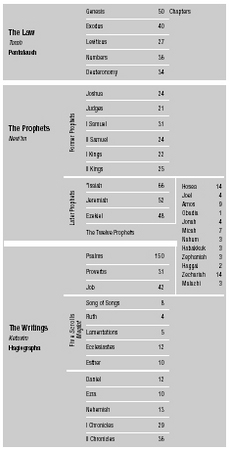
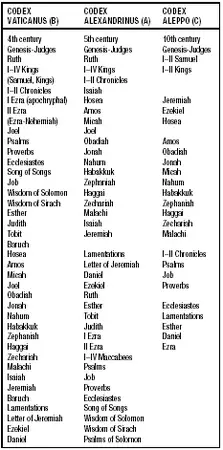 Order of the Books in the Greek Bibles (the Hebrew Codex Aleppo is given for comparison)
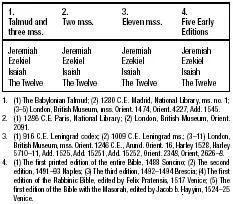 The Order of the Latter Prophets
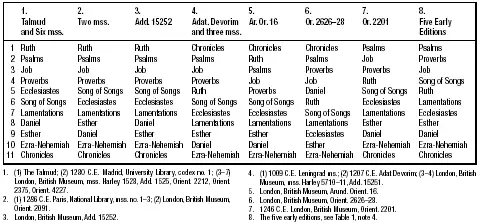 The Order of the Hagiographa
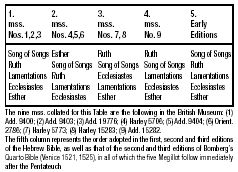 The Order of the Megillot after the Pentateuch
