Oskar Schindler
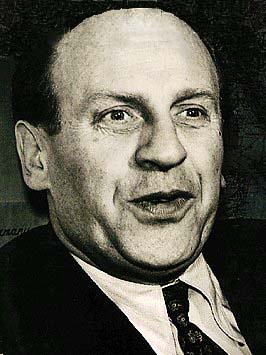
(1908 - 1974)
Oskar Schindler was a German industrialist, former member of the Nazi Party and possibly the most famous "Righteous Gentile" who is credited with saving as many as 1,200 Jews during the Holocaust. His story was brought to international acclaim by the 1982 novel Schindler's Ark and the 1993 film, Schindler's List.
Schindler was born April 28, 1908,
in Zwittau, Austria-Hungary, what is now Moravia in the Czech Republic.
He grew up in a Catholic well-to-do family with all the privileges money could buy.
He married Emilie
Schindler at nineteen, but was never without a mistress
or two. He had presided over
the demise of his family business and become a salesman when
opportunity came knocking in the guise of the war.
Never one to miss a chance to make money, he
marched into Poland on the heels of the SS. He dived headfirst into
the black-market and the underworld and soon made friends with the
local Gestapo bigwigs, softening them up with women, money and
illicit booze. His newfound connections helped him acquire a factory
which he ran with the cheapest labor around: Jewish.
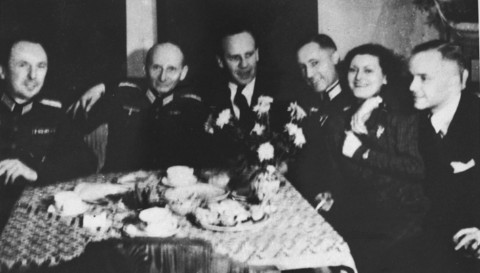 Schindler (center) with German army officers.
 |
At first he seemed like every other usurping
German industrialist, driven by profit and unmoved by the means of
his profiteering. But somewhere along the line, something changed.
In December 1939, as occupied Poland was being torn apart by the savagery of the Holocaust,
Schindler took his first
faltering steps from the darkness of Nazism towards the light of
heroism. “If you saw a dog going to be crushed under a car,” he
said later of his wartime actions, “wouldn't you help him?”
Before the outbreak of war, Poland had been a
relative haven for European Jews - Krakow's Jewish population numbered over 50,000. But when Germany invaded,
destruction began immediately and it was merciless. Jews were herded
into crowded ghettos, randomly
beaten and humiliated, capriciously killed. Jewish property and
businesses were summarily destroyed, or appropriated by the SS and
'sold' to Nazi 'investors', one of whom was the fast talking,
womanizing, money hungry Schindler.
Not long after acquiring his “Emalia” factory - which
produced enamel goods and munitions to supply the German front - the
removal of Jews to death camps began in earnest. Schindler's Jewish
accountant put him in touch with the few Jews with any remaining
wealth. They invested in his factory, and in return they would be
able to work there and perhaps be spared. He was persuaded to hire
more Jewish workers, designating their skills as “essential,”
paying off the Nazis so they would allow them to stay in Krakow.
Schindler was making money, but everyone in his factory was fed,
no-one was beaten, no-one was killed. It became an oasis of humanity
in a desert of moral torpor.
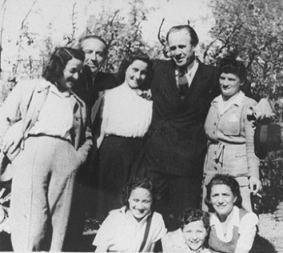 Schindler with a group of
“Schindlerjuden.
Schindler with a group of
“Schindlerjuden. |
As the brutality of the Holocaust escalated,
Schindler's protection of his Jewish workers became increasingly
active. In the summer of 1942, he witnessed a German raid on the
Jewish ghetto. Watching
innocent people being packed onto trains bound for certain death,
something awakened in him.
“Beyond this day, no thinking person
could fail to see what would happen,” he said later. “I was now
resolved to do everything in my power to defeat the system.”
By the autumn of 1944, Germany's hold on Poland had weakened. As the Russian army approached, the Nazi's tried
desperately to complete their program of liquidation and sent all
remaining Jews to die. But Schindler remained true to the “Schindlerjuden,”
the workers he referred to as “my children.”
After the liquidation of the Krakow ghetto and the transfer of many Jews to the Plaszow concentration camp, Schindler used his influence to set up a branch
of the camp for 900 Jewish workers in his factory compound in
Zablocie and made his now famous
list of the workers he would need for its operation.
The factory operated in its new location a year,
making defective bullets for German guns. Conditions were grim, for
the Schindlers as well as the workers. But Schindler saved most of
these workers when he transferred his factory to Brunnlitz (Sudetenland)
in October 1944.
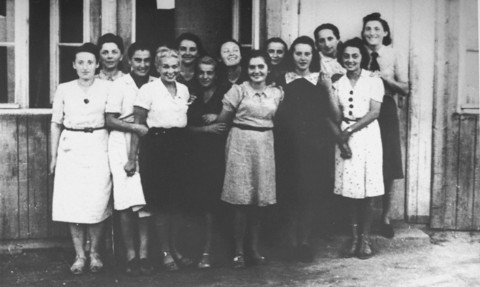 Office workers from the “Emalia” factory.
 |
When the war ended, Schindler fled to Argentina with his wife and a handful of his workers and bought a farm. In
1958, he abandoned his land, his wife and his mistress to return to Germany. He spent the remaining years of his life dividing his time
between Germany and Israel, where he was honored and taken care of by
his “Schindlerjuden.”
He died in Hildesheim in 1974. His extraordinary
story might have died with him but for their gratitude.
In trying to
answer the inevitable question, why did he do it, one of the
survivors said: “I don't know what his motives were... But I don't
give a damn. What's important is that he saved our lives.”
“He negotiated the salvation of his 1,300 Jews by operating right
at the heart of the system using all the tools of the devil - bribery,
black marketeering and lies,” said Thomas Keneally, whose book
about this paradoxical man was the basis of the movie Schindler's
List.
Perhaps the question is not why he did it, but
rather how could he not. And perhaps the answer is unimportant. It is
his actions that matter now, testimony that even in the worst of
circumstances, the most ordinary of us can act courageously. If Oskar
Schindler, flawed as he was, did it, then so might we, and that is
reason enough to hope.
Sources: Susan Pottinger and the Life Magazine Hall of Heroes; United
States Holocaust Memorial Museum.
Photos also from the Holocaust
Museum and The
Story of Oscar Schindler
|