Yasser Abed Rabbo (Abu Bashar)
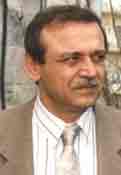
(1945 - )
Yasser Abed Rabbo (also known as Abu Bashar) is a Palestinian politician and a member of the PLO Executive Committee.
Born in 1945 in Jaffa, Abed Rabbo worked alongside Yasser
Arafat starting in the 1960s. In 1968, Abed Rabbo was a founding member
(with Nayef Hawatmeh)
of the Democratic Front for the Liberation of Palestine (DFLP), a leftist
group in the PLO. He became
its Deputy Secretary-General in 1973 and headed the Information and
Culture department from 1973 - 1994.
He was part of the Palestinian negotiation team in
1988 - 1990 which involved Jordan and the U.S. In 1991, Abed Rabbo broke away from the DFLP and formed
Fida, the Palestinian Democratic Union, a group that protested Jordanian
involvement in Palestinian politics. Later the group solidly supported
the Madrid and Oslo peace processes. Abed Rabbo participated in both Middle East peace
negotiation teams.
When the Palestinian
Authority was established in 1994, he headed the Information Ministry.
He was later appointed head of the Palestinian Authority's
negotiating team's Final Status talks, but resigned in May 2000.
Abed Rabbo is part of the "old guard"
yet some feel he recognizes the failures of the PLO to bring about a
lasting peace with Israel. Some feel he appears to be someone who will
officially recognize Israel's right to exist and will earnestly work
for a viable peace plan.
In 2001, Abed Rabbo was one of three notable Palestinians
who signed the Joint Israeli-Palestinian Declaration "No to Bloodshed,
No to Occupation, Yes to Negotiations, Yes to Peace," a document
which proposes negotiation instead of terrorism to resolve the Israeli-Palestinian
conflict. Mr. Arafat's name is not listed.
As an outspoken official for the elimination of Israeli
occupation, he favors implementation of the Tenet
papers and Mitchell report for any supervision and monitoring that would occur with implementation
of a peace plan.
Sources: PASSIA,
IMRA.org; WashingtonPost.com, (Jan.14, 2003); PalestineChronicle.com,
(Mar. 24, 2002); PLO Negotiations Affairs Department; Associated Press,
(Oct. 2002); al-bab.com; PeaceNow.org; Dawn.com, (Jan. 6, 2002). |