George Charles de Hevesy
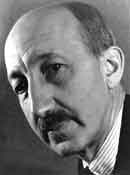
(1885-1966)
George Charles von Hevesy, also known as George Charles
de Hevesy, was born on August 1, 1885, in Budapest,
Austria-Hungary (now Hungary).
Hevesy attended college at the Technische Hochschule in Berlin and the University of Freiburg. He began his work in chemistry in 1911
at the University of Manchester under Ernest Rutherford, which stimulated
him to experiment with isotopic tracers. In 1912, Hevesy moved to Vienna, Austria to collaborate with Friedrich Paneth.
In 1923, Hevesy was a co-discoverer with Dirk Coster
of the chemical element hafnium. He became a professor at the University
of Freiburg in 1926 where he determined the comparative quantity of
chemical elements. In 1934, Hevesy began to trace a radioactive isotope
of phosphorus through the human body to study chemical processes.
After fleeing from the Nazis in 1943, Hevesy was awarded the Nobel
Prize for Chemistry for his work with radioactive isotopes. Hevesy
was the pioneer in scrutinizing the biochemical courses in living bodies
by introducing radioactive isotopes or isotopic tracers. This process
became know as the tracer method and sophisticated the world’s
knowledge of chemical sequences that take place in life cycles.
Hevesy became a professor at the Institute of organic
chemistry in Stockholm in 1943. After World
War II, Hevesy returned to Germany to continue his research. In 1962, he published his findings in the
two-volume Adventures in Radioisotope Research.
Hevesy died on July 5, 1966, in Freiburg im Breisgau,
West Germany, at the age of 80.
Sources: Wikipedia;
Britannica;
Wigoder, Geoffrey, Ed. The
New Standard Jewish Encyclopedia.
NY: Facts on File, 1992 . Photo courtesy
of ANTIQUARIAT
KLAUS HILLE / BERLIN |