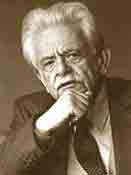
Elias Canetti was born on July 25, 1905, in Rustschuck (present-day Rousse) in Bulgaria.
Canetti chose to be a German writer because of his appreciation for
the culture and history. He was a novelist, essayist, and playwright
who drew on history and myths to produce compelling works. Canetti considered
it the responsibility of writers to preserve and invent myths to continue
this style of conventional creativity.
Elias Canetti was the eldest son in a Jewish merchant family, whose ancestors were Sephardi Jews who had been expelled from Spain in 1492. The original family name was Cañete, named after a village in Spain. Elias spent his childhood years, from 1905 to 1911, in Rustchuk until the family moved to England. In 1912 his father died suddenly, and his mother moved with their children to Vienna in the same year. They lived in Vienna from the time Canetti was aged seven onwards. His mother insisted that he speak German, and taught it to him. By this time Canetti already spoke Ladino (his mother tongue), Bulgarian, English and some French (he studied the latter two in the one year in England). Subsequently the family moved first (from 1916 to 1921) to Zurich and then (until 1924) to Germany, where Canetti graduated from high school. It was during his travels that Canetti wrote his first piece
of literature, a verse play titled Junius Brutus.
After high school, Canetti returned to Vienna to study
chemistry. However, he truly grew passionate for literature and philosophy.
Canetti submerged himself into literary groups, where he first began
his writing career. Politically leaning towards the left, he participated in the July Revolt of 1927. Ironically, in 1929, Canetti received a degree in
chemistry from the University of Vienna; he would never work as a chemist.
In 1938, with the Nazi rise to power, and the inclusion of Austria into “Greater Germany,”
Canetti moved to London. He became closely involved with the painter Marie-Louise Von Motesiczky, who was to remain a close companion for many years to come. His name has also been linked with that of the author Iris Murdoch. In 1935, Canetti produced his breakout novel,
Die Blendung (Auto-da-Fé, or The Tower of Babel); however,
he would not receive recognition for his literature until the 1960s.
His best-known piece, completed in 1960, is Masse und Macht (Crowds
and Power). This inspired work imagines a world enveloped by disorder
and power, and a study of crowd behavior as it manifests itself in human activities ranging from mob violence to religious congregations.
Despite being a German writer, Canetti settled and stayed in England until the 1970s, receiving British citizenship in 1952. For his last 20 years, Canetti mostly lived in Zurich.Elias Canetti won the Nobel
Prize for Literature in 1981. Elias Canetti died on August 13, 1994,
at the age of 89 in Zurich.
The following press release
from the Royal Swedish Academy of Sciences
describes Canetti’s work:
When surveyed, Elias Canetti’s literary work may seem
split up, comprising as it does of so many genres. His oeuvre consists
of a novel, three plays, several volumes of notes and aphorisms, a profound
examination of the origin, structures and effect of the mass movement,
a travel book, portraits of authors, character studies, and memoirs;
but these writings, pursued in such different directions, are held together
by a most original and vigorously profiled personality.
The exiled and cosmopolitian author, Canetti has one
native land, and that is the German language. He has never abandoned
it, and he has often avowed his love of the highest manifestations of
the classical German culture. He has warmly emphasized what Goethe,
for instance, has meant to him as medicina mentis.
His foremost purely fictional
achievement is the great novel, Die
Blendung,
(Auto da Fé ) published in 1935
and praised then by Thomas Mann and Hermann
Broch. But it can be said to have attained
its full effect during the last decades:
against the background of national socialism's
brutal power politics, resulting in a world
conflagration, the novel acquires a deepened
perspective.
Die
Blendung was part
of an originally planned series of novels
which was to take the shape of a “comédie humaine
of the madmen”. The book has such fantastic and demoniacal elements
that associations to Russian 19th century writers like Gogol and Dostoievsky
- to whom, by the way, Canetti himself has declared he owes a debt of
gratitude - are apparent. The main scene of the macabre and grotesque
events that the novel discloses is an apartment house in Vienna. It
is an aspect of key importance when Die
Blendung is regarded by several
critics as a single fundamental metaphor for the threat exercised by
the “mass man” within ourselves.
Close at hand is the viewpoint from which
the novel stands out as a study of a type
of man who isolates himself in self-sufficient
specialization - here, the sinologist Peter
Kien surrounded by his many books - only
to succumb helplessly in a world of ruthlessly
harsh realities.
Die Blendung leads over
to the big examination of the origin, composition
and reaction patterns of the mass movements
which Canetti, after decades of research
and study, published with Masse
und Macht (Crowds and Power, 1960). It is a magisterial
work by a polyhistor who knows how to reveal
an overwhelmingly large number of viewpoints
of men’s behaviour as mass beings. By going
in particular to the primitive peoples,
their myths and fairytales, Canetti tries
to pinpoint the character of the mass movements.
In his field of research he introduces
not only the actual masses but also the
imaginary ones: the masses of “the
spirits”, “the angels” and “the devils”,
which are such important elements in many
religions. He explores the nature and significance
of the national mass symbols; with acumen
he illustrates the psychological problems
of commands and obedience. Like Gustave
Le Bon, he sees the archaic components
in the mass movements of the new age. In
his basically ahistorical analysis, what
he wants to expose and attack by scrutinizing
the origin and nature of the mass is, in
the end, the religion of power. According
to Canetti, deep down behind every command,
every exercise of power, is the threat
of death. Survival itself becomes the nucleus
of power. At the last, the mortal enemy
is death itself: this is a principal theme,
held to with an oddly pathetic strength,
in Elias Canetti’s literary works.
Apart from the intensive
work on Masse und Macht, Canetti has written
strongly concentrated, aphoristic notes,
issued in several volumes. They usually
emanate from concrete situations which
can be regarded as metaphors for something
generic. A satirical bite in the observations
of people’s behaviour, a loathing of wars
and devastation, bitterness at the thought
of life’s brevity are characteristic features
of the continuous notes. By virtue of his
abundant wit and stylistic pithiness, Canetti
stands out as one of the foremost aphorists
of our time, a man who, in his phrasing
of life’s ironies, is sometimes reminiscent
of great predecessors like La Bruyère
and Lichtenberg.
The plays Canetti has
written are all of a more or less absurd
kind: Hochzeit (Wedding), 1932, Komödie der Eitelkeit
(The Comedy of Vanity), 1950, Die Befristeten (The Deadlined), 1956.
In their portrayal of extreme situations, often depicting human vulgarity,
these “acoustic masks”, as Canetti
calls the plays, are of decided interest.
With Die
Stimmen von Marrakesch (The Voices of Marrakesh ), 1967, Canetti
published a travel book which shows his
keen eye for life in the poor outskirts
of existence; with Der
Ohrenzeuge (Earwitness), 1974, he presented a collection of “characters” in
the spirit of Theophrastus. Among his literary
portrait studies, special mention can be
made of Der andere
Prozess (Kafka’s Other
Trial) , 1969, in which, with intense involvement,
he examines Kafka’s complicated relationship
to Felice Bauer. The study forms itself
into a picture of a man whose life and
work meant the relinquishing of power.
Finally, standing out as a peak in Elias Canetti’s
writings are his memoirs, so far in two large volumes: Die
gerettete Zunge (The Tongue Set Free), 1977, and Die
Fackel im Ohr (The Torch
in the Ear), 1980. In these recollections of his childhood and youth,
he reveals his vigorous epic power of description to its full extent.
A great deal of the political and cultural life in Central Europe in
the early 1900s - especially the form it took in Vienna - is reflected
in the memoirs. The peculiar environments, the many remarkable human
destinies with which Canetti was confronted, and his unique educational
path - always aiming at universal knowledge - are seen here in a style
and with a lucidity that have very few qualitative equivalents in the
memoirs written in the German language this century.