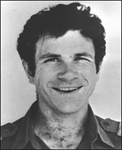
Yonatan "Yoni" Netanyahu was a commander of the elite Israeli army commando unit Sayeret Matkal. He was famously killed in action during Operation Entebbe in Uganda.
Netanyahu was born on March 13, 1946 in New York City to parents Benzion and Cela who had moved to the States to work for the New Zionist Organization. Shortly after his birth, the family returned to the newly independent state of Israel, living at first in Talpiot, a southern neighborhood of Jerusalem. Yoni’s brothers Benjamin "Bibi" and Iddo were born while the family lived in Talpiot.
In 1955, the Netanyahu family moved to a permanent home in Katamon, a district of Jerusalem. In order to further Benzion's historical research, the family went back to the United States in 1957, but soon returned to Jerusalem in 1959. In 1963, when Yoni was in 11th grade, the family resettled in Elkins Park, a suburb of Philadelphia, where Benzion Netanyahu taught at Dropsie College, a school of higher learning for Jewish studies.
Following his graduation from high school in June 1964, Netanyahu was drafted into the Israeli Defense Forces where he volunteered to serve in the Paratroopers Brigade, and later was chosen for and excelled in the Officer Training Course. Years later he took command of a paratroopers company. On June 5, 1967, during the Six Day War, his battalion fought in the battle of Um Katef in Sinai, then reinforced the Golan Heights. During the battle, Yonatan received a wound to his elbow while helping rescue a fellow soldier who lay wounded deep behind enemy lines.
In August 1967, Netanyahu married his longtime girlfriend Tuti. Shortly after their wedding, they flew to the U.S., where Netanyahu enrolled at Harvard University. He took classes in philosophy and mathematics, excelling in both and was on the Dean's List at the end of his first year. However, feeling restless at being away from Israel, especially with Israel skirmishing against Egypt during the War of Attrition, Yoni transferred to Jerusalem's Hebrew University in 1968. In early 1969, he left his studies and returned to the army.
In the early 1970s, Netanyahu joined the elite special forces unit Sayeret Matkal and in the summer of 1972 was appointed as the unit's deputy commander. During that year, he commanded a raid, Operation Crate 3, in which senior Syrian officers were captured and exchanged in return for captive Israeli pilots. The following year he participated in Operation Spring of Youth in which the alleged terrorists and leadership of Black September were selectively killed by Sayeret Matkal, Shayetet-13 and the Mossad.
During the Yom Kippur War in October 1973, Netanyahu commanded a Sayeret Matkal force in the Golan Heights that killed more than 40 Syrian Commando officers in a battle which thwarted the Syrian commandos' raid into the Golan's heartland. During the war he also rescued Lieutenant Colonel Yossi Ben Hanan from Tel Shams, while Ben Hanan was lying wounded behind Syrian lines.
Following the war, Netanyahu was awarded Medal of Distinguished Service (עיטור המופת), Israel's third highest military decoration, for his wartime conduct. Netanyahu then volunteered to serve as armor commander, due to the heavy casualties inflicted on the Israeli Armored Corps during the war, with a disproportionate number of these in the officer ranks. Netanyahu excelled in Tank Officers course and was given command of the Barak Armored Brigade, which had been shattered during the war. Netanyahu turned his brigade into the leading military unit in the Golan Heights.
In June 1975, Netanyahu left the Armored Corps and returned to Sayeret Matkal as unit commander.
On July 4, 1976, Netanyahu led Operation Entebbe, a mission to free 105 Jewish hostages being held in Entebbe, Uganda by members of the Popular Front for the Liberation of Palestine who had days earlier hijacked an Air France flight out of Athens headed for Tel Aviv. The mission was a huge success as the commandos breached the zone, rescued 102 of the hostages and killed all the terrorists and dozens of Ugandan soldiers. Netanyahu, however, was killed during the raid - the only Israeli casualty. In honor of Netanyahu, the raid was posthumously renamed Mivtsa Yonatan (Operation Yonatan).
Netanyahu was buried in Jerusalem's Military Cemetery at Mount Herzl on July 6, 1976, following a military funeral attended by enormous crowds and top-ranking officials. Shimon Peres, then-Defense Minister, said during the eulogy that “a bullet had torn the young heart of one of Israel’s finest sons, one of its most courageous warriors, one of its most promising commanders – the magnificent Yonatan Netanyahu.”
In 1972, he and Tuti were divorced. Netanyahu was living with his girlfriend of two years, Bruria, at the time of his death.
In 1980, many of Netanyahu's personal letters were published. Many of his letters were written hurriedly under trying conditions in the field, but according to a review in the New York Times, they give a “convincing portrayal of a talented, sensitive man of our times who might have excelled at many things yet chose clear-sightedly to devote himself to the practice and mastery of the art of war, not because he liked to kill or wanted to, but because he knew that, as always in human history, good is no match for evil without the power to physically defend itself.”
Letter to his parents, March 6, 1969:
In another week I'll be 23. On me, on us, the young men of Israel, rests the duty of keeping our country safe. This is a heavy responsibility, which matures us early... I do not regret what I have done and what I'm about to do. I'm convinced that what I am doing is right. I believe in myself, in my country and in my future.
Letter to his brother Benjamin, Dec. 2, 1973:
We're preparing for war, and it's hard to know what to expect. What I'm positive of is that there will be a next round, and others after that. But I would rather opt for living here in continual battle than for becoming part of the wandering Jewish people. Any compromise will simply hasten the end. As I don't intend to tell my grandchildren about the Jewish State in the twentieth century as a mere brief and transient episode in thousands of years of wandering, I intend to hold on here with all my might.
In 2005, a poll conducted by Israeli newspaper Yediot Ahronoth placed Netanyahu as the 13th-greatest Israeli of all time.