Jack Rosen
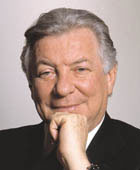
(1949 - )
When it comes to Jack Rosen's table, the question “Guess
who's coming to dinner?” rarely produces a common answer. Around
his elegant table, in his seven-story home off Fifth Avenue, Rosen and
his family have hosted presidents, senators, prime ministers, and other
major players in world politics, including the Clintons and Ariel
Sharon. But for Rosen and his gorgeous wife, Phyllis, it's not simply
about breaking bread with notables, it's about breaking barriers and
opening minds.
Lifestyles had the privilege to partake in one such
cozy dinner where the guest list was a smorgasbord of the Who's Who.
Even more flavorful and spicy than the haute cuisine was the conversation
that seasoned the evening. It quickly became as clear as the crystal
before us that the “main course” for such gatherings was
always the same: the State of Israel and the state of Jews worldwide.
“I think such evenings are very important,” Rosen says.
“We have a dialogue and they learn about our community, our feelings
and concerns, and that can make a difference.”
Though Rosen, chairman of the American Jewish Congress,
does not expect everyone to completely digest the Jewish agenda he sets
forth, his great talent is his ability to send guests off with a sweeter
taste in their mouths and no heartburn.
It is for good reason that Jack Rosen has recently
been listed by The Forward as one of the top-five most influential Jews
in America. But this one-of-a-kind man, who is a well-known guest at
the White House, who has flown the Clintons on his private airplane
and who receives phone calls from Ted Kennedy, had very humble origins.
Rosen, 58, was born in Germany in a displaced persons camp. Although he and his family moved to America
when he was only 4 years old, by age 7 he found himself living in Germany
once again because of his father's business. Being the only Jewish student
in his school, he remembers being forced to attend church once a week
and also sitting on Santa's lap. “Looking back today, I can truly
appreciate the concept of the separation between church and state,”
Rosen reflects.
When Rosen's family came back to America,
he and his brother were raised in the Bronx and went to yeshiva for
several years. He then attended Columbus High School and later graduated
from City University of New York with a degree in mathematics. Although
his upbringing was not Orthodox,
his parents still maintained a kosher and strong traditional Jewish
home. And indeed it is the preservation of Jewish tradition that has
become an integral part of Rosen's mission as a leader of the Jewish
people.
“We have a historic responsibility to maintain
Jewish traditions for our community and our children,” Rosen says.
“We have a rich tradition that must be passed on from generation
to generation in defiance of our enemies' efforts to destroy us.”
Rosen's own sensitivities toward Jewish preservation
were cultivated in his 20s, when he insisted on taking his father back
to Poland for the first time
since the war ended. “I was really curious to learn about a place
that hated Jews so much,” he tells. Yet, Rosen's heart was not
stirred as much by the sights of his journey as he was by the fear he
saw in his father's eyes when they had disembarked from the airplane.
Rosen had gone to Poland as a quasi-”tourist”
to search out its cruel history. However, his father, who lost his parents
and five brothers in the Holocaust,
was still a victim of that country's savage past. Thus, when they reached
the town of his childhood, where his family, youth and life were plucked
from him with merciless villainy, Rosen's father could not get out of
the car.
“Initially, my father made many excuses just
not to get out,” Rosen reflects. But with the fortitude of a true
survivor, David Rosen set his feet upon that very ground that once flowed
with Jewish blood, defying history by his very presence and his firstborn
at his side. “You can hear all the stories you want about the
Holocaust,” Rosen recounts, “but until you see the fear,
you can't really ever appreciate it.”
Yet, even if Rosen's father
was able to face the past, he still wasn't
able to speak about it for years to come.
It was only when Jack Rosen's own children,
Jordan and Daniel, were grown, that his
father began to tell the details of his story
and his death march out of Auschwitz.
But when he did choose to speak, the backdrop
could not have been more suitably chosen.
His story unfolded during Passover — the
holiday of freedom and triumph — during
a family vacation in the State of Israel.
Thus, with a keen eye on Jewish history and a concerned
heart for Jewish tomorrows, Rosen has chosen not to shun enemies or
threats to the Jewish people, but rather to engage them. “We are
living in a post-Holocaust era and the forces that provided for a safe
and secure Israel are changing,” Rosen points out. “We have
to look at what the future holds and have to use all the skills we've
learned in America and that are available to us to ensure security for
Jews around the world.”
And so Rosen has been actively trying to create a dialogue
between the Jewish community and prominent Arab leaders in the Muslim
world. Rosen has even hosted His Royal Highness Prince Bandar bin
Sultan bin Abdulaziz, the ambassador of the Kingdom of Saudi
Arabia to the United States, at his home. “Once people are
given a chance to talk and to get to know each other, it is not so hard
to make friends and find common bonds,” Rosen feels. He once told
Prince Bandar that even more important than the two of them getting
to know each other is that their children get to know each other. “It
is never too late for the next generation.”
Although Rosen knows that he alone cannot change the
world, he does feel that he can perhaps touch one person at a time.
Yet when it comes to Jack Rosen, that one person may be the leader of Cuba, Russia,
Israel, or the United States. His name and influence spans the international
landscape. World leaders have sent messages through him back to Washington.
And as he continues to network, he sprinkles the seeds for alliances
in his trail. Rosen reflects on how one ambassador at the UN told him that whenever he raised his hand to vote, he thought about
their discussions regarding the Jews and the Jewish state. During one
of his travels to China, Chinese
officials kept talking about one China as if conveying their sentiments
to Washington through Rosen would change American policy. Rosen took
the opportunity and graciously toasted his host, “Here is to one
China; here is to one Jerusalem.”
Rosen is not only occupied with trying to build bridges
between foreign leaders and Jews, but also between Jew and Jew. He is
a member of the executive committee of AIPAC,
a trustee of Park East Day School and Park East Synagogue, which honored
him with its “Man of the Year Award.” In a further attempt
to reach out to the Jewish community, he started an organization within
the framework of the American Jewish Congress called the Council for
World Jewry. Its objective is to get Jewish communities and leaders
around the world to work together to protect Jews and fight antisemitism.
He is greatly concerned that the antisemitism so rampant in Europe can
easily spill over the borders. “There is a real war out there,”
Rosen states. “It's a matter of our survival.”
Over the past few years, Rosen has taken Jacques Chirac's
government to task for not fighting the blatant antisemitism swelling
in France. His persistence
drew criticism from local Jewish groups who preferred to deal with matters
on their own. Even Chirac himself complained to the Sharon government
and to Bush about Rosen's
strong stance. Nonetheless, the French government has since publicly
acknowledged the problem of antisemitism in its country and Rosen certainly played a part.
Rosen and his sons, one of whom is president of the
metropolitan region of the American Jewish Congress, are also trying
to reach out to a younger generation of Jews. Their mission is to instill
Jewish pride by educating them about the great contributions that Jews
have made to the world and giving them Jewish role models to relate
to, such as Senator Joseph
Lieberman, Ruth Bader
Ginsberg and others. “We also try to make them realize that
we have to work collectively to secure a safe and better future for
Jews.”
Perhaps Rosen's greatest trick is not dining with Muslims
or getting two Jews to agree on an issue, but rather that he can comfortably
work both sides of Washington's illustrious political aisle. To start,
the American Jewish Congress has historically been on the liberal side
of domestic issues. Rosen is also a longtime friend of Ted Kennedy and
the Clintons, under whom he was appointed to the United States Holocaust
Memorial Council, as well as the NASA Advisory Council. He was also Clinton's special guest at the signing
of the Israel-Jordan Peace Treaty and part of the presidential delegation that attended Yitzhak
Rabin's funeral. He was also finance cochairman of Clinton's election
campaign in 1996.
Nonetheless, Rosen's integrity, influence and perhaps
even his disarming blue eyes and unyielding dimples have earned him
not only easy access to the White House but have also rendered him into
the Republican's beloved poster boy of a Democrat who supports the president's
policy. He has been nicknamed “Rosey” by President Bush,
who is well known for bestowing nicknames on people he really likes.
Rosen told The Forward that he acknowledges that his jump between the
two parties has created some ideological gaps that he has not been able
to overcome—particularly on the domestic side. But Rosen says
that he can put those differences aside to work for the political needs
of Jews around the world. Rosen always pursues a road of pragmatism.
Often the pragmatic comes down to the bottom line.
Indeed Rosen, who is an eminently successful real estate developer,
has signed a check or two and contributed to the American political
system. But he and others have made it very clear that it is not the
checks that are keeping our U.S. representatives in tune with the Jewish
community. “They just don't take you seriously if all you give
is a check,” Rosen explains. “I have found that political
leaders will only take you seriously if you engage them in issues of
substance and bring to their awareness arguments and facts with which
they can make a difference.” It does appear, however, that the
press itself is very impressed with the $100,000 check that Rosen donated
to Bush. That single check has been written about so many times that
Rosen's purported contributions have snowballed into the millions.
Perhaps it is because Jack Rosen has the special talent
to cross lines, build bridges, turn enemies into friends and open very
difficult doors that it has been speculated in press articles that he
will be the next chairman of the Conference of Presidents of Major American
Jewish Organizations — the central coordinating organization representing
52 national Jewish organizations on issues of national and international
concern. Although Rosen is reluctant to declare whether the rumors are
true, he does say it would be a great honor to be chairman and be considered
among such distinguished leaders as Mortimer Zuckerman, Kenneth Bialkin,
Ronald Lauder and James Tisch. Rosen said that a good leader needs to
be able to get consensus and feels that is the requisite skill for the
position. In Rosen's case, his track record speaks for itself.
Even though Rosen has soared high both as pilot of
his own plane and in his business and other endeavors, his feet are
very much planted on the ground. He says that his wife, kids and mother
help keep him very humble. “We don't always succeed at everything
in life that we want and that keeps us grounded, too,” he says.
“The public may only see one side—the success—but
when you're living it, you're privy to the failures as well.”
One of Jack Rosen's biggest regrets in life is that
he didn't start contributing earlier on in life to the Jewish community
and to Jewish life and was too involved in business. “Sometimes
we look back on life and wish we could do it all over again,”
Rosen expresses. “But there is always some price for success and
for failure. Basically, there is a price for living.”
Sources: Lifestyles
Magazine |