State Department Background Notes On Israel
|  | |






Introduction
Official Name:
State of Israel
Geography:
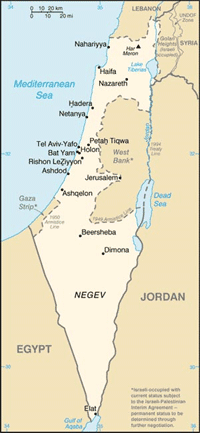
Area: 20,330 sq. km.1 (7,850 sq. mi. - about the size of New Jersey)
Cities: Capital--Jerusalem (Other Major Cities--Tel Aviv, Haifa, Beersheba)
Terrain: Plains, mountains, desert, and coast.
Climate: Temperate, except in desert areas.
People:
Population (2010 est.): 7.59 million.
Annual population growth rate (2009 est.): 1.7%.
Ethnic groups: Jews 76.2%; Arabs 19.5%; other 4.3%.
Religions: Judaism, Islam, Christianity, Druze.
Languages: Hebrew (official), Arabic (official), English, Russian.
Education: Years compulsory--11. Literacy--96.9% (female 95.6%; male 98.3%).
Health: Infant mortality rate (2009 est.)--4.22/1,000 births. Life expectancy at birth--80.73 years; female 82.95 years, male 78.62 years.
Work force (3.02 million; Central Bureau for Statistics, 2009): Agriculture--2.1%; manufacturing--16.2%; electricity and water supply--0.8%; construction--5.4%; trade and repair of motor vehicles--3.6%; accommodation services and restaurants--4.3%; transport, storage, and communication--6.5%; banking, insurance, and finance--3.3%; business activities--13.4%; public administration--4.7%; education--12.7%; health, welfare, and social services--10.7%; community, social, and personal services--4.6%; services for households by domestic personnel--1.6%.
Government:
Type: Parliamentary democracy.
Independence: May 14, 1948.
Constitution: None; however, the Declaration of Independence (1948), the Basic Laws of the parliament (the Knesset), and the Israeli citizenship law fill many of the functions of a constitution.
Branches: Executive--president (head of state); prime minister (head of government). Legislative--unicameral Knesset. Judicial--court system headed by Supreme Court president.
Political parties: Likud, Kadima, Labor, Yisrael Beiteinu and various other secular and religious parties, including some wholly or predominantly supported by Israel's Arab citizens. A total of 12 parties are represented in the 18th Knesset, elected February 2009.
Suffrage: Universal at 18.
Economy:
Nominal GDP (2009 est.): $195 billion.
Annual real growth rate (2009): 0.8%.
Per capita GDP (2009): $26,178.
Currency: Shekel (3.82 shekels = 1 U.S. dollar; 2009 est.).
Natural resources: Copper, phosphate, bromide, potash, clay, sand, sulfur, bitumen, manganese.
Agriculture: Products--citrus and other fruits, vegetables, beef, dairy, and poultry products.
Industry: Types--high-technology projects (including aviation, communications, computer-aided design and manufactures, medical electronics, fiber optics), wood and paper products, potash and phosphates, food, beverages, tobacco, caustic soda, cement, construction, plastics, chemical products, diamond cutting and polishing, metal products, textiles, and footwear.
Trade: Exports (2009 est.)--$50.015 billion. Exports include polished diamonds, electronic communication, medical and scientific equipment, chemicals and chemical products, electronic components and computers, machinery and equipment, transport equipment, rubber, plastics, and textiles. Imports (excluding defense imports, 2009 est.)--$55.2 billion: raw materials, diamonds, energy ships and airplanes, machinery, equipment, land transportation equipment for investment, and consumer goods. Major partners--U.S., U.K., Germany; exports--U.S., Belgium, Hong Kong; imports--U.S., Belgium, Germany, Switzerland, U.K.
People
Of the approximately 7.59 million Israelis in 2010, about 76% were counted as Jewish, though some of those are not considered Jewish under Orthodox Jewish law. Since 1989, nearly a million immigrants from the former Soviet Union have arrived in Israel, making this the largest wave of immigration since independence. In addition, an estimated 105,000 members of the Ethiopian Jewish community have immigrated to Israel, 14,000 of them during the dramatic May 1991 Operation Solomon airlift; 32.9% of Israelis were born outside of Israel.
The three broad Jewish groupings are the Ashkenazim, or Jews who trace their ancestry to western, central, and eastern Europe; the Sephardim, who trace their origin to Spain, Portugal, southern Europe, and North Africa; and Eastern or Oriental Jews, who descend from ancient communities in Islamic lands. Of the non-Jewish population, about 68% are Muslims, about 9% are Christian, and about 7% are Druze.
Education is compulsory from age 6 to 16 and is free up to age 18. The school system is organized into kindergartens, 6-year primary schools, 3-year junior secondary schools, and 3-year senior secondary schools, after which a comprehensive examination is offered for university admissions. There are seven university-level institutions in Israel, a number of regional colleges, and an Open University program.
With a population drawn from more than 100 countries on 5 continents, Israeli society is rich in cultural diversity and artistic creativity. The arts are actively encouraged and supported by the government. The Israeli Philharmonic Orchestra performs throughout the country and frequently tours abroad. The Jerusalem Symphony and the New Israel Opera also tour frequently, as do other musical ensembles. Almost every municipality has a chamber orchestra or ensemble, many boasting the talents of gifted performers from the countries of the former Soviet Union.
Israel has several professional ballet and modern dance companies, and folk dancing, which draws upon the cultural heritage of many immigrant groups, continues to be very popular. There is great public interest in the theater; the repertoire covers the entire range of classical and contemporary drama in translation as well as plays by Israeli authors. Of the three major repertory companies, the most famous, Habimah, was founded in 1917.
Active artist colonies thrive in Safed, Jaffa, and Ein Hod, and Israeli painters and sculptors exhibit works worldwide. Israel boasts more than 120 museums, including the Israel Museum in Jerusalem, which houses the Dead Sea Scrolls along with an extensive collection of regional archaeological artifacts, art, and Jewish religious and folk exhibits. Israelis are avid newspaper readers, with more than 90% of Israeli adults reading a newspaper at least once a week. Major daily papers are in Hebrew; others are in Arabic, English, French, Polish, Yiddish, Russian, Hungarian, and German.
History
The creation of the State of Israel in 1948 was preceded by more than 50 years of efforts to establish a sovereign state as a homeland for Jews. These efforts were initiated by Theodore Herzl, founder of the Zionist movement, and were given added impetus by the Balfour Declaration of 1917, which asserted the British Government's support for the creation of a Jewish homeland in Palestine.
In the years following World War I, Palestine became a British Mandate and Jewish immigration steadily increased, as did violence between Palestine's Jewish and Arab communities. Mounting British efforts to restrict this immigration were countered by international support for Jewish national aspirations following the near-extermination of European Jewry by the Nazis during World War II. This support led to the 1947 UN partition plan, which would have divided Palestine into separate Jewish and Arab states, with Jerusalem under UN administration.
On May 14, 1948, soon after the British quit Palestine, the State of Israel was proclaimed and was immediately invaded by armies from neighboring Arab states, which rejected the UN partition plan. This conflict, Israel's War of Independence, was concluded by armistice agreements between Israel, Egypt, Jordan, Lebanon, and Syria in 1949 and resulted in a 50% increase in Israeli territory.
In 1956, French, British, and Israeli forces engaged Egypt in response to its nationalization of the Suez Canal and blockade of the Straits of Tiran. Israeli forces withdrew in March 1957, after the United Nations established the UN Emergency Force (UNEF) in the Gaza Strip and Sinai. This war resulted in no territorial shifts and was followed by several years of terrorist incidents and retaliatory acts across Israel's borders.
In June 1967, Israeli forces struck targets in Egypt, Jordan, and Syria in response to Egyptian President Nasser's ordered withdrawal of UN peacekeepers from the Sinai Peninsula and the buildup of Arab armies along Israel's borders. After 6 days, all parties agreed to a cease-fire, under which Israel retained control of the Sinai Peninsula, the Golan Heights, the Gaza Strip, the formerly Jordanian-controlled West Bank of the Jordan River, and East Jerusalem. On November 22, 1967, the Security Council adopted Resolution 242, the "land for peace" formula, which called for the establishment of a just and lasting peace based on Israeli withdrawal from territories occupied in 1967 in return for the end of all states of belligerency, respect for the sovereignty of all states in the area, and the right to live in peace within secure, recognized boundaries.
The following years were marked by continuing violence across the Suez Canal, punctuated by the 1969-70 war of attrition. On October 6, 1973--Yom Kippur (the Jewish Day of Atonement), the armies of Syria and Egypt launched an attack against Israel. Although the Egyptians and Syrians initially made significant advances, Israel was able to push the invading armies back beyond the 1967 cease-fire lines by the time the United States and the Soviet Union helped bring an end to the fighting. In the UN Security Council, the United States supported Resolution 338, which reaffirmed Resolution 242 as the framework for peace and called for peace negotiations between the parties.
In the years that followed, sporadic clashes continued along the cease-fire lines, but guided by the U.S., Egypt and Israel continued negotiations. In November 1977, Egyptian President Anwar Sadat made a historic visit to Jerusalem, which opened the door for the 1978 Israeli-Egyptian peace summit convened at Camp David by President Jimmy Carter. These negotiations led to a 1979 peace treaty between Israel and Egypt, signed by President Sadat of Egypt and Prime Minister Menachem Begin of Israel, after which Israel withdrew from the Sinai in 1982.
In the years following the 1948 war, Israel's border with Lebanon was quiet relative to its borders with other neighbors. After the expulsion of Palestinian fighters from Jordan in 1970 and their influx into southern Lebanon, however, hostilities along Israel's northern border increased and Israeli forces crossed into Lebanon in 1978. After passage of Security Council Resolution 425, calling for Israeli withdrawal and the creation of the UN Interim Force in Lebanon peacekeeping force (UNIFIL), Israel withdrew its troops.
In June 1982, following a series of cross-border terrorist attacks and the attempted assassination of the Israeli Ambassador to the U.K., Israel invaded Lebanon to fight the forces of Yasser Arafat's Palestine Liberation Organization (PLO). The PLO withdrew its forces from Lebanon in August 1982. Israel, having failed to finalize an agreement with Lebanon, withdrew most of its troops in June 1985 save for a residual force which remained in southern Lebanon to act as a buffer against attacks on northern Israel. These remaining forces were completely withdrawn in May 2000 behind a UN-brokered delineation of the Israel-Lebanon border (the Blue Line). Hezbollah forces in Southern Lebanon continued to attack Israeli positions south of the Blue Line in the Shaaba Farms/Har Dov area of the Golan Heights.
The victory of the U.S.-led coalition in the Persian Gulf War of 1991 opened new possibilities for regional peace. In October 1991, the United States and the Soviet Union convened the Madrid Conference, in which Israeli, Lebanese, Jordanian, Syrian, and Palestinian leaders laid the foundations for ongoing negotiations designed to bring peace and economic development to the region. Within this framework, Israel and the PLO signed a Declaration of Principles on September 13, 1993, which established an ambitious set of objectives relating to a transfer of authority from Israel to an interim Palestinian authority. Israel and the PLO subsequently signed the Gaza-Jericho Agreement on May 4, 1994, and the Agreement on Preparatory Transfer of Powers and Responsibilities on August 29, 1994, which began the process of transferring authority from Israel to the Palestinians.
On October 26, 1994, Israel and Jordan signed a historic peace treaty, witnessed by President Bill Clinton. This was followed by Israeli Prime Minister Rabin and PLO Chairman Arafat's signing of the historic Israeli-Palestinian Interim Agreement on September 28, 1995. This accord, which incorporated and superseded previous agreements, broadened Palestinian self-government and provided for cooperation between Israel and the Palestinians in several areas.
Israeli Prime Minister Yitzhak Rabin was assassinated on November 4, 1995, by a right-wing Jewish radical, bringing the increasingly bitter national debate over the peace process to a climax. Subsequent Israeli governments continued to negotiate with the PLO resulting in additional agreements, including the Wye River and the Sharm el-Sheikh memoranda. However, a summit hosted by President Clinton at Camp David in July 2000 to address permanent status issues--including the status of Jerusalem, Palestinian refugees, Israeli settlements in the West Bank and Gaza, final security arrangements, borders, and relations and cooperation with neighboring states--failed to produce an agreement.
Following the failed talks, widespread violence broke out in Israel, the West Bank, and Gaza in September 2000. In April 2001 the Sharm el-Sheikh Fact Finding Committee, commissioned by the October 2000 Middle East Peace Summit and chaired by former U.S. Senator George Mitchell, submitted its report, which recommended an immediate end to the violence followed by confidence-building measures and a resumption of security cooperation and peace negotiations. Building on the Mitchell report, in April 2003, the Quartet (the U.S., UN, European Union (EU), and the Russian Federation) announced the "roadmap," a performance-based plan to bring about two states, Israel and a democratic, viable Palestine, living side by side in peace and security.
Despite the promising developments of spring 2003, violence continued and in September 2003 the first Palestinian Prime Minister, Mahmoud Abbas (Abu Mazen), resigned after failing to win true authority to restore law and order, fight terror, and reform Palestinian institutions. In response to the deadlock, in the winter of 2003-2004 Prime Minister Sharon put forward his Gaza disengagement initiative, proposing the withdrawal of Israeli settlements from Gaza as well as parts of the northern West Bank. President George W. Bush endorsed this initiative in an exchange of letters with Prime Minister Sharon on April 14, 2004, viewing Gaza disengagement as an opportunity to move towards implementation of the two-state vision and begin the development of Palestinian institutions. In a meeting in May 2004 the Quartet endorsed the initiative, which was approved by the Knesset in October 2004.
The run-up to disengagement saw a flurry of diplomatic activity, including the February 2005 announcement of Lieutenant General William Ward and subsequently Lieutenant General Keith Dayton as U.S. Security Coordinator; the March 2005 Sharon-Abbas summit in Sharm el-Sheikh; the return of Egyptian and Jordanian ambassadors to Israel; and the May 2005 appointment of former World Bank president James D. Wolfensohn as Special Envoy for Gaza Disengagement to work for a revitalization of the Palestinian economy after disengagement.
On August 15, 2005, Israel began implementing its disengagement from the Gaza Strip, and the Israeli Defense Forces completed their withdrawal, including the dismantling of 17 settlements, on September 12. After broad recognition for Prime Minister Sharon's accomplishment at that fall's UN General Assembly, international attention quickly turned to efforts to strengthen Palestinian governance and the economy in Gaza. The United States brokered a landmark Agreement on Movement and Access between the parties in November 2005 to facilitate further progress on Palestinian economic issues. However, the terrorist organization Hamas--building on popular support for its "resistance" to Israeli occupation and a commitment to clean up the notorious corruption of the Palestinian Authority (PA)--took a majority in the January 2006 Palestinian Legislative Council (PLC) elections, with Hamas leader Ismail Haniya as Prime Minister. The Israeli leadership pledged not to work with a Palestinian government in which Hamas had a role.
Shortly following Hamas' PLC victory, the Quartet--comprised of the United States, European Union, United Nations. and Russia--outlined three basic principles the Hamas-led PA must meet in order for the U.S. and the international community to reengage with the PA: renounce violence and terror, recognize Israel, and respect previous agreements, including the roadmap. The Hamas-led PA government rejected these principles, resulting in a Quartet statement of "grave concern" on March 30, 2006 and the suspension of U.S. assistance to the PA, complete prohibition on U.S. Government contacts with the PA, and prohibition of unlicensed transactions with the PA government. The Palestine Liberation Organization (PLO) under the leadership of PLO Chairman and PA President Mahmud Abbas (Abu Mazen), by contrast, remained consistently committed to the Quartet principles.
Despite several negotiated cease-fires between Hamas and Fatah, violent clashes in the Gaza Strip--and to a lesser extent in the West Bank--were commonplace between December 2006 and February 2007 and resulted in dozens of deaths and injuries. In an attempt to end the intra-Palestinian violence, the King of Saudi Arabia invited Palestinian rivals to Mecca, and on February 9, 2007, Abbas and Hamas leader Haniya agreed to the formation of a Palestinian national unity government and a cessation of violence. Hamas' rejectionist policies and violent behavior continued despite the formation of the national unity government.
In June 2007, Hamas effectively orchestrated a violent coup in Gaza. Hamas also launched scores of Qassam rockets into southern Israel in an attempt to involve Israel in the Hamas-Fatah conflict. On June 14, Palestinian Authority President Mahmoud Abbas exercised his lawful authority by declaring a state of emergency, dissolving the national unity government, and replacing it with a new government with Salam Fayyad as Prime Minister.
The Palestinian Authority (PA) government under President Abbas and Prime Minister Fayyad has no elements controlled by Hamas. The government is dedicated to pursuing a negotiated solution to the Arab-Israeli conflict, and the Quartet principles. As a result, the PA has been supported politically and financially by the international community, and engaged by Israel. The U.S. reinstated its assistance to the PA in 2007 and provides budget and development assistance as well as support for the PA’s efforts to reform and improve security and rule of law in the West Bank.
In November 2007, Israeli and Palestinian leaders participated in an international conference in Annapolis, at which they committed to launch bilateral negotiations towards the establishment of a Palestinian state in the West Bank and Gaza, and the realization of Israeli-Palestinian peace. During the year that followed, Israeli Prime Minister Olmert and Palestinian Authority President Abbas and other members of their governments engaged in regular bilateral negotiations on final status issues. Although the two sides reportedly narrowed their differences on some issues, the negotiations were suspended in December 2008 when conflict broke out between Israel and Hamas in Gaza.
On December 27, 2008, in response to a sharp increase in the number and frequency of rocket attacks into Israel shortly prior to and following the formal expiration of a 6-month "calm" between Israel and Hamas, the Israel Defense Forces launched Operation Cast Lead, targeting Hamas security installations, personnel, and other facilities in the Gaza Strip. The Israeli military operation continued until January 18, 2009, when Israel and Hamas each declared a unilateral cease-fire.
On January 22, 2009, President Barack Obama named Senator Mitchell his and Secretary of State Hillary Clinton’s special envoy for Middle East peace. Special Envoy Mitchell immediately traveled to the region and has subsequently returned on a nearly monthly basis in an effort to help create the conditions that would support a two-state solution as part and to re-launch credible and productive negotiations. The President has visited Turkey, Egypt, and Saudi Arabia and hosted Prime Minister Netanyahu and numerous Arab heads of state in Washington, DC. On September 22, 2009 he hosted a trilateral meeting with Prime Minister Netanyahu and President Abbas, and he has written to over a dozen Arab heads of state asking for their assistance in ending the Arab-Israeli conflict. Senator Mitchell began indirect talks between the two parties in March 2010, and direct talks were launched on September 2, 2010 in Washington, DC. Secretary Clinton has met many leaders from the region and has traveled to the Middle East multiple times since her appointment to promote a Middle East peace settlement.
Government
Israel is a parliamentary democracy. Its governmental system is based on several basic laws enacted by its unicameral parliament, the Knesset. The president (head of state) is elected by the Knesset for a 5-year term.
The prime minister (head of government) exercises executive power and has in the past been selected by the president as the party leader most able to form a government. Between May 1996 and March 2001, Israelis voted for the prime minister directly. (The legislation, which required the direct election of the prime minister, was rescinded by the Knesset in March 2001.) The members of the cabinet must be collectively approved by the Knesset.
The Knesset's 120 members are elected by secret ballot to 4-year terms, although the prime minister may decide to call for new elections before the end of the 4-year term. Voting is for party lists rather than for individual candidates, and the total number of seats assigned each party reflects that party's percentage of the vote. Successful Knesset candidates are drawn from the lists in order of party-assigned rank. Under the present electoral system, all members of the Knesset are elected at large.
The independent judicial system includes secular and religious courts. The courts' right of judicial review of the Knesset's legislation is limited. Judicial interpretation is restricted to problems of execution of laws and validity of subsidiary legislation. The highest court in Israel is the Supreme Court, whose judges are approved by the President.
Israel is divided into six districts, administration of which is coordinated by the Ministry of Interior. The Ministry of Defense is responsible for the administration of the occupied territories.
Principal Government Officials
Prime Minister: Benjamin Netanyahu (Likud)
President: Shimon Peres
Foreign Minister: Avigdor Lieberman (Yisrael Beitanu)
Ambassador to the United States: Michael Oren
Ambassador to the United Nations: Meron Reuben
Israel maintains an embassy in the United States at 3514 International Drive NW, Washington DC, 20008 (tel. 202-364-5500). There also are consulates general in Atlanta, Boston, Chicago, Houston, Los Angeles, Miami, New York, Philadelphia, and San Francisco.
POLITICAL CONDITIONS
From the founding of Israel in 1948 until the election of May 1977, Israel was ruled by successive coalition governments led by the Labor alignment or its constituent parties. From 1967-70, the coalition government included all of Israel's parties except the communist party. After the 1977 election, the Likud bloc, then composed of Herut, the Liberals, and the smaller La'am Party, came to power forming a coalition with the National Religious Party, Agudat Israel, and others. As head of Likud, Menachem Begin became Prime Minister. The Likud retained power in the succeeding election in June 1981, and Begin remained Prime Minister. In the summer of 1983, Begin resigned and was succeeded by his Foreign Minister, Yitzhak Shamir.
After Prime Minister Shamir lost a Knesset vote of confidence early in 1984, new elections in July provided no clear winner, with both Labor and Likud considerably short of a Knesset majority and unable to form even narrow coalitions. After several weeks of difficult negotiations, they agreed on a government of national unity, including the rotation of the office of Prime Minister and the combined office of Vice Prime Minister and Foreign Minister midway through the government's 50-month term.
During the first 25 months of unity government rule, Labor's Shimon Peres served as Prime Minister, while Likud's Shamir held the posts of Vice Prime Minister and Foreign Minister, until they switched positions in October 1986. In November 1988 elections, Likud edged Labor out by one seat but was unable to form a coalition, producing another national unity government in January 1989. Yitzhak Shamir became Prime Minister, and Shimon Peres became Vice Prime Minister and Finance Minister. This government fell in March 1990, however, in a vote of no confidence precipitated by disagreement over the government's response to U.S. Secretary of State Baker's initiative in the peace process. Labor Party leader Peres was unable to attract sufficient support among the religious parties to form a government. Yitzhak Shamir then formed a Likud-led coalition government, including members from religious and right-wing parties.
Shamir's government took office in June 1990, and held power for 2 years. In the June 1992 national elections, the Labor Party reversed its electoral fortunes, taking 44 seats. Labor Party leader Yitzhak Rabin formed a coalition with Meretz (a group of three leftist parties) and Shas (an ultra-Orthodox religious party). The coalition included the support of two Arab-majority parties. Rabin became Prime Minister in July 1992, presiding over the signing of the Oslo accords with the Palestine Liberation Organization. However, Rabin was assassinated by a right-wing Jewish radical on November 4, 1995. Peres, then Deputy Prime Minister and Foreign Minister, once again became Prime Minister and immediately proceeded to carry forward the peace policies of the Rabin government and to implement Israel's Oslo commitments, including military redeployment in the West Bank and the holding of historic Palestinian elections on January 20, 1996.
Enjoying broad public support and anxious to secure his own mandate, Peres called for early elections after just 3 months in office (elections would have been held by the end of October 1996.) In late February and early March, a series of suicide bombings by Palestinian terrorists took some 60 Israeli lives, seriously eroding public support for Peres and raising concerns about the peace process. Increased fighting in southern Lebanon, which also brought Katyusha rocket attacks against northern Israel, also raised tensions and weakened the government politically, a month before the May 29 elections.
In those elections--the first direct election of a Prime Minister in Israeli history--Likud leader Binyamin Netanyahu won by a narrow margin, having sharply criticized the government's peace policies for failing to protect Israeli security. Netanyahu subsequently formed a right-wing coalition government publicly committed to pursuing the peace process, but with an emphasis on security and reciprocity. In 1999, with a shrunken coalition and facing increasing difficulty passing legislation and defeating no-confidence motions, Netanyahu dissolved parliament and called for new elections. This time, the Labor candidate--Ehud Barak--was victorious. Barak formed a mixed coalition government of secular and religious parties, with Likud in the opposition. In May 2000, Barak fulfilled one of his major campaign promises by withdrawing Israeli forces from Southern Lebanon. However, by mid-autumn, with the breakdown of the Camp David talks and the worsening security situation caused by the second Palestinian intifada, Barak's coalition was in jeopardy. In December, he resigned as Prime Minister, precipitating a new prime ministerial election.
In a special election on February 6, 2001, after a campaign stressing security and the maintenance of Israeli sovereignty over Jerusalem, Likud leader Ariel Sharon defeated Barak by over 20 percentage points. As he had promised in his campaign, Sharon formed a broad unity government that included the Labor and Likud parties, the far-right parties, some smaller secular parties, and several religious parties. The unity government collapsed in late 2002, and new elections were held in January 2003. Sharon again won, and formed a new government consisting of his own Likud party, the right-wing National Religious Party and National Union party, and centrist Shinui.
The summer of 2004 saw renewed instability in the government, as disagreement over the Gaza disengagement plan resulted in Sharon's firing two ministers of the National Union Party and accepting the resignation of a third from the National Religious Party in order to secure cabinet approval of the plan (it was endorsed on June 6, 2004). Continuing divisions within the Likud on next steps then prompted Ariel Sharon to leave the party in November 2005 to form the Kadima ("Forward") party and call new elections for March 2006. However, Sharon was unexpectedly incapacitated in January 2006 due to a severe stroke and leadership of Kadima shifted to Acting Prime Minister Ehud Olmert. Olmert led the Kadima party to electoral victory on March 28, and was able to form a coalition with Labor and several smaller parties. The new government was sworn in on May 4, 2006.
Corruption allegations and an ensuing police investigation of Prime Minister Olmert led to his resignation in September 2008. In October, President Peres asked deputy Prime Minister and Foreign Minister Tzippi Livni to form a new government. When Livni was unable to secure a governing majority, President Peres called for new elections to be held in February 2009. Even though Kadima, led by Tzippi Livni won more seats than any other single party, the right-of-center parties, both religious and secular, had the largest overall gains in the new Knesset. Subsequently, President Peres asked Likud leader Netanyahu to form a government. Netanyahu was sworn in as Prime Minister on March 31, 2009.
Economy
Israel has a diversified, technologically advanced economy with substantial but decreasing government ownership and a strong high-tech sector. The major industrial sectors include high-technology electronic and biomedical equipment, metal products, processed foods, chemicals, and transport equipment. Israel possesses a substantial service sector and is one of the world's centers for diamond cutting and polishing. It also is a world leader in software development and, prior to the violence that began in September 2000, was a major tourist destination.
Israel's strong commitment to economic development and its talented work force led to economic growth rates during the nation's first 2 decades that frequently exceeded 10% annually. The years after the 1973 Yom Kippur War were a lost decade economically, as growth stalled and inflation reached triple-digit levels. The successful economic stabilization plan implemented in 1985 and the subsequent introduction of market-oriented structural reforms reinvigorated the economy and paved the way for rapid growth in the 1990s.
A wave of Jewish immigration beginning in 1989, predominantly from the countries of the former U.S.S.R., brought nearly a million new citizens to Israel. These new immigrants, many of them highly educated, now constitute some 13% of Israel's 7.5 million inhabitants. Their successful absorption into Israeli society and its labor force forms a remarkable chapter in Israeli history. The skills brought by the new immigrants and their added demand as consumers gave the Israeli economy a strong upward push and in the 1990s, they played a key role in the ongoing development of Israel's high-tech sector.
During the 1990s, progress in the Middle East peace process, beginning with the Madrid Conference of 1991, helped to reduce Israel's economic isolation from its neighbors and opened up new markets to Israeli exporters farther afield. The peace process stimulated an unprecedented inflow of foreign investment in Israel, and provided a substantial boost to economic growth in the region over the last decade. The onset of the intifada beginning at the end of September of 2000, the downturn in the high-tech sector and NASDAQ crisis, and the slowdown of the global economy have all significantly affected the Israeli economy. However, despite the conflicts in Gaza and Lebanon, the Israeli economy grew during 2006.
Israeli companies, particularly in the high-tech area, have in the past enjoyed considerable success raising money on Wall Street and other world financial markets; Israel has approximately the same number of companies listed on NASDAQ as the next three countries (Canada, Japan, and Ireland) combined. Israel's tech market is very developed, and in spite of the pause in the industry's growth, the high-tech sector is likely to be the major driver of the Israeli economy. Almost 45% of Israel's exports are high tech. Most leading players, including Intel, Motorola, IBM, and Cisco have a presence in Israel.
After growing by an exceptional 9.2% in 2000, growth was negative in 2001 and 2002, as a result of the security situation, global recession, and high-tech downturn. Growth returned in 2003, and as a result of the improvement in the security situation and the economic recovery plan undertaken by the Government of Israel, the Israeli economy grew by an average of more than 5% per year from 2004 to 2007. This was followed by growth of 4.2% in 2008. With the onset of the global financial crisis, the slowdown in the Israeli economy only began in the third quarter of 2008, but had largely recovered by the third quarter of 2009. Unemployment reached a high of 10.7% in 2003, a level not seen in 20 years, and declined consistently each year until 2008, when it reached 6.1%, the lowest level since 1995. The global economic slowdown raised the 2009 unemployment rate to 7.6%.
Trade of goods and services in Israel grew by 9.3% and 5.2%, respectively, in 2006 and 2007. Exports declined by a sharp 35.6% in the fourth quarter of 2008 and 28.6% in the first quarter of 2009. Diamond exports alone declined by more than 36% in the fourth quarter of 2008 compared with the same quarter the previous year. Agricultural exports, which increased by 44% in 2007, declined by almost 12% in the fourth quarter of 2008. However, recovery was well underway by early 2010, with exports posting 15.8% growth in the second quarter while imports were up 8.3%.
The general consensus among economists is that Israel entered the global economic crisis in relatively good shape. Because the Government of Israel maintained conservative policies during the crisis and avoided ambitious fiscal spending packages, the Israeli economy is expected to quickly emerge from a shallow recession and return to a path of growth, even if not at levels that were seen prior to the crisis.
The United States is Israel's largest single trading partner. In 2009, bilateral trade totaled $22.3 billion, a decline of about 20% over 2008, victim of the slowdown in global trade. The U.S. trade deficit with Israel was $11.1 billion in 2009. The principal goods exported from the U.S. include civilian aircraft parts, telecommunications equipment, semiconductors, civilian aircraft, electrical apparatus, and computer accessories. Israel's chief exports to the U.S. include diamonds, pharmaceutical preparations, telecommunications equipment, medicinal equipment, electrical apparatus, and cotton apparel. The two countries signed a free trade agreement (FTA) in 1985 that progressively eliminated tariffs on most goods traded between the two countries over the following 10 years. An agricultural trade accord signed in November 1996 addressed the remaining goods not covered in the FTA but has not entirely erased barriers to trade in the agricultural sector. Israel also has trade and cooperation agreements in place with the European Union, Canada, Mexico, and other countries.
Best prospect industry sectors in Israel for U.S. exporters are energy; defense; security and safety; health care; industrial chemicals; information and telecommunications; electronics; building and construction; travel and tourism; and education.
Foreign Relations
In addition to seeking an end to hostilities with Arab forces, against which it has fought five wars since 1948, Israel has given high priority to gaining wide acceptance as a sovereign state with an important international role.
Before 1967, Israel had established diplomatic relations with a majority of the world's nations, except for the Arab states and most other Muslim countries. UN Security Council resolutions provided the basis for cease-fire and disengagement agreements concerning the Sinai and the Golan Heights between Israel, Egypt, and Syria and for promoting the Camp David accords and the Egyptian-Israeli Peace Treaty. The Soviet Union and the communist states of Eastern Europe (except Romania) broke diplomatic relations with Israel during the 1967 war, but those relations were restored by 1991.
The landmark October 1991 Madrid conference recognized the importance of Security Council Resolutions 242 and 338 in resolving regional disputes, and brought together for the first time Israel, the Palestinians, and the neighboring Arab countries, launching a series of direct bilateral and multilateral negotiations. These talks were designed to finally resolve outstanding security, border, and other issues between the parties while providing a basis for mutual cooperation on issues of general concern, including the status of refugees, arms control and regional security, water and environmental concerns, and economic development.
Today, Israel has diplomatic relations with 163 states. Following the signing of the Israel-PLO Declaration of Principles on September 13, 1993, Israel established or renewed diplomatic relations with 36 countries. Israel has full diplomatic relations with Egypt and Jordan. In addition, on October 1, 1994, the Gulf States publicly announced their support for a review of the Arab boycott, in effect abolishing the secondary and tertiary boycotts against Israel.
Israel has diplomatic relations with nine non-Arab Muslim states and with 32 of the 43 Sub-Saharan states that are not members of the Arab League. Israel established relations with China and India in 1992 and with the Holy See in 1993.
U.S.-Israel Relations
Commitment to Israel's security and well being has been a cornerstone of U.S. policy in the Middle East since Israel's founding in 1948, in which the United States played a key supporting role. Israel and the United States are bound closely by historic and cultural ties as well as by mutual interests. Continuing U.S. economic and security assistance to Israel acknowledges these ties and signals U.S. commitment. The broad issues of Arab-Israeli peace have been a major focus in the U.S.-Israeli relationship. U.S. efforts to reach a Middle East peace settlement are based on UN Security Council Resolutions 242 and 338 and have been based on the premise that as Israel takes calculated risks for peace the United States will help minimize those risks.
On a bilateral level, relations between the United States and Israel are continually strengthening in every field. In addition to the Joint Political-Military Group described above, there are: bilateral science and technology efforts (including the Binational Science Foundation and the Binational Agricultural Research and Development Foundation); the U.S.-Israeli Education Foundation, which sponsors educational and cultural programs; the Joint Economic Development Group, which maintains a high-level dialogue on economic issues; the Joint Counterterrorism Group, designed to enhance cooperation in fighting terrorism; and a high-level Strategic Dialogue.
Principal U.S. Officials
U.S. Embassy
Ambassador--James Cunningham
Deputy Chief of Mission--Thomas Goldberger
Political Affairs--Robert Silverman
Economic Affairs--David Burnett
Management-- Robert Davis
Consular Affairs--Andrew Parker
Public Affairs--Hillary Olsin-Windecker
Commercial Affairs--Jonathan Heimer
Science Attache--Paul Rohrlich
Defense Attache-- Col. Richard Burgess
Legal Attache-- Jeff Walker
The U.S. Embassy in Israel is located at 71 Hayarkon Street, Tel Aviv (tel. 03-519-7575).
U.S. Consulate General
Consul General--Daniel Rubinstein
Deputy Principal Officer--Gregory Marchese
The U.S. Consulate General in Jerusalem has offices at 18 Agron Road (tel. 02-622-7230) and on Nablus Road (tel. 02-622-7230). The Consulate General in Jerusalem is an independent U.S. mission, established in 1844, whose members are not accredited to a foreign government.
U.S. Consular Agent
The U.S. Consular Agent in Haifa is located at 26 Ben Gurion Boulevard (tel. 972-4-853-1470), and reports to the Embassy in Tel Aviv. The Consular Agent can provide routine and emergency services in the north.
Israel's ground, air, and naval forces, known as the Israel Defense Force (IDF), fall under the command of a single general staff. Conscription is universal for Jewish men and women over the age of 18, although exemptions may be made on religious grounds. Druze, members of a small Islamic offshoot living in Israel's mountains, also serve in the IDF. Israeli Arabs, with the exception of some Bedouins, do not serve. During 1950-66, Israel spent an average of 9% of GDP on defense. Real defense expenditures increased dramatically after both the 1967 and 1973 wars. The defense budget in 2009 totaled U.S. $12 billion, representing 6.2% of GDP, and accounting for 16.3% of government expenditures. U.S. military aid to Israel in 2009 totaled U.S. $2.55 billion. This will increase to U.S. $3 billion in 2012, and will total U.S. $3.15 billion per year from 2013 to 2018.
In 1983, the United States and Israel established the Joint Political Military Group, which meets twice a year. Both the U.S. and Israel participate in joint military planning and combined exercises, and have collaborated on military research and weapons development.
Travel and Business Information
Travel Alerts, Travel Warnings, Trip Registration
The U.S. Department of State's Consular Information Program advises Americans traveling and residing abroad through Country Specific Information, Travel Alerts, and Travel Warnings. Country Specific Information exists for all countries and includes information on entry and exit requirements, currency regulations, health conditions, safety and security, crime, political disturbances, and the addresses of the U.S. embassies and consulates abroad. Travel Alerts are issued to disseminate information quickly about terrorist threats and other relatively short-term conditions overseas that pose significant risks to the security of American travelers. Travel Warnings are issued when the State Department recommends that Americans avoid travel to a certain country because the situation is dangerous or unstable.
For the latest security information, Americans living and traveling abroad should regularly monitor the Department's Bureau of Consular Affairs Internet web site at http://travel.state.gov, where current Worldwide Caution, Travel Alerts, and Travel Warnings can be found. The travel.state.gov website also includes information about passports, tips for planning a safe trip abroad and more. More travel-related information also is available at http://www.usa.gov/Citizen/Topics/Travel/International.shtml.
The Department's Smart Traveler app for U.S. travelers going abroad provides easy access to the frequently updated official country information, travel alerts, travel warnings, maps, U.S. embassy locations, and more that appear on the travel.state.gov site. Travelers can also set up e-tineraries to keep track of arrival and departure dates and make notes about upcoming trips. The app is compatible with iPhone, iPod touch, and iPad (requires iOS 4.0 or later).
The Department of State encourages all U.S. citizens traveling or residing abroad to register via the State Department's travel registration website or at the nearest U.S. embassy or consulate abroad (a link to the registration page is also available through the Smart Traveler app). Registration will make your presence and whereabouts known in case it is necessary to contact you in an emergency and will enable you to receive up-to-date information on security conditions.
Emergency information concerning Americans traveling abroad may be obtained by calling 1-888-407-4747 toll free in the U.S. and Canada or the regular toll line 1-202-501-4444 for callers outside the U.S. and Canada.
Passports
The National Passport Information Center (NPIC) is the U.S. Department of State's single, centralized public contact center for U.S. passport information. Telephone: 1-877-4-USA-PPT (1-877-487-2778); TDD/TTY: 1-888-874-7793. Passport information is available 24 hours, 7 days a week. You may speak with a representative Monday-Friday, 8 a.m. to 10 p.m., Eastern Time, excluding federal holidays.
Health Information
Travelers can check the latest health information with the U.S. Centers for Disease Control and Prevention in Atlanta, Georgia. A hotline at 800-CDC-INFO (800-232-4636) and a web site at http://wwwn.cdc.gov/travel/default.aspx give the most recent health advisories, immunization recommendations or requirements, and advice on food and drinking water safety for regions and countries. The CDC publication "Health Information for International Travel" can be found at http://wwwn.cdc.gov/travel/contentYellowBook.aspx.
More Electronic Information
Department of State Web Site. Available on the Internet at http://www.state.gov, the Department of State web site provides timely, global access to official U.S. foreign policy information, including more Background Notes, the Department's daily press briefings along with the directory of key officers of Foreign Service posts and more. The Overseas Security Advisory Council (OSAC) provides security information and regional news that impact U.S. companies working abroad through its website http://www.osac.gov
Export.gov provides a portal to all export-related assistance and market information offered by the federal government and provides trade leads, free export counseling, help with the export process, and more.
Mobile Sources. Background Notes are available on mobile devices at http://m.state.gov/mc36882.htm, or use the QR code below.In addition, a mobile version of the Department's http://www.state.gov website is available at http://m.state.gov, or use the QR code below. Included on this site are Top Stories, remarks and speeches by Secretary Clinton, Daily Press Briefings, Country Information, and more.
Source: U.S. Department of State

Download our mobile app for on-the-go access to the Jewish Virtual Library