IAF Aircraft Inventory: North American T-6 Harvard
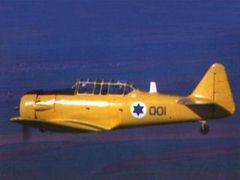 |
Originating from the BT-9 which first flew in 1935, thousands of T-6 variants were built during World War II and saw extensive service around the world, the latest variant, the Texan, still in service today. The name Harvard was given to the type by the RAF which operated a large fleet of the aircraft from 1938 into the late 1950s.The first Harvards for the IAF were purchased in the U.S. and Canada during the summer of 1948. 17 examples were shipped to Israel in crates and after their arrival on October 24th were taken to Ekron AFB (Tel-Nof AFB today) and assembled. The Harvards formed the 35th squadron but instead of serving as trainers as the planes were designed for and operated abroad, they served as dive bombers, a role the young and under-equipped IAF had a need for. The new squadron was manned mainly by foreign volunteers which came to aid Israel in its war of independence and which drew on their experience during WWII to fly the Harvard in this unusual role. Furthermore, the planes were not equipped with any bombing aids, the accuracy of the attacks dependant only on the pilot's skills and abilities. The first ten aircraft entered service during November 1948, with others later on. The War of Independence was already nearing its end by this stage and the Harvards were used for driving the Egyptian army out of the Negev desert in southern Israel. The Harvards took a large part in operation “Horev” (for more see January 7th, 1949 - Israel Vs Britain), almost 100 sorties flown against various ground targets. At least two were lost, one destroyed upon landing after a bomb failed to disconnect from its pylon, and another in an Egyptian raid on Ekron AFB.
With the end of the War of Independence the Harvards were converted back to their intended role as trainers at the IAF flight school. The 14 examples which had remained in service were joined by more bought abroad, reaching a total of 65 aircraft, 25 having been bought in France. Serving in Ekron and Ramat-David the aircraft still maintained their ground attack capabilities, a backup in case hostilities broke out. On April 5th 1951, a Harvard was used to coordinate between Israel's Northern Command and IAF Spitfires and Mustangs attacking the Syrian police station at El-Hama, an Israeli enclave run over by the Syrians.
Tensions in the Middle East flared up again in 1955 and these escalated a year later into the 1956 Suez Crisis. The Harvards which in 1955 equipped a single squadron, were assigned at first to attack the Egyptian AFB at El-Arish, but the presence of Arab jet fighters dictated they be given another, safer role. Shortly before the outbreak of the crisis, in October 1956, the IAF's flight school was closed and its aircraft put on alert. During the crisis the Harvards were tasked with patrolling the Sinai and attacking any Egyptian units they could find. Only on the third day of the fighting, October 31st, after air superioriy over the Sinai had been accomplished were the Harvards put into use. 16 Harvard sorties were staged on the first day but the aircraft failed to accomplish good results and enemy ground fire proved to be quite effective against these slow and aged aircraft. The squadron commander was shot down and almost all the aircraft were hit, forcing the IAF to send the Harvard only on missions where it was to meet little resistance. On November 1st, the squadron carried out 8 more sorties in and around the Gaza Strip, one being hit and crash landing in Israel.
The Harvards returned to their training role after the end of the crisis, and served until 1961 when they were replaced by the Fouga Magister. Some Harvards were handed over to Israel Aircraft Industries which used them to escort test flights. 2 examples remain airworthy today, one which had originaly served in the IAF and purchased back in 1988 and one bought in Britain in 1976. Both can be found at the IAF museum at Hatzerim.
Specification: North American Harvard T-6
Type: two-seat advanced trainer/dive bomber.
Powerplant: one Pratt-&-Whitney R-1340-AN-1 Wasp engine.
Performance: max speed - 182 knots, crusing speed - 126 knots, operational range - 1014km, service ceiling - 24,000ft.
Weights: empty - 1814kg, max takeoff - 2381kg.
Dimensions: span - 12.80m, length - 8.99m, height - 3.56m.
Armament: 2 * 0.5cm machine guns with 8 * 50kg bombs under the wings, or a single 0.303 machine gun with 16 * 80mm rockets and 4 * 50kg bombs under the wings.
Sources: IAF Inventory

Download our mobile app for on-the-go access to the Jewish Virtual Library