MASHAV: Activity Report - 1996
The 1996 Activity Report reflects some of the new policy orientations in Israel's technical cooperation program. These changes should be viewed against the backdrop of recent global strategies designed to better assist countries in their efforts to achieve sustainable development, and as economic policy reforms are being implemented at the national level. If development aid is to achieve its primary goal of long-term improvement, programs must be both financially viable, and have a management structure that is committed to sustainable development on all levels - central and local governments, as well as public and private enterprises. Moreover, to achieve true development countries must depend on the availability of human resources.
MASHAV remains committed to the universal goal of poverty reduction. Focus has been placed or the enrichment of human resources and institution-building, to enable individuals to participate in the development of their own society in such fields as market-oriented agriculture, women in the development process, environmental conservation, health care, micro-enterprise and community development. In 1996, 4,045 participants took part in 144 training courses conducted in Israel, and 5,327 participants shared in 120 on-the-spot courses held in 47 countries worldwide.
Small-scale improvement of daily living is the major issue for the majority of the African people. The Government of Israel firmly upholds the belief that the African continent, especially Sub-Saharan Africa, must be integrated into the global economy, and support be provided by the international community. As aid to Africa comprises approximately 25% of MASHAV training activities and long-term projects, a special team of experts has been appointed to study the present Africa-Israel relationship in order to formulate a more positive program for future cooperation.
In an attempt to pursue more cohesive programming, bilateral development cooperation strategies have been designed for each client country. These strategies were formulated in cooperation with program countries and relevant institutions, and are based on specific national priorities. Moreover, high priority has been given to multilateral activities, and concerted efforts have been made to increase collaboration with international organizations. Towards that end, a multilateral agreement between Israel, the Palestinian Authority, Luxembourg and Morocco was signed relating to an agricultural project in the Gaza Strip. In addition, agreements were signed in 1996 between MASHAV and UNDP, UNESCO and the FAO on development cooperation and institution-building programs.
Cooperation with development banks has also been a major focus of attention. MASHAV and the Inter-American Development Bank (IDB) have enjoyed a fruitful professional relationship since 1994, for the promotion of technical cooperation with countries in Latin America, and an agreement with the Economic Development Institute of the World Bank is currently in preparation.
Peace in the Middle East will be secured only when it takes root in the everyday lives of people in the region. Therefore, cooperation with countries, authorities, NGOs and the private sector in the Middle East/North Africa region, as well as with the Gulf States, will continue to be a basic objective of Israel's development program. As indicated in this Report, joint activities with the Arab Republic of Egypt, the Hashemite Kingdom of Jordan, the Palestinian Authority, the Kingdom of Morocco, and the Islamic Republic of Mauritania have either continued during the course of 1996, or have recently been initiated. Comprehensive regional cooperation will begin to be translated into practice when peace agreements are reached, but there is no need to wait until then to begin wording together. Progress towards peace could be accelerated by taking immediate action that anticipate the eventual agreements. It is our hope that MASHAV will serve as a bridge between the people of the region.
Cooperation with countries undergoing fundamental social restructing will be maintained, especially those witnessing the termination of armed conflict - as in Angola, Mozambique, Ethiopia and Eritrea, or in transition from a centrally-controlled economy to a market-based economy - similar to the Russian Federation, Eastern Europe and countries of the Commonwealth of Independent States.
Greater emphasis on long-term programs has become evident, therefore development projects must withstand the test of sustainability - from inception through operation. Several examples of synergies in project development that have been successful include, the establishment of the Gahtelai Agricultural Project (Eritrea) designed to assist in the settlement of refugees and demobilized soldiers; Kibwezi Agricultural Demonstration Farm (Kenya); Shibani Agricultural Farm (Swaziland); Akkurgan Dairy Demonstration Project (Uzbekistan); Akhmed Yasawi Privatized Collective Farm (Kazakhstan); and the Yongledian Agricultural Demonstration Farm (Beijing).
The success of project implementation depends to a large degree on the professionalism of long and short-term experts. There are currently 38 long-term Israeli experts serving abroad, and 198 short-term experts were dispatched in 1996 to assist in program implementation.
There are no shortcuts in the development process. It is an ongoing challenge that must be met for the benefit of all, and the moral responsibility of the international community.
Many of MASHAV's programs have been realized through resources generously provided by the United States Agency for International Development and the Kingdom of the Netherlands' Ministry of Foreign Affairs. Additional resources are provided by the Danish International Development Agency (DANIDA); Norway's International Development Agency (NORAD); Sweden's International Development Agency (SIDA); Federal Republic of Germany's Ministry of Economic Cooperation; Inter-American Development Bank; Organization of American States, and various UN agencies (UNDP, WHO, FAO, UNESCO, DDSMS, and WMO).
Haim Divon
Deputy Director General
Ministry of Foreign Affairs
Head of the Center for International Cooperation (MASHAV)
This report is dedicated to the memory of
Dr. Shimeon Amir
(1921-1997)
One of the first directors and architects
of Israel's international
development programme.
Message from |
TRAINING
Training in Israel
Training activities in Israel are held at MASHAV-affiliated study centres, academic and professional institutions, which provide the personnel to conduct the courses.
Training activities and on-the-spot courses concentrate on traditional areas where Israel has acquired experience. Areas of training include: agriculture and rural society, education, community development and health. MASHAV's programs continue to emphasize relevant issues in environmental and natural resource protection, as well as specific topics pertaining to women in the development process.
| Training in Israel - 1958-1996 | |
|---|---|
| Africa | 23,730 |
| Asia & Oceania | 8,614 |
| Latin America & and Caribbean | 18,408 |
| CEE & CIS | 2,166 |
| Middle East/North Africa | 2,452 |
| Europe | 2,826 |
| North America | 506 |
The geographical distribution of trainees in international courses held in Israel has gradually changed, due to an increase in the number of participants from the Middle East/North Africa, Eastern Europe and the Commonwealth of Independent States, In several cases, trainees from Europe and North America participated in MASHAV courses, and are included in the 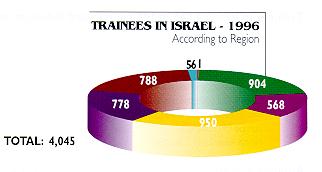 following statistics. During 1996, a total of 4,045 participants attended 144 training courses, individual study tours and various graduate and postgraduate programs, of which 788 trainees arrived from the Middle East/North Africa, including 279 from the Palestinian Authority.
In May 1996, Israel hosted the Agritech '96 Exhibition in Tel-Aviv. Within this framework, MASHAV conducted a Conference on International Agricultural Cooperation, with the participation of over 300 trainees from more than 30 countries and authorities.
|
| ||||||||||||||||||||||||||||||||||||||
On-the-Spot Courses
In 1996, a total of 5,327 trainees from 47 countries worldwide participated in 120 on-the-spot courses, of which 8 were conducted in the Arab Republic of Egypt, and a course was conducted for the first time in the Kingdom of Morocco on "Technology of Irrigation". During the course of the year, 237 Israeli experts were dispatched by MASHAV to provide the training.
| Trainees in On-the Sport Course Abroad - 1958-1996 | |
|---|---|
| Africa | 16,757 |
| Asia & Oceania | 17,688 |
| Latin America & and Caribbean | 35,098 |
| CEE & CIS | 1,590 |
| Middle East/North Africa | 872 |
| Europe | 1,458 |
|
| ||||||||||||||||||||||||||||
Shalom Clubs
MASHAV's relationship with its trainees does not end with the conclusion of the course. In order to build a basis for continued communication and follow-up, Shalom Clubs have been established in countries throughout the world.
Shalom Clubs serve as a forum for MASHAV alumni to participate in professional and social activities relating to their field of specialization. Operated under the auspices of the Israeli mission in the host country, members are invited to attend lectures by skilled experts, encouraged to exchange ideas on technical cooperation and humanitarian concerns, as well as organize cultural functions. Members of the Shalom Clubs also play an integral role in determining the focus and scope of programming.
In 1996, several Shalom Clubs were either established or reactivated as follows:
AFRICA - Benin, Zaire; ASIA - India (New Delhi); LATIN AMERICA - Brazil (Rio de Janeiro); CEE and CIS - Czech Republic; Russian Federation; Ukraine; Belorussia; Lithuania; Latvia and Kazakhstan.
Shalom Magazine
Shalom Magazine for MASHAV alumni (published 3 times a year in 3 languages, with abstracts in Arabic and Russian) is printed in Israel and sent directly to all former participants. This professional publication consists of updated material on such relevant issues as early childhood and adult education, agricultural innovations, women in the development process, public health, cooperative development, and environmental conservation.
Shalom Magazine in English is available on-line.
MASHAV TRAINING CENTRES AND AFFILIATED INSTITUTIONS
Centre for International Agricultural Development Cooperation (CINADCO)
The Israel Ministry of Agriculture's Centre for International Agricultural Development Cooperation (CINADCO), established in 1958, one of the larger institutions in Israel dealing with international agricultural cooperation. Its functions include:
-
Training courses and workshops in Israel;
-
On-the-spot courses in developing countries;
-
Apprenticeship and practical training for medium-level professionals and leading farmers;
-
Long and short-term consultancy missions overseas;
-
Joint research on agriculture-related subjects in host countries, with the participation of experts from those countries.
CINADCO's international training programs are conducted in two agricultural training centres and are held in the English, Spanish Russian, French and Arabic languages.
CINADCO's activities follow current trends in world agriculture and offer projects relevant to subsistence agriculture, improved traditional agriculture, diversified farming and specialized market-oriented agriculture.
Training programs place special emphasis on adapting improved technologies to local conditions. Twenty-five percent of the curriculum in all courses relating to agricultural technologies is devoted to issues of organization and methods of technology transfer, extension and agro-ecological sustainability.
CINADCO's activities are based upon existing know-how acquired by Israeli experts at home and abroad, At present, project work concentrates on issues of agro-business initiatives, satellite farming systems peri-urban agriculture and linking public and private action to advance tangible, socioeconomic results.
CINADCO draws upon the professional skills of experts from the Israel Ministry of Agriculture and other public entities, as well as from national farmers' organizations and private firms.
The integration of research, extension and project development is the hallmark of CINADCO activities.
CINADCO conducted 43 courses and workshops in 1996 at its two training centres; 10-English, 4-Spanish, 4-French, 8-Russian and 17-Arabic, including a study tour for young Egyptian leaders. In addition, 64 on-the-spot courses were conducted in Africa, Asia, Oceania, Latin America, Central and Eastern Europe (CEE) and the Commonwealth of Independent States (CIS), and in the Middle East/North Africa region.
The International Institute - Histadrut
The Institute is an independent, nongovernmental institution, affiliated with the Histadrut, Israel's General Federation of Labour. The International Institute was officially established on March 1, 1994. It incorporates the International Institute for Labour, Development and Cooperative Studies (Afro-Asian Institute), the Abraham Alon Centre for Cooperative and Labour Studies for Latin America, Spain and Portugal, and the Institute for Eastern and Central Europe.
This year, in conjunction with MASHAV, the Institute conducted 30 courses and seminars in Israel in the English, Spanish, French, Arabic Russian, Bulgarian, Czech, Slovak, Albanian and Portuguese languages. In keeping with the Institute's policy of responding to rapidly changing global needs, a significant number of courses were held in new subject areas such as: economic development planning utilising computers, economic initiatives in the urban informal sector, consumer rights protection, trade unions in transition and voluntary organisations. In addition, 10 on-the-spot courses were held in 8 countries. Other courses were conducted in Israel and abroad in cooperation with international organizations and development agencies.
The Aharon Ofri International Study Centre
The Centre, established in Jerusalem in 1989, is engaged in training activities encompassing technological, community, and adult education, as well as the use of computers in educational systems.
Study programs are conducted in the English and Spanish languages. In 1996, the Centre held 1 5 courses in Israel (8 in English, 7 in Spanish), as well as 5 on-the-spot courses.
The Development Study Centre
The Development Study Centre (DSC) is an independent academic institution engaged in research, training and planning activities related to rural regional development in developing countries and in Israel.
Since its establishment in 1962, the DSC has developed an integrated approach to reduce poverty and promote social and economic development in rural areas, This approach has been translated into a detailed methodology of planning, already adopted by many countries in Africa, Asia and Latin America.
The main training program at the DSC is a 7-month post-graduate course on "Integrated Rural Regional Development Planning." In 1996, this course was held twice, in English and Spanish, including practical stages conducted in selected areas of Peru and China. In addition, 6 courses (English, Spanish, Portuguese and 3 in Arabic) were held on specific subjects relating to rural development. Two on-the-spot courses on "Urban Management" were also conducted.
The Golda Meir Mount Carmel International Training Centre (MCTC)
The Centre, located in Haifa, was founded in 1961 following the First International Seminar for Women Leaders from Developing Countries entitled "The Role of Women in a Developing Society." A resolution taken at the conclusion of the Conference recommended the establishment of a permanent facility in Israel for the training of women in community services, thereby enhancing their status in the development process. For the past 35 years, MCTC's programs for middle-level professionals, supervisors and planners have emphasized methods to: establish and manage services and projects; orient programs to client's needs; enhance skills for staff development. Main areas of study include organization of community and family services; management of micro-enterprises; and early childhood education with emphasis on related aspects and gender issues, In 1996, 12 courses and workshops were held in Israel according to the following breakdown: English-6, Spanish-5, French-1, as well as 10 on-the-spot courses, The Centre also hosted an international symposium for women leaders entitled "Economic Development, Entrepreneurship and Gender". In addition, a study tour was conducted on "Early Childhood Education and Women's Activities" for participants from Jordan and Israel.
The Director of the Centre participated in the following international conferences:
-
Women's Leadership and Representation, Inter-American Development Bank, Nicaragua, September 1996;
-
Mediterranean UNICEF National Committee Meeting, Sicily, April 1996;
-
The 7th Forum of the Association of Women in Development, Washington, D.C., August 1996
-
LIST OF MASHAV TRAINING CENTRES AND INSTITUTIONS
|
 Agricultural Research Organization - Volcani Centre
CONSULTANCIES
During 1996, a total number of 236 consultancies in 72 countries were carried out under MASHAV's auspices.
Short-Term Consultancies
The short-term consultancy (STC) is geared to provide rapid, specific advisory services, assistance in program implementation and back- up for Israeli experts on long-term projects.
The duration of an average STC is 3-4 weeks, and is usually carried out by 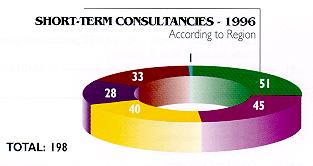 one consultant. Consultations in 1996 covered various aspects of agriculture, cooperation and labour studies, community development, rural development, medicine and public health, management, science and technology, and education.
198 short-term consultancies were conducted with a regional breakdown of 5 1 in Africa, 45 in Asia and Oceania, 40 in Latin America and the Caribbean, 28 in Central and Eastern Europe (CEE) and the Commonwealth of Independent States (CIS), 33 in the Middle East/North Africa and I in Europe.
Long-Term Consultancies
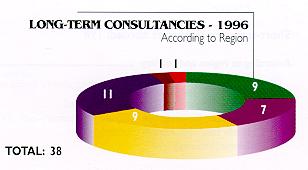 The basic objective of a long-term consultancy (LTC) is to facilitate the transfer of technology and knowledge and to assist in the design, implementation, management or general assessment of development projects. Its Term of Reference (TOR) is well-defined by the host country and covers a 24-month period, with an option of extension. Long-term technical consultancies included 38 ongoing missions in 1996, ot which 9 were in Africa, 7 in Asia and Oceania, 9 in Latin America and the Caribbean, 11 in the Commonwealth of Independent States (CIS), 1 in the Middle East/North Africa and 1 in North America (within the framework of the United Nations Peace-Keeping Force).
RESEARCH
Joint Programs in Research
Joint programs in research, conducted under the auspices of MASHAV in cooperation with the Federal Republic of Germany and the Kingdom of The Netherlands, continued in 1996.
1. German-Israel Agricultural Research Agreement (GIARA)
During 1996, 19 agricultural research programs were carried out within the framework of this Agreement.
GIARA was initiated in 1986 by MASHAV and the German Miristry of Economic Cooperation (BMZ) and extended for a second phase until 1996. Its main objective is to support trilateral agricultural research between institutions in Israel, Germany and developing countries.
German-Israel Agricultural Research for Developing Countries
| Brazil Chile Costa Rica Egypt Kenya Malawi | Mexico Nepal Nigeria Thailand Turkey |
2. Netherlands-Israel Research Program (NIRP)
A joint Netherlands-Israel research project on the improvement of potato production in developing countries began in 1991 and terminated in 1996. A new program was launched in 1992, emphasizing the social, economic and cultural aspects of rural development. The program is directed by a joint steering committee of scientists from both countnes. Each research proposal is expected to include scientists from The Netherlands and Israel, and one from a developing country. In 1996, 28 research programs were conducted, including two joint research programs between Israel and the Palestinian Authority.
Netherlands-Israel Research Program for Developing Countries
| Benin Cameroon China Côte d'lvoire Ethiopia Kenya | Nepal Nigeria Senegal Tanzania Thailand Uganda Zambia |
Joint Research Initiatives - Middle East
Two joint projects are being conducted between The Netherlands, Israel and the Palestinian Authority.
INTERNATIONAL AGREEMENTS
Working together with a growing number of countries and international organizations has enabled Israel to contribute to the global efforts made towards environmental conservation, human development and gender issues. These agreements have also allowed for the focus to be placed on the upbuilding of the Middle East/North Africa region.
In February 1996, a multilateral agreement was signed between the Government of the State of Israel, the PLO - for the benefit of the Palestinian Authority, the Government of the Grand Duchy of Luxembourg and the Government of the Kingdom of Morocco relating to the project "Optimization of Intensive Agriculture in the Gaza Strip Under Varying Water Quality Conditions."
In addition, Israel signed three agreements with international organizations: UNDP, UNESCO and the FAO, for technical cooperation in the developing world, The agreement with the FAO, signed in July 1996, establishes a mechanism to promote economic growth and human resource development.
The programme for cooperation between MASHAV and UNESCO, signed in July 1996, is designed to provide further training activities in Israel in UNESCO'S field of competence.
The third agreement, signed in February 1996 with the UNDP, combines the operational as well as the professional resources of both parties in support of national and regional development efforts. Within this programme, emphasis will be put on strengthening the role of women in the development process. UNDP and MASHAV will also host a workshop on the subject of "Environmental Treaties."
Sources: Israel Ministry of Foreign Affairs

Download our mobile app for on-the-go access to the Jewish Virtual Library