|
A Peace Process PrimerIntroduction
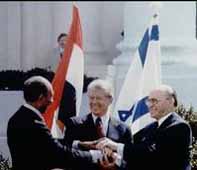
Egyptian President Anwar Sadat accepted Prime Minister Begin's invitation for dialogue, and the two countries embarked on historic bilateral negotiations that led to the 1978 Camp David Accords and the 1979 Israel-Egypt peace treaty. Since then, the treaty has withstood regional tensions and cooperation between the two states has grown, though the relationship is still referred to as a "cold peace" because it has failed to result in the neighborly ties Israelis hoped for. The breakup of the Soviet Union and the Gulf War produced a change in the basic political order of the Middle East, prompting the Arab world to reassess its attitude toward Israel and to enter into negotiations to build a new future for the Middle East. In October 1991, a conference was convened in Madrid to inaugurate direct peace talks. Subsequently, bilateral negotiations were conducted between Israel and Syria, Lebanon, Jordan and the Palestinians, as well as multilateral talks on key regional issues. No agreements were reached, but the groundwork was laid for future talks. Israel-PLO RecognitionFollowing intense behind-the-scenes contacts between Israeli and Palestinian negotiators in Oslo, Norway, an agreement was achieved between Foreign Minister Shimon Peres and PLO Chairman Yasser Arafat. On September 9, 1993, Chairman Arafat sent a letter to Prime Minister Rabin, in which he stated unequivocally that the PLO recognized the right of Israel to exist in peace and security and renounced the use of terrorism and other acts of violence. In reply, Israel recognized the PLO as the representative of the Palestinians in the peace negotiations. Four days later, a joint Israeli-Palestinian Declaration of Principles (DOP), based on the agreement worked out in Oslo, was signed by the two parties in Washington, outlining the proposed interim self-government arrangements, as envisioned and agreed by both sides. The arrangements contained in the DOP include immediate Palestinian self-rule in Gaza and Jericho, early empowerment for the Palestinians in West Bank, and an agreement on self-government and the election of a Palestinian council. The Interim AgreementShortly after the signing of the Declaration of Principles, negotiations commenced between Israeli and PLO delegations on the implementation of the interim agreement, which was accomplished through a series of agreements that led to the transfer of territory and power to the Palestinians. The Gaza-Jericho Agreement signed on May 4, 1994, led to a withdrawal of Israeli military forces from Gaza and Jericho and a transfer of authority from the Israeli Civil Administration to a Palestinian Authority. , the structure and composition of the Palestinian Authority, its jurisdiction and legislative powers, a Palestinian police force, and relations between Israel and the Palestinian Authority.
The May 1999 deadline was not met because of ongoing disputes over the final borders of a Palestinian state and Israel, and disagreement over the final status of Jerusalem, what to do about Jews living in settlements in the West Bank and Gaza, and concerns regarding the return of Palestinian refugees. The full implementation of agreements has also been impeded by the failure of the Palestinians to fulfill all their obligations and Israeli reluctance to make further concessions in the light of Palestinian violence. Israel's position regarding a permanent status agreement is that it will not return to the 1967 borders; Jerusalem must remain the united capital of Israel; settlement blocs in the territories will remain under Israeli sovereignty and there will be no foreign army west of the Jordan River. Israel-Jordan Negotiations
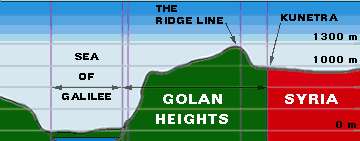
Israel-Syria NegotiationsThe dispute between Israel and Syria centers on the Golan Heights, which Israel captured in the Six-Day War and defended against Syrian attack in the 1973 war. For many years, Israel insisted that it could not return the Golan Heights because of their strategic value. Prime Minister Yitzhak Rabin, however, offered to return part, and possibly all, of the territory in exchange for security guarantees and a peace treaty that would lead to the normalization of relations between Syria and Israel. Negotiations continued off and on, but stalled because of the Syrian insistence that Israel completely withdraw from the Golan Heights as a precondition to any agreement. Syrian President Hafez Assad, moreover, never said he would be prepared to make peace with Israel even if the entire Golan area was returned.
Prime Minister Ehud Barak has reiterated a willingness to negotiate with Syria and, like Rabin, pledge to put any proposed treaty to a national referendum before it is signed. The death of longtime Syrian President Hafez Assad has opened up the possibility that his son may alter his father's rejectionist policies and take steps toward peace with Israel. For now, however, he is focused on consolidating his power and addressing Syrian domestic issues. Israel-Lebanon NegotiationsFrom the beginning of the peace process, negotiations with Lebanon have been overshadowed by Syrian control over Lebanon's policies and decision-making process. Israel has consistently said it makes no claims to Lebanese land or resources, and that its primary concern is for security on its northern border. On May 24, 2000, the Government of Israel completed the withdrawal of its forces from southern Lebanon to the international border, in accordance with UN Security Council Resolution 425. Israel still waits for the Lebanese army to take control of the southern border region to prevent terrorist attacks. The expectation is that no formal peace treaty can be signed before Syria reaches an agreement with Israel. |
 |

 Since
its
Since
its 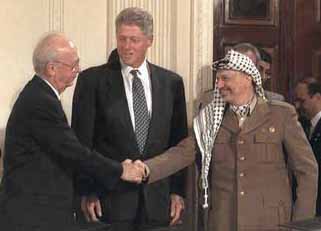 The
The
 Israel
and
Israel
and