 |
A Peace Process PrimerIntroduction
May 1989, Israel presented a new peace initiative. The breakup of the Soviet Union and the Gulf War produced a change in the basic political order of the Middle East, prompting the Arab world to reassess its attitude toward Israel and to enter into negotiations to build a new future for the Middle East. In October 1991, a conference was convened in Madrid to inaugurate direct peace talks. Subsequently, bilateral negotiations were conducted between Israel and Syria, Lebanon, Jordan and the Palestinians, as well as multilateral talks on key regional issues. Israel-PLO RecognitionRecent years have witnessed a series of landmarks in negotiations between Israel and the Palestinians. Following intense behind-the-scenes contacts between Israeli and Palestinian negotiators in Oslo, an agreement was achieved between Foreign Minister Shimon Peres and PLO Chairman Yasser Arafat. On September 9, 1993, Chairman Arafat sent a letter to Prime Minister Rabin, in which he stated unequivocally that the PLO:
In reply, Israel recognized the PLO as the representative of the Palestinians in the peace negotiations. On September 13, 1993, a joint Israeli-Palestinian Declaration of Principles (DOP), based on the agreement worked out in Oslo, was signed by the two parties in Washington, outlining the proposed interim self-government arrangements, as envisioned and agreed by both sides. The arrangements contained in the DOP include immediate Palestinian self-rule in Gaza and Jericho, early empowerment for the Palestinians in West Bank, and an agreement on self-government and the election of a Palestinian council. Additionally, extensive economic cooperation between Israel and the Palestinians plays an important role in the DOP. The Interim AgreementShortly after the signing of the Declaration of Principles, negotiations commenced between Israeli and PLO delegations on the implementation of the interim agreement, which was accomplished in three stages: 1. The Gaza-Jericho Agreement was signed in Cairo on May 4, 1994, and applies to the Gaza Strip and to a defined area of about 65 square kilometers including Jericho and its environs. The document includes agreement to a withdrawal of Israeli military forces from Gaza and Jericho, a transfer of authority from the Israeli Civil Administration to a Palestinian Authority, the structure and composition of the Palestinian Authority, its jurisdiction and legislative powers, a Palestinian police force, and relations between Israel and the Palestinian Authority.
The main object of the Interim Agreement is to broaden Palestinian self-government in the West Bank by means of an elected self-governing authority -- the Palestinian Council -- for an interim period not to exceed five years from the signing of the Gaza-Jericho Agreement (i.e. no later than May 1999). This will allow the Palestinians to conduct their own internal affairs, reduce points of friction between Israelis and Palestinians, and open a new era of cooperation and co-existence based on common interest, dignity and mutual respect. At the same time it protects Israel's vital interests, and in particular its security interests, both with regard to external security as well as the personal security of its citizens in the West Bank. The Interim Agreement sets forth the future relations between Israel and the Palestinians. To the main body of the agreement are appended seven annexes dealing with: security arrangements, elections, civil affairs (transfer of powers), legal matters, economic relations, Israeli-Palestinian cooperation, and the release of Palestinian prisoners. Milestones in the Implementation of the Interim AgreementOn January 20, 1996, following completion of the first stage of IDF redeployment (with the exception of Hebron), elections were held to the Palestinian Council and for the Head of the Palestinian Authority. Yasser Arafat was elected Ra'ees (head) of the Authority. On April 24, 1996, the Palestinian National Council, convening in Gaza, voted 504 to 54, with 14 abstentions, as follows:
On December 14, 1998, the Palestinian National Council, in accordance with the Wye River Memorandum, convened in Gaza in the presence of U.S. President Clinton and voted to reaffirm this decision. The Protocol Concerning the Redeployment in Hebron was signed on January 17, 1997. On October 23, 1998, The Wye River Memorandum was signed at the White House, Washington D.C., between Israel and the PLO, following a nine-day summit hosted by U.S. President Mr. Bill Clinton in Wye Plantation, Maryland. On September 4, 1999, the Sharm el-Sheikh Memorandum was signed by representatives of Israel and the PLO. Restating the commitment of the two sides to full implementation of all agreements reached since September 1993, the Memorandum sets out to resolve the outstanding issues of the present interim status, in particular those set out in the Wye River Memorandum of October 23, 1998. Stages of Sharm el-Sheikh implementation: Release of prisoners: Sep 9, 1999; Oct 15, 1999. Permanent Status NegotiationsThe negotiations on the permanent status arrangements commenced in Taba on May 5, 1996. These negotiations will deal with the remaining issues to be resolved, including Jerusalem, refugees, settlements, security arrangements, borders, relations and cooperation with neighboring countries. In the Wye Memorandum of October 23, 1998 both sides agreed to immediately resume permanent status negotiations on an accelerated basis and to make a determined effort to reach agreement by May 4, 1999. A first meeting between Foreign Minister Sharon and Abu Mazen took place on November 18, 1998. Following the Sharm el-Sheikh Memorandum, the permanent status negotiations were formally resumed on September 13, 1999, at the Erez checkpoint. Foreign Minister David Levy was appointed to head the Israeli negotiating team with the Palestinians, and Abu-Mazen heads the Palestinian team. In his speech at the opening of the talks, Foreign Minister Levy summarized the basic principles by which Israel will be guided up in negotiating a permanent status agreement: we will not return to the 1967 lines; united Jerusalem will remain the capital of Israel; settlement blocs in the territories will remain under Israeli sovereignty; there will be no foreign army west of the Jordan River. Israel-Jordan NegotiationsThe bilateral talks between Israel and Jordan, initiated at the Madrid Conference, continued for almost two years in Washington until the signing of the Israeli-Jordanian Common Agenda on September 14, 1993. The Common Agenda constituted the blueprint for the peace treaty, comprising the following components: security, water, refugees and displaced persons, borders and territorial matters. The first public meeting between King Hussein and Prime Minister Rabin took place in Washington, on July 25, 1994. Out of this meeting emerged The Washington Declaration, signed by Prime Minister Rabin and King Hussein, with President Clinton serving as a witness. The major achievements of the Washington Declaration were a series of agreements and concrete steps symbolizing the new era:
Concrete steps included the establishment of direct telephone links, joint electricity grids, new border crossings, free access to third country tourists, and cooperation between the police forces in combating crime, with special emphasis on drug smuggling. It was also decided to continue negotiations on bilateral economic cooperation and abolishing economic boycotts, as well as on the opening of an international air corridor between the two countries. The first meeting in the region of the Israeli and Jordanian bilateral delegations took place on July 18-19, 1994 at Ein Avrona, located in the boundary area north of Aqaba and Eilat. The parties agreed to hold talks on a continuous basis, alternately on the Israeli and Jordanian sides of the border. These talks culminated in the signing of a Treaty of Peace between Israel and Jordan on October 26, 1994.
The open border crossings between the two countries have facilitated the normalization of relations. Joint business ventures are being consistently initiated and the free movement of businessmen, by both land and air, has created an atmosphere of cooperation and open communication. Tourism between the two countries has been on the rise. Israel-Syria NegotiationsFollowing the Madrid Conference, talks between Israeli and Syrian delegations commenced in Washington under the framework of the Madrid formula. During 1994, negotiations were held on the ambassadorial level in Washington. These talks led to focused discussions on security arrangements and the convening of two meetings between the Israeli and Syrian chiefs-of-staff in December 1994 and June 1995. These negotiations were supported by the involvement of high-ranking U.S. officials, including two meetings between President Clinton and President Assad and a number of visits by Secretary of State Warren Christopher to the region. The Israeli negotiators have stated to the Syrians that Israel accepts the principle of withdrawal on the Golan Heights, in the context of a peace settlement which simultaneously addresses four key issues:
Israel feels that direct and public high-level meetings between Israeli and Syrian leaders will promote the negotiations and bolster public confidence in Syria's desire for peace. The late Prime Minister Rabin stated that should a peace treaty including a significant withdrawal on the Golan Heights be negotiated with Syria, the proposed treaty will be put to a national referendum before it is signed. In December 1995, Syria agreed to resume the negotiations without preconditions and with elements of flexibility in the form of those negotiations. The Syrians decided not to raise the level of negotiators to a political level, but to empower and increase the authority of Ambassador Mualem and give him and his colleagues a larger mandate, both in terms of substance and in terms of atmosphere. The Syrians agreed now to deal with those elements that make up the notion of full peace: quality of peace, normalization, water. Two rounds of Syrian-Israeli peace talks were conducted under U.S. auspices at the Aspen Institute's Wye River Conference Center in December 1995 and January 1996, focusing on both security and other issues. The discussions were highly detailed and comprehensive in scope. The discussion of security arrangements identified important areas of conceptual agreement and convergence. Not unexpectedly, it also revealed differences of substance or perspective. Ideas for dealing with some of the differences were referred to leaderships in Israel and Syria for consideration. All participants in this session agreed that it had significantly advanced the discussion of key issues in a future peace treaty, and clarified each side's views and needs. They agreed that the talks laid a solid basis for further discussions. Although there have been no direct talks since January 1996, former Prime Minister Benjamin Netanyahu repeatedly called upon Syria to return to the negotiating table, without preconditions. The guidelines of the government established by Prime Minister Ehud Barak in July 1999 reiterate: "The Government will resume the negotiations with Syria with a view toward concluding a peace treaty therewith -- full peace that bolsters the security of Israel, grounded in UN Security Council Resolutions 242 and 338 and on the existence of a normal relationship between two neighboring states, living side by side in peace. The peace treaty with Syria will be submitted for approval in a referendum." On December 8, 1999, President Clinton announced that Prime Minister Barak and President Assad agreed that the Israel-Syrian peace negotiations would be resumed from the point that they were halted since January 1996. The talks were launched at a summit meeting with President Clinton in Washington on December 15, with Prime Minister Barak and Syrian Foreign Minister Farouk a-Shara, followed by a round of talks held in Shepherdstown, West Virginia from January 3-11, 2000. Israel-Lebanon NegotiationsFrom the beginning of the peace process, negotiations with Lebanon have been overshadowed by Syrian control over Lebanon's policies and decision-making process. Over a dozen rounds of bilateral talks were held between Israel and Lebanon in the framework of the Washington talks. These negotiations have been stalled since February 1994, and there is currently no contact between the two sides. Israel has clarified to the Lebanese that it makes no claims to Lebanese land or resources, and that its primary concern is for security on its northern border. Israel has suggested a settlement based on the following principles:
In April 1996, following months of provocations by Iranian-backed Hizbullah terrorists based in Lebanon, Israel initiated "Operation Grapes of Wrath" directed against these terrorist elements. On April 26, 1996, through U.S. mediation, a document of understanding was achieved in consultation with Syria, Lebanon and Israel. In addition to establishing what it is hoped will be a lasting end to hostilities, the document recognizes that a comprehensive peace can be achieved only on the basis of negotiations:
"It is recognized that the understanding to bring the current crisis between Lebanon and Israel to an end cannot substitute for a permanent solution. The United States understands the importance of achieving a comprehensive peace in the region. Toward this end, the United States proposes the resumption of negotiations between Syria and Israel and between Lebanon and Israel at a time to be agreed upon, with the objective of reaching comprehensive peace. The United states understands that it is desirable that these negotiations be conducted in a climate of stability and tranquility." On April 1, 1998, the Israeli government adopted a decision "accepting UN Security Council Resolution 425, so that the IDF will leave Lebanon with appropriate security arrangements, and so that the Lebanese government can restore its effective control over Southern Lebanon and assume responsibility for guaranteeing that its territory will not be used as a base for terrorist activity against Israel." In addition, the government "calls on the Lebanese government to begin negotiations, on the basis of UN Security Council Resolution 425 to restore its effective control over territories currently under IDF control, and to prevent terrorist activities from its territory against Israel's northern border." The guidelines of the government established by Prime Minister Barak in July 1999 reiterate: "The Government will act toward bringing the IDF out of Lebanon, while guaranteeing the welfare and security of residents of the north, and aspiring to conclude a peace treaty with Lebanon." On March 5, 2000, the Israeli government passed a resolution to deploy the IDF forces on the border with Lebanon by July 2000, preferably in the framework of an agreement. |
 |

 Since
its
Since
its 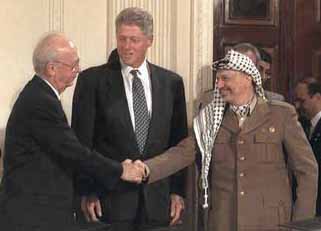 3.
On September 28, 1995, the
3.
On September 28, 1995, the 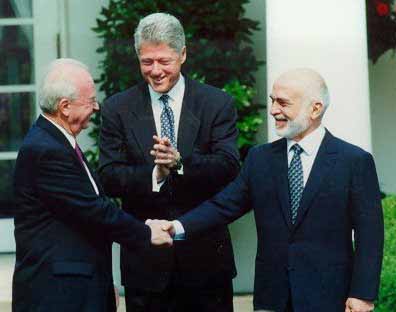 With
the ratification of the peace treaty full diplomatic relations were
established between Israel and Jordan on November 27, 1994. Since
that time, relations between Israel and Jordan have been steadily
progressing. The Jordanian parliament's action in August 1995 to
rescind its adherence to the Arab boycott on Israel, as well as the
regional economic conference in Amman in November 1995, served as
significant positive indicators for the future.
With
the ratification of the peace treaty full diplomatic relations were
established between Israel and Jordan on November 27, 1994. Since
that time, relations between Israel and Jordan have been steadily
progressing. The Jordanian parliament's action in August 1995 to
rescind its adherence to the Arab boycott on Israel, as well as the
regional economic conference in Amman in November 1995, served as
significant positive indicators for the future.