Proper Tefillin Placement
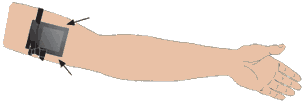
The Bayis shel yad must rest on the
center of the width of the biceps muscle of the weaker
arm leaning slightly toward the heart.
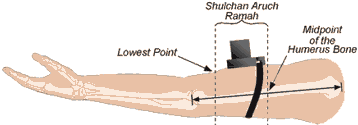
According to the Shulchan
Aruch and
the Rama, no part of the bayis shel yad may rest any
higher than the midpoint of the humerus bone.
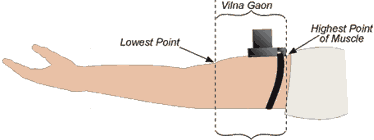
According to the Vilna
Gaon, the bayis
shel yad may rest anywhere on the biceps muscle. Consult
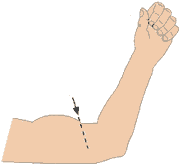
your rabbi. The bayis shel yad must not rest below the
lower point of the biceps muscle.
Some say that the lowest edge of the biceps muscle
is determined when the arm is outstretched and relaxed.
Others say that the lowest edge of the biceps muscle
is determined when the arm is bent at approximately
90°. Consult a rabbi which opinion to follow.
|
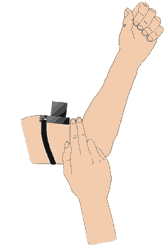
Verify that the bayis is not positioned
too low by locating the base of the muscle with one's
finger and making sure that the front edge of the base
is above it. If one can place the pinky, ring, and middle
fingers between the cleft of the arm and the front edge
of the base while the arm is outstretched, then it is
most likely in the proper position according to the
opinion that the base of the muscle is determined when
the arm is outstretched and relaxed. If one can place
the index and middle finger between the cleft of the
arm and front edge of the base while the arm is bent
at approximately 90° then it is most likely in the
proper position according to the opinion that the base
of the muscle is determined when the arm is bent at
approximately 90°.
 |
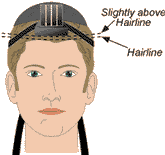
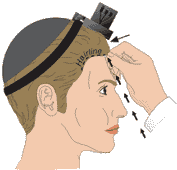
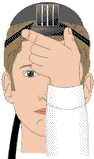
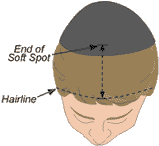
The entire bayis shel rosh must rest
above the original hairline, which is determined by
the hair's roots. It's suggested to allow a finger's
width of leeway. One whose hairline has receded should
continue to place the bayis shel rosh above his original
hairline, even though hair no longer grows there.
Feel along the hairline with the length
of the index finger or with the tips of his fingers
to verify that the bayis is resting above it.
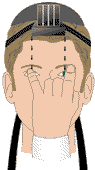
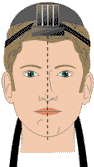
Draw the index finger and pinky or
the index finger and thumb from the sides of the base
down to the eyes to verify that the bayis is centered.
The back edge of the bayis can reach
until the top of the head, which is equivalent to the
end of the soft spot on a baby's head.
Identify this point by running the
tip of a finger straight up from the front of the ear.
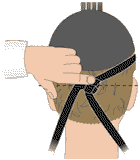
The majority of the knot must rest
on the center of the base of the skull. The remainder
of the knot may rest just below it in the indentation
on the nape.
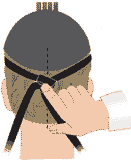
Verify that the majority of the knot
is resting on the base of the skull by pressing on the
upper part of the knot. If one feels the small, round,
protruding bone when pressing, then the knot is in position.
If by pressing on the lower part of the knot one feels
that it's in the indentation of the neck, then that
verifies that it's centered.
Sources: Rabbi Yerachmiel Askotzy, STAM |