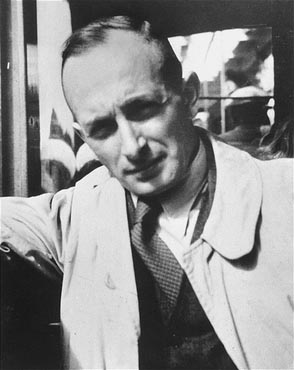
The declasse son of a solid middle-class Protestant
family which had moved to Linz, Austria, where Eichmann spent his youth,
he failed to complete his engineering studies. After working briefly
as an ordinary labourer in his father's small mining enterprise and
then in the sales department of an Upper Austrian electrical construction
company, Eichmann became a travelling salesman for the Vacuum Oil Company
between 1927 and 1933.
On April 1, 1932 he joined the Austrian Nazi
Party at the suggestion of his compatriot Ernst
Kaltenbrunner. Having lost his job he sought employment across the
border in Bavaria in July 1933, joining the exiled Austrian legion and
undergoing fourteen months' military training.
In September 1934 he found an opening in Himmler's Security Service (SD) which provided him with an outlet for his bureaucratic
talents. By the beginning of 1935 he was the official responsible for
'Jewish questions' at the Berlin head office of the SD, specializing
in the Zionist movement.
He acquired a smattering of Hebrew and Yiddish, and briefly
visited Palestine in 1937 to explore the possibilities of Jewish emigration
from Nazi Germany to Palestine.
Appointed assistant to the SD leader of the SS main
region, Danube, Eichmann's first big opportunity came after he was sent
to Vienna by the Gestapo to prepare the ground for the Anschluss.
From August 1938 he was in charge of the "Office
for Jewish Emigration" in Vienna set up by the SS as the sole Nazi agency authorized to issue exit permits
for Jews from Austria, then Czechoslovakia and later the old German
Reich. Eichmann's acquired expertise in "forced emigration"--in
less than eighteen months approximately 150,000 Jews left Austria--and
extortion was to prove an ideal training-ground for his later efficiency
in "forced evacuation," i.e., the registering, assembly and
deportation of Jews to extermination centres in the East. By March 1939
he was already handling forced deportations to Poland and, in October of the same year, he was appointed special adviser on
the "evacuation" of Jews and Poles.
In December 1939 Eichmann was transferred to Amt IV
(Gestapo) of the Reich Main Security Office (RSHA) where he took over
Referat IV B4 dealing with Jewish affairs and evacuation. For the next
six years Eichmann's office was the headquarters for the implementation
of the 'Final Solution'; though it was not until the summer of 1941
that his 'resettlement' department began the task of creating death
camps, developing gassing
techniques and organizing the system of convoys that were to take
European Jewry to their deaths.
It was in 1941 that Eichmann first visited Auschwitz
and in November of the same year he was promoted to SS Lieutenant-Colonel.
He had already begun to organize the mass deportation of Jews from Germany
and Bohemia, in accordance with Hitler's order to make the Reich free of Jews as rapidly as possible.
The Wannsee
Conference of January 20, 1942 consolidated Eichmann's position
as the "Jewish specialist" of the RSHA and Heydrich now formally entrusted him with implementing the "Final
Solution." In this task Eichmann proved to be a model of bureaucratic
industriousness and icy determination even though he had never been
a fanatical anti-semite and always
claimed that "personally" he had nothing against Jews. His
zeal expressed itself in his constant complaints about obstacles in
the fulfilment of death-camp quotas, his impatience with the existence
of loopholes such as the free zone in Vichy France or the unco- operativeness
of the Italians and other German allies in expediting their Jews.
When even Himmler became more "moderate" towards the end of the
war, Eichmann ignored his 'no gassing' order, as long as he was covered
by immediate superiors like Heinrich Muller and his old friend, Kaltenbrunner.
Only in Budapest after March
1944 did the desk-murderer become a public personality, working in the
open and playing a leading role in the massacre of Hungarian Jewry.
In August 1944 the 'Grand Inquisitor' of European Jewry could report
to Himmler that approximately four million Jews had died in the death
camps and that another two million had been killed by mobile extermination
units. Though arrested at the end of the war, Eichmann's name was not
yet widely known and he was able to escape from an American internment
camp in 1946 and flee to Argentina.
He was eventually captured
by Israeli intelligence agents on May 11, 1960, living under an
assumed name in a suburb of Buenos Aires. Nine days later he was secretly
abducted to Israel, to be publicly tried in Jerusalem. The trial, which
aroused enormous international interest and some controversy, began
on April 11, 1961. On December 11, 1961, Eichmann was indicted on 15
criminal charges, including crimes against humanity, crimes against
the Jewish people and membership in an outlawed organization. On December
15, he was sentenced to death.
Eichmann was visited by a Lutheran minister before he was taken from his cell. Rafi Eitan, one of the men who captured Eichmann walked behind him along with Tuvia Dori, the deputy prison commisioneer. Eichmann's last words were believed to be “I hope that all of you will follow me,” according to Eitan. A few minutes before midnight on May
31, 1962, Eichmann was executed by hanging in Ramleh, Israel. His body
was cremated and the ashes were spread at sea, beyond Israel's territorial
waters. The execution of Adolf Eichmann remains the only time that Israel
has enacted a death sentence.
Sources: United States
Holocaust Memorial Museum; Wistrich, Robert S. Who's
Who in Nazi Germany, Routledge,
1997; Jerusalem Report, (October 5, 2015).
Photo courtesy of the United
States Holocaust Memorial Museum