|
The Simon Wiesenthal Center's
36 Questions About the Holocaust
(Questions 1 - 18)
Click on any Question to Reveal the Corresponding Answer:
[Questions 19-36]
The "Holocaust" refers to the period from January 30, 1933, when Hitler became Chancellor of Germany, to May 8, 1945 (V-E Day), the end of the war in Europe.
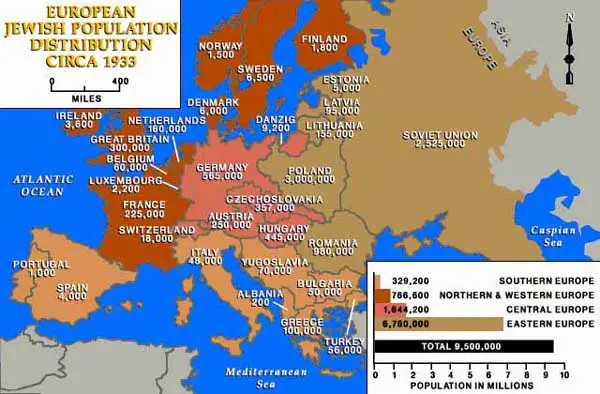
While it is impossible to ascertain the exact number of Jewish victims, statistics indicate that the total was over 5,860,000. Six million is the round figure accepted by most authorities
While it is impossible to ascertain the exact number, the recognized figure is approximately 5,000,000. Among the groups which the Nazis and their collaborators murdered and persecuted were: Gypsies, Serbs, Polish intelligentsia, resistance fighters from all the nations, German opponents of Nazism, homosexuals, Jehovah's Witnesses, habitual criminals, and the "anti-social," e.g. beggars, vagrants, and hawkers.
Every Jewish community in occupied Europe suffered losses during the Holocaust. The Jewish communities in North Africa were persecuted, but were not subjected to the same large-scale deportations or mass murder. Some individuals, however, were deported to German death camps, where they perished.
Austria 50,000 -- 27.0%
Italy 7,680 -- 17.3%
Belgium 28,900 -- 44.0%
Latvia 71,500 -- 78.1%
Bohemia/Moravia 78,150 -- 66.1%
Lithuania 143,000 -- 85.1%
Bulgaria 0 -- 0.0%
Luxembourg 1,950 -- 55.7%
Denmark 60 -- 0.7%
Netherlands 100,000 -- 71.4%
Estonia 2,000 -- 44.4%
Norway 762 -- 44.8%
Finland 7 -- 0.3%
Poland 3,000,000 -- 90.9%
France 77,320 -- 22.1%
Romania 287,000 -- 47.1%
Germany 141,500 -- 25.0%
Slovakia 71,000 -- 79.8%
Greece 67,000 -- 86.6%
Soviet Union 1,100,000 -- 36.4%
Hungary 569,000 -- 69.0%
Yugoslavia 63,300 -- 81.2
A death (or mass murder) camp is a concentration camp with special apparatus specifically designed for systematic murder. Six such camps existed: Auschwitz-Birkenau, Belzec, Chelmno, Majdanek, Sobibor, Treblinka. All were located in Poland.
The term "Final Solution" (Endl"sung) refers to Germany's plan to murder all the Jews of Europe. The term was used at the Wannsee Conference (Berlin; January 20,1942) where German officials discussed its implementation.
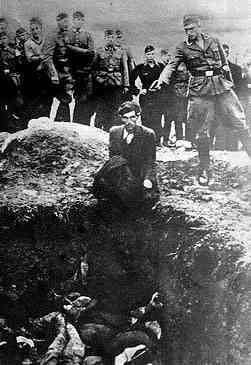
While thousands of Jews were murdered by the Nazis or died as a direct result of discriminatory measures instituted against Jews during the initial years of the Third Reich, the systematic murder of Jews did not begin until the German invasion of the Soviet Union in June 1941.
On November 14, 1935, the Nazis issued the following definition of a Jew: Anyone with three Jewish grandparents; someone with two Jewish grandparents who belonged to the Jewish community on September 15, 1935, or joined thereafter; was married to a Jew or Jewess on September 15, 1935, or married one thereafter; was the offspring of a marriage or extramarital liaison with a Jew on or after September 15, 1935.
Those who were not classified as Jews but who had some Jewish blood were categorized as Mischlinge (hybrids)and were divided into two groups:
Mischlinge of the first degree--those with two Jewish grandparents;
Mischlinge of the second degree--those with one Jewish grandparent.
The Mischlinge were officially excluded from membership in the Nazi Party and all Party organizations (e.g. SA, SS, etc.). Although they were drafted into the Germany Army, they could not attain the rank of officers. They were also barred from the civil service and from certain professions. (Individual Mischlinge were, however, granted exemptions under certain circumstances.) Nazi officials considered plans to sterilize Mischlinge, but this was never done. During World War II, first-degree Mischlinge, incarcerated in concentration camps, were deported to death camps.
The first measures against the Jews included:
April 1, 1933: A boycott of Jewish shops and businesses by the Nazis.
April 7, 1933: The law for the Re-establishment of the Civil Service expelled all non-Aryans (defined on April 11, 1933 as anyone with a Jewish parent or grandparent) from the civil service. Initially, exceptions were made for those working since August 1914; German veterans of World War I; and, those who had lost a father or son fighting for Germany or her allies in World War I.
April 7, 1933: The law regarding admission to the legal profession prohibited the admission of lawyers of non-Aryan descent to the Bar. It also denied non-Aryan members of the Bar the right to practice law. (Exceptions were made in the cases noted above in the law regarding the civil service.) Similar laws were passed regarding Jewish law assessors, jurors, and commercial judges.
April 22, 1933: The decree regarding physicians' services with the national health plan denied reimbursement of expenses to those patients who consulted non-Aryan doctors. Jewish doctors who were war veterans or had suffered from the war were excluded.
April 25, 1933: The law against the overcrowding of German schools restricted Jewish enrollment in German high schools to 1.5% of the student body. In communities where they constituted more than 5% of the population, Jews were allowed to constitute up to 5% of the student body. Initially, exceptions were made in the case of children of Jewish war veterans, who were not considered part of the quota. In the framework of this law, a Jewish student was a child with two non-Aryan parents.
This question is one of the most difficult to answer. While Hitler made several references to killing Jews, both in his early writings (Mein Kampf) and in various speeches during the 1930s, it is fairly certain that the Nazis had no operative plan for the systematic annihilation of the Jews before 1941. The decision on the systematic murder of the Jews was apparently made in the late winter or the early spring of 1941 in conjunction with the decision to invade the Soviet Union.
The first concentration camp, Dachau, opened on March 22, 1933. The camp's first inmates were primarily political prisoners (e.g. Communists or Social Democrats); habitual criminals; homosexuals; Jehovah's Witnesses; and "anti-socials" (beggars, vagrants, hawkers). Others considered problematic by the Nazis (e.g. Jewish writers and journalists, lawyers, unpopular industrialists, and political officials) were also included.
The following groups of individuals were considered enemies of the Third Reich and were, therefore, persecuted by the Nazi authorities: Jews, Gypsies, Social Democrats, other opposing politicians, opponents of Nazism, Jehovah's Witnesses, homosexuals, habitual criminals, and "anti-socials" (e.g. beggars, vagrants, hawkers), and the mentally ill. Any individual who was considered a threat to the Nazis was in danger of being persecuted.
The Jews were the only group singled out for total systematic annihilation by the Nazis.
To escape the death sentence imposed by the Nazis, the Jews could only leave Nazi-controlled Europe. Every single Jew was to be killed according to the Nazis' plan. In the case of other criminals or enemies of the Third Reich, their families were usually not held accountable. Thus, if a person were executed or sent to a concentration camp, it did not mean that each member of his family would meet the same fate. Moreover, in most situations the Nazis' enemies were classified as such because of their actions or political affiliation (actions and/or opinions which could be revised). In the case of the Jews, it was because of their racial origin, which could never be changed.
The explanation of the Nazis' implacable hatred of the Jew rests on their distorted world view which saw history as a racial struggle. They considered the Jews a race whose goal was world domination and who, therefore, were an obstruction to Aryan dominance. They believed that all of history was a fight between races which should culminate in the triumph of the superior Aryan race. Therefore, they considered it their duty to eliminate the Jews, whom they regarded as a threat. Moreover, in their eyes, the Jews' racial origin made them habitual criminals who could never be rehabilitated and were, therefore, hopelessly corrupt and inferior.
There is no doubt that other factors contributed toward Nazi hatred of the Jews and their distorted image of the Jewish people. These included the centuries-old tradition of Christian antisemitism which propagated a negative stereotype of the Jew as a Christ-killer, agent of the devil, and practitioner of witchcraft. Also significant was the political antisemitism of the latter half of the nineteenth and early part of the twentieth centuries, which singled out the Jew as a threat to the established order of society. These combined to point to the Jew as a target for persecution and ultimate destruction by the Nazis.
Certain initial aspects of Nazi persecution of Jews and other opponents were common knowledge in Germany. Thus, for example, everyone knew about the Boycott of April 1, 1933, the Laws of April, and the Nuremberg Laws, because they were fully publicized. Moreover, offenders were often publicly punished and shamed. The same holds true for subsequent anti-Jewish measures. Kristallnacht (The Night of the Broken Glass) was a public pogrom, carried out in full view of the entire population. While information on the concentration camps was not publicized, a great deal of information was available to the German public, and the treatment of the inmates was generally known, although exact details were not easily obtained.
As for the implementation of the "Final Solution" and the murder of other undesirable elements, the situation was different. The Nazis attempted to keep the murders a secret and, therefore, took precautionary measures to ensure that they would not be publicized. Their efforts, however, were only partially successful. Thus, for example, public protests by various clergymen led to the halt of their euthanasia program in August of 1941. These protests were obviously the result of the fact that many persons were aware that the Nazis were killing the mentally ill in special institutions.
As far as the Jews were concerned, it was common knowledge in Germany that they had disappeared after having been sent to the East. It was not exactly clear to large segments of the German population what had happened to them. On the other hand, there were thousands upon thousands of Germans who participated in and/or witnessed the implementation of the "Final Solution" either as members of the SS, the Einsatzgruppen, death camp or concentration camp guards, police in occupied Europe, or with the Wehrmacht.
Although the entire German population was not in agreement with Hitler's persecution of the Jews, there is no evidence of any large scale protest regarding their treatment. There were Germans who defied the April 1, 1933 boycott and purposely bought in Jewish stores, and there were those who aided Jews to escape and to hide, but their number was very small. Even some of those who opposed Hitler were in agreement with his anti-Jewish policies. Among the clergy, Dompropst Bernhard Lichtenberg of Berlin publicly prayed for the Jews daily and was, therefore, sent to a concentration camp by the Nazis. Other priests were deported for their failure to cooperate with Nazi antisemitic policies, but the majority of the clergy complied with the directives against German Jewry and did not openly protest.
Source: Copyright The Simon Wiesenthal Center
9760 West Pico Boulevard, Los Angeles, California 90035
|
 |