The Hussein-McMahon Correspondence
by Mitchell Bard
The central figure in the Arab nationalist movement at
the time of World War I was Hussein ibn 'Ali, who was appointed by the
Turkish Committee of Union and Progress to the position of Sharif of Mecca
in 1908. As Sharif, Hussein was responsible for the custody of Islam's
shrines in the Hejaz and, consequently, was recognized as one of the
Muslims’ spiritual leaders.
In July 1915, Hussein sent a letter to Sir Henry McMahon,
the High Commissioner for Egypt, informing him of the terms for Arab
participation in the war against the Turks.
The letters between Hussein and MacMahon that followed
outlined the areas that Britain was prepared to cede to the Arabs. The
Hussein-McMahon correspondence conspicuously fails to mention Palestine.
The British argued the omission had been intentional, thereby justifying
their refusal to grant the Arabs independence in Palestine after the
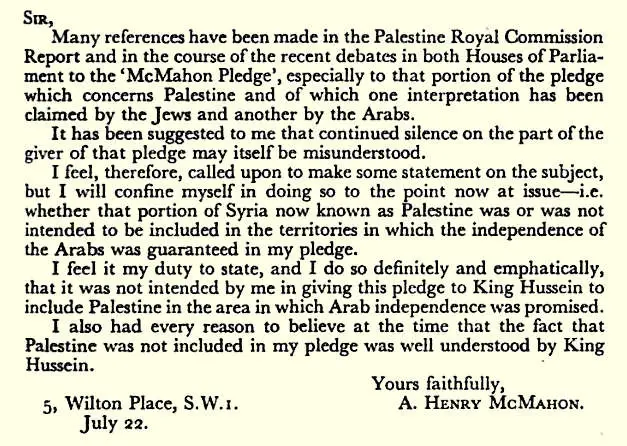
war.1 MacMahon explained:
I feel it my duty to state, and I do so definitely
and emphatically, that it was not intended by me in giving this pledge
to King Hussein to include Palestine in the area in which Arab
independence was promised. I also had every reason to believe at the
time that the fact that Palestine was not included in my pledge was well
understood by King Hussein.2
Nevertheless, the Arabs held then, as now, that the
letters constituted a promise of independence for the Arabs.
Sources: 1George Kirk, A Short History of the Middle
East, (NY: Frederick Praeger Publishers, 1964), p. 314.
2London Times, (July 23, 1937). |