Jewish American Historical Places: The Gomez House
Newburgh, New York
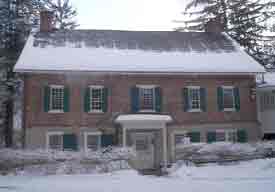 |
The Mill House, located just off 9W, five miles north of Newburgh, New York, on the Hudson River, is the oldest house on the National Register of Historic Places in Orange County and the earliest surviving Jewish residence in North America. It has been continuously inhabited for more than 280 years.
It would indeed be difficult to find a landmark more richly intertwined with our complex history, or complex fate: site of an ancient Indian ceremonial ground; frontier trading post; earliest extant Jewish residence in North America; center of patriot activity in the American Revolution; home of writers and artists and men of affairs; the Mill House symbolizes and sums up our regional and national history. It is a most dramatic and absolutely irreplaceable incarnation of American history.
In 1710, Luis Moses Gomez, the son of a well-to-do Jewish immigrant merchant, and a member of one of the foremost Jewish families in colonial New York, began to purchase land in Ulster and Orange Counties, finally acquiring about 2500 acres. On this tract of land Gomez constructed a stone house, the original section of the present Mill House, to accommodate his fur trading business with the American Indians. Land was cheap at that time due to the unpopulated character of the location and the belief held by some of the Dutch settlers that the area was haunted. Gomez had purchased his land near a rocky point of land which juts into Newburgh Bay. A number of American Indian trails converged at this point where Algonquin tribes of New York, New Jersey and Pennsylvania met at certain seasons of the year to worship. Gomez realized the advantages afforded the location for barter and trade. He sited his house near the trails and close to a spring where the Algonquin travelers regularly stopped for water.
Constructed in 1714-1720, the stone house served both as a trading post and fortress. The walls were made three feet thick in the rear and two feet thick in the front, dimensions which according to local tradition resulted from the real possibility of attack. The house had two large cellars to serve as vaults for the storage of goods. In the main room, Gomez placed a fireplace, eight feet wide, possibly to help with business entertaining during the winter months. According to local tradition, as many as twenty Native Americans might gather before the fire at one time to discuss the price of skins. Luis Gomez became the first president when the synagogue of New York's Spanish and Portuguese congregation was built. At this time most of the Jewish population of the British Colonies was Sephardic, or Spanish-Portuguese Jews. These were descended from Jewish people expelled from Spain and Portugal who made their way to the Netherlands, and hence the Dutch Colony of New Amsterdam before the British conquered it and renamed it New York.
The great walls of the house — which are about three feet thick — still stand today. Native Americans came to hold ceremonial rites at their campground at the Duyfil’s Danskammer (Devil’s Dance Chamber) on the shores of the Hudson on Gomez’s property. For some thirty years Luis Gomez and his sons conducted a thriving fur trade from the fortress like house. Luis Moses Gomez became the first parnas (president) when the synagogue of New York’s Spanish and Portuguese congregation was built. Among the family connections were poetess Emma Lazarus and Supreme Court Justice Benjamin Cardozo.
During the years leading up to the American Revolution, Gomez moved to Philadelphia, and Wolfert Acker, a patriotic Dutch-American, became the second owner of the house in 1772. Acker added the second story to the house. The house became a meeting place for American Revolutionaries during the Revolution, and a secret passageway beginning in the library and leading under the house to the woods provided a hasty means of escape. Henry Armstrong, the novelist, came to the house after Acker. He wrote his Civil War novel, Rutledge there, and set many of the scenes in the house. Today the home founded by Gomez still stands, remarkably preserved. The earliest portion of the Mill House was a one-story, rectangular structure built of fieldstone chinked with clay. No mortar was used during construction. Large Dutch doors are set in the center of the front and rear sides of the building. The first story of the house on its rear side was covered with stucco in order to afford some protection against a bank of earth which at one time sloped down close to the house and which had been removed. A second story of brick was added by the second owner.
The most famous owner in the 20th century was Dard Hunter, renowned craftsman and paper maker who, just before World War I, built a paper mill on the creek in the shape of a “Devonshire cottage” complete with a thatched roof. Students from all over the world came to learn from him as he made paper by hand, cut and cast type and handprinted his own books. The Gomez Foundation for Mill House has restored Hunter’s Mill and completed in 1997 the mill dam and bridge.
After World War II, the Starin family purchased the house with a G.I. loan. They raised their children here while Mildred Starin enriched the house, furnishings and garden. The Mill House was listed in the National Register of Historic Places on January 29, 1973 and today is administered by the Gomez Foundation for Mill House, which according to their claims administers the oldest extant Jewish dwelling in North America continuously lived in for nearly three centuries.
Contact Information
Address: Gomez Mill House
11 Mill House Rd
Marlboro, NY 12542
Phone: 845.236.3126
E-mail: [email protected]
Website: http://www.gomez.org/
Sources: Gomez Mill House; National Parks Service

Download our mobile app for on-the-go access to the Jewish Virtual Library