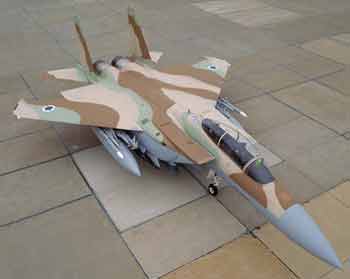
"The F-15I is the product of unparalleled collaboration between Boeing, the U.S. Air Force and the Israel Air Force," said Mike Sears, Boeing president of the McDonnell Aircraft and Missile Systems group. "Soon, the F-15I will take to the skies in protection of Israel's peace. And when it does, its performance will be a dramatic testament to this team's aggressive drive for perfection," he said. The two-seat F-15I, known as the Thunder in Israel, incorporates new and unique weapons, avionics, electronic warfare and communications capabilities. Israel selected the F-15I in January 1994 after evaluating a variety of aircraft to meet its defense needs. The F-15I, like the U.S. Air Force's F-15E Strike Eagle, is a dual-role fighter that combines long-range interdiction with the Eagle's awe-inspiring air superiority capabilities. "From a purely technological standpoint, the F-15I is a masterpiece. It will provide the qualitative edge Israel requires to preserve peace," said Phil Condit, chairman and chief executive officer of The Boeing Company. "Israeli engineers and suppliers played a significant role in the production of this airplane. That fact is meaningful not just from a technology standpoint, but as a matter of pride," he said." Israel's minister of defense, Yitzhak Mordechai, formally accepted the F-15I on behalf of the people of Israel by placing the Star of David on the aircraft's fuselage. "I wish to extend my heartfelt gratitude to the government of the United States, to the Boeing Company, to all of the American and Israeli employees who labored to build this aircraft, and of course, to the air crews who will fly it," said Minister Mordechai. "The F-15I will provide a significant contribution to Israel's air deterrence power. I pray this aircraft will bestow upon us the wings of peace and not the ghosts of war," he said. The F-15I is one of the most advanced fighters ever to be produced. Its avionics include the Hughes APG-70 synthetic aperture radar, the Kaiser holographic head-up display system, and an Elbit display and sight helmet (DASH) system. The aircraft is armed with a number of precision weapons systems, as well as Python and AMRAAM air-to-air missiles. Power is provided by two Pratt & Whitney F100-PW-229 low bypass turbofan engines, each capable of developing approximately 29,000 pounds of thrust. The aircraft presented at today's ceremony first flew on Sept. 12, 1997, on schedule. Since then, the aircraft has flown three times, and a variety of tests have been conducted to verify the plane's systems and capabilities. The first two F-15Is are scheduled to be delivered to Israel in January 1998. Boeing also is providing a software development facility for the F-15I, as well as support for the aircraft, operator and maintenance training, flight testing, and an industrial cooperation program. The F-15I industrial cooperation program currently involves 34 partners in Israel's aerospace industry, working on contracts valued at more than half a billion dollars. The relationships continue a long-standing commitment to Israeli industry that dates back 30 years.
Sources: IAF Inventory |