Virtual Jewish World: Bukharan Jews
by Joanna Sloame
The term “Bukharan Jews” refers to the Central Asian Jews of the khanate of Bukhara, those of Samarkand, and the Ferghana Valley. Today, the region is divided between the former Soviet republics of Uzbekistan, Tajikistan, and Kyrgyzstan. The majority of Bukharan Jews live in the Uzbek cities of Samarkand, Bukhara, Tashkent, and Kokand, in Tajikistan's capital, Dushanbe, and in Kyrgyzstan's capital, Bishkek. Also, a large number of Bukharan Jews have made aliyah and have congregated in Jerusalem.
Bukharan Jews call themselves Isro'il or Yahudi and speak Bukhori or Judeo-Tajik, a distinct dialect of the Tajiki-Persian language that incorporated a number of Hebrew words.
Early History
Islam Reaches Central Asia
The Arrival of Maman
Growth of the Community
Under the Russians
The Soviets
Uzbekistan
Tajikistan
Kyrgyzstan
Bukharan Sites
Contacts
Early History
Some Bukharan Jews claim they are the descendents of the ten lost tribes of Israel who were exiled by the Assyrians in the 8th century B.C.E. Whether or not this is the case, the Bukharians can trace their ancestry back to the conquest of Babylonia by Cyrus, the King of Persia, in 539 B.C.E. Cyrus decreed that all Jews in exile were free to return to Jerusalem, though many remained in Persia.
The Jews lived peacefully in Persia until 331 B.C.E., when Alexander the Great defeated the Sogdian King Spitamenes and conquered the region. At Alexander's sudden death in 323 B.C.E., the Seleucids gained control, followed by the Parthians, who reestablished the Persian Empire.
The Parthians gave the Jews citizenship and allowed them to practice Judaism freely. Under Parthian rule, the Bukharian communities flourished. In 224 A.D., however, the Sassinids conquered the region. They made Zoroastrianism the official religion and persecuted the Jews for their unwillingness to convert. Some Bukharan Jews moved to the northern and eastern parts of the region due to anti-Jewish hostilities.
Islam Reaches Central Asia
During the spread of Islam in the 7th and 8th centuries, control of Bukhara was transferred between many different Arab rulers. The Saracens overpowered Bukhara in 709 and founded the Umayyad dynasty throughout the former Persian Empire. But the Abbasids, who were Shi'ite Muslims from Baghdad, quickly defeated the Saracens. They maintained control of the region until 874, when the Saminids, who were Sunni Muslims, took over and made Bukhara the capital of their empire.
The Saminids were fairly tolerant of the Bukharan Jews, though they forced all non-Muslims who refused to convert to pay heavy taxes. Jews were given the status of dhimmi, or “protected Unbelievers.”
Under the Saminids, the Bukharians found relative peace, which was ended by the conquest of the Qarakhanids in 999. The Jews of Central Asia now found themselves completely cut off from the Jews of Europe, but they managed to maintain some contact with those in the Muslim Empire.
In 1219, the Mongols, led by Genghis Khan, conquered Bukhara, pillaging and burning the city to the ground, destroying the Bukharan Jewish community. In 1300, the new leader, Timur, rebuilt Samarkand and Bukhara when the Mongols decided to abandon their traditional nomadic way of life. Timur imported Persian Jews to work as dyers and weavers and develop the empire's textile industry. Supposedly, one could recognize a Bukharan Jew by his purple-dyed hands.
In the rebuilt city of Bukhara, the Jews lived in the makhallai yahudiyon, or Jewish quarter in Tajik. The community was restricted to this section of the city, and was strictly forbidden to live elsewhere. Jewish stores had to be one step lower than Muslim ones. Despite these restrictions, Jewish merchants established lucrative trade businesses and the women became known for their elaborate goldthread embroidery. The community also built a magnificent synagogue that was used for the next 500 years.
At the beginning of the 1500s, Persia was ruled by Shi'ite Muslims, while Central Asia came under Sunni Uzbeks in 1506. Jews in Persia and Central Asia were divided and ties severed. The isolated Bukharan Jewish community developed its own unique form of Judaism. At the same time, Bukhara had become the center of Jewish activity in the region, especially after a devastating earthquake in 1720 in Samarkand prompted its Jewish population to move to Bukhara.
Under the Uzbeks, Turkic nomads from the East, Bukharan Jews experienced waves of relative tolerance and those of discrimination. They were forced to wear yellow and black dress to distinguish themselves from the rest of the population. As non-Muslims, the heads of Jewish households were slapped in the face when they paid their annual tax, a humiliation they endured for centuries.
During the mid-18th century, Bukharan Jews were isolated further. The Durrani dynasty created the Afghani kingdom and military conflicts between Bukhara's Manghit dynasty and the Durranis. Due to the continued hostilities, Central Asian Jewry became a distinct entity, named the "Community of Bukharan Jews."
Toward the end of the 18th century, the mullahs of Bukhara began to institute forced conversions of the Jews. Converted Jews were called chalas, meaning neither one thing nor the other in Tajik, as they practiced Judaism in secret while posing as Muslims. Both the Muslim and Jewish communities looked down upon the chalas, leading to the creation of a separate anusim community.
The Arrival of Maman
Hundreds of years of isolation from European Jewry and the forced Islamization of the 1700s, led to a decline in Jewish religious and spiritual activity in Bukhara. The community lacked a strong religious leader until the arrival of Rabbi Joseph Maman Maghribi (or Joseph ben Moses Mamon al-Maghribi) in 1793. A Sephardic Moroccan Jew, Maghribi began a revival of Bukharan religious and spiritual life single-handedly. He introduced Sephardic traditions and prayer to a community who had all but forgotten their Persian rites. Maman recruited European religious teachers to re-educate Bukharan Jews. He founded Hibbat Zion, a precursor to Zionism, and encouraged aliyah to Palestine. Maman served the Bukharan Jews for thirty years, until he died in 1823, having completely transformed the destitute Jewish community.
Growth of the Community
The Jewish population of Bukhara increased in the 19th century, prompting the Muslim authorities to allow Jews to move outside of the Jewish quarter. Jews congregated in the New Mahalla and Amirabad quarters. Jewish quarters were also created in the cities of Marghelan, Samarkand, and Dushanbe.
After a mob of Shi'ite fundamentalists burned the Jewish quarter of Meshed, Persia, and forcibly converted the entire Jewish population, a wave of Jews fled to Bukhara. They mostly settled in the Bukharan cities of Shahrisabz and Merv. By 1849, the Bukharan Jewish community was made up of 2,500 families.
The Jewish community in every town was led by an elected kalontar. The Jews of Bukhara established a network of Jewish schools called khomlo. Since the emir of Bukhara had forbidden the Jews to build new synagogues, rich families allowed services to be held in their large homes. The Rubinov House Synagogue is one of these makeshift synagogues that still stands today.
Under the Russians
Tsarist Russia conquered Turkistan in 1868, but Bukhara remained under the Turkic emir for another 50 years. Eventually, Bukhara, Samarkand and several Jewish towns came under the Turkistan region and annexed by the Russian Empire.
Initially, the Russians sought the loyalty of the Bukharan Jews as they saw the Jews as their only friend among the newly conquered populations. This friendship was due to years of close trade relations between Jewish and Russian merchants. Russia did not restrict Jewish autonomy and aided the Bukharians in becoming a powerful trading class with Central Asia and the Russian Empire.
Simultaneously, the emir of Bukhara continued to subjugate the Jewish population, blaming them for the khanate's fall to the Tsar. Persecution and money extortion led to an exodus of Jews from Bukhara to Samarkand, Tashkent, and other Turkistan cities.
In the 1880s, as a result of this mass immigration, combined with growing competition between Jewish and Russian traders and industrialists, Russia began to pass anti-Jewish legislation. Claiming it was solely in the interest of Russian merchants, in 1888, the Russian authorities decreed the expulsion of all Jews from the Trans-Caspian region, encompassing Bukhara and Turkistan. Ironically, the decree was never realized due trade interests with local Jews.
In 1887-89, the Russian authorities divided Bukharan Jews in Turkistan into two categories: native Jews and Jews who had moved to the region after the annexation. Natives were allowed equal rights while the rest were labeled as foreign citizens. They were restricted in everyday life and in where they were permitted to live. By 1900, so-called foreign Jews were only allowed to live in Osh, Katta-Qurghan, and Petro-Alexandrovsk. These three border settlements were isolated and undeveloped. Anti-Jewish restrictive laws continued through World War I.
|
|
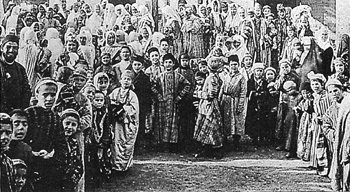
The construction of the Trans-Caspian railroad between 1880 and 1905 ended the isolation of Bukharan Jewry. The railroad ran through Samarkand, Bukhara, and Tashkent, linking the three largest Bukharan Jewish communities with the Jews of Europe for the first time in over a millennium. As early as the 1860s, European Jews began to make their way into the Bukharan emirate, and later, the Russian territory. These immigrants were mostly upper class and left their respective countries in the hopes that the government of Central Asia would be less restrictive than that of Eastern Europe under Tsar Alexander III. In 1905, following pogroms in Kiev and Odessa, a flood of Jewish immigrants arrived in the territory. These European Jews were shocked at the primitive lifestyle of Bukharan Jewry.
The railroad also enabled Bukharan Jews to begin to make aliyah to Palestine. By 1914, eight percent of Bukhara-born Jews had moved to Rehovot, the Bukharan quarter of Jerusalem. The first aliyah of Bukharan Jews, in which approximately 1,500 left the country, lasted until the outbreak of World War I.
The railroad brought with it inexpensive, factory-made textile goods, which drove the prosperous Jewish traders out of business. The Jewish community suffered, and many chose to move to Russian urban centers and assimilate.
The Soviets
By the late 19th century, much of the Bukharan Jewish population began to favor a Bolshevik takeover. Centuries of persecution under the local Muslim authorities and then the Russians, combined with the perception that the Soviets would be tolerant of the Jews and bring economic opportunities for trade, led to this support of a coup. These new political views led to even greater persecution under the Muslims. Numerous riots broke out against the Jews from 1918 to 1920.
The Bolshevik Revolution of 1917 brought the Red Army to Central Asia in 1920. While the last emir was removed from office, Bukhara maintained relative autonomy under the name of the Bukharan Soviet Peoples' Republic until 1924. At that point, it became part of the Soviet Socialist Republic of Uzbekistan, with Tashkent developing into its major city.
Beginning in 1926, OZET, the Soviet organization for settling Jewish workers on farms, established a number of Jewish collective farms, or kolkhozes, in Uzbekistan. By 1929, twenty-six kolkhozes were in existence, but, ultimately, the project failed and only two farming communities remained by the 1950s.
After a few years of looking favorably on the Jews for their support of the Soviet takeover, the Stalinist regime began the process of eradicating Judaism, and religion in general, from its empire. Many synagogues were shut down in the 1920s and 1930s, leaving only one shul in each of the large Jewish communities by the 1940s. Practicing Judaism became increasingly difficult. The result of this was that Bukharan Jews were more likely to take advantage of the new Soviet economic and education opportunities rather than fighting to sustain their religion.
At the same time, the territory's Jewish population began to grow. The Soviets exiled a group of Jewish Russian dissidents to Uzbekistan. During World War II, large numbers of European Jewish refugees fled to the region, particularly to Tashkent. The European Jews were better educated than the native Bukharan Jews and quickly rose in society. By 1959, though the Tashkent Jewish population had risen to 50,445, Bukhara's Jewish population had dropped to 5,000.
The Soviet authorities jailed a number of Jewish leaders in 1936-38, striking a heavy blow at the Jewish community. In 1938-39, the Soviets closed Jewish newspapers and in 1940, discontinued publication of Judeo-Tajik books and shut down Judeo-Bukharan schools. The Communist government did everything it could to smother Jewish culture and force assimilation on the Bukharan community.
Beginning in the 1920s, and lasting until the early 1930s, a wave of Central Asian Jews immigrated to Israel, marking the second aliyah of Bukharan Jews. Approximately 4,000 Bukharians left the region, for the most part in secret, due to Soviet anti-immigration regulations.
Anti-Semitism was prevalent in the region and the Soviets did little to curb the situation. Blood libels took place in 1926 in Charjui and in 1930 in the village of Aghaliq near Samarkand. After the creation of Israel in 1948, anti-Semitism intensified as Muslims protested throughout the region.
By the Six-Day War in 1967, the relationship between Bukharan Jews and Muslims had reached a breaking point, and the Soviet Union became openly anti-Semitic. The government discontinued diplomacy with Israel and forbade Jews to make aliyah. Although these restrictions lasted until the late 1980s, about 8,000 Bukharan Jews managed to immigrate to Israel from 1972 to the first half of 1975.
Uzbekistan
When the Soviet Union collapsed in 1989, the region was split between the newly independent republics of Uzbekistan, Tajikistan, and Kyrgyzstan. Jews began leaving in large numbers in the early 1970s, when the Soviet Union relaxed a ban on Jewish emigration. It accelerated in the 1990s after Uzbekistan became independent because of a fear that this would inspire Muslim and nationalist extremists to target Jews. More than 70,000 Jews have left the country since its independence, many moving to Israel and the United States.
“The feared nationalist backlash against minorities, particularly non-Muslim ones, never happened, and even remaining Jews who are eager to leave praise Uzbekistan as a place, unlike Israel and many parts of Europe, where Jews and Muslims live side by side without friction,” according to Andrew Higgins, who says the Uzbek government would like Bukhara’s Jews to stay and those who left to return.
Today, approximately 25,000 to 35,000 Jews remain in Uzbekistan, most of whom are Bukharan and reside in the cities of Bukhara, Samarkand, and Tashkent. These Jewish communities are well organized and provide many Jewish activities and communal services. Most Bukharan Jews speak Russian, but some in Bukhara and Samarkand still speak Judeo-Tajik and Hebrew. To this day, however, there is little mixing between the Bukharan and Ashkenazi Jewish communities.
In Samarkand, there are approximately 2,000 Bukharan Jews. The Jewish community in Bukhara today has only 100 to 150 Jews, but probably no more than five families who keep kosher and follow Jewish traditions. The city has only one elderly rabbi, but two synagogues, a primary school that teaches Hebrew, a Jewish cultural association and a Jewish cemetery with more than 10,000 graves.
The Chabad movement, which seeks to preserve Jewish life around the world, is particularly strong in Uzbekistan. The country’s chief rabbi in Tashkent, Baruch Abramchayev, is a member of Chabad. Among other tasks, he makes sure that Jews are able to get kosher food. One wealthy expatriate, Lev Leviev, an Israeli billionaire who was born in Samarkand, sends supplies of matzah to Bukhara each year so the few remaining Jews can celebrate Passover.
Because there are so few Jews left in Bukhara, it is often difficult to find a minyan. It is also difficult to find a Jewish spouse. In the local school, only 39 of the 440 students are Jewish.
Tajikistan
Jews have been present in the area currently known as Tajikistan since the Second Century B.C. The Jewish population of Tajikistan grew exponentially during the 20th century, and by the 1980's approximately 20,000 Jews lived in Tajikistan.
During the 1970's and 80's, most Jews living in Tajikistan immigrated to Israel. Almost immediately after declaring independence in September 1991, the Republic of Tajikistan was plunged into a civil war between government forces and Islamic fundamentalists. Continuous military conflicts have kept remaining Tajik Bukharan Jews in severe poverty and in fear of their lives for years, prompting a mass exodus. From 1989 through 2000, 10,800 out of the 20,000 Jews in the country made aliyah. In 1992, a secret airlift operation brought a small number of Jews to Israel.
The approximately 100 remaining Bukharan Jews in Tajikistan are for the most part elderly, poverty-stricken and subject to anti-Semitic attacks and persecution. The Joint Distribution Committee, working with community centers and other Jewish organizations, send food packages and try to care for the aged. The Jewish community of Tajikistan is barely able to function and relies on the aid of world Jewish organizations for support.
The one remaining synagogue in Tajikistan was located in Dushanbe. In the summer of 2004, the Tajik government announced its intent to demolish the 100-year-old structure to make room for a presidential palace. The community of Jews in Dushanbe, most of whom are Bukharan, as well as the world Jewish community, and the U.S. and Israeli embassies in Tajikistan intervened to prevent the destruction of the historic synagogue. Their efforts were in vain, and the Synagogue was torn down following a municipal court order in June 2008. A new Synagogue in Dushanbe opened in May 2009, in a building donated by Tajik businessman Hasan Assadullozoda.
Kyrgyzstan
On August 31, 1991, Kyrgyzstan declared its independence. Since then, the Jewish community has shrunk due to immigration to Israel. From 1989 to 2001, nearly 5,000 Jews made aliyah, mostly because radical Islamic fundamentalist activity has risen since 1991, especially after the second intifada in Israel in 2000 and the terrorist attacks of September 11 in the United States. These extremist organizations, such as the Islamic Movement of Uzbekistan (IMU) and Hizb ut-Tahrir, backed by other Muslim countries, have been gaining support, have carried out a number of terrorist attacks, and have instigated other military conflicts in the country.
In their attempt to make Kyrgyzstan an Islamic fundamentalist nation, the rebels have distributed ant-ireligious and anti-Semitic propaganda. Anti-Semitism has been met with intense opposition by the general public and the Kyrgyz government. The propaganda has infiltrated the population to some extent, however, especially in the isolated southern areas, where Islamic fundamentalism is more active, in Bishkek and the northern regions.
Bukharan Jews in the United States
Bukharan Jews represent a small fraction of the total Jewish population in the United States, but the Bukharan community is growing rapidly, especially in Queens, New York. In the past 30 years, the community went from one synagogue to thirty. Out of the total 70,000 Bukharan Jews that are estimated to live in the U.S, approximately 50,000 Bukharian Jews live in Queens, New York.
Bukharan Sites
|
|
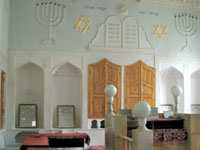
Bukhara Synagogue
20 Tsentralnaya Street
Bukhara, Uzbekistan
Sephardi Synagogue
3 Sagban Street
Tashkent, Uzbekistan
(3712) 40-0768
Central Synagogue Beit Menachem
2-ya Kunaeva str. 15/17
Tashkent, Uzbekistan 700015
Tel.: (998 71) 152-59-78, 256-51-14
Bukharan Synagogue
Nazyina Khikmeta Street 26
Dushanbe, Tajikistan
Synagogue Gumbaz
2-i Ilyazarov proezd 1
Samarkand, Uzbekistan
Tel.: (998 66) 223-09-78, 235-78-62, 233-11-45
Kokand Synagogue
Dekabristov Streeet, Fergan Oblast
Contacts
Embassy of Israel
16A Lachuti Street, 5th floor
Uzbekistan (Represents both Uzbekistan and Tajikistan)
Jewish Community of Dushanbe
Nazima Khikmata str. 26
Dushanbe, Tajikistan 7340001
Tel.: (992 372) 21-76-58, 21-20-26, 21-31-64
Jewish Community of Uzbekistan
2-ya Kunaeva str. 15/17
Tashkent, Uzbekistan 700015
Tel.: (998 71) 152-59-78, 256-51-14
Buharian Jewish Community
Chkalova str. 9
Tashkent, Uzbekistan 700015
Tel.: (998 71) 256-63-36
Jewish Community of Samarkand
Respublikanskaya str. 45
Samarkand, Uzbekistan 703000
Tel.: (998 66) 233-1145, 236-8392
Jewish Community of Fergana
Fergana, Uzbekistan
Tel.: (998 7322) 24-23-68,24-56-85
Sources: The Jews of Bukhara;
Bukhara City;
"Bukharan Jews" Encyclopedia Judaica;
The Peoples of the Red Book;
NCSJ;
The Federation of Jewish Communities of the CIS;
New synagogue of Dushanbe to open soon,
AsiaNews.it, (March 3, 2009).

Download our mobile app for on-the-go access to the Jewish Virtual Library